Loading NuWatt Energy...

We use your location to provide localized solar offers and incentives.
We serve MA, NH, CT, RI, ME, VT, NJ, PA, and TX
Loading NuWatt Energy...
NuWatt designs, installs, and manages solar, battery, heat pump, and EV charger systems across 9 states. One company, one warranty, one point of contact.
Get a Free Quote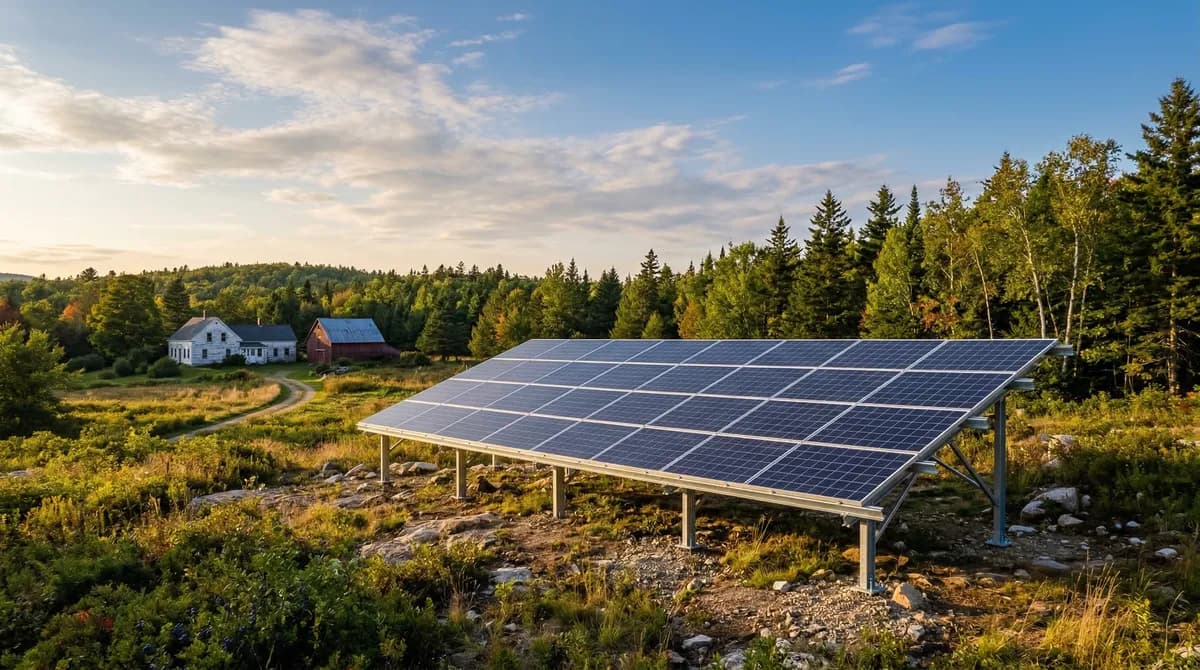
Glacial till, granite ledge, 89% forest cover, and 48-inch frost depth. Here is what Maine homeowners need to know about ground-mount solar in 2026 — without the federal tax credit.
Ground-mount is not just a backup plan when your roof does not work. For many rural Maine properties with heavy forest cover, old roofs, and ample acreage, it is the better option from the start.
Maine winters with heavy snow loads (50-100 psf) accelerate roof aging. Many homes in Aroostook, Penobscot, and Piscataquis counties have roofs over 20 years old. Replacing a roof ($8,000-15,000) plus adding roof-mount solar often costs more than a ground-mount array on your property.
Maine is 89% forested, the most forested state in the US. Properties across Oxford, Franklin, and Washington counties are surrounded by dense spruce, pine, and hardwood. A ground-mount system can be placed in an existing clearing, old field, or utility corridor where sunlight is unobstructed.
Average lot sizes in rural Maine counties exceed 2-5 acres. You only need roughly 400-600 sq ft of open ground per 5 kW of solar capacity. Many properties have far more open space than they realize, especially on old farmland, hayfields, or around outbuildings.
Maine has thousands of historic Cape Cod and Colonial-style homes with small, steep, or north-facing roof planes. Historic districts in Portland, Bath, Belfast, and Wiscasset may restrict visible roof modifications. Ground-mount behind the primary structure avoids these hurdles.
Many rural Maine properties have barns, woodsheds, or garages with structural limitations. Rather than reinforcing a century-old barn roof, placing a ground-mount array nearby is simpler, cheaper, and easier to maintain.
Ground-mount racking allows precise south-facing orientation at the ideal 38-42 degree tilt for Maine latitude (43-47°N). Roof systems are locked to the existing roof pitch and direction, often sacrificing 5-15% of potential production.
Maine's geology was shaped by glaciers that retreated roughly 12,000 years ago. Understanding what is below the surface determines which foundation type your installer will use and how much it adds to the cost.
Most of Maine is covered in glacial till: a dense, unsorted mixture of clay, sand, gravel, and boulders deposited by retreating glaciers ~12,000 years ago. It is compact but drillable with helical piles. Found statewide, thickest in river valleys.
Granite, gneiss, and schist ledge outcrops are common, especially in the western mountains (Oxford, Franklin counties), Downeast, and the Midcoast. When ledge is within 2-3 ft of surface, helical piles cannot achieve required torque.
Maine building code requires foundations below the frost line: 48 inches (4 feet) minimum statewide, with some northern counties requiring 60 inches. This applies to all permanent ground-mount structures. Helical piles typically extend 5-8 ft, well below frost.
Maine DEP regulates construction within 250 ft of great ponds, rivers, and coastal wetlands under the Natural Resources Protection Act (NRPA). Ground-mount arrays in these zones require a permit-by-rule or individual permit. Check DEP GIS maps before siting.
The right foundation depends on what is under your property. Helical piles handle most Maine sites. Concrete piers solve ledge. Ballasted systems avoid ground penetration entirely.
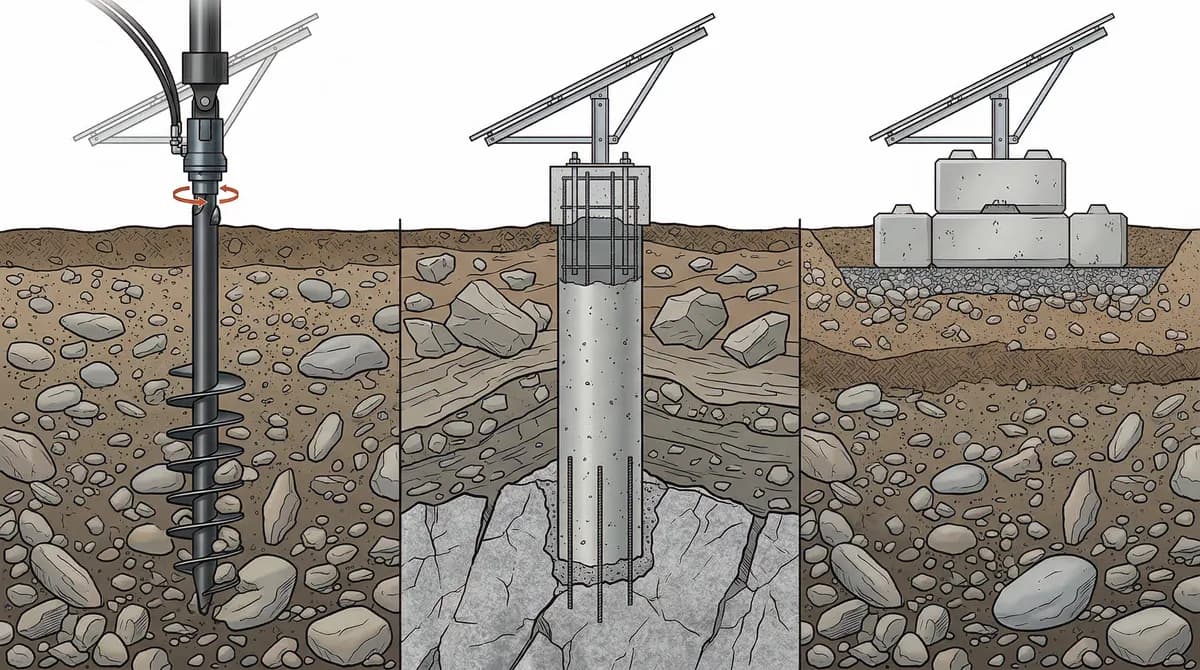
Steel piles with helical plates screwed into the ground using specialized equipment. The go-to solution for Maine glacial till. They thread between boulders and find purchase in dense till without excavation. Minimal site disturbance, no concrete, fully removable.
Best for: Most Maine sites, especially rocky glacial till and sloped terrain
Advantages
Limitations
When you hit solid granite or gneiss ledge within 2-3 ft of the surface, concrete piers are the standard solution. Holes are drilled into the rock, then filled with reinforced concrete. Common in western Maine mountains, Midcoast ledge areas, and parts of Downeast.
Best for: Shallow bedrock / granite ledge sites
Advantages
Limitations
Pre-cast concrete blocks sit on the ground surface, weighted to resist Maine wind loads. No digging, no drilling. Best for flat areas where you want zero ground penetration. Popular near well or septic buffer zones, blueberry barrens, and properties with DEP wetland constraints.
Best for: Flat lots, well/septic buffer zones, DEP-sensitive areas
Advantages
Limitations
Maine has 489 municipalities, each with its own zoning and building permit rules. There is no statewide solar permitting standard. Always start with your town Code Enforcement Officer (CEO).
Maine municipalities regulate ground-mount solar through local land use ordinances. Most classify ground-mount arrays as accessory structures. Key items: setback requirements (typically 10-50 ft from property lines), maximum height (usually 12-15 ft), lot coverage limits, and whether a site plan review is needed. Maine has 489 municipalities, each with different rules.
Contact: Town/City Planning Office or Code Enforcement
Most Maine municipalities require a building permit for ground-mount systems. The application typically includes a site plan showing array location, setbacks, access, and foundation type. Engineering drawings may be required for larger systems. Portland, South Portland, and Bangor have online permit portals. Rural towns often accept paper applications.
Contact: Code Enforcement Officer (CEO)
A separate electrical permit covers wiring from the array to your panel. Maine requires a licensed electrician for interconnection work. If your site is within 250 ft of a great pond, river, or coastal wetland, Maine DEP may require a permit-by-rule filing under the Natural Resources Protection Act.
Contact: Municipal Electrical Inspector / Maine DEP
File a net energy billing interconnection application with CMP or Versant. For systems under 100 kW (all residential), this is a standard Level 1 review. CMP uses the SmartConnect portal for applications. Versant accepts applications by mail or email. Both utilities must respond within 15 business days.
Contact: CMP or Versant Power
After installation, building and electrical inspections must pass. Your installer submits final interconnection paperwork to the utility. CMP or Versant installs a bi-directional meter and grants Permission to Operate (PTO). Total timeline from contract to PTO is typically 8-12 weeks for ground-mount.
Contact: CEO + Utility
These are representative examples. Always verify with your specific municipality. Rules can change at town meeting.
| Town | Front | Side | Rear | Max Height | Notes |
|---|---|---|---|---|---|
| Portland | 25 ft | 10 ft | 10 ft | 15 ft | Accessory structure rules, streamlined solar permit |
| Scarborough | 30 ft | 15 ft | 15 ft | 15 ft | Site plan review for arrays >500 sq ft |
| Augusta | 25 ft | 10 ft | 10 ft | 12 ft | Standard building permit, solar-friendly ordinance |
| Bangor | 30 ft | 15 ft | 15 ft | 15 ft | Online permit portal available |
| Brunswick | 25 ft | 15 ft | 15 ft | 15 ft | Planning board review if visible from road |
| Kennebunk | 35 ft | 20 ft | 20 ft | 12 ft | Historic district check if in village center |
Wetland and Shoreland Buffers
If your property is near wetlands, rivers, or great ponds, Maine DEP regulates construction under the Natural Resources Protection Act (NRPA, 38 M.R.S. Ch. 3). A 250-ft buffer zone applies around qualifying water bodies. Ground-mount solar within this zone may require a permit-by-rule or individual permit. Check Maine DEP GIS maps before siting your array.
Ground-mount adds $0.20-0.55/W over roof-mount in Maine, but better production and walk-up maintenance access narrow the lifetime gap. No federal tax credit for either option (25D expired December 2025).
| Category | Roof-Mount | Ground-Mount | Notes |
|---|---|---|---|
| System Cost (9 kW) | $27,450 | $29,250–32,400 | Ground-mount adds $0.20–0.55/W for racking + foundation |
| Foundation Work | Included (roof attachments) | $1,500–4,500 | Helical piles: ~$1,500–2,500 | Concrete piers: ~$3,000–4,500 |
| Trenching & Conduit | $0 | $500–2,500 | Depends on distance from array to electrical panel (50-200 ft typical) |
| Tree Clearing (if needed) | $0–2,000 | $0–5,000 | Maine is 89% forested; many sites need some clearing. Intent-to-cut filing if >1 cord |
| Permitting | $100–250 | $150–500 | Ground-mount may need site plan review or DEP filing |
| Annual Production (9 kW) | 9,600–10,800 kWh | 10,500–11,700 kWh | Ground-mount: optimal tilt at 40° = 5-10% more production |
| Maintenance Access | Requires ladder / roof access | Walk-up access, easy snow clearing | Ground-mount significantly easier for panel cleaning and snow removal in ME |
| Federal ITC (25D) | $0 | $0 | Expired Dec 31, 2025. No federal credit for homeowner cash/loan purchases. |
| Payback (CMP territory) | ~15–17 years | ~17–19 years | Higher upfront cost partially offset by better production |
| Payback (Versant territory) | ~12–14 years | ~14–16 years | Higher rates ($0.32/kWh) speed up payback for both mount types |
A 9 kW ground-mount system costs $29,250-32,400 and produces ~10,800 kWh/year at optimal tilt. In CMP territory ($0.27/kWh), that is ~$2,916 in year-one NEB value. Payback lands around 17-19 years without any federal credit. In Versant territory ($0.32/kWh), the same system generates ~$3,456 in annual value with payback around 14-16 years. The production advantage of ground-mount (5-10%) and walk-up snow clearing narrow the gap with roof-mount over 25 years.
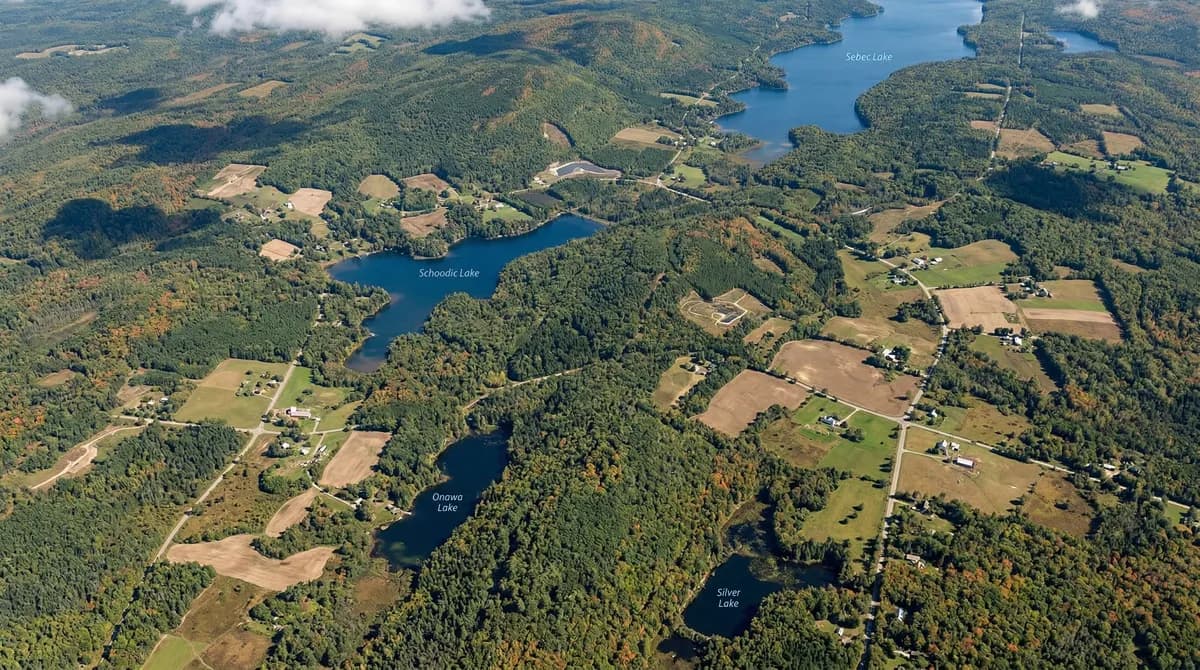
Rural counties with large lots, existing clearings, and cooperative permitting make the strongest candidates. Here is the county-by-county breakdown.
Portland, Scarborough, Gorham, Windham, Gray
Biddeford, Sanford, Kennebunk, Kittery, Berwick
Augusta, Waterville, Winslow, Gardiner, Oakland
Bangor, Orono, Brewer, Old Town, Hampden
Norway, Paris, Rumford, Bethel, Fryeburg
Presque Isle, Caribou, Houlton, Fort Kent, Madawaska
Every Maine solar incentive that applies to roof-mount also applies to ground-mount. There is no distinction in treatment.
Ground-mount solar receives identical 1:1 retail-rate net energy billing credits as roof-mount. CMP ($0.27/kWh) and Versant ($0.32/kWh) credit every exported kWh at full retail.
Solar energy equipment is 100% exempt from property tax statewide under 36 M.R.S. Section 655. Unlike New Hampshire (local option), this is a statewide mandate. Ground-mount and roof-mount are treated identically.
Efficiency Maine focuses on heat pumps, insulation, and weatherization. There is no state solar panel rebate in Maine as of 2026. The main financial benefits for solar are NEB credits and the property tax exemption.
Combined opportunity: If you are adding solar, consider pairing it with an Efficiency Maine heat pump ($1,000-3,000 rebate per unit). Ground-mount solar + heat pump is the most impactful combination for Maine energy savings.
Without the federal 25D credit, financing matters more than ever. Propel and third-party ownership via Section 48/48E are the strongest paths to affordable ground-mount solar in 2026.
Available in Maine. A third-party owner holds the system for the first 5 years, claims the 30% Section 48 commercial ITC, and passes the savings into your lower monthly payment. Ownership transfers to you via the Early Buyout Option (EBO).
Deadline: Construction must begin before July 4, 2026 for the third-party owner to claim the ITC.
Full upfront cost: $29,250-32,400 for a 9 kW ground-mount system. No federal credit. Maximum long-term savings if you can afford the upfront cost. You own the system and keep 100% of NEB credits from day one.
$0 down with standard solar loans at 6-8% APR, 10-20 year terms. Monthly payments of $180-280 partially offset by NEB credits. You own the system but no federal credit to reduce the principal.
A third-party owns the system, claims the 30% Section 48/48E ITC, and you pay a fixed monthly lease or per-kWh PPA rate. The ITC savings are passed to you as a below-retail rate. 20-25 year contracts.
Ground-mount solar in Maine costs $3.25-3.60 per watt installed in 2026, compared to $2.91-3.19/W for roof-mount. For a typical 9 kW system, expect $29,250-32,400 total. The premium covers ground-mount racking, foundation work (helical piles for Maine glacial till or concrete piers for ledge), trenching from the array to your electrical panel, and additional permitting. There is no federal tax credit for homeowner purchases in 2026, as Section 25D expired December 31, 2025.
Yes. Ground-mount residential solar receives identical 1:1 retail-rate NEB credits as roof-mount systems. Whether your array is on your roof or in your yard, CMP and Versant credit every exported kilowatt-hour at the full retail rate. Credits roll over monthly and are trued up annually at avoided cost. There is no distinction between roof-mount and ground-mount for NEB purposes in Maine.
Yes. Maine installers routinely handle glacial till and ledge using three foundation types: helical screw piles (thread around rocks in till), concrete piers (anchor to bedrock when ledge is within 2-3 ft of surface), and ballasted systems (sit on the surface with no ground penetration). Helical piles are the most common and cost-effective for typical Maine glacial till. Solid granite ledge requires concrete piers, which adds $0.15-0.30/W to the system cost.
Yes. Most Maine municipalities require a building permit for ground-mount solar arrays. The application typically includes a site plan showing the array location, property line setbacks, access, and foundation type. Some towns also require planning board or site plan review for larger arrays. If your site is within 250 feet of a great pond, river, or coastal wetland, you may also need a Maine DEP permit-by-rule filing. Contact your town Code Enforcement Officer before starting.
Yes. Solar energy equipment is 100% exempt from property tax assessment statewide in Maine under 36 M.R.S. Section 655. This applies equally to ground-mount and roof-mount systems. Unlike New Hampshire where it is a local option, Maine has a statewide mandate. Your solar array adds value to your property but $0 to your tax bill.
A typical residential ground-mount system needs 400-600 sq ft of open ground per 5 kW of solar capacity. A 9 kW system (Maine average) needs roughly 720-1,080 sq ft, about the size of a two-car garage footprint. You also need to account for setbacks from property lines (10-50 ft depending on your town), access for maintenance equipment, and enough clearance that trees or structures do not shade the panels.
Yes. Two main options exist. First, Propel financing, which is available in Maine. A third-party owner claims the Section 48 commercial ITC (30%), passes the savings into your lower payment, and ownership transfers to you after the initial period. Second, standard solar loans at 6-8% APR. With Propel, the third-party owner must begin construction before July 4, 2026 to claim the ITC, making timing critical. Cash purchase remains an option but requires the full $29,000-32,000 upfront.
Maine building code requires foundations to extend below the frost line, which is 48 inches (4 feet) minimum statewide. Some northern counties (Aroostook, Piscataquis) may require 60 inches. Helical screw piles typically extend 5-8 feet, well beyond the frost line. Concrete piers must also be poured below frost depth. Ballasted systems sit on the surface and use weight rather than depth, but require proper ground preparation to handle freeze-thaw cycles.
Yes. Third-party ownership via lease or PPA works for ground-mount systems. The financing company owns the system, claims the Section 48/48E commercial ITC (30%), and you pay a fixed monthly lease or per-kWh PPA rate. The key deadline is July 4, 2026, after which the commercial ITC is no longer available. Maine NEB credits apply the same way regardless of ownership structure.
Typically yes. Ground-mount systems produce 5-10% more electricity than same-size roof-mount systems. This is because ground-mount racking allows precise south-facing orientation at the optimal 38-42 degree tilt for Maine latitude. Most roofs are not perfectly oriented and may have partial shade. A 9 kW ground-mount in Maine produces roughly 10,500-11,700 kWh annually versus 9,600-10,800 kWh for a typical roof-mount.
Get a free site assessment for your Maine property. We evaluate soil conditions, shade, setbacks, and permitting requirements before designing your system.
City-by-city pricing: $2.91-3.19/W
$0 down, ~30% ITC built in
1:1 retail credits for all solar
Compare financing options in ME
$0.27 vs $0.32/kWh comparison
Best combo for Maine homes
Section 48 third-party options
Regional overview for all 6 states