Loading NuWatt Energy...

We use your location to provide localized solar offers and incentives.
We serve MA, NH, CT, RI, ME, VT, NJ, PA, and TX
Loading NuWatt Energy...
NuWatt designs, installs, and manages solar, battery, heat pump, and EV charger systems across 9 states. One company, one warranty, one point of contact.
Get a Free QuoteThe single most expensive mistake Maine heat pump owners make: setting back the thermostat at night like they did with their oil furnace. In Maine's extreme cold, a 10°F setback can trigger auxiliary heat that costs 2.5x more. Here is exactly what to set — and what to never touch.
#1 Rule: Do NOT Set Back Your Heat Pump Like a Furnace
A 10°F nighttime setback that saved you money with your oil furnace will COST you $60-120/month extra with a heat pump. The recovery period activates expensive auxiliary electric heat. Set 68°F and leave it.
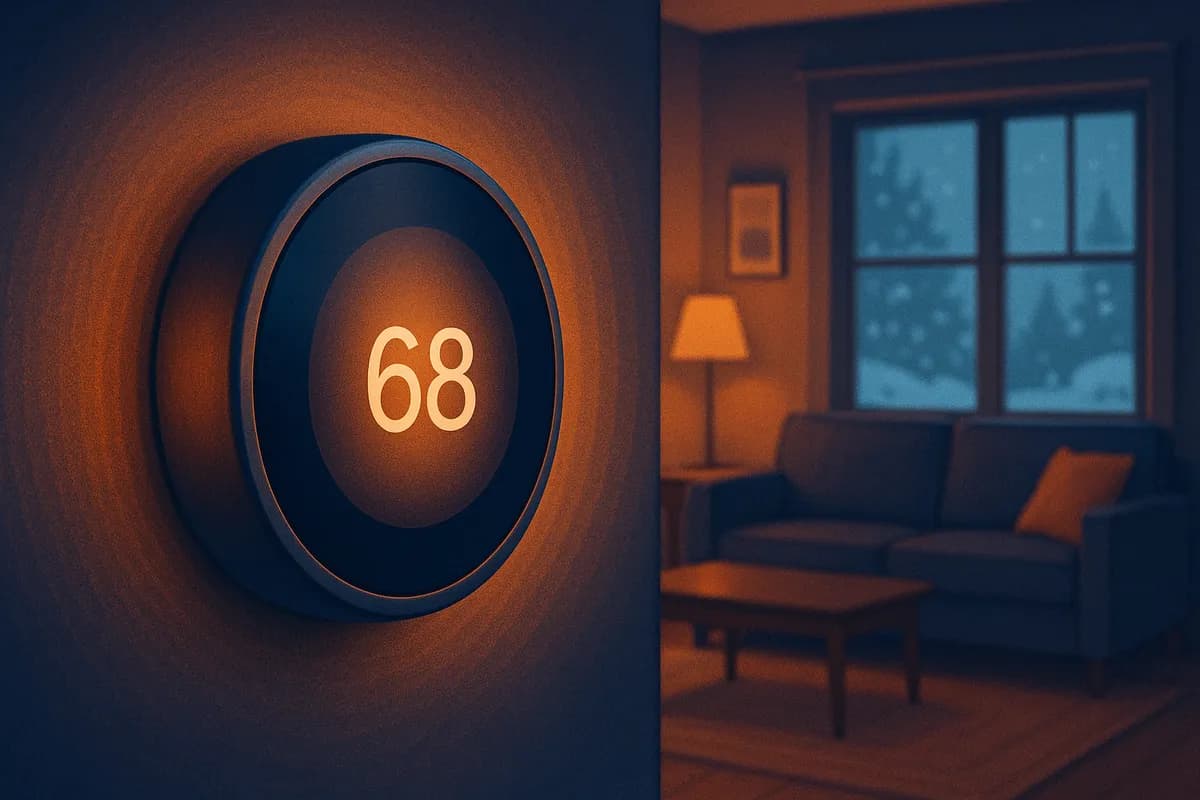
68°F
Optimal winter setting
2°F max
Nighttime setback limit
2.5x
Aux heat cost multiplier
$1,440
Potential annual waste
Everything you learned about thermostat management from oil, gas, or propane heating is wrong for heat pumps. Here is why:
Auxiliary heat (the electric resistance backup in ducted systems) is the most expensive way to heat your Maine home. It activates when the heat pump cannot recover fast enough from a thermostat setback.
You set back to 58°F at night
House cools to 58°F while Maine temp drops to 10°F outside. Heat pump runs occasionally to maintain 58°F.
6 AM: thermostat calls for 68°F
Heat pump starts but cannot bridge the 10°F gap fast enough at 10°F outdoor temp. After 15-30 min, thermostat activates AUX.
Aux heat runs 2-4 hours
10 kW of electric resistance heat at CMP $0.27/kWh = $2.70/hour. Recovery costs $5.40-10.80. This happens EVERY morning.
| Nighttime Setback | Recovery Time | Aux Heat Risk | Monthly Cost Impact | Verdict |
|---|---|---|---|---|
| 0°F (constant 68°F) | 0 min | None | $0 (baseline) | Best |
| 2°F (66°F night) | 15-25 min | Very Low | +$0-5 | OK |
| 5°F (63°F night) | 45-90 min | Moderate | +$15-40 | Avoid |
| 8°F (60°F night) | 2-3 hours | High | +$35-80 | Never |
| 10°F+ (58°F night) | 3-5 hours | Very High | +$60-120 | Never |
Costs assume January conditions: 18°F average outdoor temp, CMP $0.27/kWh rate, 10 kW aux heat strips, 1,800 sqft home. Versant customers pay ~18% more. Mini-split systems without aux heat strips are less penalized by setbacks but still more efficient at constant temperature.
Setting: 66-68°F (2°F maximum setback)
Why: Maine nights drop to 0-20°F. Any setback larger than 2°F risks aux heat during morning recovery.
Tip: If you use a programmable thermostat, set recovery to start 2 hours before you wake — not at wake time.
Setting: 68°F constant
Why: Heat pumps are most efficient at maintaining a constant temperature. The compressor modulates — running at partial capacity rather than cycling on/off.
Tip: Resist the urge to bump it up to 72°F when cold. Each degree above 68°F adds ~3% to your heating bill.
Setting: 66°F (never below 62°F)
Why: Even if you are at work all day, do not drop more than 2-4°F. Below 62°F risks pipe freezing in Maine homes, and recovery costs erase any savings.
Tip: Smart thermostats with geofencing can warm the house as you head home — keeping setback minimal.
Setting: 55-58°F minimum
Why: Going below 55°F risks pipe freezing in Maine winters. Even with winterization, unexpected temperature drops happen.
Tip: Remote monitoring (Ecobee, Nest) alerts you if the house drops below a threshold. Critical for Maine where January cold snaps hit -20°F.
Setting: 72-76°F
Why: Maine summers are mild. Heat pumps in cooling mode are very efficient (COP 4.0+). You can use standard setback strategies in summer — higher when away, lower when home.
Tip: Summer setback rules are the same as traditional AC. The aux heat trap only applies to heating.
Setting: 68°F active rooms, 55-60°F unused rooms
Why: Mini-splits allow zone control. Heat the rooms you use; keep unused rooms above freezing. This is the biggest advantage over ducted systems.
Tip: Close doors between zones. A 68°F living room and 55°F guest room saves 15-20% vs heating the whole house to 68°F.
A good smart thermostat can prevent the aux heat trap automatically. Here are the best options for Maine heat pump owners:
Built-in air quality monitor, SmartSensor included. Best overall for heat pumps.
Pros
Cons
Learns your schedule. Has heat pump balance mode. Good budget option.
Pros
Cons
Pro-installed thermostat. Excellent for ducted heat pump systems.
Pros
Cons
Designed for baseboard heaters only. NOT compatible with heat pumps.
Pros
Cons
If your thermostat supports it, set auxiliary heat lockout above 35°F. Your heat pump can handle everything above 35°F without help. Below 35°F, allow aux heat as backup only — the heat pump should still be primary.
CMP offers time-of-use rates. If you are on TOU, set your thermostat to pre-heat during off-peak hours (11 PM - 7 AM) and maintain during peak hours. This can save 10-15% on heating costs.
When Maine hits -10°F to -20°F, do NOT bump the thermostat to 72°F out of anxiety. Your heat pump is working as designed. Raising the setpoint during extreme cold almost guarantees aux heat activation. Trust the system.
Your thermostat shows "AUX" or "EM HEAT" when resistance heat is active. If you see this frequently during normal cold (above 10°F), something is wrong — schedule service. It should only appear during recovery or extreme cold.
Set your heat pump to 68°F and leave it there. Unlike furnaces, heat pumps work most efficiently at a constant temperature. The biggest mistake Maine homeowners make is using deep setbacks (lowering the temperature at night), which forces the heat pump to run auxiliary electric resistance heat during recovery — costing 2-3x more per BTU.
No more than 2°F. Dropping from 68°F to 66°F at night is fine and saves a small amount. But dropping to 60°F or lower is counterproductive because recovery in Maine cold requires auxiliary heat (electric resistance strips at COP 1.0), which costs $0.27-0.32/kWh vs the heat pump at COP 2.5. A 5-10°F setback can add $35-120/month to your bill.
Auxiliary heat (aux heat) is the electric resistance backup built into most ducted heat pump systems. It activates when the heat pump cannot keep up — usually during recovery from a deep setback or at extreme cold. Aux heat has a COP of 1.0, meaning it converts electricity to heat at 100% efficiency. A heat pump at COP 2.5 delivers 250% efficiency. So aux heat costs 2.5x more per BTU. At CMP rates ($0.27/kWh), aux heat costs about $0.08/kBTU vs heat pump at $0.03/kBTU.
Yes, you should use a thermostat designed for heat pumps. Standard furnace thermostats do not manage auxiliary heat staging properly. A heat pump thermostat (like Ecobee Premium, Nest Learning, or Honeywell T10 Pro) can lock out aux heat above a set outdoor temperature — preventing expensive resistance heating when the heat pump can handle the load alone.
Yes. Efficiency Maine offers rebates on ENERGY STAR certified smart thermostats. The rebate is typically $50-75 per unit when purchased through a registered Efficiency Maine contractor. Check efficiencymaine.com for current rebate amounts and qualifying models.
Mini-splits (ductless) typically use a remote control or built-in thermostat rather than a wall thermostat. Set each zone to 68°F in rooms you use, and 55-60°F in rooms you do not (guest rooms, storage). Mini-splits do not have auxiliary heat strips, so setback is less penalized — but constant temperature is still more efficient because it prevents ice buildup on the outdoor unit.
Never turn off your heat pump in winter. Modern cold-climate units (Mitsubishi Hyper-Heat, Fujitsu XLTH, Daikin Aurora) are rated to operate at -15°F to -22°F. Turning it off and back on causes a cold-start that is much less efficient than continuous operation. If your unit seems to struggle below 0°F, have it serviced — it should maintain heat output at these temperatures.
If your heat pump is running aux heat frequently or your bills seem too high, it may need servicing or your thermostat may need reconfiguration.