Loading NuWatt Energy...

We use your location to provide localized solar offers and incentives.
We serve MA, NH, CT, RI, ME, VT, NJ, PA, and TX
Loading NuWatt Energy...
NuWatt designs, installs, and manages solar, battery, heat pump, and EV charger systems across 9 states. One company, one warranty, one point of contact.
Get a Free Quote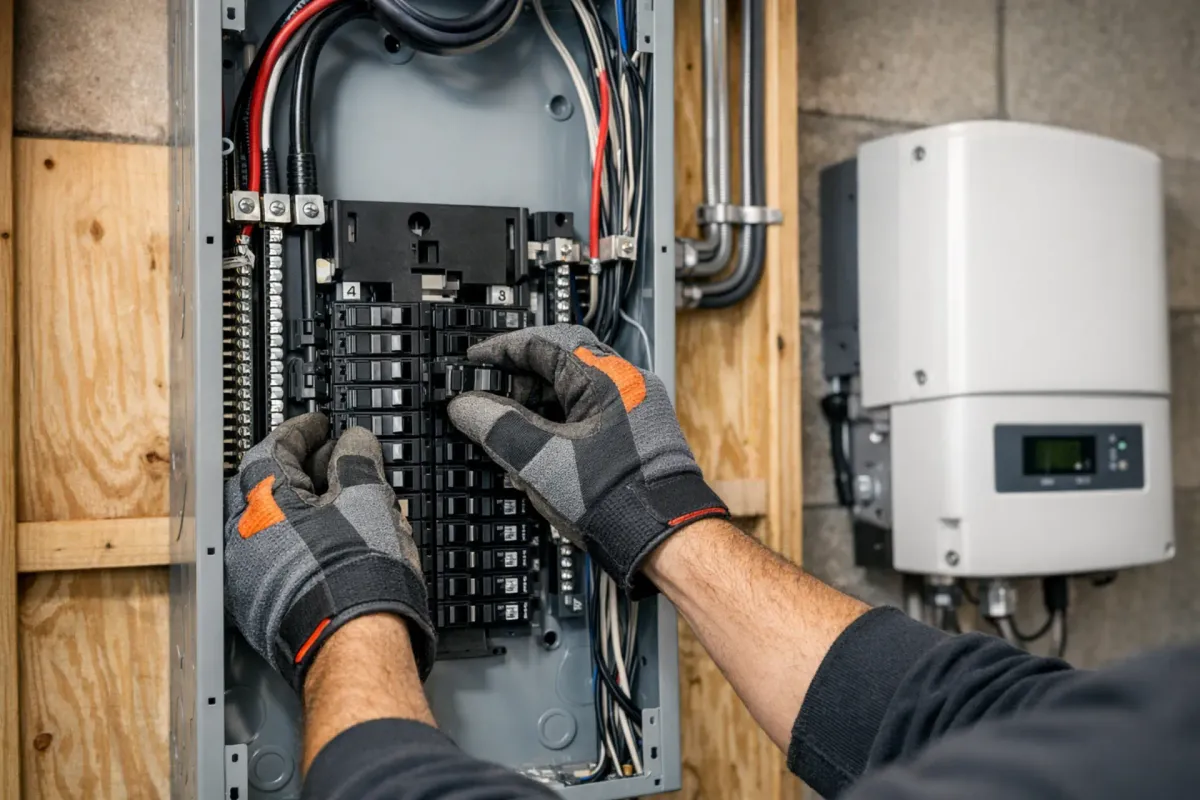
Most Massachusetts homes built before 1980 need an electrical panel upgrade before solar can be installed. Here is what it costs, how long it takes, and whether a SPAN smart panel is a better option.
A 200-amp panel upgrade costs $1,800–$3,500 (panel only) or $4,000–$8,000 (full service upgrade) in Massachusetts, and takes 2–4 weeks (including permits and utility coordination). You need one if your current panel is 100 or 150 amps and your solar system is 7kW or larger. It adds about 0.5–1.5 years to your solar payback period. A SPAN smart panel ($7,000–$9,500 installed) is an alternative that adds load management but may not eliminate the need for a service upgrade.
Panel Only
$1,800–$3,500
Panel + labor + permit
Full Upgrade
$4,000–$8,000
Panel + cable + meter
Timeline
2–4 weeks
Including permits
Payback Impact
+0.5–1.5 yr
On solar payback
Not every home needs an upgrade. Here is how to tell whether yours does.
Current panel is 100 amps or less
Home built before 1980 with original wiring
Planning solar system 7kW or larger
Adding solar + EV charger (Level 2)
Adding solar + heat pump
Panel has fuses instead of breakers
Utility has flagged your service as undersized
No available breaker slots in current panel
Current panel is already 200 amps
Home built after 2000 with modern wiring
Planning solar system under 7kW
Panel has available breaker slots
No plans to add EV charger or heat pump
Recently upgraded electrical service
All-gas home with minimal electric load
How to check your panel amperage:Open your electrical panel cover and look at the main breaker at the top. It will show "100A," "150A," or "200A." If you see fuses instead of breakers, your panel is almost certainly too old and undersized for solar.
Costs vary depending on whether you need just the panel, or a full service upgrade including the meter and entrance cable.
| Component | Cost Range | Notes |
|---|---|---|
| Panel swap only (100A → 200A) | $1,800–$3,500 | Same service entrance cable; just the panel, breakers, and labor |
| Service entrance cable upgrade | $800–$2,000 | Required if existing cable is undersized (common pre-1980) |
| Utility meter base/socket | $200–$800 | Older meter boxes often not rated for 200A |
| Electrical permit (MA) | $75–$500 | Varies by municipality; required by MA building code |
| Inspection | Included | Municipal inspector verifies code compliance |
| Full service upgrade total | $4,000–$8,000 | Panel + cable + meter + permit + labor (typical MA range) |
NuWatt includes panel upgrades in your project cost. When we determine an upgrade is needed during our site survey, we include it in your total project proposal. No surprise bills from separate electricians.
Here is exactly what happens from assessment to completion.
Check your existing electrical panel amperage (printed on the main breaker). If it shows 100A or 150A and your solar system will be 7kW+, an upgrade is likely needed.
Your solar installer will assess your panel, service entrance cable, and utility meter during the site survey and include any upgrade in your project proposal.
An electrical permit is required for panel upgrades in Massachusetts. Your installer handles this, including scheduling the municipal inspection.
A licensed electrician replaces your panel with a new 200-amp panel, installs new breakers, and upgrades the service entrance cable if needed. Takes 4-8 hours.
The utility (Eversource, National Grid, or Unitil) swaps your meter to a bidirectional smart meter compatible with your new panel and solar system.
Municipal inspector approves the panel upgrade. Your solar installation proceeds on the upgraded panel with no capacity constraints.
The SPAN smart panel is an intelligent electrical panel that manages loads circuit-by-circuit. In some cases, it can eliminate the need for a service upgrade.
SPAN does not always replace a service upgrade
If your service entrance cable from the utility is only rated for 100 amps, SPAN cannot increase that capacity. SPAN manages loads within your existing service — it does not increase the power coming into your home. A site assessment determines whether SPAN alone is sufficient or if a service upgrade is also needed.
If you are upgrading your panel for solar, consider your future electrification plans. Adding capacity now is far cheaper than upgrading twice.
| Appliance | Amps Required | Breaker Size |
|---|---|---|
| Solar System (8–11kW) | 30–40A | 40A |
| Level 2 EV Charger | 30–50A | 50A |
| Heat Pump (ducted) | 20–40A | 40A |
| Home Battery (Tesla/Enphase) | 30A | 30A |
| Electric Dryer | 24–30A | 30A |
| Electric Range/Oven | 40–50A | 50A |
| Central AC | 20–30A | 30A |
| Electric Water Heater | 18–25A | 30A |
A fully electrified home (solar + battery + heat pump + EV charger) can draw 150–200 amps during peak loads. A 200-amp panel is the minimum for whole-home electrification.
It depends on your current panel capacity and solar system size. Most homes built before 1980 have 100-amp or 150-amp panels that cannot safely handle a solar system plus existing loads (AC, EV charger, dryer). If your solar system is 7kW or larger and your panel is 100 amps, an upgrade is almost always required. Your installer will assess this during the site survey.
A 200-amp panel upgrade in Massachusetts typically costs $1,800–$3,500 for a panel-only swap (same service cable). If the utility meter base and service entrance cable also need upgrading — common in pre-1980 homes — the total for a full service upgrade is $4,000–$8,000. These costs are separate from your solar installation cost.
The physical installation takes 4–8 hours. However, the full process — including permit application, scheduling the electrician, utility meter swap, and inspection — takes 2–4 weeks total. Your solar installer should coordinate this so it does not delay your solar installation timeline.
In some cases, yes. A SPAN smart panel ($7,000–$9,500 installed) provides intelligent circuit-level load management that can work within a 100-amp service. SPAN can prioritize solar charging and manage loads to avoid overloading your panel. However, SPAN is not always a substitute — if your service entrance cable is undersized, you still need a service upgrade.
A $3,500–$5,000 panel upgrade adds approximately 0.5–1.5 years to a typical Massachusetts solar payback period (from about 7.8 years to 8.3–9.3 years). Over 25 years, this is negligible compared to the $147,000+ in total savings. The upgrade also adds value to your home by bringing the electrical system up to modern code.
A Level 2 EV charger draws 30–50 amps, and a typical 8–11kW solar system uses a 30–40 amp breaker. Combined with existing loads (AC, electric dryer, cooking), you almost certainly need 200 amps. If you plan to add a heat pump as well, consider a 320-amp or 400-amp panel, or a SPAN smart panel to manage loads dynamically.
NuWatt coordinates the entire process. If a panel upgrade is needed, we include it in your project scope, handle the permit, schedule the work, and coordinate the utility meter swap. You do not need to hire a separate electrician — everything is managed as part of your solar installation.
If your panel cannot handle the additional load, the utility will not approve your solar interconnection. Skipping the upgrade is not an option if your installer determines it is required — the system will not pass inspection and cannot be connected to the grid.
Our site survey includes a full electrical assessment. We will tell you exactly what your panel can handle and what — if anything — needs upgrading.
Or call us: (877) 772-6357
Adding a heat pump? See 2026 rebate tiers and 0% HEAT Loan financing.
Read more10-point checklist, red flags, and questions to ask before signing.
Read moreAll MA solar incentives, costs, and payback in one comprehensive guide.
Read morePanel upgrade costs: NuWatt Energy installation data, Massachusetts 2025–2026.
SPAN smart panel pricing: SPAN.IO manufacturer specifications and NuWatt install quotes.
Electrical load data: National Electrical Code (NEC 2023), Article 220.
Massachusetts building code: 527 CMR, electrical permit requirements.