Loading NuWatt Energy...

We use your location to provide localized solar offers and incentives.
We serve MA, NH, CT, RI, ME, VT, NJ, PA, and TX
Loading NuWatt Energy...
NuWatt designs, installs, and manages solar, battery, heat pump, and EV charger systems across 9 states. One company, one warranty, one point of contact.
Get a Free QuoteHow AOBCs replace traditional net metering for large commercial solar systems in Massachusetts. Understand credit rates, utility differences, and the impact on your project economics.
AOBC Rate Range
$0.10-$0.18
Per kWh credit value
All-In Retail Rate
$0.38-$0.48
MA IOU bundled rate
Applicable Systems
>25 kW
Under certain tariffs
Virtual NM
Eligible
Multi-account allocation
AOBCs are a billing mechanism that replaces traditional net metering for large commercial solar systems in MA. Instead of receiving kWh-for-kWh credits at the full all-in retail rate ($0.38-$0.48/kWh), AOBC systems receive monetary credits based on the utility's avoided cost — typically $0.10-$0.18/kWh depending on your utility (National Grid, Eversource, or Unitil). AOBCs apply primarily to systems over 25kW under certain tariffs. While the per-kWh credit is lower than net metering, AOBCs work well with virtual net metering for multi-site businesses and community solar. On-site consumption still offsets the full retail rate, and SMART 3.0 incentives, ITC, and MACRS are unaffected.
Alternative On-Bill Credits (AOBCs) represent a fundamental shift in how Massachusetts compensates commercial solar generators for the electricity they export to the grid. Unlike traditional net metering — which provides a simple kilowatt-hour-for-kilowatt-hour offset at or near the full retail electricity rate — AOBCs assign a monetary value to each kilowatt-hour of generation based on the costs the utility actually avoids by not having to procure that electricity from other sources.
The concept emerged from years of utility rate design proceedings before the Massachusetts Department of Public Utilities (DPU). As distributed solar generation grew from a small fraction of electricity supply to a significant contributor, utilities argued that traditional net metering at full retail rates overcompensated solar generators and shifted costs to non-solar ratepayers. The AOBC framework was developed as a more granular approach that values solar generation based on its actual components of value to the grid.
For commercial solar customers in Massachusetts, understanding AOBCs is essential because the credit rate directly determines how much your exported solar generation is worth. With all-in MA utility rates running from $0.38/kWh (Eversource) up to $0.48/kWh (Unitil), the difference between a full retail net metering credit and an AOBC credit of $0.10-$0.18/kWh can represent tens of thousands of dollars annually for a mid-size commercial system. This makes system sizing, self-consumption optimization, and financing structure all critically dependent on which billing mechanism applies to your project.
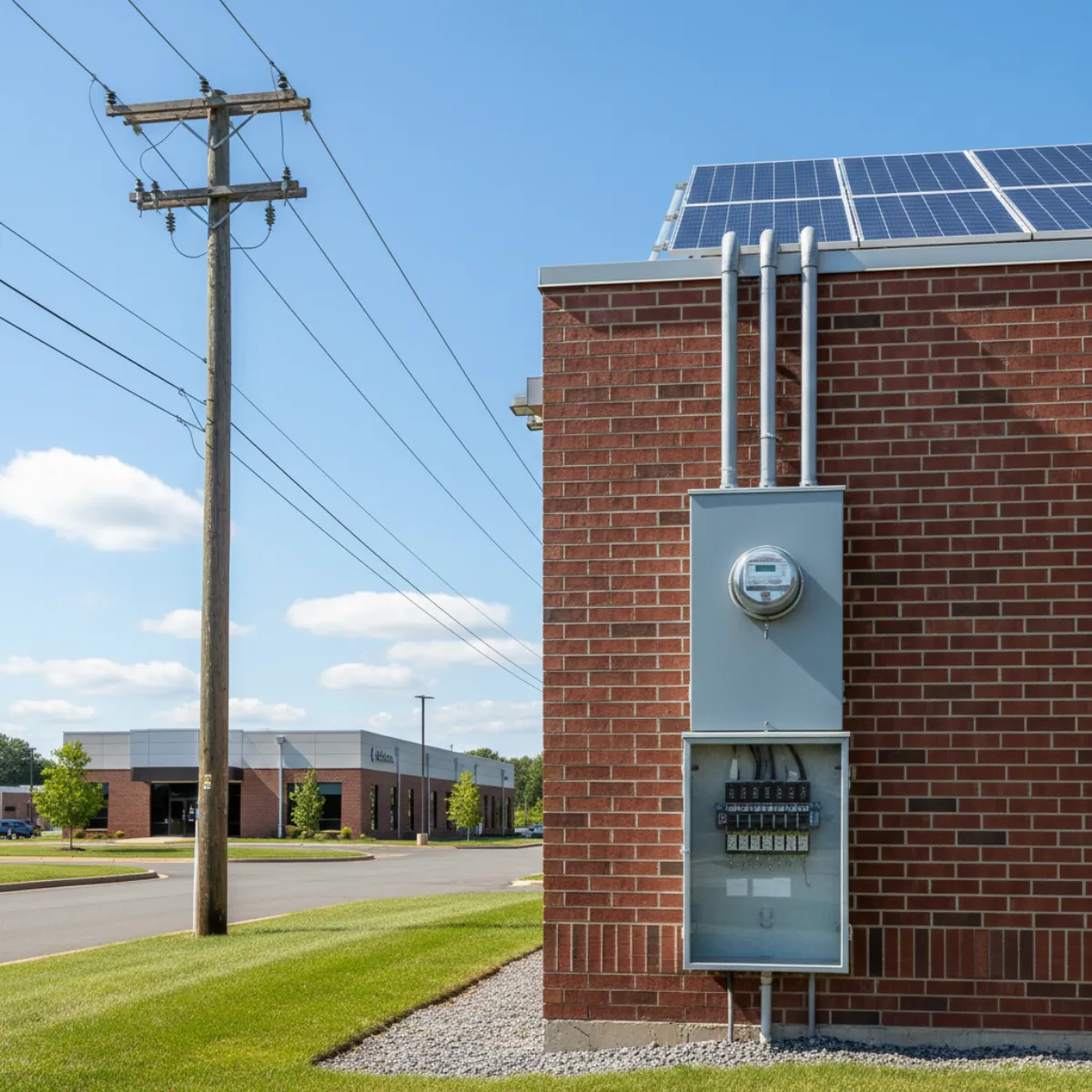
AOBCs only affect the value of exported solar generation — electricity your system produces that flows to the grid rather than being consumed on-site. Electricity consumed directly by your facility still offsets the full all-in retail rate ($0.38-$0.48/kWh across the three MA utilities). This means the AOBC vs net metering difference primarily matters for the portion of generation you export. Systems sized to maximize self-consumption minimize the impact of lower AOBC rates.
The AOBC rate is not a single number — it is the sum of multiple components, each representing a different category of cost the utility avoids when your solar system generates electricity. This avoided cost methodology is reviewed and approved by the Massachusetts DPU. Understanding each component helps you evaluate the fairness of your AOBC rate and identify opportunities (like producing during peak hours) to maximize credit value.
Wholesale energy price avoided by the utility when your solar produces
Avoided cost of peak generation capacity your solar displaces
Avoided transmission infrastructure costs from distributed generation
Reduced distribution system costs in constrained areas
Value of avoided emissions and renewable energy certificates (RECs)
For a 250kW commercial rooftop system on National Grid territory, the AOBC rate might break down as follows:
This $0.150/kWh AOBC rate compares to National Grid's all-in retail rate of approximately $0.42/kWh. The system would receive $0.15 per kWh exported vs the full $0.42 per kWh under traditional net metering — roughly 36% of the retail value.
The table below compares the two billing mechanisms across all key dimensions. Understanding these differences is critical for accurate financial modeling of your commercial solar project. The right mechanism for your project depends on system size, export ratio, and whether you need virtual net metering capabilities.
| Feature | Traditional Net Metering | AOBC |
|---|---|---|
| Credit Type | kWh credit (energy offset) | Monetary credit ($) on bill |
| Credit Value | Full retail rate (Class I/II) | Avoided cost rate ($0.10-$0.18/kWh) |
| Applicable Systems | All sizes (Class I: ≤60kW, Class II: 60kW-1MW) | Primarily systems >25kW under certain tariffs |
| Rate Calculation | Based on retail electricity rate | Avoided cost methodology (generation + capacity) |
| Monthly Carryover | kWh credits roll over month-to-month | Dollar credits roll over with annual true-up |
| Virtual Net Metering | Available for all NM classes | Available — credits allocable to multiple accounts |
| Utility Interaction | Standard interconnection | AOBC-specific tariff filing required |
| Best For | Small-to-mid commercial (<60kW) | Large commercial, community solar, multi-site |
Consider a 200kW commercial rooftop system producing 250,000 kWh/year with 40% on-site consumption (100,000 kWh) and 60% exported (150,000 kWh):
The $41,520/year difference is significant but can be offset by SMART 3.0 incentives, optimized system sizing, and battery storage for peak-shaving. On-site consumption always gets full retail value under both mechanisms.
Each of Massachusetts' three investor-owned utilities files its own AOBC tariff with the DPU, resulting in different credit rates and structures. Your utility territory determines which AOBC rate schedule applies to your commercial solar system. Here is a comparison of current AOBC rates across all three utilities.
Central & Western MA
$0.11-$0.16/kWh
AOBC rate range
Retail Rate
$0.42/kWh
AOBC Rate
$0.11-$0.16/kWh
AOBC as % of Retail
28-41%
Rates vary by rate class and capacity tag. Seasonal adjustments apply.
Eastern MA & Greater Boston
$0.12-$0.18/kWh
AOBC rate range
Retail Rate
$0.38/kWh
AOBC Rate
$0.12-$0.18/kWh
AOBC as % of Retail
33-50%
Higher capacity value in constrained areas. Time-of-use rates may apply.
North-Central MA (Fitchburg area)
$0.10-$0.14/kWh
AOBC rate range
Retail Rate
$0.48/kWh
AOBC Rate
$0.10-$0.14/kWh
AOBC as % of Retail
22-31%
Smallest service territory and the highest all-in retail rate of the three MA IOUs. Limited capacity block availability.
Eversource territory includes the Greater Boston area, which has higher grid congestion and capacity constraints. This means the capacity value and distribution value components of the AOBC rate are higher in Eversource territory — the utility avoids more cost per kWh of distributed generation in constrained areas. If your commercial facility is in the Eversource service territory, your AOBC rate will generally be more favorable than National Grid or Unitil.
One of the most powerful features of the AOBC framework is its compatibility with virtual net metering (VNM). Virtual net metering allows the monetary credits generated by a single solar installation to be allocated across multiple electric accounts — even accounts at different physical locations within the same utility territory.
This capability is particularly valuable for three commercial scenarios: (1) businesses with multiple locations that want to install solar at one site and share credits across all facilities, (2) municipalities and school districts that can install solar on one building and offset electricity costs at other municipal properties, and (3) community solar developers who need to allocate credits to dozens or hundreds of subscriber accounts.
Under the AOBC framework, the credit calculation occurs at the host meter — where the solar system is interconnected — and the resulting monetary credits are then distributed to designated beneficiary accounts according to a pre-registered allocation schedule. The allocation can be updated periodically (typically quarterly or annually, depending on the utility) to accommodate changes in subscriber accounts or credit distribution preferences.
A restaurant group with 4 locations in National Grid territory installs a 200kW ground-mount system at their warehouse property:
A 1MW community solar project on Eversource territory allocates AOBC credits to 150 residential and commercial subscribers:
The Massachusetts Department of Public Utilities (DPU) oversees the regulatory framework that governs AOBC rates. Understanding the key proceedings and rate design principles helps commercial solar developers anticipate rate changes and advocate for fair compensation. The DPU process is where the balance between solar generator compensation and ratepayer cost protection gets determined.
DPU 25-200 is the foundational proceeding that established the current AOBC framework for Massachusetts. This docket addressed the transition from traditional net metering to the avoided cost-based AOBC methodology for large distributed generation facilities. The ruling required each utility to file specific AOBC tariffs with detailed rate component calculations, subject to DPU review and approval.
The rate design for AOBCs follows the avoided cost methodology, which is recalculated periodically based on updated market data. The energy component tracks wholesale electricity prices (ISO New England real-time and day-ahead markets), while the capacity component reflects the cost of maintaining generation capacity to meet peak demand. Transmission and distribution values are derived from utility capital spending plans and avoided infrastructure investments.
DPU 25-200: Net Metering & AOBC Framework
Established the AOBC billing mechanism and avoided cost methodology. Set the transition rules for existing vs new systems.
Utility Rate Cases: National Grid / Eversource / Unitil Rate Filings
Each utility rate case can reset the underlying cost components used to calculate AOBC rates. Distribution and transmission values are particularly affected.
Grid Modernization: DPU Grid Modernization Dockets
Grid modernization investments change the distribution value component. Advanced metering infrastructure (AMI) enables more granular time-of-use AOBC pricing.
SMART 3.0 Integration: DOER SMART Program Amendments
SMART 3.0 incentive rates are designed to complement (not duplicate) AOBC values. Changes to SMART rates indirectly affect total project economics.
Commercial solar developers should actively monitor DPU proceedings and participate in public comment periods when AOBC rate changes are proposed. The DPU 25-200 net metering ruling fundamentally shaped how AOBCs work today, and future proceedings will continue to evolve the framework. Working with an experienced solar developer who understands the regulatory landscape helps ensure your project economics account for realistic AOBC rate trajectories over the 25-year system life.
While AOBC rates are lower than full retail net metering credits, there are several strategies to optimize your commercial solar economics under the AOBC framework. The goal is to maximize the value of every kilowatt-hour your system produces — whether consumed on-site at full retail value, exported under AOBC rates, or earning SMART 3.0 incentive payments.
Size your system to match your facility load profile as closely as possible. Every kWh consumed on-site offsets the full all-in retail rate ($0.38-$0.48/kWh, depending on your MA utility) rather than receiving the lower AOBC export credit. Consider shifting flexible loads (EV charging, HVAC pre-conditioning, water heating) to peak solar production hours.
Battery energy storage systems (BESS) can store excess solar generation for use during evening peak hours rather than exporting at AOBC rates. This shifts consumption to offset more expensive peak retail electricity. Batteries also qualify for SMART 3.0 storage adders and ConnectedSolutions demand response payments.
SMART 3.0 production-based incentive payments are paid on ALL generation — not just exports. A 250kW commercial system earning $0.04-$0.08/kWh from SMART over 20 years significantly supplements AOBC revenue. SMART payments are independent of the AOBC vs net metering distinction.
The 30% base ITC (up to 70% with adders) and 5-year MACRS depreciation with 100% first-year bonus depreciation (permanent under OBBBA) are completely unaffected by whether you are on AOBC or net metering. These federal tax benefits often represent the largest portion of commercial solar value — especially in Year 1.
Even with AOBC rates at $0.10-$0.18/kWh instead of full retail net metering, commercial solar in Massachusetts remains an excellent investment. The federal ITC (30-70%), MACRS depreciation, SMART 3.0 incentives, sales tax exemption (6.25%), and 20-year property tax exemption all contribute to typical payback periods of 4-7 years for AOBC projects. The key is proper system sizing and financial modeling that accounts for the AOBC rate from the start.
The dividing line between traditional net metering and AOBCs depends on system size, net metering class, utility tariff, and interconnection date. Here is a practical breakdown to help determine which billing mechanism applies to your project.
Small commercial systems under 60kW generally remain on traditional net metering with credits at or near the full retail rate. These systems represent the vast majority of small business solar installations — rooftop systems on retail stores, restaurants, small offices, and similar facilities.
Mid-size commercial systems in the 60kW-1MW range may be subject to either mechanism depending on utility tariff rules and interconnection timing. Newer interconnections are increasingly moved to AOBC. Existing grandfathered systems may retain traditional net metering. Check your specific utility tariff.
Large commercial and community solar systems over 1MW are generally subject to AOBC tariffs. These systems also qualify for SMART 3.0 incentives that complement the AOBC revenue. Virtual net metering is commonly used at this scale to allocate credits across multiple accounts.
For a detailed breakdown of net metering classes, credit rates, and the latest DPU rulings, see our Massachusetts Commercial Net Metering Guide 2026. If you are considering a system that might fall under AOBC, getting an accurate financial model with AOBC rates rather than net metering assumptions is essential — learn more about overall project economics in our MA Commercial Solar 2026 guide.
Complete commercial solar guide: ITC stacking, SMART 3.0, pricing, financing, and ROI for MA businesses.
Net metering classes, credit rates, virtual net metering, and recent DPU rulings for commercial solar.
Massachusetts SMART production incentives for commercial solar. Rates, adders, enrollment, and stacking with AOBCs.
Complete Massachusetts net metering guide covering all classes, utilities, and recent policy changes.
Alternative On-Bill Credits (AOBCs) are a billing mechanism for commercial solar in Massachusetts that provides monetary credits on your electric bill rather than traditional kilowatt-hour (kWh) net metering credits. AOBCs are calculated using an avoided cost methodology that values your solar generation based on the costs the utility avoids — including wholesale energy, capacity, transmission, distribution, and environmental components. AOBC rates typically range from $0.10-$0.18/kWh depending on your utility and rate class, compared to full all-in retail rates of roughly $0.38-$0.48/kWh under traditional net metering.
Our team will model your project economics using actual AOBC rates for your utility territory — not generic net metering assumptions.