Loading NuWatt Energy...

We use your location to provide localized solar offers and incentives.
We serve MA, NH, CT, RI, ME, VT, NJ, PA, and TX
Loading NuWatt Energy...
NuWatt designs, installs, and manages solar, battery, heat pump, and EV charger systems across 9 states. One company, one warranty, one point of contact.
Get a Free QuoteHow to properly size a commercial solar system starting from an energy audit. From reading your electric bills to production modeling in PVWatts.
Rooftop Density
7-10 W/ft²
Solar per sq ft
MA Production
1,200
kWh/kW per year
Mass Save Audit
Free
For most businesses
Target Offset
80-120%
Annual consumption
To size a commercial solar system in MA: (1) Conduct an energy audit using 12 months of utility bills to determine annual kWh consumption, (2) Request interval data (15-min or hourly) from your utility for load profile analysis, (3) Target 80-120% offset of annual usage, (4) Divide target production by 1,200 kWh/kW (MA production factor) to get required system size, (5) Verify available roof area at 7-10 W per sq ft for rooftop or 4-6 W/sq ft for ground mount. A free Mass Save commercial energy audit can identify 10-30% efficiency savings to right-size your system. For a 200,000 sq ft warehouse using 400,000 kWh/year, you would need approximately 333 kW of solar capacity.
The most common mistake in commercial solar sizing is jumping straight to panel counts without understanding the facility's actual energy consumption patterns. An energy audit is the essential first step because it reveals not just how much electricity you use, but when you use it, where the biggest loads are, and what can be reduced before sizing the solar system.
In Massachusetts, where commercial electricity rates range from $0.22 to $0.30 per kWh, every kilowatt-hour matters. A properly sized system — one that matches your actual consumption profile — maximizes behind-the-meter offset and minimizes the amount of energy exported at net metering rates (which may be lower than retail for larger systems). The energy audit ensures you are investing in the right amount of solar capacity, not too much (wasting capital) and not too little (leaving savings on the table).
Furthermore, implementing efficiency improvements identified in the audit — LED lighting, HVAC optimization, building envelope upgrades — can reduce your baseline consumption by 10-30%. This means a smaller, less expensive solar system achieves the same offset percentage. On a 250 kW system at $1.75/W, a 20% load reduction translates to 50 kW fewer panels and approximately $87,500 in saved capital costs.
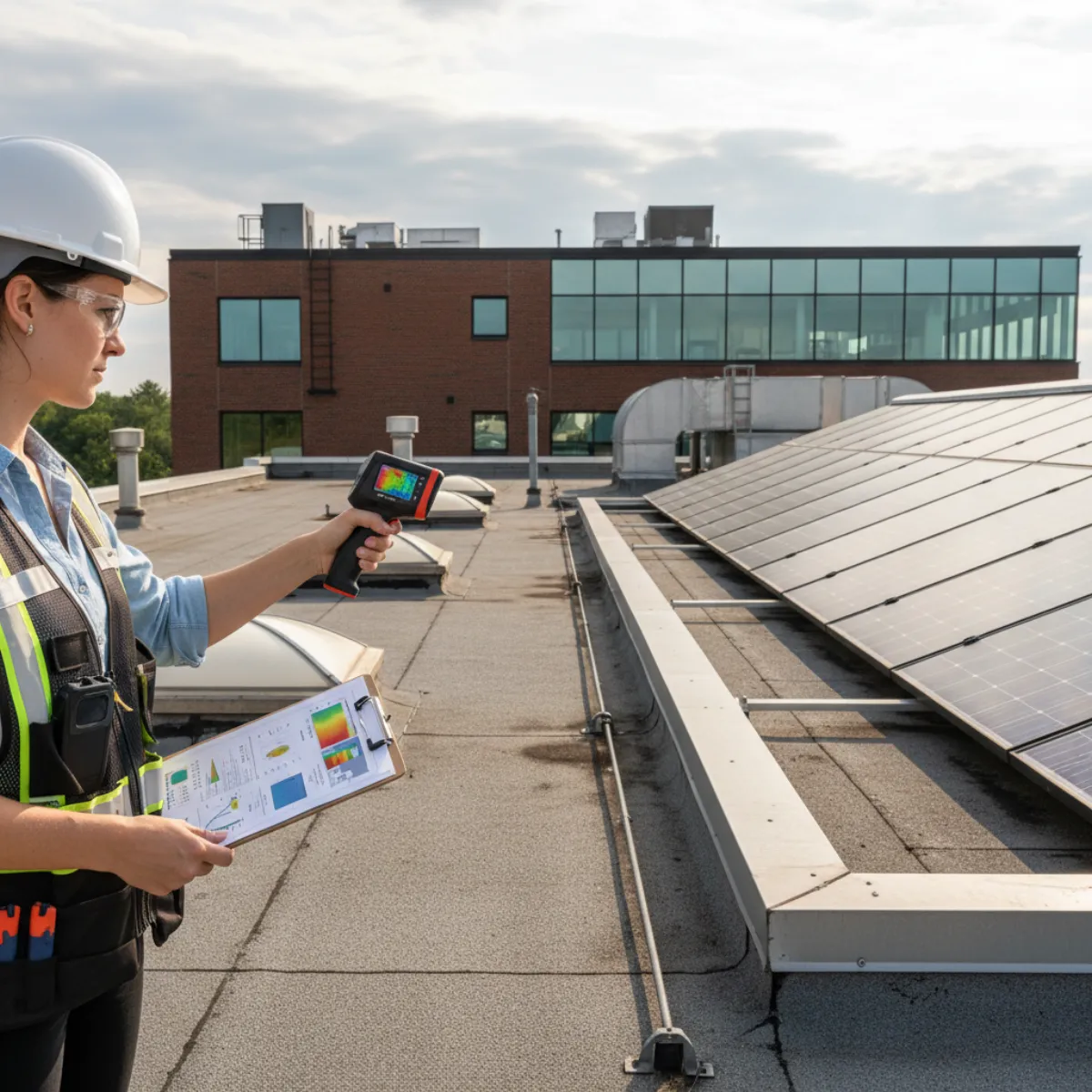
Commercial electric bills in Massachusetts are more complex than residential bills. Understanding each component is essential for accurate solar sizing and ROI projection. Here are the key elements to analyze across your most recent 12 months of bills.
The per-kilowatt-hour charge for electricity consumed. This is what solar directly offsets. In MA, commercial energy rates range from $0.22-$0.30/kWh, among the highest in the nation. This rate includes supply charges, transmission, and distribution components.
Solar directly reduces this charge.
Based on your peak power draw (kW) in a billing period, typically the highest 15-minute average. Commercial demand charges in MA range from $3-$25/kW. This single measurement sets your demand charge for the entire month.
Solar has limited impact. Battery storage is needed.
Calculated as: (Total kWh) / (Peak kW x Hours in Period) x 100. A high load factor (60%+) means steady usage — good for solar self-consumption. A low load factor (30-40%) means peaky usage — more energy may be exported during off-peak hours.
Higher load factor = better solar economics.
Measures efficiency of electrical use (ratio of real to apparent power). Poor power factor (<0.85) results in utility penalties. Some MA utilities charge power factor surcharges on commercial accounts. Solar inverters can provide power factor correction.
Modern inverters can correct this, adding value.
Beyond monthly bills, request 15-minute interval data from your utility for the most recent 12 months. This granular data reveals exactly when your facility consumes electricity, enabling precise solar sizing that maximizes self-consumption. National Grid and Eversource provide interval data through their online commercial portals. Our Demand Charge Battery Calculator can model savings using this data.
Different commercial building types have fundamentally different electricity consumption patterns. Understanding your load profile is critical because it determines how much solar production your facility can absorb on-site versus how much will be exported to the grid. Here are the four most common MA commercial building profiles.
Load Pattern
Weekday peak (9am-6pm), low weekends
Load Factor
35-50%
Demand Charges
Moderate ($5-$15/kW)
Solar Match
Excellent — peak production aligns with peak consumption
Ideal Offset Target
80-100%
HVAC drives summer peak. Demand charges significant but predictable.
Load Pattern
Relatively flat 24/7 with shift peaks
Load Factor
50-70%
Demand Charges
Low to moderate ($3-$10/kW)
Solar Match
Good — large roof area, consistent baseline load absorbs production
Ideal Offset Target
60-80%
Large flat roofs ideal for solar. High load factor means less exported energy.
Load Pattern
Daytime peak (10am-9pm), seasonal variation
Load Factor
40-55%
Demand Charges
Moderate to high ($8-$20/kW)
Solar Match
Very good — operating hours align with solar production
Ideal Offset Target
70-100%
Consider carport installations for additional capacity. SMART canopy adder applies.
Load Pattern
High baseline with shift-driven peaks
Load Factor
60-80%
Demand Charges
High ($10-$25/kW)
Solar Match
Good — high baseline absorbs solar, but peaks may exceed solar offset
Ideal Offset Target
50-70%
Battery storage highly valuable for demand charge management. Large energy consumers.
Mass Save offers free commercial energy audits for businesses in Massachusetts served by the three investor-owned utilities (Eversource, National Grid, and Unitil). These audits are conducted by qualified energy engineers who assess your entire facility — lighting, HVAC, building envelope, process loads, and controls.
For businesses considering solar, the Mass Save audit serves a dual purpose. First, it identifies efficiency improvements that can reduce your baseline consumption by 10-30%, allowing you to right-size your solar system. Second, the audit provides detailed energy consumption data and professional analysis that your solar developer can use for more accurate system design. Many of the efficiency measures identified in the audit qualify for Mass Save rebates that further improve the overall return on your clean energy investment.
The audit process typically takes 2-4 weeks from request to final report. For smaller facilities, Mass Save provides a walkthrough assessment. For larger facilities (>50,000 sq ft), they offer comprehensive engineering studies that include detailed load analysis, equipment inventories, and cost-benefit analysis for recommended measures. For more on Mass Save's residential programs, see our Mass Save Home Energy Assessment guide.
Use this 9-step sizing worksheet to determine the optimal commercial solar system size for your Massachusetts facility. The process considers both energy requirements and physical space constraints.
Formula: Sum of 12 months of kWh from utility bills
Unit: kWh/year
Formula: Typically 80-120% of annual usage
Unit: %
Formula: Step 1 x Step 2
Unit: kWh/year
Formula: 1,200 kWh per kW installed (typical MA)
Unit: kWh/kW
Formula: Step 3 / Step 4
Unit: kW DC
Formula: Measured usable roof area (minus setbacks, equipment)
Unit: sq ft
Formula: 7-10 W per sq ft for rooftop (4-6 W for ground)
Unit: W/sq ft
Formula: Step 6 x Step 7 / 1,000
Unit: kW DC
Formula: MIN(Step 5, Step 8) — constrained by usage or area
Unit: kW DC
The worksheet above produces an initial estimate. Final sizing should account for: net metering class limits (Class II: 25 kW - 1 MW, Class III: 1-5 MW), utility interconnection thresholds that may trigger costly infrastructure upgrades, SMART program capacity block availability, future load growth (EV charging, electrification), and financial optimization between system cost and incentive capture. For detailed financial analysis, use our Commercial Solar IRR Calculator.
The physical area available for solar panels is often the binding constraint on system size for commercial projects. The effective solar density (watts per square foot) varies significantly between rooftop and ground-mount installations, and between flat and pitched roofs.
Flat commercial roofs use ballasted racking with row spacing to avoid inter-row shading. Usable area is typically 60-75% of total roof area after setbacks and equipment clearances.
Ground-mount systems require more land per kW due to wider row spacing and higher tilt angles. However, optimal tilt produces 10-15% more energy per kW than low-slope flat roof installations.
Once you have determined the system size, production modeling predicts how much electricity the system will generate annually. The industry standard tool is NREL PVWatts Calculator, a free online tool developed by the National Renewable Energy Laboratory. For Massachusetts, a well-designed commercial solar system produces approximately 1,200 kWh per kW of installed capacity per year. Here are the key PVWatts inputs and their Massachusetts-specific values.
MA Value: Boston, MA (42.36, -71.06) or site-specific coordinates
Impact: Determines solar irradiance and weather data
MA Value: From sizing worksheet above
Impact: Directly scales production output
MA Value: Standard (crystalline silicon)
Impact: Premium modules add ~5% production vs standard
MA Value: Fixed (roof mount) or Tracking (ground mount)
Impact: Single-axis tracking adds 15-25% production
MA Value: 10-15 for flat roofs, 30-40 for optimal (latitude tilt)
Impact: Low-slope commercial roofs typically 10-15 degrees
MA Value: 180 (due south), 90-270 acceptable range
Impact: East/West facing loses 10-15% vs south-facing
MA Value: 14% (NREL default), adjust for snow 2-5%
Impact: Includes soiling, shading, wiring, inverter clipping
MA Value: 1.15-1.25 typical for commercial
Impact: Higher ratio captures more morning/evening energy
A 200 kW system on a flat commercial roof at 12-degree tilt, due south azimuth, with standard system losses produces approximately 240,000 kWh per year — enough to offset a facility consuming 20,000 kWh per month. At $0.26/kWh commercial rate, that represents approximately $62,400 in annual energy savings before SMART program revenue and tax benefits.
For complete financial analysis including ITC, MACRS, and SMART revenue, use our Commercial Solar IRR Calculator.
Energy professionals consistently recommend this sequence: reduce load first, then size solar to the reduced baseline. This approach maximizes the return on every dollar invested. Here is why it works.
Consider a manufacturing facility consuming 500,000 kWh per year. Without efficiency improvements, a 100% offset system would need approximately 417 kW of solar capacity, costing roughly $667,000-$792,000 at $1.60-$1.90/W. After a Mass Save audit identifies and implements LED lighting, HVAC optimization, and compressed air leak repair — reducing consumption by 20% to 400,000 kWh — the required system drops to 333 kW, costing $533,000-$633,000. That is $134,000-$159,000 in avoided solar costs, much of which is recouped through Mass Save rebates covering the efficiency measures.
However, do not let efficiency improvements stall your solar project. Projects that began Section 48E construction on or before July 4, 2026 locked in the most flexible placed-in-service window (later starts must be placed in service by December 31, 2027), and the 30% ITC (up to 70% with adders) plus the 100% first-year MACRS bonus depreciation (permanent under OBBBA) are too valuable to delay. The ideal approach is to implement quick-win efficiency measures (LED retrofits, controls optimization) in parallel with the solar project timeline, and plan larger HVAC or envelope upgrades for subsequent years. For project timeline planning, see our Commercial Solar Project Timeline Guide.
Start with a 12-month energy audit — gather all utility bills to determine total annual kWh consumption. Divide your annual consumption by 1,200 kWh/kW (the typical MA production factor) to get the required system size in kW. Then verify that your available roof or ground area can support that system at 7-10 W per sq ft for rooftop or 4-6 W per sq ft for ground mount. The target offset is typically 80-120% of annual consumption. For example, a business using 240,000 kWh/year would need approximately 200 kW of solar capacity.
Our engineers conduct detailed energy audits and provide custom solar sizing analysis for MA businesses.