Loading NuWatt Energy...

We use your location to provide localized solar offers and incentives.
We serve MA, NH, CT, RI, ME, VT, NJ, PA, and TX
Loading NuWatt Energy...
NuWatt designs, installs, and manages solar, battery, heat pump, and EV charger systems across 9 states. One company, one warranty, one point of contact.
Get a Free QuotePlaster walls. No ductwork. Knob-and-tube wiring. 10-foot ceilings. Historic district rules. Your Victorian is beautiful — and challenging to heat efficiently. Here is how mini-splits solve every problem.
3" hole
Only wall penetration needed
$8.5K
Mass Save standard cap
40-60%
Heating cost savings vs oil
2-6 wks
HDC approval timeline
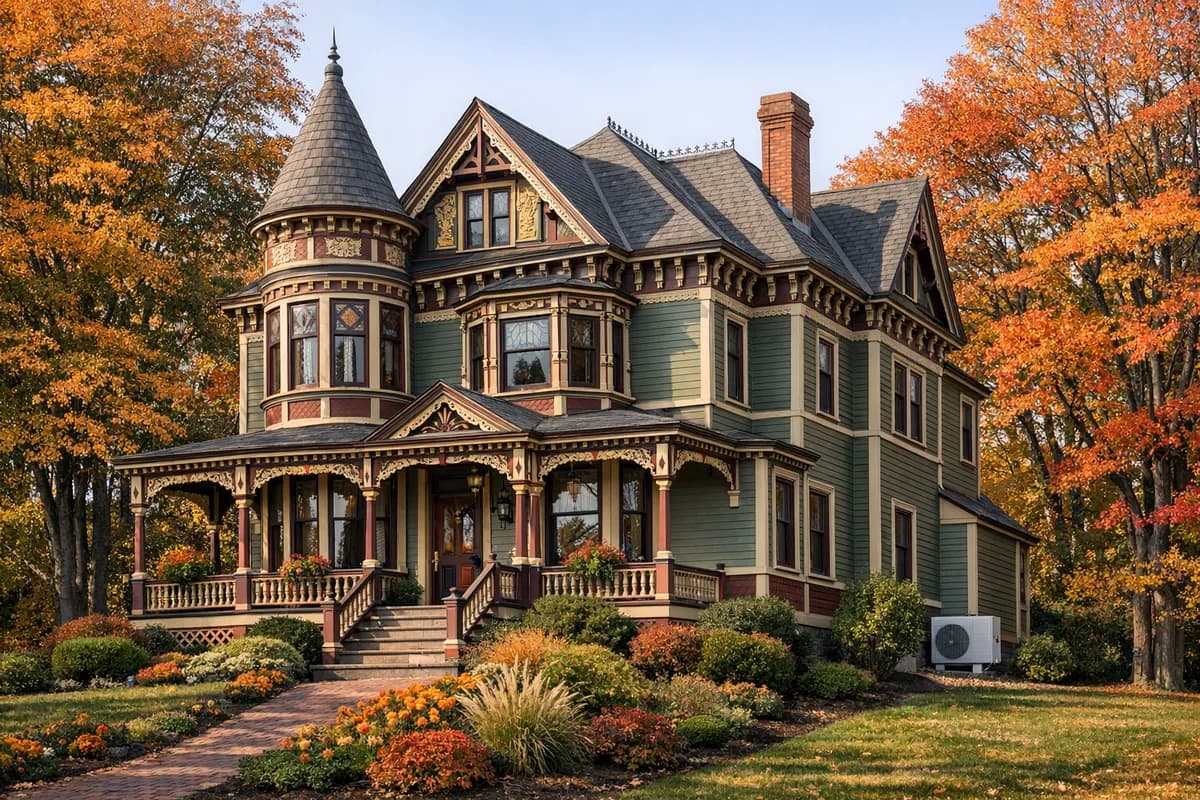
The biggest obstacle to modern HVAC in Victorian homes is the lack of ductwork. Installing ducts means ripping open plaster walls and ceilings — a $20,000-$50,000 demolition project that destroys the home's character. Ductless mini-splits bypass this entirely.
Each indoor unit needs just one 3-inch hole through the exterior wall for the refrigerant and power lines. Plaster walls stay intact. Period moldings are untouched.
Victorian homes have distinct rooms — parlor, library, bedrooms, kitchen. Each mini-split zone has its own thermostat. Heat the rooms you use, not the whole house.
Most Victorian homes in MA have no central AC. Mini-splits provide both heating and cooling from one system. No more window AC units cluttering your historic windows.
Every old-house challenge has a proven solution. The key is hiring an installer experienced with pre-1900 construction — not every HVAC company knows how to work with plaster, balloon framing, and historic district rules.
The Problem
Victorian homes were built for radiator or stove heat. There are no ducts in the walls, floors, or ceilings. Adding ducts would require demolishing plaster walls and ceilings.
The Solution
Ductless mini-splits are purpose-built for this. Each indoor unit connects to the outdoor unit via a small refrigerant line through a 3-inch wall penetration. No ducts needed.
The Problem
Original horsehair plaster on wood lath is beautiful but fragile. Vibrations from drilling or routing wires can crack plaster in adjacent rooms.
The Solution
Experienced installers drill slowly with diamond-bit hole saws through plaster. Route line sets through the exterior or basement, not through plaster walls. Use surface-mount conduit where interior routing is unavoidable.
The Problem
Pre-1900 homes use balloon framing — wall studs run from foundation to attic uninterrupted. This creates open cavities that are a fire risk if not fire-stopped, and makes insulation tricky.
The Solution
Fire-stop any open stud bays before insulating. Blown-in cellulose through small holes is the best approach. Some installers route line sets through these cavities — only if fire-stopped first.
The Problem
Knob-and-tube wiring (pre-1940), early Romex, or undersized panels (60-100A). Heat pumps need dedicated 20-30A circuits on modern wiring.
The Solution
200-amp panel upgrade ($2,000-$4,000). Replace knob-and-tube in the circuit path. Mass Save provides $300-$500 for electrical upgrades. An electrician must verify the home meets NEC code before installation.
The Problem
Outdoor units visible from the street may require Historic District Commission (HDC) approval. Some districts regulate equipment placement, color, and screening.
The Solution
Place outdoor units in the rear or on the non-street-facing side. Use low-profile wall brackets. Paint line set covers to match siding. Apply to HDC early — most approve heat pumps within 2-6 weeks.
The Problem
Victorian parlors and bedrooms often have 10-14 foot ceilings. This means significantly more cubic footage to heat per room, and standard BTU calculations undersize the system.
The Solution
Size heat pump capacity 10-20% above standard calculations. Wall-mounted units work well — hot air rises and the high mounting point distributes evenly. Ceiling cassettes provide the best coverage for tall rooms.
Not all heat pump systems work equally well in old homes. Here are your options, ranked by suitability for pre-1900 Massachusetts homes.
One outdoor unit serves 2-8 indoor wall-mounted units. Each room has independent temperature control. This is the go-to for Victorian homes.
Top brands: Mitsubishi Hyper-Heat, Fujitsu Halcyon, Daikin Aurora
Cost: $15,000-$30,000 (3-5 zones)
Best for: Whole-home heating in homes with no ductwork
One outdoor unit per indoor unit. Simpler installation. Best for supplementing existing heat in specific rooms rather than whole-home replacement.
Top brands: Mitsubishi MSZ-FH, Fujitsu RLS3H, LG LGRED
Cost: $4,000-$7,000 per zone
Best for: 1-3 rooms that need cooling or supplemental heat
Flush-mounted in the ceiling with only a decorative grille visible. Provides more even air distribution than wall-mounted units in tall-ceiling rooms.
Top brands: Mitsubishi SLZ, DaikinDERA Ceiling, Fujitsu Compact
Cost: $5,000-$8,000 per zone (installed)
Best for: Formal parlors, living rooms with 10+ ft ceilings
A small air handler hidden in a closet or attic with 10-20 feet of small-diameter ductwork. Invisible — no wall units or ceiling cassettes visible.
Top brands: Mitsubishi SEZ, DaikinDERA Ducted, LG Ducted
Cost: $6,000-$10,000 per zone
Best for: Owners who want zero visible equipment in period rooms
Massachusetts has over 200 local historic districts. If your Victorian is in one, the Historic District Commission (HDC) must approve exterior changes — including outdoor heat pump units. Here is what to expect.
| District | Rules | Approval | Strictness |
|---|---|---|---|
| Beacon Hill (Boston) | No equipment visible from public way. Rear-only placement. May require color-matching screening. | 4-6 weeks | Very Strict |
| Back Bay (Boston) | No equipment on street-facing facades. Side and rear OK with screening. Line set covers must match building. | 3-5 weeks | Strict |
| Cambridge Historic Districts | Equipment not visible from the street. Rear and side placement OK. No screening required if not visible. | 2-4 weeks | Moderate |
| Concord Center | No equipment on primary facade. Landscaping screening encouraged. Low-profile preferred. | 3-5 weeks | Strict |
| Salem/Marblehead | Maritime historic districts. No equipment visible from public way. Coastal location may affect unit selection. | 3-6 weeks | Strict |
| Worcester Triple-Decker Districts | Generally lenient for energy efficiency improvements. Side placement usually OK. | 2-3 weeks | Moderate |
| Brookline Local Historic | No visible equipment from the street. Color-matching recommended. Rear preferred. | 2-4 weeks | Moderate |
Victorian homes are notoriously drafty. Without insulation improvements, a heat pump works harder and costs more to run. Mass Save makes weatherization affordable.
Attic insulation (blown cellulose)
Biggest single impact. Reduces heat loss by 25-30%.
Subsidized 75-100% by Mass Save.
Basement rim joist + sill sealing
Stops cold air infiltration from below. 10-15% reduction.
Usually included in Mass Save assessment.
Storm windows over originals
Preserves historic wood windows while cutting drafts 50%.
$150-$300 per window. Some Mass Save subsidy.
Wall insulation (blown-in cellulose)
Difficult in balloon-frame. 15-20% improvement if done.
Subsidized 75% by Mass Save. Requires small holes in siding.
Door weatherstripping & caulking
Addresses the smallest but most noticeable drafts.
$5-$20 per door. DIY.
Free Energy Assessment
A Mass Save auditor visits your home, runs a blower door test, and identifies air leaks. This is the starting point for every old-house heat pump project.
75-100% Insulation Subsidy
Mass Save covers 75% of insulation costs for most homeowners, 100% for income-eligible households. The subsidy applies to attic, walls, and basement.
Heat Pump Rebates (up to $10,000+)
After weatherization, Mass Save provides rebates for qualifying heat pump systems. Whole-home systems get the highest rebates. Income-eligible households may qualify for free or heavily subsidized installations.
0% Heat Loan
Mass Save Heat Loan offers 0% interest for up to 7 years on heat pump installations and weatherization. Up to $50,000 financed.
Here is a realistic cost breakdown for a 2,500 sq ft Victorian in the Boston metro area, converting from oil heat to a multi-zone mini-split system.
4-zone mini-split system (Mitsubishi Hyper-Heat)
Equipment + installation
200-amp electrical panel upgrade
If needed — most pre-1940 homes
Historic district application
Most towns charge nothing
Line set covers (painted to match)
Cosmetic, but HDC may require
Mass Save heat pump rebate
Whole-home system rebate
Mass Save electrical upgrade
If panel upgrade needed
Annual savings vs. oil heat
A 2,500 sq ft Victorian burning 800-1,200 gallons of oil per year ($2,800-$4,200 at $3.50/gal) will typically see annual heating costs drop to $1,200-$1,800 with a heat pump — a savings of $1,500-$2,400 per year. At that rate, the net cost (after rebates) pays back in 4-9 years, depending on your specific oil usage and Mass Save rebate amount.
We specialize in heat pump installations for old homes. Get a free assessment with insulation recommendations, Mass Save rebate estimates, and historic district guidance.
Yes. Ductless mini-split heat pumps are ideal for Victorian homes because they require no ductwork, only a 3-inch hole through the wall for the refrigerant line, and can be installed room-by-room. Thousands of Victorian-era homes in Massachusetts — in neighborhoods like Jamaica Plain, Cambridge, Somerville, Brookline, and Worcester — have successfully installed heat pumps.
Ductless mini-splits require only a single 3-inch hole per indoor unit through the exterior wall. A skilled installer can drill through plaster and brick/balloon-frame walls without cracking surrounding plaster. The hole is sealed and hidden behind the indoor unit. No interior wall demolition is needed — unlike ducted systems, which would require extensive plaster removal.
Likely yes. Most pre-1950 homes have 60-100 amp service, and heat pumps require a dedicated 20-30 amp circuit per outdoor unit. A 200-amp panel upgrade costs $2,000-$4,000 in Massachusetts. The good news: Mass Save offers $300-$500 toward electrical upgrades as part of heat pump installations, and the upgrade adds value and safety to the home.
Most Massachusetts historic district commissions (HDCs) approve heat pumps when outdoor units are placed on the rear or side of the building, not visible from the street. The HDC review takes 2-6 weeks and is free in most towns. Indoor units do not require HDC approval. Some districts (Beacon Hill, Old Deerfield) have stricter rules and may require screening or color-matching.
High ceilings are actually good for wall-mounted mini-splits — the unit mounts high on the wall and the warm air naturally descends. For rooms with 10-12 foot ceilings, oversizing the BTU capacity by 10-15% accounts for the extra volume. Ceiling cassette mini-splits (flush-mounted in the ceiling) are another option that provides more even distribution in tall rooms. Use the ceiling fan reverse setting in winter to push warm air down.
Victorian homes are notoriously leaky — expect 40-60 BTU per square foot in an un-insulated Victorian, compared to 25-35 BTU/sq ft in a modern home. A 2,000 sq ft Victorian typically needs 80,000-120,000 BTU of heating capacity. A Mass Save energy assessment (free) provides precise room-by-room Manual J calculations. Do NOT skip this step — oversizing or undersizing is the #1 mistake in old homes.
Ideally yes, but not always. Mass Save provides 75-100% subsidized insulation for most homeowners. Insulating first reduces the heat pump size (and cost) needed by 20-40%. However, balloon-frame Victorians with plaster walls have limited insulation options — blown-in cellulose through small holes is the main approach. At minimum: insulate the attic (biggest impact), seal the basement rim joist, and add storm windows.
A multi-zone mini-split system for a typical 2,000-3,000 sq ft Victorian runs $18,000-$35,000 before rebates. Mass Save provides up to $8,500 in standard rebates for whole-home heat pump systems. After Mass Save rebates, expect $10,000-$25,000 out of pocket. The electrical panel upgrade ($2,000-$4,000 if needed) is additional. Annual heating savings of $1,500-$3,000 vs. oil or $800-$1,500 vs. gas.
General guide for pre-1960 homes
Read guideHDC rules for solar panels too
Read guide0% financing up to $50K
Read guideCurrent Mass Save rebates
Read guideBest for formal Victorian rooms
Read guideFull cost comparison
Read guide