Loading NuWatt Energy...

We use your location to provide localized solar offers and incentives.
We serve MA, NH, CT, RI, ME, VT, NJ, PA, and TX
Loading NuWatt Energy...
NuWatt designs, installs, and manages solar, battery, heat pump, and EV charger systems across 9 states. One company, one warranty, one point of contact.
Get a Free QuoteMassachusetts lots are small. Boston triple-deckers share 10-foot side yards. Cape Cod cottages sit 15 feet apart. Here is how to keep your heat pump legal, quiet, and neighbor-friendly — town-by-town noise bylaws included.
50 dB
Boston night limit
46 dB
Quietest mini-split
$30-80
Anti-vibe pads
6 dB
Drop per 2x distance
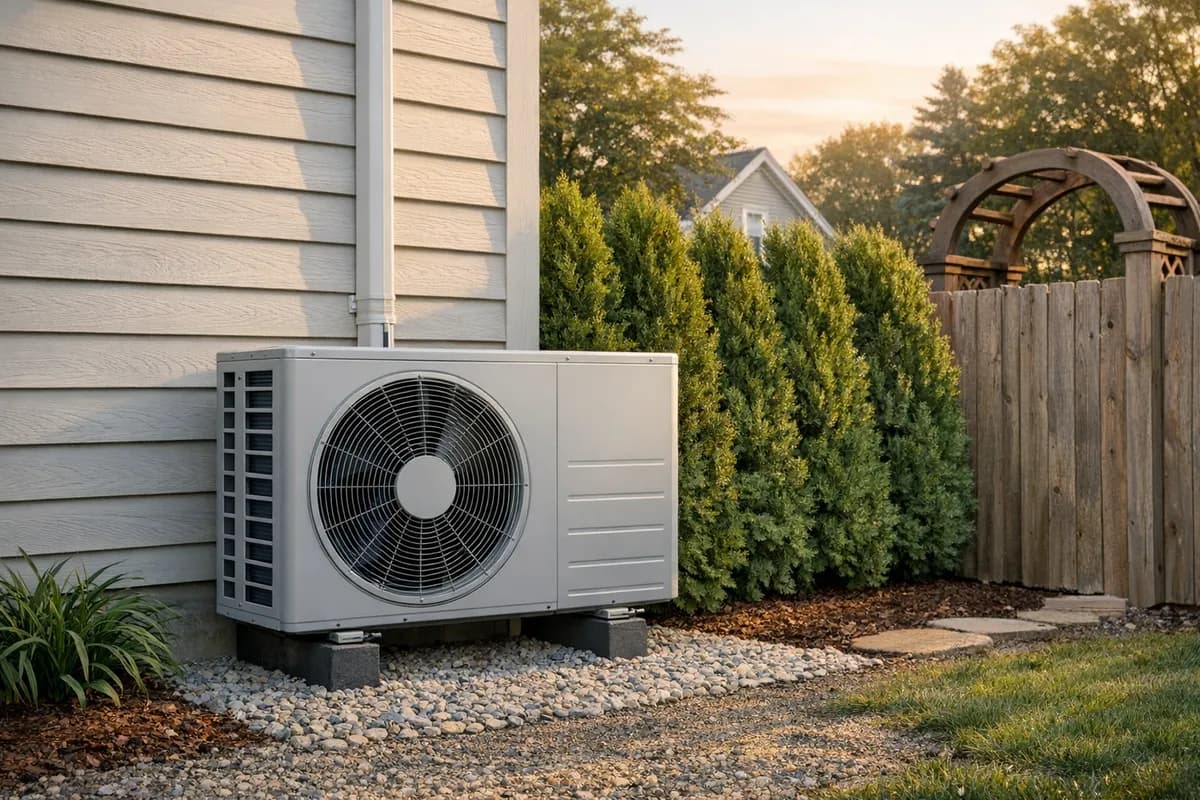
Massachusetts has some of the smallest residential lot sizes in the country. The average lot in Boston is 3,800 sq ft. In Somerville, it is 3,200 sq ft. Cape Cod cottages often sit 12-18 feet apart. When outdoor units are 10-15 feet from a neighbor's bedroom window, every decibel matters.
Triple-deckers with 8-12 foot side yards. Units often visible and audible to 3+ abutters. Placement is constrained by driveways, walkways, and fire code setbacks.
Typical lot: 2,500-5,000 sq ft
Typical colonial lots with 15-25 foot side yards. More placement options but neighbors are still close. HOA or historic district restrictions may apply.
Typical lot: 5,000-12,000 sq ft
Larger lots with 30+ foot setbacks. Noise is rarely an issue but some towns (Concord: 45 dB night) have the strictest bylaws. Ironic but true.
Typical lot: 15,000+ sq ft
Sound drops with distance
Sound decreases by approximately 6 dB for every doubling of distance. A heat pump at 52 dB measured 3 feet away reads approximately 46 dB at 6 feet, 40 dB at 12 feet, and 34 dB at 24 feet. Most MA property lines are 10-20 feet from the unit — placing your unit correctly can make or break neighbor relations.
Massachusetts does not have a statewide residential noise ordinance. Each city and town sets its own limits. Below are the most common limits for residential zones — measured at the property line. These limits apply 24/7; nighttime limits are stricter.
| Town / City | Day Limit | Night Limit | Notes |
|---|---|---|---|
| Boston | 65 dB | 50 dB | Boston Noise Code Ch. 16-26; strictest in MA |
| Cambridge | 65 dB | 55 dB | Chapter 8.16; measured at property line |
| Somerville | 65 dB | 55 dB | Revised Ordinances Sec. 8-9; enforcement active |
| Brookline | 60 dB | 50 dB | Article 8.31; strict enforcement in residential zones |
| Newton | 65 dB | 55 dB | Chapter 20 Sec. 7; standard suburban limit |
| Worcester | 70 dB | 60 dB | Chapter 14 Sec. 2; more permissive than metro Boston |
| Quincy | 65 dB | 55 dB | Title 7 Ch. 7.04; standard residential limit |
| Springfield | 70 dB | 60 dB | Code Sec. 7.40.100; Western MA typical |
| Wellesley | 60 dB | 50 dB | General Bylaws Art. 27; stricter suburban town |
| Concord | 55 dB | 45 dB | Bylaws Art. 33; among the strictest in MA |
| Lexington | 60 dB | 50 dB | Noise Bylaw Ch. 80; residential zone limits |
| Most other MA towns | 65 dB | 55 dB | Default MGL guidance; varies by adoption |
Nighttime is what matters
Almost all noise complaints come between 10 PM and 7 AM when ambient noise drops. Your heat pump runs harder at night in winter (coldest hours = highest load = most noise). This is when compliance margins are tightest. Focus your placement strategy on nighttime limits.
How noise is measured
Code enforcement typically uses an A-weighted sound level meter (dBA) at the property line, sustained for 1 minute. Brief spikes during defrost cycles are usually excluded. NIOSH SLM (free app) gives readings within 2 dB of professional equipment.
If you live on a tight lot or have noise-sensitive neighbors, choosing the right unit upfront prevents problems later. These are the quietest models sold by Massachusetts installers in 2026, ranked by outdoor unit noise.
6K-12K BTU
Best for: Tightest lots, urban triple-deckers
9K-24K BTU
Best for: Year-round heating in dense neighborhoods
9K-18K BTU
Best for: Cape Cod cottages, close-lot suburbs
18K-48K BTU
Best for: Whole-home in suburban neighborhoods
24K-60K BTU
Best for: Ducted retrofit in existing homes
9K-36K BTU
Best for: Budget-friendly with acceptable noise
Pro tip: Ask for the low-speed spec
Manufacturer dB ratings are at maximum capacity. Most of the time your unit runs at 40-60% capacity, which is 5-10 dB quieter than the rated spec. A Mitsubishi at 46 dB rated may run at 38-40 dB during mild weather — virtually inaudible at the property line.
Where you put the outdoor unit matters more than which unit you buy. A quiet unit in a bad location will generate more complaints than a louder unit in a smart location.
Reduces neighbor-perceived noise by 5-8 dB
Street noise of 55-65 dB makes unit inaudible
Raises sound above fence line, reduces ground reflection
Eliminates transmitted vibration; -3 to -5 dB
Prevents echo/amplification between surfaces
Sleep disruption is the #1 source of complaints
If placement alone does not solve the problem, these barriers can reduce noise reaching your neighbor by 3-15 dB. Never fully enclose the unit — airflow restriction kills efficiency and voids most warranties.
| Option | Cost | Noise Reduction | Difficulty | Notes |
|---|---|---|---|---|
| Anti-vibration pads | $30-80 | 3-5 dB | DIY | Rubber or neoprene pads under condenser feet. Should be on every installation. |
| Mass-loaded vinyl barrier | $150-300 | 5-8 dB | DIY | Attach to a frame, place 2+ feet from unit on neighbor side. Do not block airflow. |
| Acoustic fence panel | $400-800 | 8-12 dB | Moderate | Purpose-built panel with sound-absorbing fill. Maintain top and side clearance. |
| Dense hedge (arborvitae) | $600-1,500 | 3-6 dB (mature) | Easy plant | Takes 2-3 years to reach full density. Plant 3+ feet from unit. Year-round screen. |
| Composite sound wall | $1,500-3,000 | 10-15 dB | Professional | Permanent solution for the most sensitive situations. May need a building permit. |
| Relocate the unit | $800-2,000 | Variable | Professional | Move to a less neighbor-facing wall. Line set extension needed. Most effective long-term. |
Never fully enclose the outdoor unit
Heat pump condensers need unrestricted airflow. Enclosing the unit in a box or tight fence raises operating temperature, reduces efficiency by 10-30%, increases compressor strain, and can void your manufacturer warranty. Always maintain 2+ feet clearance on sides and 4+ feet above. One-sided barriers are fine; four-sided enclosures are not.
Most complaints can be resolved with a conversation and minor adjustments. Here is the step-by-step approach that works.
Thank your neighbor for coming to you first. Most people just want to be heard. A defensive response escalates to code enforcement.
Download the NIOSH Sound Level Meter app (free, developed by the CDC). Take readings at the property line during peak operation (cold night, defrost cycle). Record a 1-minute average. Screenshot the result.
Check the table above. If your reading is below the nighttime limit, share the data with your neighbor. If it is borderline or above, proceed to step 4.
Check for: loose panel screws (tighten), missing anti-vibration pads (add them), unit on a resonant surface like a deck (relocate to concrete), debris in the fan (clear), or refrigerant charge issues (call a tech).
A single mass-loaded vinyl panel or acoustic fence on the neighbor-facing side costs $200-$800 and typically reduces their perceived noise by 5-10 dB. This is the most cost-effective fix.
Keep records of noise measurements, installation date, equipment model, any modifications made, and correspondence. If code enforcement visits, provide documentation. Professional calibrated measurements cost $150-$300 if needed.
Not all heat pump sounds are created equal. Some are normal operation; others indicate a problem that will get louder if ignored.
Cause: Normal compressor operation
Level: 45-56 dB
Action: Normal — no action needed
Cause: Defrost cycle reversing valve
Level: +3-8 dB above normal
Action: Normal — lasts 2-5 minutes. Inform neighbors this is temporary.
Cause: Loose panel screws, debris in fan, or refrigerant line vibration
Level: +5-15 dB above normal
Action: Tighten screws. Clear debris. If persistent, call tech — may be a loose compressor mount.
Cause: Refrigerant flow restriction or failing bearing
Level: +10-20 dB, high frequency
Action: Call technician immediately. Could indicate TXV failure or compressor issue.
Cause: Compressor hard-start or loose internal component
Level: Intermittent spikes to 65+ dB
Action: Call technician. May need a hard-start kit ($150-$300) or compressor replacement.
Cause: Refrigerant in the line set during low ambient
Level: Moderate, intermittent
Action: Usually normal in cold weather. If persistent or accompanied by reduced heating, check refrigerant charge.
Massachusetts strongly supports heat pump adoption as part of its clean energy and climate goals. Several legal frameworks protect your right to install and operate a heat pump.
The state has set a target of 1 million heat pumps by 2030. Local regulations cannot unreasonably prevent installation of heat pumps. Code enforcement must apply noise ordinances objectively, not selectively target heat pumps.
Mass Save provides up to $8,500 in standard rebates and up to $16,000 through enhanced pathways for whole-home heat pump installations. The state has invested heavily in driving adoption. An unreasonable noise complaint that prevents installation conflicts with state policy.
If your installation meets Massachusetts building code, local zoning setbacks, and the applicable noise ordinance, you are fully compliant. A neighbor complaint does not override code compliance. Document your measurements.
Massachusetts does not have a specific "solar access" style law for heat pumps, but HOAs cannot impose unreasonable restrictions on energy efficiency equipment. An HOA can require screening or placement rules but cannot ban heat pumps outright.
The irony: many homeowners switching from noisy window AC units or old central AC condensers to a heat pump actually make the neighborhood quieter.
| Equipment | Typical dB (at 3 ft) | At 15 ft (property line) |
|---|---|---|
| Modern mini-split (Mitsubishi) | 46 dB | ~34 dB |
| Modern mini-split (Fujitsu) | 48 dB | ~36 dB |
| Modern ducted heat pump | 52-56 dB | ~40-44 dB |
| Old central AC condenser (10+ yr) | 65-72 dB | ~53-60 dB |
| Window AC unit | 50-65 dB | N/A (at window) |
| Gas furnace outdoor vent | 50-60 dB | ~38-48 dB |
| Portable generator | 70-85 dB | ~58-73 dB |
We know which models and placement strategies work best for Massachusetts lots. Get a free assessment with noise-optimized placement recommendations.
Boston enforces a 50 dB limit at the property line during nighttime (11 PM - 7 AM) and 65 dB during daytime under the Boston Noise Code (Chapter 16-26). Most modern mini-split outdoor units operate at 46-56 dB at 3 feet. At a typical 15-20 foot property line distance, they drop to 34-44 dB — well within Boston limits.
No. Neighbors cannot legally prevent you from installing a heat pump in Massachusetts. Heat pumps are protected under Massachusetts Clean Energy and Climate Plan policies. However, your installation must comply with local noise ordinances, setback requirements, and zoning bylaws. If your unit meets these requirements, your neighbor has no legal standing to block installation.
Step 1: Measure actual noise at the property line with a smartphone dB meter app (NIOSH SLM is free and accurate). Step 2: Compare the reading to your town's noise bylaw limit. Step 3: If within limits, share the measurement with your neighbor. Step 4: If over the limit or borderline, consider anti-vibration pads ($30-80), a sound barrier fence ($200-800), or relocating the unit. Step 5: If the complaint escalates to a code enforcement visit, document everything — most officers will measure and confirm compliance.
The Fujitsu HalcyonDERA series at 48 dB outdoor is excellent for tight lots. Mitsubishi Hyper-Heat MUZ-FS at 46 dB is the quietest widely available mini-split. Daikin Fit at 47 dB is a good ducted option. At 15 feet (typical MA lot line distance), these units produce 34-38 dB — equivalent to a quiet library.
Sound barrier options range from $50 for DIY anti-vibration pads, $200-$500 for a vinyl mass-loaded sound barrier panel, $400-$800 for a purpose-built acoustic fence section, and $1,200-$3,000 for professional landscaping with sound-absorbing hedges (arborvitae or dense holly). Most homeowners find anti-vibration pads plus a single acoustic fence panel on the neighbor-facing side ($250-$600 total) sufficient.
Yes, temporarily. During defrost (every 30-90 minutes in freezing conditions, lasting 5-15 minutes), the reversing valve clicks, refrigerant changes direction with a whoosh, and the compressor briefly runs harder. This can add 3-8 dB above normal operation. The sound is intermittent and typically lasts only 2-5 minutes at peak loudness. Neighbors are more likely to notice this at night in winter — placement away from bedroom windows helps.
Most Massachusetts towns require the outdoor unit to be at least 3-5 feet from the property line and 10-15 feet from an abutter's window or door. Boston requires 5 feet minimum from the lot line. Cambridge and Somerville require 3 feet. Always check your specific town zoning bylaw. Some historic districts have additional placement restrictions.
HOA rules can restrict where and how a heat pump is installed (location, screening, color) but cannot outright ban them. Massachusetts law protects clean energy installations. An HOA can require you to place the unit on a specific side of the building, add screening, or use a particular color cover — but cannot prevent installation entirely. Get any HOA restrictions in writing before installation.
Complete dB comparison for all brands
Read guideCost & savings comparison
Read guideWhat to look for in MA installers
Read guideCurrent standard rebates up to $8,500
Read guideCondo-specific noise & HOA rules
Read guideYour rights under MA law
Read guide