Loading NuWatt Energy...

We use your location to provide localized solar offers and incentives.
We serve MA, NH, CT, RI, ME, VT, NJ, PA, and TX
Loading NuWatt Energy...
NuWatt designs, installs, and manages solar, battery, heat pump, and EV charger systems across 9 states. One company, one warranty, one point of contact.
Get a Free QuoteBoston condos present unique heat pump challenges — HOA architectural review, outdoor unit placement on balconies and rooftops, noise bylaws, and aging electrical panels. This guide covers everything you need to get your condo association to say yes.
$4K–$7K
Single-zone installed
50 dB
Boston daytime noise limit
$2,500+
Mass Save rebate
19 dB
Quietest indoor unit
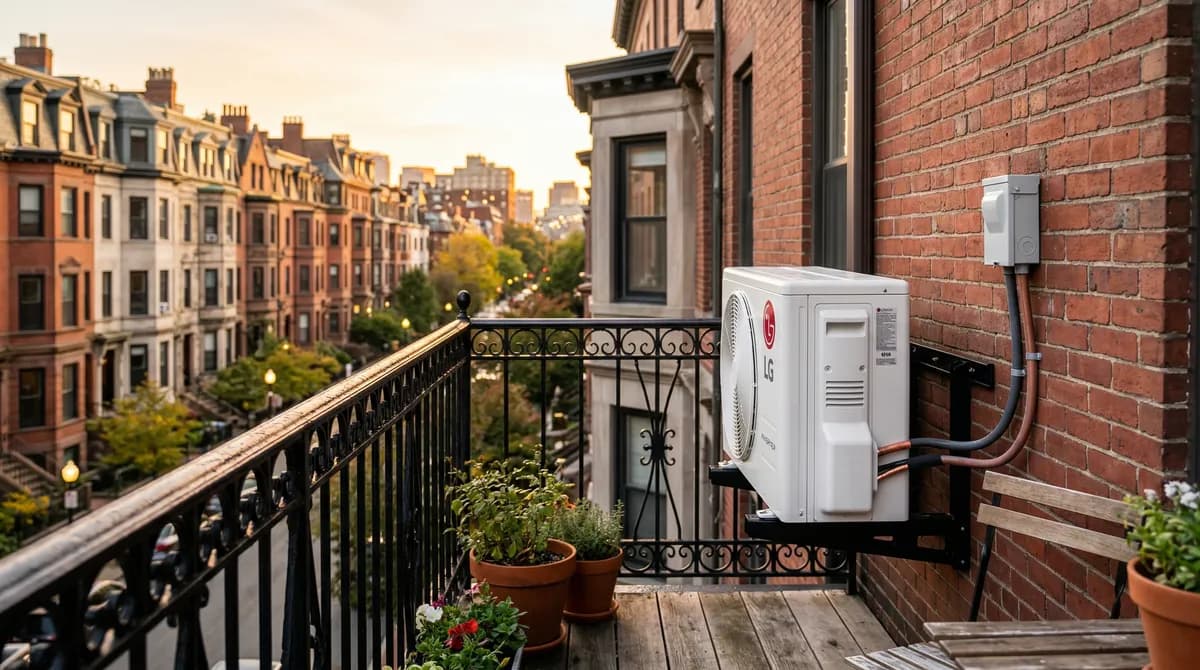
A condo installation is not a scaled-down version of a single-family job. You share walls, roofs, and outdoor spaces with neighbors — and your condo association has rules about all of them. Here are the five key differences.
Most Boston condo associations require written approval before any outdoor unit installation. This adds 2-8 weeks to your timeline. Submit plans early with unit specs, placement drawings, and noise data.
Boston limits residential HVAC to 50 dB at the property line (daytime) and 40 dB (nighttime). Condo setbacks are short. You need a unit rated 48 dB or below to ensure compliance at typical balcony-to-property-line distances.
No yard, small balconies, shared roofs. Outdoor unit placement requires creative solutions — wall brackets, slim-profile units, or coordinated rooftop installations. Every inch matters.
Many older Boston buildings (pre-1970) have 100A service per unit. A heat pump needs a dedicated 20-30A/240V circuit. If your panel is full, budget $1,500-$3,500 for an upgrade.
Beacon Hill and Back Bay condos may need Boston Landmarks Commission approval for any exterior-visible equipment. Concealed rooftop or courtyard installations are the path forward.
Line sets may need to run through common areas. Drainage must be coordinated. Multiple units installing together can share costs and negotiate bulk deals with installers.
Getting your condo board to approve a heat pump requires preparation. Boards worry about noise complaints, aesthetic impact, and liability. Address all three proactively and you will get approved faster.
Read your master deed, bylaws, and rules & regulations. Look for sections on "exterior modifications," "HVAC," "noise," or "architectural changes." Note the approval process and any required forms.
Have a licensed HVAC installer visit your unit and assess placement options, electrical capacity, and line set routing. Get a written proposal with unit specs, placement diagram, and noise ratings.
Include: (1) Equipment spec sheet with noise ratings, (2) Placement diagram showing unit location and distance to nearest neighbor, (3) Photo mockup of how the unit will look, (4) Vibration pad and bracket details, (5) Reference to Mass Save program showing this is state-encouraged.
Most Boston condo boards meet monthly. Submit at least 2 weeks before the next meeting. Offer to attend and present in person. Bring noise comparison data (your unit vs window AC vs traffic).
Common objections: "It will be too loud" (show dB data vs their current window ACs at 55+ dB). "It looks bad" (show Daikin Emura or concealed options). "It sets a precedent" (frame it as building-wide improvement opportunity with bulk pricing).
Get approval in writing. Coordinate installation timing with your HOA — most require advance notice to neighbors and restrict work hours (typically 8am-5pm weekdays). Installation takes 1-2 days for a single-zone system.
Do not skip the approval step
Installing a heat pump outdoor unit without HOA approval can result in forced removal at your expense, fines, and legal action. Even if your neighbor did it without asking, that does not set a precedent for you. Get it in writing first.

Boston's noise regulations are stricter than most Massachusetts suburbs. Condo installations face tighter constraints because property lines are closer and neighbors share walls.
50 dB
at the property line, 7am-11pm
Most modern mini-split outdoor units produce 46-52 dB at 3 feet. At a typical condo setback of 10-15 feet, this drops to 38-44 dB — within limits for units rated 50 dB or below.
40 dB
at the property line, 11pm-7am
This is the critical threshold. Heat pumps run at reduced speed overnight, dropping 5-8 dB below rated capacity. A unit rated at 46 dB will likely read 38-41 dB at low speed — compliant, but barely. Choose the quietest model available.
Sound decreases approximately 6 dB for every doubling of distance in open air. In condo settings with reflective walls, expect 4-5 dB reduction per doubling.
| Distance | Unit Rated 46 dB | Unit Rated 48 dB | Unit Rated 52 dB |
|---|---|---|---|
| 3 feet (at unit) | 46 dB | 48 dB | 52 dB |
| 6 feet | 40 dB | 42 dB | 46 dB |
| 12 feet | 34 dB | 36 dB | 40 dB |
| 20 feet | 30 dB | 32 dB | 36 dB |
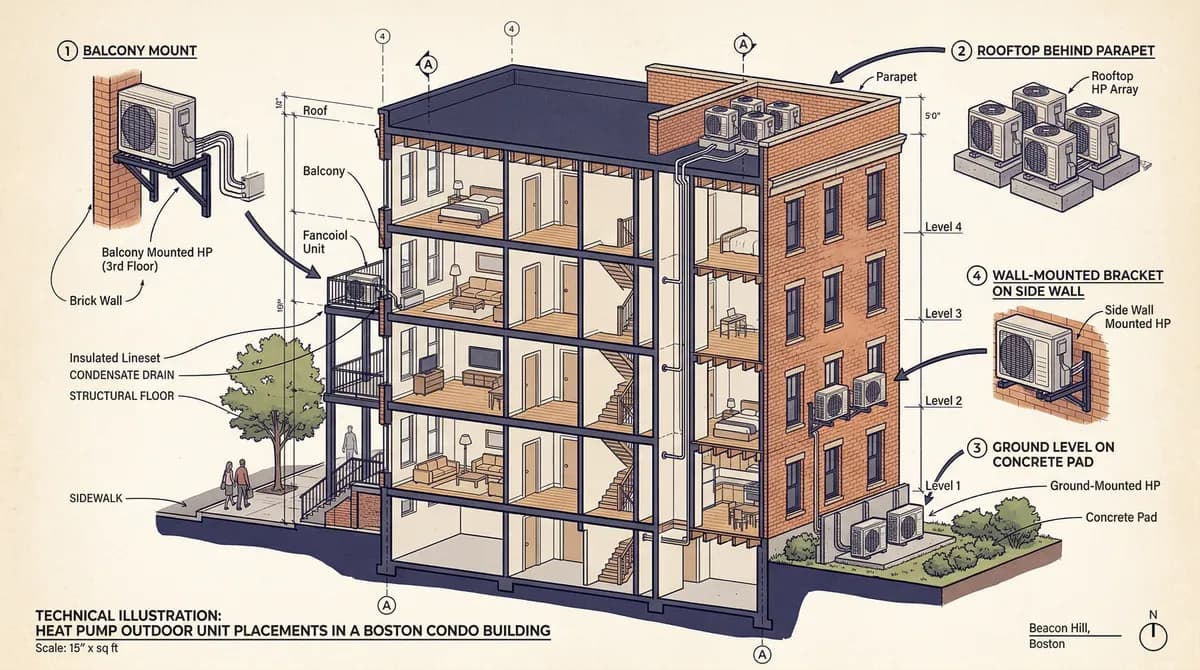
Where you put the outdoor unit is the single biggest decision for a condo heat pump installation. Each location has trade-offs between cost, ease of approval, and maintenance access.
Pros
Cons
Best for: Modern buildings with 4+ ft deep balconies
Pros
Cons
Best for: Back Bay, Beacon Hill, and historic district condos
Pros
Cons
Best for: First-floor condos with exclusive-use patios or yards
Pros
Cons
Best for: Mid-floor units without balcony or ground access
Condo installations need units that are slim, quiet, and aesthetically acceptable to HOA boards. These four models are specifically chosen for Boston condo constraints.
Outdoor Depth
7.9"
Outdoor Noise
48 dB
Indoor Noise
21 dB
SEER2 / HSPF2
22 / 10.5
Tight balcony installations — slimmest outdoor unit on the market
$4,500-$6,500 installed
Outdoor Depth
13"
Outdoor Noise
46 dB
Indoor Noise
19 dB
SEER2 / HSPF2
24 / 11.2
Quietest indoor unit — 19 dB is whisper-silent for open-plan condos
$4,200-$6,000 installed
Outdoor Depth
12"
Outdoor Noise
47 dB
Indoor Noise
20 dB
SEER2 / HSPF2
21 / 10.8
Designer flat-panel aesthetic — HOA-friendly sleek wall unit
$4,800-$7,000 installed
Outdoor Depth
14"
Outdoor Noise
49 dB
Indoor Noise
22 dB
SEER2 / HSPF2
20 / 12
Best cold-climate performance — operates to -15F for top-floor condos
$4,000-$5,800 installed
All four models qualify for Mass Save rebates
Each is cold-climate rated (operates to -13F or below) and meets the ENERGY STAR specifications required for the $2,500+ basic tier Mass Save rebate. Verify your specific model number on the Mass Save Qualified Products List before purchasing.
Over 60% of Boston condo heat pump installations start as window AC replacements. The upgrade eliminates every pain point of window units while adding year-round heating.
| Feature | Window AC | Mini Split |
|---|---|---|
| Indoor Noise | 55-65 dB (loud) | 19-28 dB (whisper quiet) |
| Heating Capability | None | Yes, to -15F |
| Efficiency (Cooling) | SEER 10-12 | SEER2 20-24 |
| Window Blocked | Yes, all season | No — windows fully usable |
| Security Risk | Yes (window gap) | None |
| Appearance | Ugly, often HOA-prohibited | Sleek wall unit, HOA-friendly |
| Seasonal Install/Remove | Twice yearly hassle | Permanent, year-round |
| Monthly Electric (cooling) | $80-$120 | $30-$50 |
| Upfront Cost | $200-$500/unit | $4,000-$7,000 (before rebate) |
| Lifespan | 5-8 years | 15-20 years |
The math: A window AC costs $200-$500 and lasts 5-8 years — that is $800-$2,000 over 15 years, with no heating. A mini split at $4,500 after Mass Save rebate lasts 15-20 years and cuts your heating bill by 30-50% compared to electric baseboard. The mini split pays for itself in 5-7 years through lower energy costs alone.
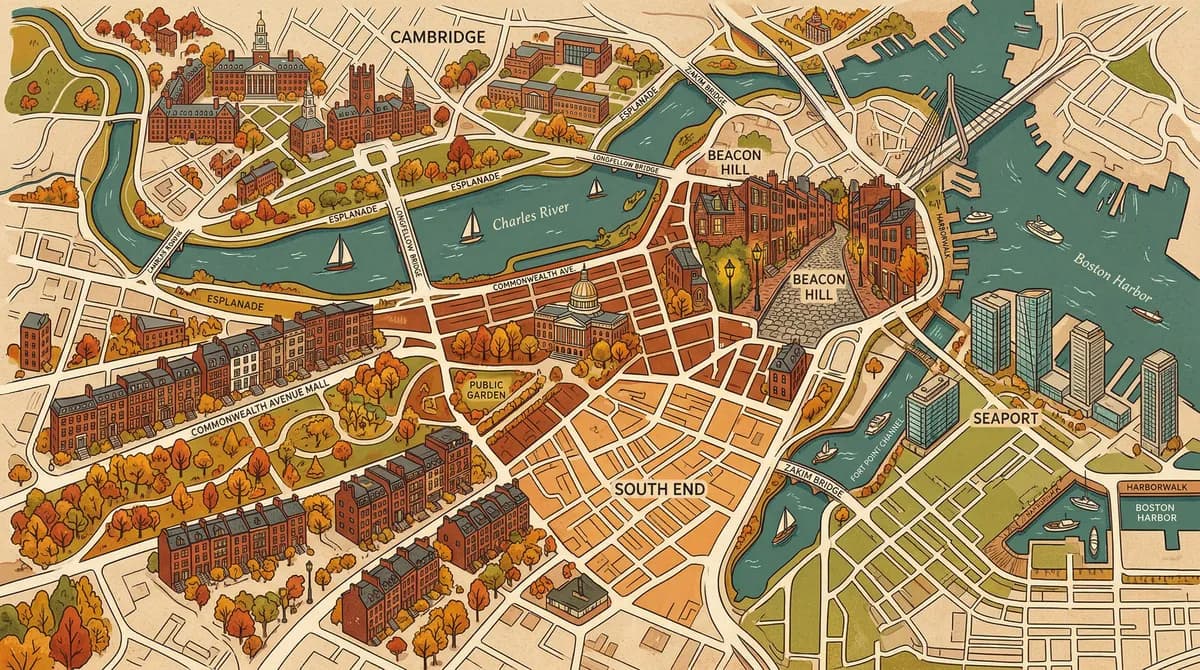
Every Boston neighborhood has different condo cultures and approval hurdles. Here is what to expect based on where you live.
HOA Climate
Strict architectural review, brownstone facades protected
Placement
Rooftop or rear courtyard only; no street-facing units
Pro Tip
Submit professional drawings showing unit hidden behind parapet. Match unit color to building.
HOA Climate
Boston Landmarks Commission + HOA review required
Placement
Rooftop or interior courtyard; concealed installations only
Pro Tip
BLC fast-tracks HVAC if unit is not visible from public way. Use a specialized installer.
HOA Climate
Most buildings require architectural committee approval
Placement
Rear-facing walls, rooftop, or designated mechanical areas
Pro Tip
Many South End condos have rear decks — ideal for bracket-mounted units.
HOA Climate
Modern buildings often have pre-approved HVAC modification policies
Placement
Balcony, designated mechanical chase, or rooftop
Pro Tip
Check if your building has a pre-approved equipment list. Many Seaport buildings do.
HOA Climate
Varies widely by building; some triple-deckers are easier
Placement
Ground level (if yard), wall bracket, or rear porch
Pro Tip
Cambridge noise limit is stricter: 60 dB day / 50 dB night at property line.
HOA Climate
Many smaller condo associations with flexible rules
Placement
Ground pad, side wall bracket, or rear deck
Pro Tip
Smaller 3-6 unit buildings are often easier to get approval. Talk to neighbors directly.
Most Boston condos are 600-1,200 sq ft — a sweet spot for single-zone mini splits. Larger units or multi-bedroom layouts may benefit from multi-zone systems.
| Condo Size | BTU Needed | Recommended System | Cost Range |
|---|---|---|---|
| Studio (400-600 sq ft) | 9,000-12,000 | Single-zone 9K/12K | $4,000-$5,500 |
| 1 BR (600-900 sq ft) | 12,000-18,000 | Single-zone 12K/18K | $4,500-$6,500 |
| 2 BR (900-1,200 sq ft) | 18,000-24,000 | Single-zone 24K or 2-zone | $5,500-$9,000 |
| 3 BR (1,200-1,600 sq ft) | 24,000-36,000 | Multi-zone 2-3 heads | $8,000-$14,000 |
| Penthouse / loft (1,500+ sq ft) | 30,000-48,000 | Multi-zone 3-4 heads | $12,000-$18,000 |
Electrical capacity is the hidden cost in many condo installations. Boston has a large stock of pre-war and mid-century buildings with limited electrical service.
Typical service: 60-100A
Likely needs upgradeFuse boxes common. Must upgrade to breaker panel + add dedicated circuit. Budget $2,500-$3,500.
Typical service: 100A
May need sub-panelBreaker panel likely present but may be full. Sub-panel ($800-$1,500) may suffice if a few breakers can be consolidated.
Typical service: 200A
Usually readyMost modern Boston condos have 200A service with spare capacity. A dedicated 30A breaker is typically all that is needed.
Electrical work in condos may need board approval too
If the electrical panel upgrade requires work in common areas (main electrical room, shared conduit runs), your condo association must approve the scope. Include electrical requirements in your initial HOA submission to avoid a second approval cycle.
Condo installations typically cost less than single-family homes due to smaller spaces and simpler line set runs. Mass Save rebates apply to condo owners just like homeowners.
Bulk deals: 3+ units save more
When 3 or more condo units in the same building install heat pumps together, installers can offer volume pricing — typically 10-15% off per unit. This covers shared mobilization costs, crane rental (for rooftop), and permits. Additionally, buildings with 5+ units may qualify for Mass Save's multi-family program, which offers enhanced rebates and energy audits at no cost.
If your condo is in a designated historic district, the Boston Landmarks Commission (BLC) adds a layer of review. But heat pumps are regularly approved — you just need the right approach.
Almost never. Most Boston condo associations require architectural review committee approval before any exterior modifications, including heat pump outdoor units. Even if your condo docs are silent on HVAC, the master deed typically covers "exterior alterations." Submit plans proactively — installing without approval can result in removal orders and fines. The only exception is some newer Seaport/Ink Block buildings that pre-approve certain HVAC models.
A single-zone ductless mini split for a typical 600-1,200 sq ft Boston condo costs $4,000-$7,000 installed. Multi-zone systems (2-3 indoor heads) run $8,000-$14,000. Mass Save basic rebates are $250/ton up to $2,500, while larger partial- or whole-home projects can qualify for higher tonnage-based rebates. Electrical panel upgrades, if needed for older buildings, add $1,500-$3,000.
Boston's noise ordinance limits residential HVAC equipment to 50 dB at the property line during daytime and 40 dB at nighttime. Modern mini-split outdoor units produce 46-52 dB at 3 feet. At a typical condo setback of 10-15 feet, this drops to 38-44 dB — within daytime limits for most units. For nighttime compliance, choose models rated 48 dB or below, such as the Mitsubishi MUZ-FH or LG Multi V S.
The top three models for Boston condos are: (1) LG Multi V S — the slimmest outdoor unit at 7.9 inches deep, ideal for tight balcony installations. (2) Mitsubishi MSZ-FH — the quietest indoor unit at 19 dB, perfect for open-plan condos. (3) Daikin Emura — a designer wall unit with a flat panel aesthetic that HOA boards rarely object to. All three are cold-climate rated and qualify for Mass Save rebates.
Yes, and this is the number one reason Boston condo owners switch to mini splits. A single-zone mini split replaces a window AC unit and adds heating capability. Benefits: no blocked windows, better security, dramatically quieter (19 dB indoor vs 55+ dB window AC), far more efficient (SEER2 20+ vs SEER 10-12), and year-round comfort including heat. Your HOA may even prefer it since window units are often restricted or unsightly.
Yes. Mass Save rebates apply to individual condo units just like single-family homes. Basic heat pump rebates are $250/ton up to $2,500, while partial-home and whole-home projects can qualify for higher tonnage-based rebates. If your condo qualifies as income-eligible (based on household income), rebates increase significantly — potentially covering 75-100% of costs. Each unit owner applies separately. Condo associations doing 3+ units together may also qualify for multi-family program incentives.
Yes, but with extra steps. The Boston Landmarks Commission (BLC) reviews exterior modifications in historic districts. For heat pumps, they focus on outdoor unit visibility from public ways. Strategies that win approval: rooftop placement behind parapets, courtyard installation not visible from the street, wall-mounted brackets on non-street-facing walls, and choosing units in colors that match the building exterior. Interior work (indoor unit, line sets) does not require BLC review.
A single-zone mini split requires a dedicated 20-30 amp, 240V circuit. Many older Boston buildings (pre-1970) have 100A service to each unit, which may already be near capacity with existing appliances. If your panel is full, you will need either a sub-panel ($800-$1,500) or a panel upgrade to 200A ($2,000-$3,500). Newer buildings (post-2000) typically have 200A service and can accommodate a heat pump without upgrades.
NuWatt's installers have completed hundreds of Boston condo installations — we know the HOA process, noise compliance, and the best placement for every building type. Get a free quote including your Mass Save rebate estimate.
Free site assessment includes electrical panel check, outdoor unit placement plan, and HOA submission support.