Loading NuWatt Energy...

We use your location to provide localized solar offers and incentives.
We serve MA, NH, CT, RI, ME, VT, NJ, PA, and TX
Loading NuWatt Energy...
NuWatt designs, installs, and manages solar, battery, heat pump, and EV charger systems across 9 states. One company, one warranty, one point of contact.
Get a Free Quote
What happens when it hits -10 degrees Fahrenheit? Modern cold-climate heat pumps handle it. But if your home is older or your system is not sized for the full load, you need a backup plan. Here are the real options, real costs, and Mass Save rules.
Quick Answer: Do You Need Backup Heat?
Most MA homeowners with a modern cold-climate heat pump and good insulation do NOT need backup heating. Mitsubishi Hyper-Heat, Fujitsu XLTH, and Carrier Greenspeed maintain effective heating down to -13 to -15 degrees Fahrenheit. Boston's coldest winter nights rarely drop below -5 to -10 degrees Fahrenheit. The key is proper sizing (Manual J) and insulation (Mass Save pays 75-100%).
If your home IS older, drafty, or your HP is not cold-climate rated, the hybrid/dual-fuel approach (keeping your gas furnace as emergency backup) is the most popular and cost-effective option in Massachusetts.
Not every home needs a backup system. Understanding when and why a heat pump needs help is the first step to choosing the right backup strategy — or eliminating backup entirely.
When outdoor temperature drops below your heat pump's balance point, the compressor cannot meet the full heating load alone. Modern cold-climate HPs: -10 to -15 degrees Fahrenheit. Standard units: 25-30 degrees Fahrenheit.
Older MA homes (pre-1980) with inadequate insulation lose heat faster than the heat pump can replace it. The solution is insulation first — Mass Save provides 75-100% subsidized insulation upgrades.
Cathedral ceilings, bonus rooms over garages, sunrooms, and finished basements may have higher heat loss than the rest of the house. These zones may need supplemental heat even when the main system is adequate.
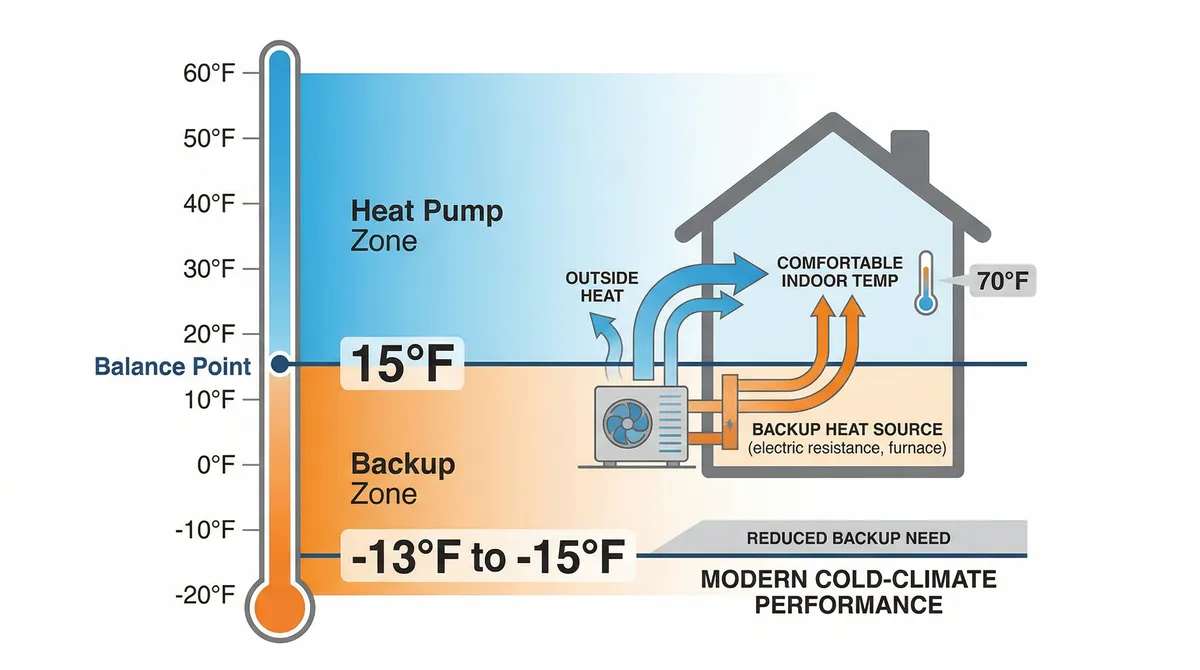
Each option has different cost, comfort, safety, and Mass Save implications. The right choice depends on your home, budget, and how often backup is actually needed.
Electric resistance strips are heating elements built into your ducted heat pump air handler or mounted alongside mini-split heads. They activate automatically when the thermostat detects the heat pump cannot maintain setpoint. At Massachusetts electric rates of $0.37-$0.48/kWh, running 10 kW of strip heat for 8 hours costs $30-$39 per day. For a well-insulated home with a cold-climate heat pump rated to -13 to -15 degrees Fahrenheit, aux heat may only run 5-10 hours per month during the coldest weeks. For poorly insulated or undersized systems, it can run 40+ hours per month, adding $149-$337 to your bill.
Pros
Cons
Best for: Well-insulated homes where backup is rarely needed (fewer than 10 hours/month)
The hybrid or dual-fuel approach is the most popular backup strategy in Massachusetts. Your heat pump operates as primary heating above 15-25 degrees Fahrenheit (depending on model and home insulation). Below that balance point, the gas furnace takes over automatically via integrated controls. In a typical MA winter, the heat pump handles 80-90% of all heating hours. The furnace runs only during the coldest 100-200 hours. Natural gas at $1.85/therm is much cheaper than electric resistance at $0.37-$0.48/kWh for those backup hours. The trade-off: you keep paying the monthly gas connection fee ($10-20/month) and need annual furnace maintenance.
Pros
Cons
Best for: Homes with a working gas furnace (5-15 years old) and existing ductwork
Many Massachusetts homes, especially those built before 1980, have oil-fired boilers with baseboard or radiator heat. Adding ductless mini-split heat pumps as primary heating while keeping the oil boiler for deep-cold backup is a common transitional approach. The heat pump handles spring, fall, and mild winter days. The boiler fires only when temperatures drop below the balance point. For a well-insulated home with cold-climate mini-splits, the boiler may run fewer than 50-80 hours per year, consuming only 50-100 gallons of oil versus the original 700-900 gallons. Many homeowners eliminate the boiler entirely after 2-3 years of seeing how rarely it runs.
Pros
Cons
Best for: Homes with a working oil boiler that has 5+ years of life remaining
Wood and pellet stoves are a popular backup strategy in western Massachusetts, the Berkshires, and rural areas where firewood is abundant and cheap (or free for landowners). A modern EPA-certified wood stove or pellet stove in the main living area provides radiant heat during power outages and extreme cold. The heat pump handles the rest of the house. This combination works particularly well because the wood stove heats the main gathering space while the heat pump efficiently conditions bedrooms and other zones. Pellet stoves ($3,000-$5,000 installed) offer thermostat control and automatic pellet feeding, making them more convenient than traditional wood stoves. A ton of pellets ($250-$350) provides about one month of heating for an average room.
Pros
Cons
Best for: Rural MA homes, western MA, Berkshires — where firewood is cheap or free
Electric space heaters are a last resort, not a real backup strategy. They cost exactly the same per BTU as the electric resistance strips in your heat pump system — $0.37-$0.48/kWh in Massachusetts. A 1,500W space heater costs about $0.56-$0.72/hour to run, or $13-$17/day for 24 hours. The fire risk is significant: portable space heaters cause an estimated 1,700 home fires per year in the US, according to the NFPA. If you find yourself relying on space heaters regularly, it means your heat pump system is undersized, your home needs insulation work, or the system has a malfunction. Get a Mass Save assessment ($0 cost) and address the root cause.
Pros
Cons
Best for: Emergency-only use while waiting for HP repair or system upgrade
Propane wall heaters are vented, thermostat-controlled units that mount on an exterior wall and provide consistent heat to a single room. Direct-vent models draw combustion air from outside and exhaust through the wall, making them relatively safe. They are best suited for specific rooms that the heat pump does not reach well — enclosed porches, additions, or detached workshops. At Massachusetts propane prices of $3.65/gallon, a 30,000 BTU wall heater costs about $1.50-$2.00/hour to run. This is cheaper than electric resistance but more expensive than a heat pump at COP 3.0. Avoid vent-free models — they release moisture and combustion gases indoors and are restricted or banned in some MA municipalities.
Pros
Cons
Best for: Specific problem rooms (sunrooms, additions) where running ductwork is impractical
Quick-reference table comparing cost, efficiency, comfort, maintenance, safety, and Mass Save compatibility.
| Option | Monthly (Jan) | Upfront | Efficiency | Maintenance | CO Risk | Mass Save |
|---|---|---|---|---|---|---|
Electric Resistance Strips (Aux Heat) | $150 - $350/mo | $0 (built into system) | 100% (COP 1.0) | None — solid-state elements | Zero — no combustion | Yes — included in whole-home rebate systems |
Gas Furnace Backup (Hybrid/Dual-Fuel) | $30 - $80/mo (gas usage only) | $0 if keeping existing furnace | 92-97% AFUE | Annual tune-up ($100-$150), filter changes | Low with proper venting and CO detectors | Yes — partial rebate at $2,650/ton (keep existing furnace) |
Oil Boiler Backup | $60 - $150/mo (oil usage only) | $0 if keeping existing boiler | 83-87% AFUE | Annual tune-up ($200-$300), tank inspection, filter changes | Moderate — requires venting inspection and CO detectors | Yes — partial rebate tier. Mass Save actively encourages oil-to-HP conversion |
Wood Stove or Pellet Stove | $0 - $200/mo (if buying wood/pellets) | $2,000 - $5,000 installed (stove + chimney) | 70-85% (EPA-certified stove) | Annual chimney sweep ($150-$250), ash removal | Moderate — requires proper installation, chimney, and CO/smoke detectors | Not directly — but does not disqualify HP from whole-home rebate |
Electric Space Heaters | $50 - $200/mo per unit | $30 - $150 per unit | 100% (COP 1.0) | None — replace if damaged | Zero — no combustion. Fire risk from overheating or cords | Not relevant — portable equipment |
Propane Wall Heater | $40 - $120/mo | $1,500 - $3,500 installed | 80-99% (direct-vent models) | Annual inspection ($100-$150), pilot light check | Low with direct-vent models — moderate with vent-free | Not directly — does not disqualify HP rebate |
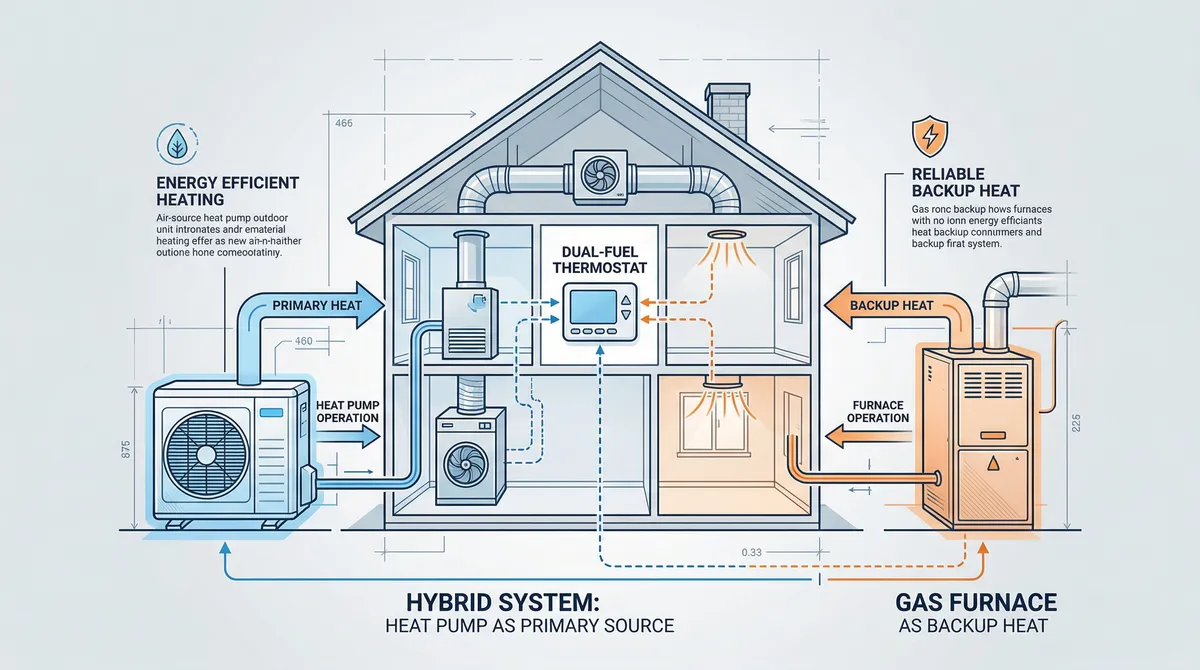
80% of Massachusetts heat pump backup conversations end here. Keep your existing furnace or boiler as emergency-only backup. The heat pump does the heavy lifting.
Gas furnace only
Annual savings: $1,200-$1,500/yr
Oil boiler only
Annual savings: $2,300-$2,900/yr
Propane furnace
Annual savings: $2,900-$3,100/yr
Hybrid Trade-Off: Gas Connection Fee
Keeping your gas line active means you pay $10-$20/month ($120-$240/year) in gas connection and delivery charges even when using minimal gas. This is a real ongoing cost of the hybrid approach. However, it is typically much smaller than your annual heating savings of $1,200-$3,100. Many homeowners start hybrid and convert to fully electric when the furnace reaches end of life — eliminating the connection fee entirely.
Your backup heating choice directly affects which Mass Save rebate tier you qualify for. Understanding these rules can save you thousands.
Backup allowed
Electric resistance strips only (built-in aux heat)
Requirement
Heat pump must be PRIMARY heat for the entire home. The system must cover 100% of the design heating load per Manual J. Aux heat is allowed as emergency backup but the HP must handle all normal conditions.
Backup allowed
Gas furnace, oil boiler, or any existing system
Requirement
Heat pump supplements existing heating. Requires integrated controls to ensure HP runs as primary above the balance point. Existing fossil fuel system provides backup below balance point.
Backup allowed
Any — no restrictions on backup system
Requirement
Minimum ENERGY STAR certification. Single-zone or supplemental installations. No requirement that HP serves as primary heat.
Important: Wood stoves and propane heaters do NOT disqualify whole-home rebate
Mass Save evaluates whether the heat pump system itselfcovers 100% of the design heating load. A wood stove in the living room or a propane heater in the workshop is supplemental — it does not change the heat pump's rebate tier. As long as the HP is sized to handle the full heating load per Manual J, you qualify for the whole-home rate.
Estimated additional monthly cost for each backup option during the three coldest months. Based on typical MA homes (1,800-2,400 sq ft) at 2026 fuel prices.
| Backup Option | January | February | March | 3-Month Total |
|---|---|---|---|---|
| No backup needed (well-insulated + cold-climate HP) | $0 | $0 | $0 | $0 |
| Electric resistance strips (10 hrs/mo) | $37 | $34 | $19 | $90 |
| Electric resistance strips (40 hrs/mo) | $149 | $134 | $78 | $361 |
| Gas furnace backup (hybrid) | $65 | $55 | $30 | $150 |
| Oil boiler backup | $100 | $85 | $45 | $230 |
| Wood stove (own wood) | $0 | $0 | $0 | $0 |
| Wood stove (buy cord wood) | $80 | $70 | $40 | $190 |
| Pellet stove | $100 | $85 | $50 | $235 |
| Electric space heater (1 unit) | $65 | $55 | $30 | $150 |
| Propane wall heater | $85 | $70 | $40 | $195 |
* Costs assume backup is used only when needed (below balance point). Heat pump handles all heating above balance point. Electric resistance rows use the Eversource all-in rate ($0.37/kWh); MA utility rates run $0.37-$0.48/kWh. Gas: $1.85/therm. Oil: $4.19/gal. Propane: $3.65/gal. Cord wood: $300-$400/cord.
Modern cold-climate heat pumps plus good insulation can eliminate the need for any backup system. Here is what it takes.
Mitsubishi Hyper-Heat, Fujitsu XLTH, or Carrier Greenspeed rated to -13 to -15 degrees Fahrenheit. These units maintain 75-80% capacity at 5 degrees Fahrenheit.
R-38+ attic, R-13+ walls, air-sealed envelope. Mass Save provides 75-100% subsidized insulation that can transform a drafty home into a tight one.
A Manual J load calculation ensures the heat pump matches your home's actual heating needs — not a guess. Oversized or undersized systems both cause backup dependency.
200A service is ideal. A cold-climate ducted system draws 3-6 kW. If your panel is 100A, consider an upgrade before going backup-free.

Boston record low
-18°F (1934)
Extremely rare
Typical coldest night
-5 to -10°F
Few times per winter
Fujitsu XLTH rated to
-15°F
Below MA record in most areas
Mitsubishi HH rated to
-13°F
Covers 99.5%+ of MA hours
Mass Save pays 75-100% of insulation costs. Better insulation means your heat pump handles a bigger share of the heating load, reducing or eliminating the need for backup.
Uninsulated (pre-1960)
Reduces heating load 30-40%
May still need backup below 10-15°F
Partial insulation (1960-1990)
Reduces heating load 15-25%
Cold-climate HP likely sufficient alone
Well-insulated (post-2000)
Already efficient
Backup heating unnecessary with cold-climate HP
Common questions about heat pump backup and supplemental heating in Massachusetts.
It depends on your heat pump model and home insulation. Modern cold-climate heat pumps (Mitsubishi Hyper-Heat, Fujitsu XLTH, Carrier Greenspeed) operate effectively down to -13 to -15 degrees Fahrenheit — well below the coldest MA temperatures. A well-insulated home with a properly sized cold-climate heat pump may need zero backup heating. Older or standard heat pumps lose significant capacity below 25-30 degrees Fahrenheit and benefit from a backup source during January and February cold snaps.
If you own firewood: a wood stove is the cheapest ($0 fuel cost). For purchased fuel, a gas furnace backup in a hybrid/dual-fuel configuration costs $30-$80/month during winter because the furnace only runs 100-200 hours per year. Electric resistance strips (built-in aux heat) are the most expensive at $0.37-$0.48/kWh — they can add $149-$337/month to your bill if the system is undersized or your home is poorly insulated.
Yes. Mass Save offers a partial-home rebate of $1,125 per ton (maximum depends on system) for hybrid/dual-fuel installations where the heat pump supplements your existing gas furnace. The rebate is lower than the $2,650/ton whole-home rate because you are keeping fossil fuel backup. Integrated controls are required — the thermostat must ensure the heat pump operates as primary heating above the balance point.
For the $2,650/ton whole-home rebate (maximum $8,500), the heat pump must serve as the PRIMARY heating source for the entire home and must cover 100% of the design heating load as calculated by Manual J. Electric resistance backup (built-in aux heat strips) is allowed because it is part of the heat pump system. You cannot claim whole-home rebate if your gas furnace or oil boiler is still the primary heat source.
A hybrid (dual-fuel) system pairs an electric heat pump with your existing gas furnace or oil boiler. The heat pump operates as primary heating — handling 80-90% of all heating hours. When outdoor temperatures drop below the balance point (typically 15-25 degrees Fahrenheit for average MA homes), the fossil fuel system automatically takes over via integrated controls. In a typical Massachusetts winter, the furnace or boiler runs only 100-200 hours total.
You can eliminate backup heating when three conditions are met: (1) Modern cold-climate heat pump rated to -13 to -15 degrees Fahrenheit (Mitsubishi Hyper-Heat, Fujitsu XLTH, Carrier Greenspeed), (2) Well-insulated home with R-38+ attic, R-13+ walls, and air sealing (Mass Save provides 75-100% subsidized insulation), and (3) Properly sized system based on a Manual J load calculation — not a rule-of-thumb estimate. The coldest temperature recorded in Boston is -18 degrees Fahrenheit (1934), and most MA winters bottom out at -5 to -10 degrees Fahrenheit.
Yes, especially in western MA, the Berkshires, and rural areas where firewood is cheap or free. A wood stove provides radiant heat during power outages (no electricity needed) and costs nothing to run if you cut your own wood. The heat pump handles bedrooms and the rest of the house while the wood stove keeps the main living area warm. A wood stove does not disqualify you from the Mass Save whole-home rebate as long as the heat pump covers 100% of the design heating load.
At Eversource and National Grid rates of $0.37-$0.42/kWh, electric resistance backup (aux heat) costs approximately $3.74-$4.18 per hour for a 10 kW system. If your system runs aux heat 10 hours per month (well-sized, cold-climate HP in a well-insulated home), that adds $37-$42/month. If aux heat runs 40+ hours per month (undersized system or poor insulation), it adds $149-$167/month. During a January cold snap, an underperforming system can run aux heat 6-10 hours per day, costing $22-$42 per day.
Before — or at the same time. Mass Save provides 75-100% subsidized insulation through a free home energy assessment. Insulating your home first reduces the heating load, which means a smaller (cheaper) heat pump can handle the entire load without backup, and you qualify for the higher whole-home rebate tier. Mass Save offers a $500 weatherization bonus when insulation work is completed within 12 months of heat pump installation.
No. Electric space heaters cost exactly the same per BTU as the electric resistance strips in your heat pump system ($0.37-$0.48/kWh) and add significant fire risk. Portable space heaters cause approximately 1,700 home fires per year in the US. If you are relying on space heaters regularly, it means your heat pump system is undersized, your home needs insulation, or the system has a malfunction. Get a Mass Save assessment ($0 cost) and fix the root cause instead.
Get a free assessment from a Mass Save-registered installer. We will evaluate your insulation, current heating system, and heat pump options to recommend the most cost-effective approach — whether that is going backup-free or keeping your furnace as emergency-only.
Hybrid Heat Pump Guide
Full guide to dual-fuel systems
Read guideAux & Emergency Heat Explained
Why your electric bill spiked
Read guideCold-Climate Heat Pumps
Models rated to -15°F
Read guideMass Save Insulation Rebates
75-100% subsidized insulation
Read guideHeat Pump Sizing Guide
Manual J load calculation explained
Read guideHeat Pump vs Gas Furnace
Full cost comparison for MA
Read guide