Loading NuWatt Energy...

We use your location to provide localized solar offers and incentives.
We serve MA, NH, CT, RI, ME, VT, NJ, PA, and TX
Loading NuWatt Energy...
NuWatt designs, installs, and manages solar, battery, heat pump, and EV charger systems across 9 states. One company, one warranty, one point of contact.
Get a Free Quote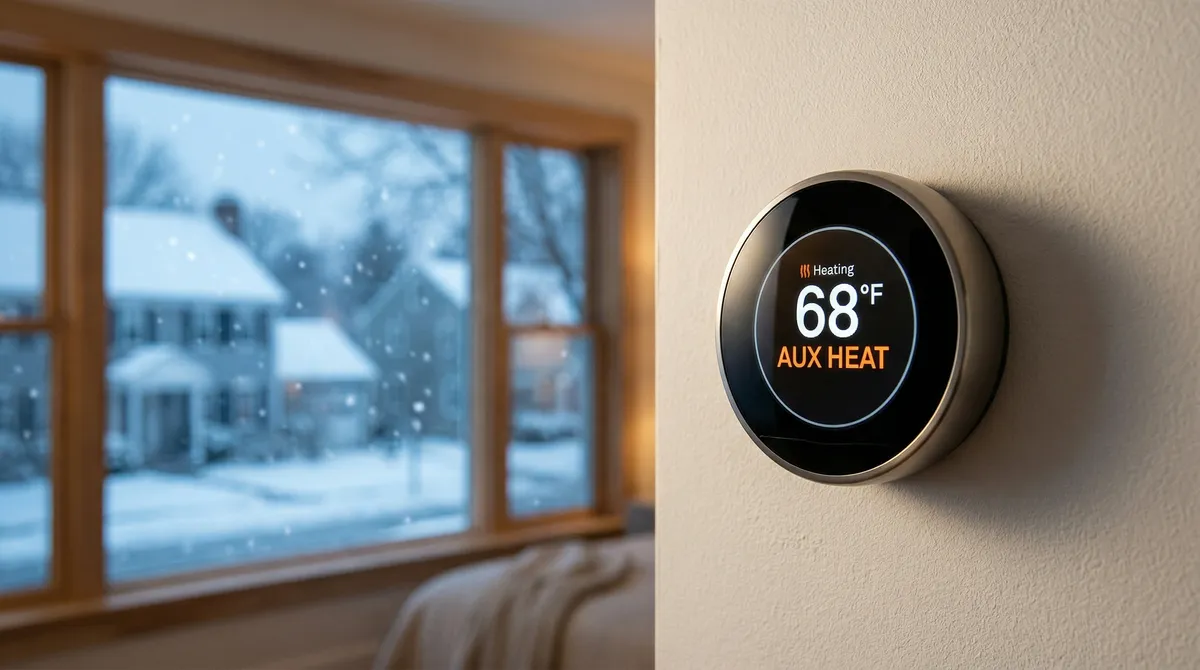
If your heat pump bill doubled this winter, auxiliary or emergency heat is probably running. Aux heat at COP 1.0 costs 3x more than your heat pump at COP 3.0. Here is how to identify it, reduce it, and know when it is actually needed.
Quick Answer
Your heat pump operates at COP 3.0 — effectively $0.13/kWh. Auxiliary/emergency heat uses electric resistance at COP 1.0 — $0.38-$0.42/kWh. That is a 3x cost increase. The fix: limit thermostat setbacks to 2°F, clean filters, never press "Emergency Heat" unless the outdoor unit is broken, and get a Mass Save assessment to address insulation gaps.
These two terms confuse most homeowners because they both use electric resistance heating strips — the same technology as a space heater. The critical difference is when and how they activate.
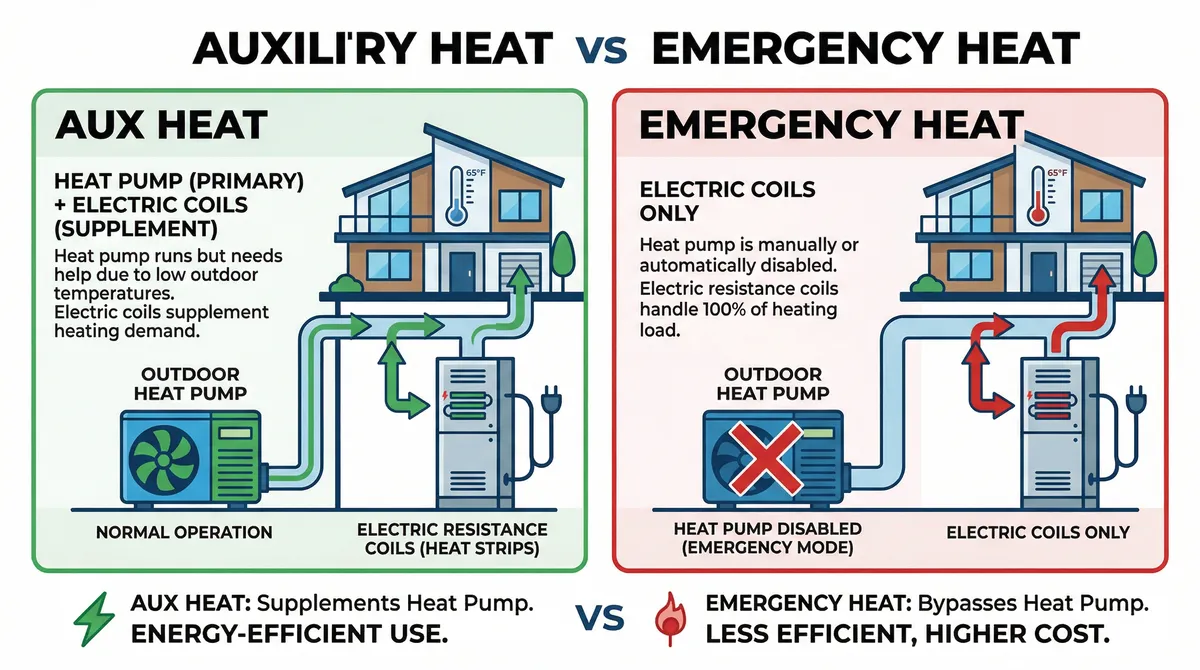
Auxiliary heatis your heat pump saying "I need help" — the compressor still runs alongside the resistance strips. Emergency heatis you saying "forget the heat pump" — only resistance strips run, at 3x the cost.
At Massachusetts electric rates of $0.38-$0.42/kWh (Eversource and National Grid), the cost difference between heat pump operation and auxiliary/emergency heat is dramatic. A heat pump at COP 3.0 delivers 3 units of heat for every 1 unit of electricity — effectively cutting your cost per kWh of heat to $0.13. Electric resistance at COP 1.0 gives you exactly 1 unit of heat per unit of electricity — the full $0.38-$0.42/kWh.
Daily (8hr run)
$5 - $8
Monthly (Jan est.)
$130 - $190
How it works
Normal operation — compressor moves heat from outdoor air
Daily (8hr run)
$30 - $33
Monthly (Jan est.)
$280 - $440
How it works
Electric resistance strips — auto-activates when HP cannot keep up
Daily (8hr run)
$38 - $50
Monthly (Jan est.)
$440 - $640
How it works
Bypasses heat pump entirely — only use when outdoor unit is broken
Heat Pump at COP 3.0
1 kWh electricity = 3 kWh heat
Cost per kWh of heat = $0.38 / 3 = $0.13
Electric Resistance at COP 1.0
1 kWh electricity = 1 kWh heat
Cost per kWh of heat = $0.38 / 1 = $0.38
That is a 3x cost difference. For a typical MA home drawing 10 kW of heating, one hour of aux heat costs ~$3.76 vs ~$1.25 for heat pump operation. Over a cold January week with 6 hours of daily aux heat, that is an extra $105 on your bill.
Understanding why aux heat activates is the first step to reducing it. Some triggers are normal. Others are avoidable. And some signal a problem that needs fixing.
When the outdoor temperature falls below your heat pump's balance point, the compressor alone cannot maintain your setpoint. Aux heat kicks in to bridge the gap. Older units: 25-30°F. Modern cold-climate HPs: -10°F to -15°F.
If you dropped your thermostat from 68°F to 58°F overnight and set it back to 68°F in the morning, the system detects the 10°F gap and fires aux heat to recover quickly. This is the #1 avoidable cause of high bills.
In winter, frost builds on the outdoor coil. The system reverses to defrost (briefly sends warm refrigerant outside). During defrost, aux heat activates to avoid blowing cold air indoors. This is normal and lasts 5-10 minutes.
Restricted airflow forces the system to work harder, reducing capacity. The thermostat sees the home not reaching setpoint and calls for aux heat. Clean or replace filters every 1-3 months.
If your system was not properly sized with a Manual J load calculation, it may be too small for your home's heating needs. This means aux heat runs frequently — especially during January and February cold snaps.
When snow drifts or ice block the outdoor unit, airflow is restricted and the heat pump cannot extract heat efficiently. The system compensates with aux heat. Keep 2+ feet of clearance around the outdoor unit.
The balance pointis the outdoor temperature where your heat pump's heating output exactly matches your home's heat loss. Below this temperature, aux heat kicks in. It depends on two factors: your heat pump's capacity curve and your home's insulation level.
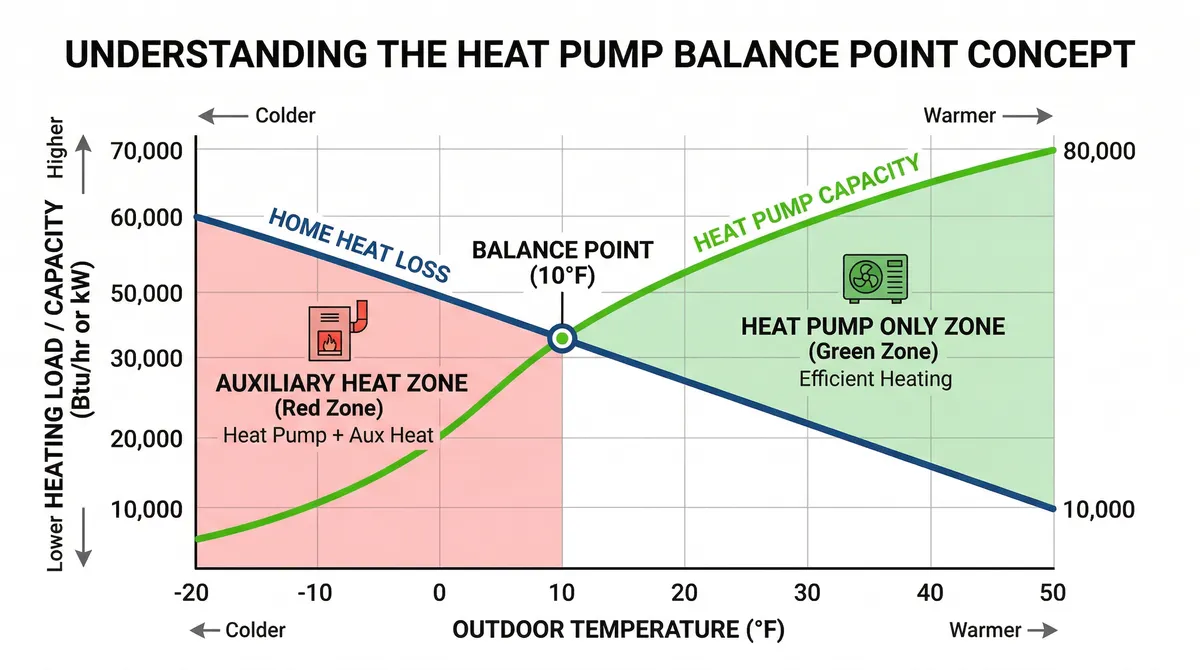
Boston averages 22°F in January with lows reaching 5-10°F regularly. Inland areas (Worcester, Springfield) can see -5°F to -15°F during polar vortex events. Coastal areas stay slightly warmer (15-25°F lows). A cold-climate heat pump rated to -13°F handles 95%+ of Massachusetts winter hours without needing aux heat. The remaining 5% (roughly 20-40 hours per winter) is where aux heat earns its keep — briefly supplementing during the coldest overnight hours.
Massachusetts has some of the highest electricity rates in the country. That makes the difference between heat pump mode and aux heat mode especially painful on your bill.
| Utility | Standard Rate | HP Rate (Nov-Apr) | Aux Heat Cost/Day | HP Cost/Day |
|---|---|---|---|---|
| Eversource | $0.38/kWh | $0.18/kWh | $28-$30/day | $4-$7/day |
| National Grid | $0.42/kWh | $0.19/kWh | $31-$33/day | $5-$8/day |
| Unitil | $0.48/kWh | N/A | $36-$39/day | $5-$8/day |
* Daily costs based on 10 kW system running 8 hours. Heat pump COP 3.0 during normal operation. Aux heat at COP 1.0 with standard residential rate. HP rate available Nov-Apr from Eversource and National Grid only.
During a 5-day cold snap with lows of -5°F to 5°F, a poorly sized system might run aux heat 6-8 hours per day. At Eversource standard rates, that is $113-$150 in extra electricity over those 5 days alone — compared to roughly $40-$55 in the same period for a well-sized cold-climate system running on compressor only. Multiply this across a full January with 10-15 cold nights, and you see bills of $380-$440 vs $190-$230.
Do not wait for your next electric bill to find out. Here is how to check right now.
If your thermostat shows "EM HEAT" and you did not manually activate it, this could indicate a heat pump malfunction (failed compressor, refrigerant leak, or outdoor fan failure). Some systems auto-switch to emergency heat when they detect a fault. Call your installer immediately — you are paying 3x electric rates until the heat pump is repaired.
Most excessive aux heat usage is fixable without replacing your system. Start with the easy wins and work toward the bigger improvements.
This is the single most impactful change. Set your thermostat to 68°F and leave it. If you must set back overnight, go no lower than 66°F. A 10°F setback (68 to 58) guarantees 30-60 minutes of aux heat recovery in the morning.
Emergency heat bypasses the compressor entirely. It is not a "cold weather" setting — it is an equipment failure setting. If you pressed it because your home was not warming up, turn it off and call your installer instead.
Dirty filters restrict airflow, reduce capacity, and force aux heat to compensate. Mini-split filters are washable — rinse with water monthly during heavy-use seasons. Ducted systems need filter replacement every 1-3 months.
After snow storms, shovel a 2-foot perimeter around the outdoor unit. Never stack firewood, trash cans, or other items near it. Ice dams from roof runoff can also block airflow — consider a protective awning.
A free Mass Save assessment identifies insulation gaps, air leaks, and duct leakage that increase your home's heat loss — which is what forces aux heat to activate earlier. Fixing insulation lowers your balance point, meaning the heat pump handles more hours without help.
If your system was sized by "rules of thumb" (1 ton per 500 sq ft) instead of a Manual J calculation, it may be undersized for Massachusetts winters. A properly sized cold-climate system rated to -13°F handles 95%+ of MA heating hours without aux heat. Ask your installer to verify.
If your current system was installed before 2020, it may not be a cold-climate model. Modern ccASHP units (Mitsubishi Hyper-Heat, Daikin, Fujitsu XLTH) maintain capacity to -13°F to -15°F. Mass Save covers up to $8,500 in rebates plus $500 sizing bonus.
Not all aux heat usage is a problem. Here are the three situations where aux heat is doing its job.
Every 30-90 minutes in cold, humid weather, the system reverses to melt frost off the outdoor coil. Aux heat prevents cold air from blowing indoors during the 5-10 minute cycle.
Perfectly NormalDuring polar vortex events (2-5 days per MA winter), even cold-climate heat pumps need help. Aux heat runs a few hours per night to bridge the gap. This is what the system was designed for.
Expected BehaviorIf the compressor or outdoor fan fails, the system may auto-switch to emergency/aux heat to keep your home warm. This is a safety feature — but call your installer immediately.
Call InstallerThis is the most misunderstood button on a heat pump thermostat.
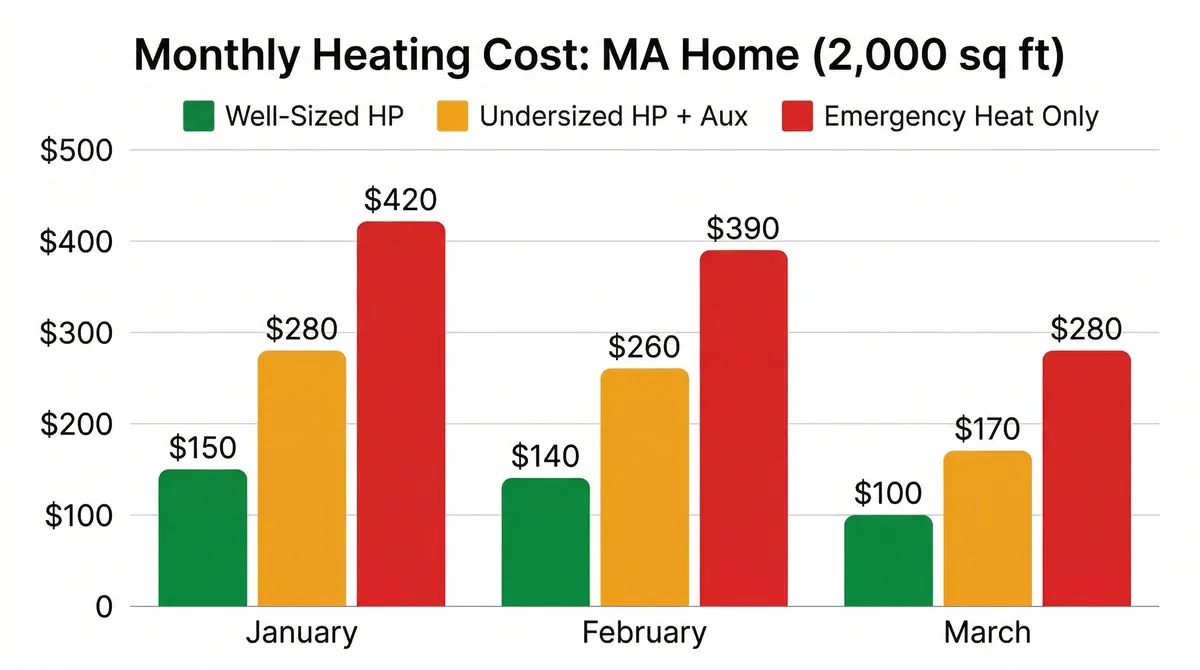
Here is what your electric bill looks like under three different scenarios for a typical 2,000 sq ft Massachusetts home. The difference between a well-sized system and emergency heat is over $370/month in January.
| Scenario | Jan | Feb | Mar | Aux Hours/Mo |
|---|---|---|---|---|
Well-Sized HP (cold-climate rated) Properly sized via Manual J, -13°F rated, 2°F setbacks max, clean filters | $190 | $170 | $130 | 5-10/mo |
Undersized HP with Aux Heat Slightly undersized, triggers aux below 15°F, moderate setbacks | $380 | $350 | $230 | 20-40/mo |
Emergency Heat Only Mode HP bypassed or broken — running only electric resistance heat | $560 | $520 | $380 | 100% (all hours) |
* Estimates for a 2,000 sq ft home with Eversource standard rate (~$0.38/kWh). Actual costs vary by insulation level, thermostat behavior, and outdoor temperatures.
Your heat pump's balance point is directly tied to your home's insulation quality. Better insulation means less heat loss, which means your heat pump's capacity exceeds demand at lower outdoor temperatures — pushing the balance point down and eliminating aux heat triggers.
Mass Save provides a free home energy assessment that identifies insulation gaps and air leaks. They offer 75% off insulation costs (up to 100% for income-eligible households), plus the 0% HEAT Loan covers up to $25,000 for insulation and heat pump improvements. The insulation upgrade typically costs $2,000-$5,000 after rebates — and can save $150-$250/month in reduced aux heat usage during winter.
January and February are when aux heat usage spikes in Massachusetts. Here is what to expect based on actual weather data and system performance.
| Region | Jan Avg Low | Coldest Events | Aux Heat (Sized Right) | Aux Heat (Undersized) |
|---|---|---|---|---|
| Boston / Metro | 22°F | -5°F to 5°F | 5-10 hrs/mo | 25-40 hrs/mo |
| Worcester / Central | 17°F | -10°F to 0°F | 8-15 hrs/mo | 35-55 hrs/mo |
| Berkshires / Western | 12°F | -15°F to -5°F | 10-20 hrs/mo | 40-60 hrs/mo |
| Cape Cod / Coast | 25°F | 5°F to 15°F | 3-8 hrs/mo | 15-30 hrs/mo |
A well-sized cold-climate heat pump for Massachusetts should be designed to handle your home's full heating load at your town's 99% design temperature — the temperature that is exceeded 99% of the year. For Boston, that is 9°F. For Worcester, 4°F. For the Berkshires, -2°F. If your installer sized the system to handle 100% of heating at these temperatures (using a Manual J calculation), aux heat should rarely activate.
The most common cause is auxiliary heat running excessively. Aux heat uses electric resistance strips at COP 1.0, costing 3x more than your heat pump at COP 3.0. With Eversource or National Grid rates of $0.38-$0.42/kWh, even 20 hours of aux heat per month can add $100+ to your bill. Check your thermostat for "AUX" indicator lights and reduce temperature setbacks to 2°F maximum.
Auxiliary (aux) heat activates automatically when your heat pump cannot maintain setpoint — during extreme cold, defrost cycles, or large setback recovery. It supplements the heat pump. Emergency heat bypasses the heat pump compressor entirely and runs only electric resistance strips. Emergency heat should ONLY be used if the outdoor unit is physically broken (fan motor failure, compressor down). Both use electric resistance at COP 1.0, but emergency heat costs more because there is zero contribution from the heat pump.
It depends on your heat pump model and your home's heat loss. Modern cold-climate heat pumps (Mitsubishi Hyper-Heat, Daikin, Fujitsu XLTH) maintain capacity down to -10°F to -15°F before needing aux heat. Older standard heat pumps may lose capacity below 25-30°F. The "balance point" — where heat pump output equals your home's heat loss — is what determines when aux activates. A Manual J calculation determines this for your specific home.
Check your thermostat display: look for "AUX" or "AUX HEAT" indicator. On Mitsubishi systems, check the kumo cloud app. Daikin uses the Daikin One app. Ecobee and Nest thermostats show aux heat runtime in their energy reports. You can also check your electric meter — aux heat draws 5-15 kW compared to 1-3 kW for the heat pump compressor, so a sudden spike in real-time usage indicates aux heat is on.
Brief aux heat use is normal and expected — during defrost cycles (5-10 minutes) and the coldest days of the year. In Massachusetts, well-sized cold-climate heat pumps should only need aux heat 5-10 hours per month in January. If your system runs aux heat 20-40+ hours per month, something is wrong: undersized system, large thermostat setbacks, dirty filters, or blocked outdoor unit. Excessive aux heat can add $100-$200/month to your electric bill.
Almost never. The emergency heat button bypasses your heat pump entirely and runs only electric resistance strips. This costs 3x more. Only use it if: (1) the outdoor unit is physically broken — fan not spinning, unusual noises, or compressor failure, and (2) you need heat while waiting for a technician. Call your installer immediately if you resort to emergency heat. It is not a cold-weather setting.
Five strategies: (1) Limit thermostat setbacks to 2°F maximum overnight — never set back more than 3°F. (2) Clean filters every 1-3 months. (3) Keep 2+ feet of clearance around the outdoor unit — shovel snow away after storms. (4) Never use the emergency heat button unless the HP is broken. (5) If aux heat runs frequently, get a Mass Save assessment — insulation upgrades reduce heat loss, which lowers your balance point and eliminates aux heat triggers.
Yes. Mass Save offers free home energy assessments that identify insulation gaps, air leaks, and sizing issues contributing to excess aux heat usage. They provide rebates for insulation and air sealing work that directly reduces heat loss — which means your heat pump handles more of the load before needing aux heat. The 0% HEAT Loan covers up to $25,000 for insulation and heat pump improvements.
At Eversource and National Grid rates of $0.38-$0.42/kWh, running a 10 kW electric resistance heater for 8 hours costs $30-$33/day. During a January cold snap, an undersized system might run aux heat 6-10 hours per day, costing $20-$35/day in added electricity above normal heat pump operation. Over a month, that is $200-$320 in extra costs compared to a properly sized system.
Aux heat is normal during: (1) Defrost cycles — 5-10 minutes every 30-90 minutes when outdoor temps are 25-40°F with high humidity. (2) Extreme cold events below your heat pump's rated minimum — for cold-climate models, that means below -13°F to -15°F. (3) Initial startup after a power outage. In Massachusetts, a well-sized system should need aux heat fewer than 10 hours per month in January. If it exceeds 20 hours, investigate.
If aux heat is running constantly or your electric bill is unusually high, a proper assessment can identify the root cause — whether it is sizing, insulation, or equipment issues.
Related Massachusetts Heat Pump Guides