Loading NuWatt Energy...

We use your location to provide localized solar offers and incentives.
We serve MA, NH, CT, RI, ME, VT, NJ, PA, and TX
Loading NuWatt Energy...
NuWatt designs, installs, and manages solar, battery, heat pump, and EV charger systems across 9 states. One company, one warranty, one point of contact.
Get a Free QuoteThe #1 heat pump thermostat mistake in Massachusetts: large nighttime setbacks that trigger auxiliary electric resistance heat. Your bill doubles. Here is exactly how to set your thermostat for every season.
Set to 68°F and leave it. If you must set back at night, drop to 66°F maximum. Never drop more than 2°F.
Set to 74–76°F. Larger setbacks are fine in cooling mode because there is no auxiliary heat penalty. But avoid setting below 72°F.
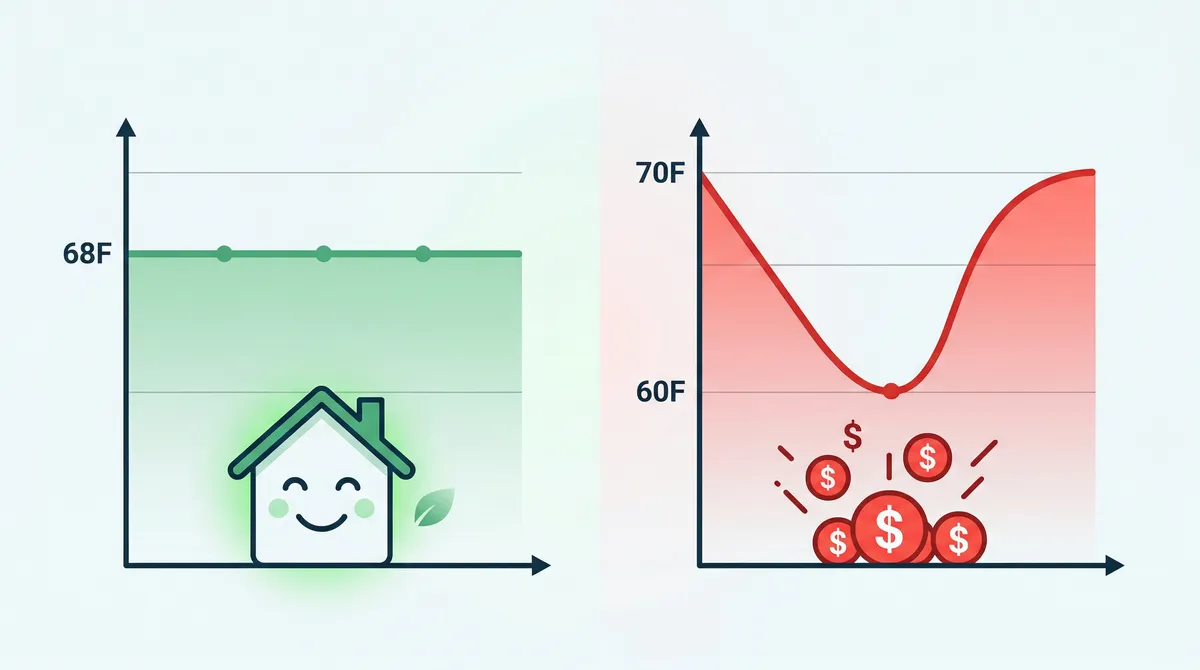
The #1 rule:Heat pumps are NOT furnaces. A gas furnace can recover from 60°F to 70°F in 15 minutes with cheap gas. A heat pump recovering from that setback triggers $0.38/kWh electric resistance strips for 1–2 hours. That single morning recovery can cost $7–$11 — every day.
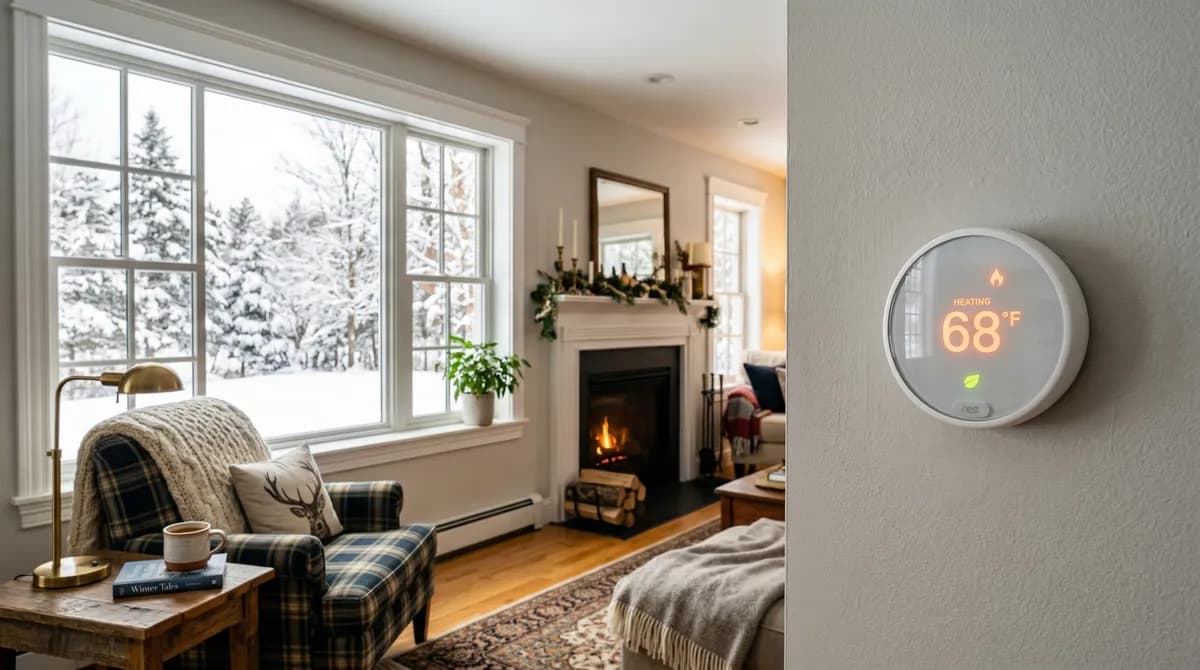
Massachusetts homeowners switching from gas or oil furnaces instinctively program their thermostats the same way: 60°F at night, 70°F in the morning. With a furnace, this saves 10–15% on your heating bill. With a heat pump, it doubles it.
10:00 PM:You set the thermostat to 60°F. The heat pump shuts off. Your house cools slowly overnight.
6:00 AM:The thermostat calls for 70°F. It sees a 10°F gap. The heat pump compressor starts, but it can only raise the temperature about 2°F per hour.
6:15 AM: The thermostat decides recovery is too slow. It activates auxiliary heat strips— 10–15 kW of pure electric resistance at $0.38/kWh. Your Eversource meter spins at 3x the rate.
7:30–8:00 AM:The house reaches 70°F after 1.5–2 hours of aux heat running. That single recovery cost $7–$11. Do this every morning from November to March — that is $1,010–$1,600 in wasted electricity.
Based on a typical 2,000 sq ft MA home with a 3-ton heat pump, Eversource electricity at $0.38/kWh, January temperatures averaging 28°F.
| Strategy | HP Compressor | Aux Heat | Monthly Bill | Grade |
|---|---|---|---|---|
| Set-and-forget at 68°F | HP compressor only | Never (above lockout) | $240–$300 | A |
| 2°F night setback (68→ 66°F) | HP compressor only | Rarely | $230–$280 | A- |
| 5°F night setback (68→ 63°F) | HP compressor + aux on recovery | 1-2 hours each morning | $310–$390 | C |
| 10°F night setback (70→ 60°F) | HP + aux running together | 2-4 hours each morning | $430–$560 | F |
Key insight:A 2°F setback saves roughly $15–$20/month. A 10°F setback costs an extra $130–$270/month. The furnace mentality of “turn it way down at night” actively punishes you with a heat pump.
Massachusetts has four distinct seasons. Your heat pump thermostat strategy should change with each one.
66–70°F
68°F daytime, 66°F sleeping
2°F maximum
NEVER drop below 64°F. Setbacks of 5°F or more trigger aux/emergency heat strips.
Program gentle 1°F ramps over 30-minute intervals. Let the heat pump gradually adjust rather than demanding rapid recovery.
74–78°F
76°F daytime, 74°F sleeping
3–4°F acceptable
Larger cooling setbacks are fine because there is no aux heat in cooling mode. But avoid setting below 72°F — it wastes energy.
Heat pumps dehumidify while cooling. Setting slightly higher (76°F) with the fan on AUTO feels comfortable because humidity drops to 45-50%.
68–72°F
70°F heating, 74°F cooling
2°F heating, 4°F cooling
Switch to cooling mode when outdoor temps consistently exceed 65°F. Auto-changeover works well but monitor for short-cycling.
Widen the dead band between heating and cooling setpoints (e.g., heat at 68°F, cool at 74°F) to prevent the system from switching modes constantly.
When IS it OK to use Emergency Heat?
Only when the outdoor unit has physically failed: a refrigerant leak, a broken compressor, a damaged fan motor, or severe ice damage. Emergency heat keeps your pipes from freezing until a technician arrives. Call your installer immediately — do not run emergency heat for days.
All three qualify for the $100 Mass Save instant rebate. Prices shown before rebate. Net cost = after rebate.
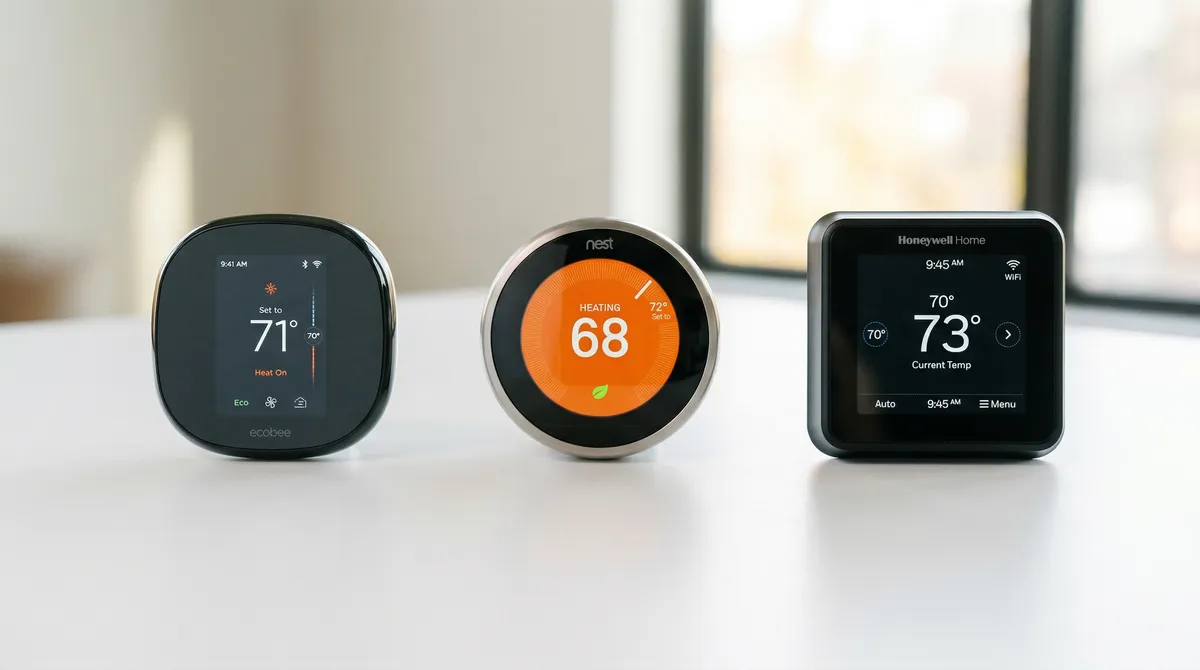
HP Compatibility: Excellent
Verdict: Best overall for MA heat pump owners. Most compatible with Mass Save systems.
HP Compatibility: Good — verify wiring
Verdict: Great if already in Google ecosystem. Verify your heat pump wiring compatibility before buying.
HP Compatibility: Good
Verdict: Budget-friendly choice. Lowest net cost after Mass Save rebate. Solid heat pump support.
Gas furnaces and heat pumps have fundamentally different recovery physics. Here is why the thermostat strategy that saved money on gas will cost you money on a heat pump.
A gas furnace produces 80,000–120,000 BTU/hr. It can raise indoor temperature 5–7°F per hour. Recovery from a 10°F setback takes 1.5–2 hours of burning gas at roughly $1.50–$2.00/therm.
Cost of 10°F recovery:~$1.50–$3.00
Savings from nightly setback:~$0.50–$1.00/night = $45–$90/winter
Net result: Setbacks save money with a furnace.
A heat pump produces 24,000–48,000 BTU/hr (3–4 ton). It can raise indoor temperature 1–2°F per hour on cold days. A 10°F gap triggers aux heat strips at $0.38/kWh × 10–15 kW.
Cost of 10°F recovery: ~$7.00–$11.00
Savings from nightly setback: ~$1.50–$2.50/night (HP was cheap anyway)
Net result: Setbacks cost MORE than they save with a heat pump.
The right strategy: Instead of large setbacks, use gentle ramps. Program your thermostat to drop 1°F every 30 minutes, reaching a maximum 2°F setback. In the morning, ramp up 1°F every 30 minutes. The heat pump compressor handles these small changes without ever calling for auxiliary heat. Smart thermostats like Ecobee do this automatically in heat pump mode.
Heat pumps excel at dehumidification in cooling mode but do not add humidity in heating mode. Massachusetts winters require special attention to indoor humidity levels.
Risk if wrong
Below 30%: dry air, static. Above 45%: window condensation, mold risk.
Pro tip
Run a standalone humidifier if needed. Heat pumps do not humidify in heating mode.
Risk if wrong
Above 60%: clammy feeling, mold risk. Below 40%: uncomfortably dry.
Pro tip
Heat pumps dehumidify naturally in cooling mode. Set fan to AUTO (not ON) for best dehumidification.
Risk if wrong
Fluctuating humidity as system switches modes.
Pro tip
Monitor with a hygrometer. If humidity spikes above 55% on mild days, a standalone dehumidifier helps.
Fan setting matters: Always set your fan to AUTO, not ON. When the fan runs continuously, it blows air across the wet evaporator coil and re-evaporates the moisture your heat pump just removed. This can raise indoor humidity by 10–15% and make your home feel clammy even when the thermostat reads 74°F.
Many MA heat pump installations use mini-splits with 2–5 indoor zones. Each zone has its own remote or wall thermostat. Managing them together is critical for efficiency.
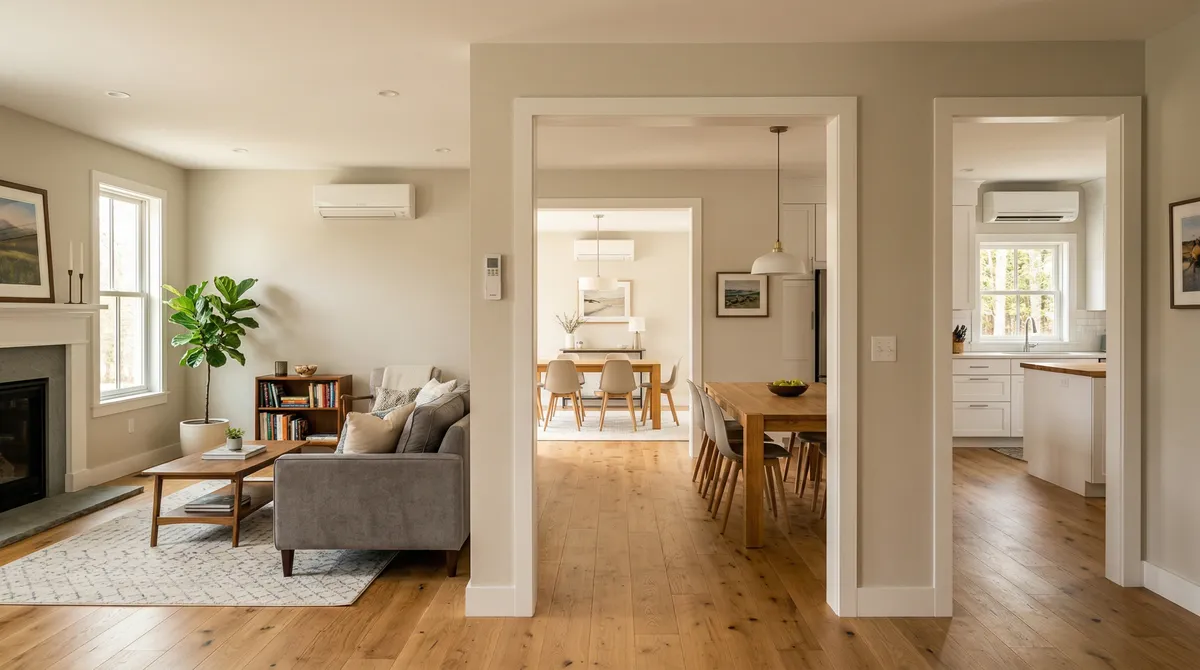
If your master bedroom is set to 66°F and the living room to 72°F, the system overworks the living room zone. Keep all zones within a 3°F band for efficient operation.
Open doors between differently-conditioned zones force the system to fight itself. Mini-split zones work best when each zone is isolated with its door closed.
Turning a mini-split head completely off in an unused room lets that room drop to 50°F+. The adjacent zones then lose heat through shared walls. Instead, set unused rooms to 60°F minimum.
If all zones call for heat simultaneously, the outdoor unit maxes out. Stagger setpoint increases by 15 minutes so the compressor can ramp smoothly.
In Massachusetts winters, your heat pump outdoor unit will periodically run a defrost cycle — reversing the refrigerant flow to melt ice on the outdoor coil. Here is what your thermostat should (and should not) do during defrost.
Defrost cycles are normal — the outdoor unit periodically reverses to melt ice buildup on the coil.
During defrost, the outdoor unit stops heating. Your thermostat should NOT call for aux heat during this 3-10 minute cycle.
Smart thermostats (Ecobee, Nest) recognize defrost cycles and suppress aux heat calls. Basic thermostats do not.
If you notice aux heat running every time the outdoor unit defrosts, your thermostat is not properly configured for heat pump operation.
In MA winters, defrost cycles happen more frequently (every 30-90 minutes in heavy frost conditions). This is normal behavior.
If aux heat runs during every defrost cycle: Your thermostat is not configured for heat pump operation. A basic thermostat sees “temperature dropping” during defrost and panics, calling for aux heat. Smart thermostats recognize the defrost signal from the heat pump and wait. This is one of the biggest reasons to upgrade to a smart thermostat — it can save $25–$55/month in avoided aux heat during MA winters.
Mass Save offers a $100 instant rebate on qualifying smart thermostats. Here is how to get it.
Ecobee, Nest (4th gen), Honeywell T9/T10 Pro, and others on the Mass Save qualified products list.
Home Depot, Lowe's, Best Buy, Amazon (select models), and masssave.com/shop. The $100 rebate is applied instantly at checkout.
Install the thermostat and configure heat pump mode. If you have a hybrid (HP + furnace) system, use the dual-fuel settings for optimal efficiency.
Note: The Mass Save thermostat rebate is separate from heat pump installation rebates. You can claim both. If your heat pump installer includes a smart thermostat in their quote, verify the $100 rebate is reflected. Some installers pass through the savings; others pocket the difference.
Gentle ramps, not aggressive setbacks. Here is a sample winter schedule that keeps you comfortable without triggering auxiliary heat.
Up to $16,000 in Mass Save rebates
Real installed prices by system type
Required for hybrid system rebates
How to vet MA heat pump contractors
Manual J and proper system sizing
Common MA heat pump problems solved
Set your heat pump thermostat to 68°F during the day and no lower than 66°F at night. The maximum recommended setback is 2°F. Unlike gas furnaces, heat pumps recover slowly from large setbacks. Dropping to 60°F at night forces the auxiliary electric resistance heat strips to activate during morning recovery, which uses electricity at 100% efficiency instead of the heat pump's 250-350% efficiency. This can double your heating bill for those recovery hours.
Heat pumps are most efficient when maintaining a steady temperature. When you program a large setback (e.g., 60°F at night, 70°F in the morning), the thermostat sees a 10°F gap and calls for emergency/auxiliary heat strips to recover quickly. These electric resistance strips consume 3x more electricity per BTU than your heat pump compressor. A single morning recovery from 60°F to 70°F can use as much electricity as 6-8 hours of steady heat pump operation at 68°F.
Only if your outdoor heat pump unit has physically failed — a refrigerant leak, a broken fan motor, or ice damage that prevents operation. Emergency heat bypasses the heat pump compressor entirely and runs only the electric resistance backup strips at 100% efficiency. Your heat pump compressor runs at 250-350% efficiency. Running emergency heat for a full day in January costs roughly $55–$80 in Massachusetts at current Eversource rates ($0.38/kWh), versus $20–$35 for normal heat pump operation.
Yes. Mass Save provides a $100 instant rebate on qualifying smart thermostats through participating retailers. Eligible models include Ecobee Smart Thermostat Premium, Google Nest Learning Thermostat, and Honeywell Home T9/T10 Pro. The rebate is applied at checkout — no mail-in required. Check masssave.com/en/saving/residential-rebates for the current qualifying product list. Note: this is separate from the heat pump rebate itself.
The Google Nest Learning Thermostat (4th generation) supports heat pump operation through the O/B reversing valve wire. However, compatibility depends on your specific heat pump model and wiring configuration. Before purchasing, use the Nest compatibility checker at store.google.com/compatibility. Key requirement: your system must have a C-wire (common wire) for reliable operation. Some older MA homes with 2-wire setups need a C-wire adapter or professional rewiring.
In winter, target 30-40% relative humidity. In summer, 45-55%. Heat pumps naturally dehumidify in cooling mode but do not add humidity in heating mode. For winter comfort in Massachusetts, most homes benefit from a separate whole-house humidifier. If your thermostat has a humidity setpoint (Ecobee does), set it to 40% in winter and 50% in summer. Critical: keep your fan set to AUTO, not ON. Running the fan continuously reintroduces moisture from the evaporator coil back into your air.
Keep all zone setpoints within 3°F of each other. If your master bedroom is 66°F and your living room is 72°F, the outdoor unit overworks serving the warm zone while the cold zone loses heat through shared walls. Close doors between zones for best isolation. Never turn a zone completely off — set unused rooms to 60°F minimum to prevent heat loss through interior walls. Stagger setpoint changes by 15 minutes to avoid overwhelming the compressor with simultaneous demand.
If your heat pump briefly blows cool air every 30-90 minutes in cold weather, it is running a defrost cycle — this is completely normal. The outdoor unit temporarily reverses to melt ice on the coil, which means it briefly cools your indoor air. This cycle lasts 3-10 minutes. A properly configured smart thermostat will NOT call for auxiliary heat during defrost. If you notice aux heat activating during every defrost cycle, your thermostat needs reconfiguration — contact your installer.
They use the same electric resistance heating strips but are triggered differently. Auxiliary heat activates automatically when the heat pump cannot keep up — typically during recovery from a large setback or in extreme cold. Emergency heat is a manual override that bypasses the heat pump entirely. Both cost 2-3x more than heat pump operation. Auxiliary heat is sometimes unavoidable (e.g., when it is 5°F outside and you need supplemental warmth), but emergency heat should only be used if the outdoor unit has failed.
Technically yes, but it is not recommended. Basic programmable thermostats do not understand heat pump operation — they will aggressively call for aux heat during setback recovery, costing you significantly more. Smart thermostats like Ecobee specifically have heat pump modes that manage aux heat lockout, defrost awareness, and gentle ramp recovery. Given the $100 Mass Save rebate, an Ecobee costs only $149 after rebate — the energy savings pay for it within the first winter.
Whether you need a smart thermostat installation, integrated controls setup, or a new heat pump system — NuWatt connects Massachusetts homeowners with vetted, Mass Save registered contractors.