Loading NuWatt Energy...

We use your location to provide localized solar offers and incentives.
We serve MA, NH, CT, RI, ME, VT, NJ, PA, and TX
Loading NuWatt Energy...
NuWatt designs, installs, and manages solar, battery, heat pump, and EV charger systems across 9 states. One company, one warranty, one point of contact.
Get a Free Quote
Short answer: No. A heat pump IS an air conditioner and a heater in one unit. It cools more efficiently than a standard AC (20-22 vs 15-16 SEER2) and qualifies for up to $8,500 in Mass Save rebates. A central AC gets $0.
A heat pump uses the exact same refrigeration cycle as a central air conditioner. The only difference is a reversing valve that lets it switch direction — pushing heat OUT of your house in summer (cooling) or pulling heat IN during winter (heating).
Every heat pump is a fully functional air conditioner. A central AC is just a heat pump that can only run in one direction. Installing both is like buying two cars when one does everything.
Both heat pumps and central ACs use a compressor, condenser coil, evaporator coil, and refrigerant to move heat. The only mechanical difference is the heat pump's reversing valve. Here is how the cooling cycle works:
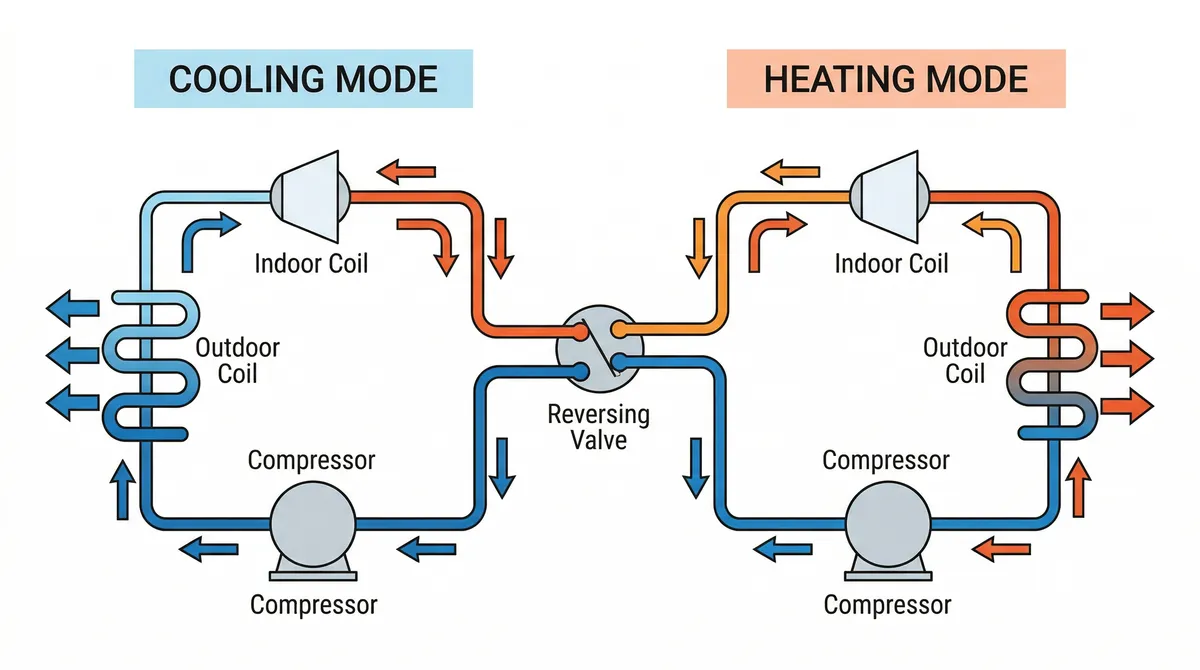
This is identical to how a central AC works. No difference whatsoever.
A central AC cannot do this — it lacks the reversing valve and defrost controls.
SEER2 (Seasonal Energy Efficiency Ratio 2) measures cooling efficiency. Higher is better. Modern heat pumps beat standard central ACs by a wide margin because they use variable-speed inverter compressors that modulate to match the exact cooling demand.
| Metric | Heat Pump | Central AC |
|---|---|---|
| SEER2 Range | 18 - 22 SEER2 | 14 - 16 SEER2 |
| Federal Minimum (2023+) | 14 SEER2 | 14 SEER2 |
| Compressor Type | Variable-speed inverter | Single or two-stage |
| Dehumidification | Excellent (runs at low speed longer) | Good (cycles on/off) |
| Noise Level | 50-55 dB (outdoor unit) | 60-75 dB (outdoor unit) |
| Also Heats? | ||
| Mass Save Rebate | Up to $8,500 | $0 |
Bottom line: A heat pump is a more efficient air conditioner that also heats your home. The average MA homeowner saves $74/year on cooling alone by choosing a heat pump over a central AC — before accounting for any heating savings.
Using Eversource's standard rate of $0.38/kWh for a typical 2,000 sq ft Massachusetts home. Both systems cool the same space — the heat pump just uses less electricity to do it.
| Month | HP Cost | AC Cost | Savings |
|---|---|---|---|
| May | $13 | $17 | $4 |
| June | $43 | $58 | $15 |
| July | $69 | $93 | $24 |
| August | $62 | $84 | $22 |
| September | $26 | $35 | $9 |
| Season Total | $213 | $287 | $74 |
The real question is not “heat pump OR AC” — it is “heat pump OR AC plus a furnace.” When you factor in both heating and cooling, a heat pump replaces two systems with one.
Upfront Cost
$4,000 - $7,000
SEER2 Rating
14 - 16 SEER2
Annual Cooling
$287/yr
Mass Save Rebate
$0
Mass Save does NOT rebate AC-only installations
Upfront Cost
$8,000 - $15,000
SEER2 Rating
18 - 22 SEER2
Annual Cooling
$213/yr
Annual Heating
$1673/yr
Mass Save Rebate
Up to $8,500
Mass Save whole-home rebate + 0% HEAT Loan
Upfront Cost
$12,000 - $20,000
SEER2 Rating
Mixed
Annual Cooling
$287/yr
Annual Heating
$1673/yr
Mass Save Rebate
Up to $8,500
Rebate covers HP portion only — rarely makes financial sense
Why “Both” Rarely Makes Sense
Paying $12,000-$20,000 for a central AC AND a heat pump means you are buying two cooling systems. The heat pump already cools more efficiently than the AC. The only scenario where keeping both is reasonable is when your existing AC is nearly new (less than 5 years old) and you add a heat pump primarily for heating.
Your situation determines the best approach. Here are the four most common scenarios we see in Massachusetts homes:
Recommendation: Heat pump only
Modern cold-climate HPs handle both heating and cooling. No reason to buy a separate AC system.
Recommendation: Add mini-split HP for heating, keep AC for cooling
Your AC still has 10-15 years of life. Add a ductless HP for heating zones. When the AC eventually dies, replace it with a ducted HP.
Recommendation: Replace with heat pump
Old ACs run at 10-13 SEER. A new HP at 20+ SEER2 cuts cooling costs 35-45% AND eliminates your heating fuel bill.
Recommendation: Add mini-split HP zones
Mini-splits handle heating AND cooling for individual rooms. Your furnace and AC become the backup system.
Most Massachusetts homes currently run a gas furnace for winter heat and central AC for summer cooling. A single heat pump replaces both. Here is how the costs break down by season using current Eversource/National Grid rates.
Heat pump in cooling mode: 20-22 SEER2
Central AC: 14-16 SEER2
25-35% lower cooling bills
Heat pump in heating mode: COP 2.5-4.0
Gas furnace: 95-96% AFUE (no AC contribution)
Operating cost runs close to gas at current MA electric rates; the win is one system instead of two plus rebates
HP modulates to exact demand — variable speed
AC short-cycles on mild days — wastes energy
40-50% more efficient at partial load
Annual savings with heat pump: $-260/yr — based on Eversource electric rates with heat pump winter discount and National Grid gas rates. Savings vary by utility territory and home size.
Both major MA utilities offer discounted electric rates for heat pump customers during the heating season (November through April). This makes heat pumps even more cost-competitive with gas furnaces during winter — when electricity demand would otherwise be highest.
52% discount during heating season
54% discount during heating season
Central AC installations do not qualify for heat pump electric rates. The rate discount is another financial advantage exclusive to heat pump owners.
One common concern: “Can a heat pump really handle Massachusetts winters?” The answer in 2026 is an unambiguous yes. Modern cold-climate heat pumps (ccASHP) are ENERGY STAR Cold Climate certified and maintain rated heating capacity down to -15°F.
Source: NOAA climate normals 1991-2020. MA summers peak at 85-95°F — well within heat pump cooling capacity.
This is the single biggest financial argument for choosing a heat pump over a central AC in Massachusetts. Mass Save provides generous rebates for heat pumps because they reduce both electricity and fossil fuel consumption. Central ACs only cool — they do nothing for heating decarbonization, so they get zero incentive.
$2,650/ton
Max $8,500
HP serves as primary heating source for the entire home. ENERGY STAR Cold Climate certified. R-32 or R-454B refrigerant.
$1,125/ton
Max $8,500
HP supplements existing heating. Keep your furnace as backup. ENERGY STAR Cold Climate certified required.
$250/ton
Max $2,500
Single-zone or supplemental HP. Minimum ENERGY STAR certified. Lowest tier for simple installations.
Up to $25,000 at 0% interest. Terms: 3, 5, or 7 years based on income. Available for heat pump installations only — not central AC.
$500 sizing bonus (Manual J load calc) + $500 weatherization bonus (insulation within 12 months). Up to $1,000 extra on top of the per-ton rebate.
Federal Tax Credits Are Dead
Both Section 25D (residential solar) and Section 25C (energy efficiency / heat pumps) expired December 31, 2025. There is no federal tax credit for heat pumps or central ACs in 2026. Mass Save rebates are state-funded through utility ratepayers and remain fully available.
Many Massachusetts homeowners are not replacing everything at once. The most common approach we see is a phased strategy: add ductless mini-split heat pumps for heating zones while keeping your existing central AC for whole-home cooling — then replace the AC with a ducted heat pump when it reaches end of life.
Install 2-3 zone ductless mini-splits in main living areas. Cost: $6,000-$10,000. Mass Save partial rebate: $1,125/ton. These handle heating for the zones they serve AND provide cooling — often better than the central AC.
Mini-splits handle 70-80% of heating load and some cooling. Existing central AC provides whole-home cooling backup. Furnace kicks in only on the coldest days. Heating bills drop 40-60% immediately.
When the central AC reaches end of life (15-20 years typical), replace it with a ducted cold-climate heat pump. Now the entire home is electrified. Furnace removed. Mass Save whole-home rebate applies at this stage.
No. A heat pump IS an air conditioner that can also heat. It uses the same refrigeration cycle as a central AC but with a reversing valve that lets it switch between cooling and heating. A single heat pump replaces both your AC and your furnace/boiler.
Modern heat pumps are actually better at cooling than standard central ACs. A typical new central AC runs at 14-16 SEER2, while a cold-climate heat pump rates 18-22 SEER2. That means the heat pump uses 25-35% less electricity to deliver the same cooling.
A central AC system costs $4,000-$7,000 installed in MA. A whole-home heat pump costs $8,000-$15,000 but qualifies for up to $8,500 in Mass Save rebates plus a 0% HEAT Loan. After rebates, a heat pump can cost less than a new AC while providing both heating and cooling.
No. Mass Save rebates apply exclusively to heat pump installations, not AC-only systems. The whole-home rebate is $2,650/ton (max $8,500), and there is a separate 0% HEAT Loan up to $25,000. AC-only installations receive zero incentives from Mass Save.
Yes. A properly sized ducted heat pump or multi-zone mini-split system will cool your entire home. Massachusetts summers typically peak around 90-95 degrees F, well within a heat pump's rated capacity. The same system then heats your home in winter down to -15 degrees F with modern cold-climate models.
Only if your AC is relatively new (less than 5 years old) and you are installing a ductless mini-split system primarily for heating zones. In that case, the AC serves as whole-home cooling while the mini-splits handle heating. When the AC eventually needs replacement, the heat pump system takes over cooling too.
SEER2 is the updated efficiency testing standard (effective January 2023) that uses more realistic conditions. SEER2 numbers are about 5-10% lower than old SEER numbers for the same equipment. A 16 SEER2 heat pump is roughly equivalent to a 17 SEER unit under the old standard. Always compare SEER2 to SEER2.
Both Eversource and National Grid offer discounted heat pump electric rates from November through April. Eversource drops from its all-in $0.38/kWh rate to roughly $0.18/kWh, and National Grid from $0.42/kWh to about $0.19/kWh. These winter discounts cut heat pump operating costs by roughly 52-54% during the heating season, making a heat pump far more competitive with a gas furnace plus AC combo over the year.
Get a free assessment from a Mass Save-certified installer. One system for heating and cooling — with up to $8,500 in rebates and 0% financing.
Full pricing breakdown by system type and home size
Detailed heating cost comparison with current gas rates
Models rated for Massachusetts winters
Keep your furnace as backup — dual-fuel approach
All three tiers + HEAT Loan details
Which heat pump type is right for your home