Loading NuWatt Energy...

We use your location to provide localized solar offers and incentives.
We serve MA, NH, CT, RI, ME, VT, NJ, PA, and TX
Loading NuWatt Energy...
NuWatt designs, installs, and manages solar, battery, heat pump, and EV charger systems across 9 states. One company, one warranty, one point of contact.
Get a Free QuoteAt $0.42/kWh, National Grid customers pay one of the highest electric rates in Massachusetts — higher than Eversource at $0.38/kWh, and topped only by the small Unitil territory at $0.48/kWh. That means income-eligible solar programs deliver outsized savings here — double SMART rates, free community solar credits, and no-cost Mass Save weatherization that cuts your bills before solar even goes on the roof.
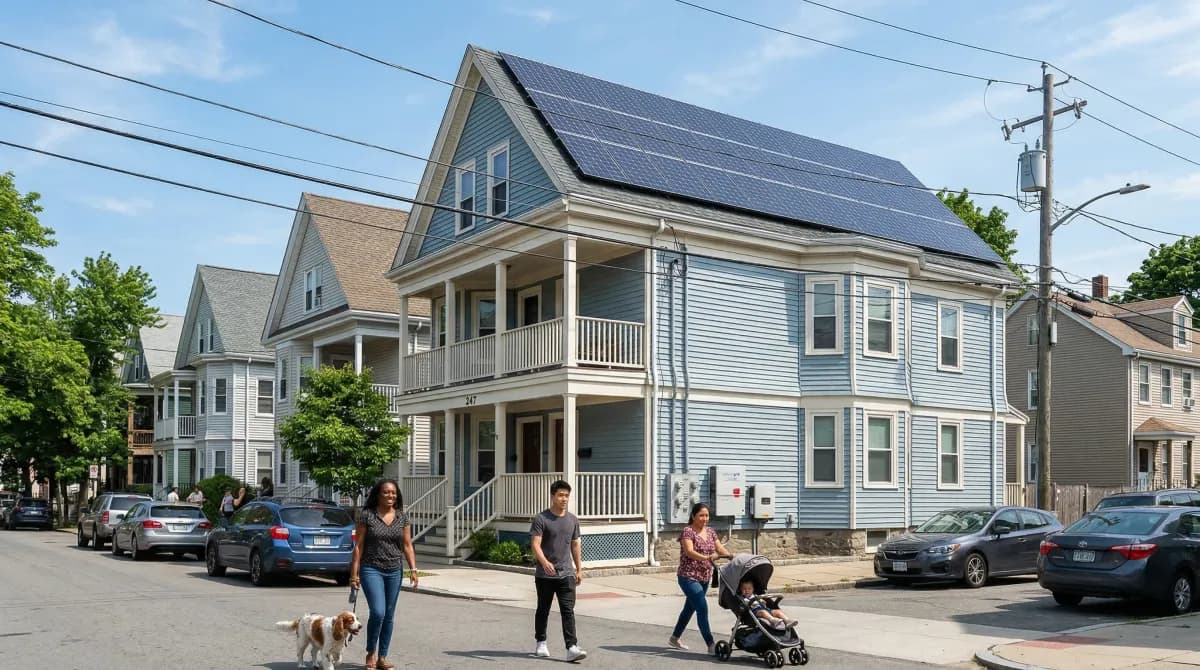
National Grid MA customers who qualify as income-eligible (household income ≤80% AMI) can access the SMART 3.0 low-income rate of $0.06/kWh for 20 years — double the standard rate. Combined with net metering at $0.42/kWh (among the highest in MA), a typical 8 kW system saves over $4,577/year. Renters can join community solar for 10-20% bill savings with zero installation. Mass Save provides free weatherization that reduces energy waste before solar goes on.
Solar savings are directly proportional to your electric rate. The higher your rate, the more each kilowatt-hour of solar generation is worth. National Grid's $0.42/kWh rate is among the highest in Massachusetts — higher than Eversource ($0.38/kWh) and trailing only the small Unitil territory ($0.48/kWh) — and that rate advantage compounds every year.
$0.42/kWh
~1.3M customers in central/southeast MA
8 kW system net metering value: ~$4,001/yr
$0.38/kWh
Eastern & western MA
8 kW system net metering value: ~$3,612/yr
$0.48/kWh
North-central MA (small territory)
8 kW system net metering value: ~$4,621/yr
The math is clear: National Grid customers earn $389 more per year in net metering savings than Eversource customers with an identical 8 kW system. Over 25 years, that adds up to $9,725 in additional savings — simply because your rate is higher. When you layer income-eligible SMART rates on top, the advantage grows even further.
Massachusetts uses Area Median Income (AMI) thresholds to determine eligibility. Your household size and county determine the exact income cutoff. Two tiers of income-eligible programs exist, each unlocking different benefits.
Double SMART rate ($0.06/kWh), priority community solar, Mass Save no-cost weatherization
SMART low-income rate ($0.06/kWh), community solar bill credits, Mass Save subsidized services
Standard SMART rate ($0.03/kWh), community solar available at market terms
The Massachusetts SMART program pays solar system owners a fixed rate per kilowatt-hour for 20 years. Income-eligible households receive $0.06/kWh — double the standard $0.03/kWh rate. This is guaranteed income on top of your net metering savings.
$0.03/kWh
For 20 years, guaranteed
8 kW system (9,600 kWh/yr):
$288/year SMART income
$5,760 over 20 years
$0.06/kWh
For 20 years, guaranteed
8 kW system (9,600 kWh/yr):
$576/year SMART income
$11,520 over 20 years
SMART payments stack with net metering. For a National Grid income-eligible customer, the combined annual benefit of an 8 kW system is approximately $576 (SMART) + $4,001 (net metering at $0.42/kWh) = $4,577/year. That is among the highest combined solar income available to any residential customer in Massachusetts. Read the full SMART 3.0 guide →
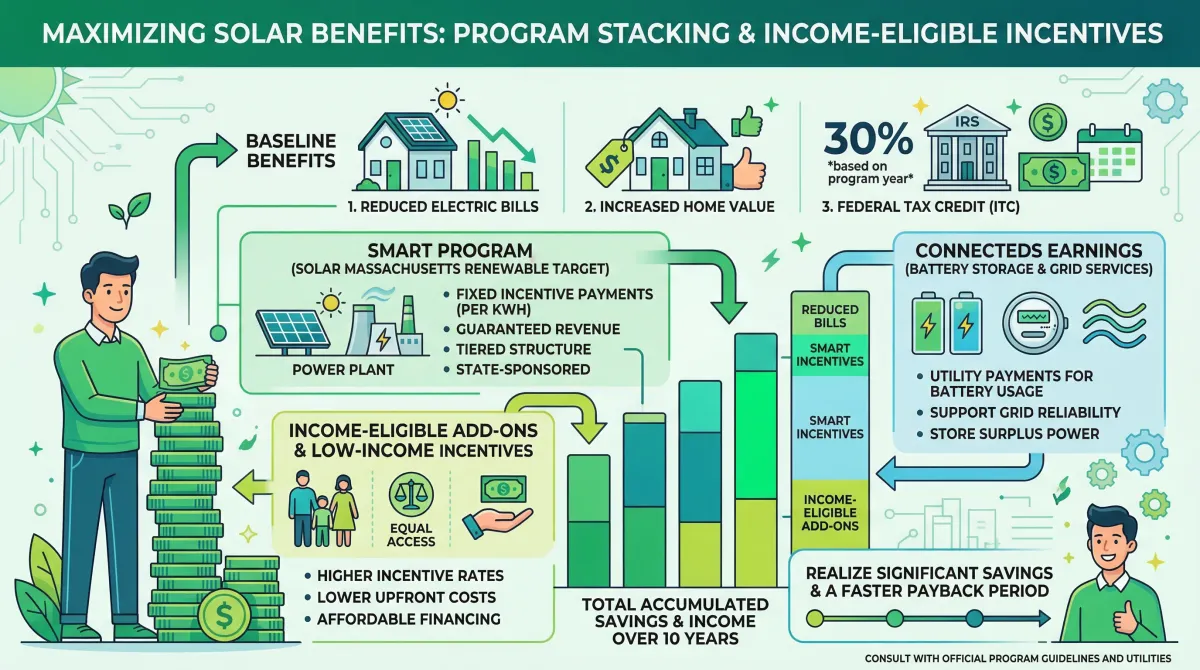
Income-eligible solar incentives stack across multiple programs for maximum savings
You do not need to own a home or have a suitable roof to benefit from solar. Community solar farms generate power that is credited to your National Grid bill. Income-eligible customers receive priority enrollment and guaranteed savings.
No installation required
No panels on your roof, no permits, no construction
No upfront cost
Subscribe for free — savings appear as bill credits
10-20% guaranteed bill savings
At NGrid's $0.42/kWh, that is $50-$100/month for a typical household
No long-term commitment
Cancel anytime if you move or change your mind
National Grid is a Mass Save sponsor, which means income-eligible NGrid customers get access to no-cost home energy assessments and heavily subsidized (or free) weatherization. The smart move is to weatherize before going solar — a tighter home needs a smaller solar system, which costs less and pays back faster.
Schedule a no-cost Mass Save home energy assessment. Income-eligible customers get priority scheduling.
Income-eligible households receive free insulation, air sealing, and efficiency upgrades — typically $3,000-$8,000 in value.
With lower energy usage post-weatherization, you need fewer panels — saving $2,000-$5,000 on system cost.
Why this matters: A household using 10,000 kWh/year that weatherizes first might drop to 7,500 kWh/year. That means you need a 6 kW system instead of an 8 kW system — saving roughly $4,500 in upfront cost while still covering 100% of your electricity needs. The smaller system also qualifies for the same SMART rate and net metering credits per kWh.
ConnectedSolutions pays you to let the utility draw from your home battery during peak demand events (typically 10-30 events per summer). National Grid's rates are lower than Eversource's, but still generate meaningful annual income.
ConnectedSolutions is available to all National Grid battery owners regardless of income level. It stacks fully with SMART payments and net metering credits. A complete income-eligible solar + battery system on National Grid can generate $576 (SMART) + $4,001 (net metering) + $625 (ConnectedSolutions) = ~$5,202/year in total annual benefit. Full ConnectedSolutions guide →
The federal residential solar tax credit (Section 25D) expired on December 31, 2025. Homeowners who buy solar with cash or a loan receive $0 in federal tax credits. However, the commercial ITC (Section 48E) remains available for projects beginning construction before July 4, 2026 — and it includes a powerful low-income adder.
Under a third-party ownership (TPO) structure — such as a solar lease or PPA — the financing company owns the system and claims the Section 48E credit. When the system serves an income-eligible household, the financing company can claim an additional 10-20% low-income adder on top of the base 30% credit.
Base ITC
30%
Low-Income Adder
+10-20%
Total Credit
40-50%
This larger credit enables the financing company to offer lower lease/PPA rates to income-eligible customers — effectively passing the federal benefit through as lower monthly payments.
Important: The Section 48E low-income adder applies to the financing company, not the homeowner directly. The homeowner benefits through reduced lease or PPA pricing. Cash and loan purchasers do not have access to any federal solar tax credit in 2026.
NuWatt verifies your eligibility, handles SMART enrollment, coordinates Mass Save weatherization, and designs a system sized to your actual energy needs. National Grid customers in central and southeast MA — start here.
Complete guide to SMART 3.0 rates, adders, and enrollment
Side-by-side rate comparison and solar value analysis
How to save 10-20% without rooftop panels
Earn $225/kW summer + $50/kW winter with demand response
All Massachusetts solar incentives in one place
Check your home and eligibility in 2 minutes