Loading NuWatt Energy...

We use your location to provide localized solar offers and incentives.
We serve MA, NH, CT, RI, ME, VT, NJ, PA, and TX
Loading NuWatt Energy...
NuWatt designs, installs, and manages solar, battery, heat pump, and EV charger systems across 9 states. One company, one warranty, one point of contact.
Get a Free QuoteMassachusetts homeowners heating with oil spend $3,500-$4,500 per year. A cold-climate heat pump delivers the same warmth for $2,150-$3,350 -- a potential savings of $700-$1,600 annually. But upfront costs, rebate eligibility, and home-specific factors matter. This is the definitive, neutral analysis to help you decide.
Last updated March 2026. Based on MA heating oil at $3.80/gal, Eversource all-in residential electric rate $0.38/kWh, cold-climate HP COP 3.0.
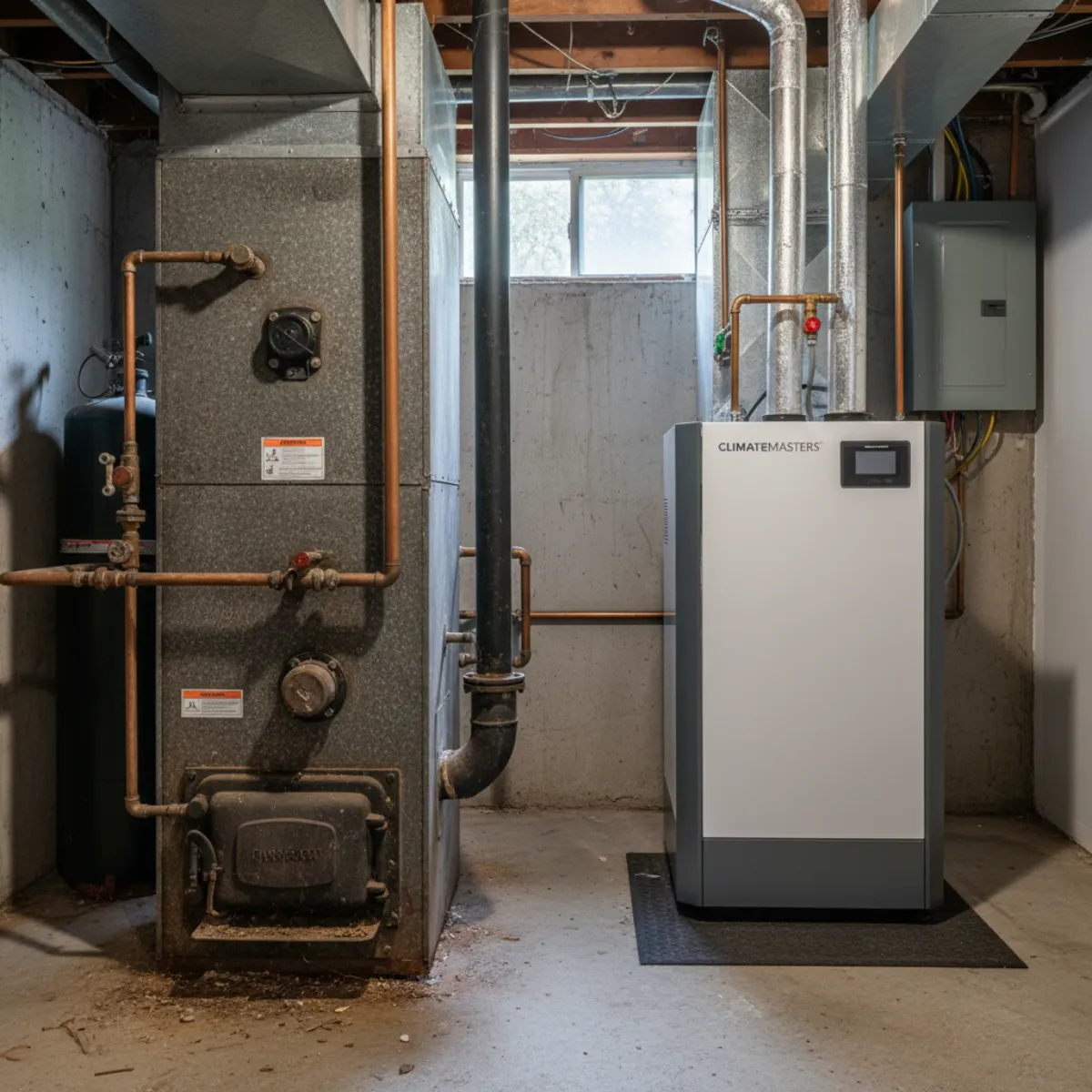
For most Massachusetts homeowners, switching from oil to a cold-climate heat pump saves $700-$1,600 per year in operating costs, with a 4-8 year payback after Mass Save rebates ($250-$8,500 standard). Over 10 years, heat pump owners save $10,000-$20,000 compared to staying on oil. Heat pumps also provide air conditioning, reduce CO2 by 80%, and increase home value. However, oil may still make sense for homes with hydronic radiant floors, those with brand-new oil boilers, or severely under-insulated homes that need weatherization first. The right answer depends on your specific home -- start with a free Mass Save Home Energy Assessment.
Massachusetts has roughly 800,000 households still heating with oil -- the third-highest rate in the nation. With oil prices fluctuating between $3.50 and $4.50 per gallon through 2025-2026 and the state committed to net-zero emissions by 2050 under the Climate Act, the question is not whether oil heating will phase out, but when and how fast.
Meanwhile, cold-climate heat pump technology has matured dramatically. Systems from Mitsubishi, Fujitsu, Daikin, and Carrier now operate efficiently down to -13F to -15F, covering even the coldest Massachusetts nights. The Massachusetts Department of Energy Resources (DOER) and utility companies have responded with some of the most generous heat pump incentives in the country through the Mass Save program.
But switching is not always straightforward. Upfront costs for heat pumps are higher than a new oil boiler. Some homes are better suited than others. And the math changes depending on your insulation levels, electricity rate, and whether you qualify for income-eligible enhanced rebates. This guide provides the data and framework to make the right decision for your specific situation -- not a sales pitch for either technology.
A detailed breakdown of what you actually spend each year to heat a typical Massachusetts home with oil versus a cold-climate heat pump.
800 gal/yr at $3.80/gal
COP 3.0, $0.38/kWh
Annual Savings: $1,280 per year
That is $107/month back in your pocket -- and the heat pump provides cooling that oil cannot.
The real comparison is not just annual fuel cost -- it is the total cost over the life of the system, including equipment, rebates, maintenance, and hidden costs like oil tank liability.
| Category | Oil | Heat Pump | Notes |
|---|---|---|---|
| Equipment cost | $5,000-$10,000 | $12,000-$25,000 | New oil boiler vs cold-climate HP system |
| Mass Save rebates | $0 | -$250 to -$8,500 standard | Income-eligible up to $16,000 |
| 0% HEAT Loan | N/A | Up to $25,000 at 0% | 7-year term, no interest |
| Annual fuel/electric | $3,500-$4,500 | $2,150-$3,350 | Oil at $3.80/gal vs $0.38/kWh, COP 3.0 |
| 10-year fuel/electric total | $35,000-$45,000 | $21,500-$33,500 | Assumes stable pricing |
| Annual maintenance | $300-$500 | $100-$200 | Oil requires annual tune-up + filter |
| 10-year maintenance total | $3,000-$5,000 | $1,000-$2,000 | Excludes major repairs |
| Oil tank insurance/liability | $200-$400/yr | $0 | Tank leak cleanup $10K-$50K+ |
| 10-year total cost of ownership | $45,000-$64,000 | $25,250-$50,500 | HP saves $10K-$20K over 10 years |
How costs compare month by month for a 2,000 sq ft Massachusetts home. Note: heat pumps add summer cooling costs that oil systems do not have, but this replaces window AC or central air.
| Month | Oil Cost | Heat Pump Cost | Net Savings |
|---|---|---|---|
| January | $450-$650 | $300-$480 | $150-$170 |
| February | $400-$600 | $275-$455 | $125-$145 |
| March | $300-$450 | $215-$360 | $85-$90 |
| April | $150-$250 | $95-$170 | $55-$80 |
| May | $0 | $50-$95 | -$50 to -$95 |
| June | $0 | $60-$110 | -$60 to -$110 |
| July | $0 | $70-$120 | -$70 to -$120 |
| August | $0 | $65-$115 | -$65 to -$115 |
| September | $0 | $35-$70 | -$35 to -$70 |
| October | $100-$200 | $70-$145 | $30-$55 |
| November | $250-$400 | $180-$300 | $70-$100 |
| December | $400-$550 | $265-$430 | $120-$135 |
Reading the table: Negative savings in summer months reflect the heat pump providing cooling that oil cannot. When you factor in eliminating window AC units ($150-$400/summer) or central AC ($300-$600/summer), the heat pump still comes out ahead annually.
One of the most underappreciated advantages of heat pumps is cost predictability. Massachusetts electricity rates are regulated and published in advance by the DPU, changing at most twice per year. Oil prices can swing 30-50% in a single season based on global supply disruptions, refinery capacity, and winter severity.
Over the last decade, Massachusetts electricity rates have increased an average of 3-4% per year, while heating oil has experienced year-over-year swings of 15-40%. For household budgeting, the predictability of electric heat is a significant practical advantage even beyond the absolute cost difference.
The upfront cost is the biggest barrier to switching. A new oil boiler is significantly cheaper than a heat pump system. But Massachusetts has among the most generous heat pump incentives in the country, which dramatically changes the math.
Installed, including oil tank inspection
Installed, whole-home system
The most common concern about switching from oil to a heat pump is winter performance. Ten years ago, this concern was valid -- standard heat pumps lost significant capacity below 30F. Today, cold-climate heat pump technology has eliminated this barrier for Massachusetts conditions.
COP = Coefficient of Performance. COP 3.0 means 3 units of heat per 1 unit of electricity. Even at COP 1.5, the heat pump produces heat -- just less efficiently. Electric resistance backup is COP 1.0.
Massachusetts winter temperatures typically range from 10F to 35F for 90%+ of heating hours. Cold-climate heat pumps operate at COP 2.0-3.5 across this range, making them significantly cheaper than oil (which operates at a fixed efficiency of 80-85% regardless of temperature). Only during the handful of hours per winter below 0F does efficiency drop to the point where supplemental backup might activate.
During the January 2024 cold snap, Boston saw temperatures drop to -10F. Homeowners with properly sized cold-climate heat pumps (Mitsubishi Hyper-Heat, Fujitsu XLTH) reported their systems maintained comfortable indoor temperatures throughout. The key is proper sizing -- a Manual J load calculation ensures the system has enough capacity for your specific home at design temperature. Undersized systems are the primary cause of cold-weather complaints, not the technology itself.
Massachusetts Climate Act requires the state to reach net-zero greenhouse gas emissions by 2050. Residential heating is the largest source of building emissions, and oil heating is the most carbon-intensive option. Switching from oil to an electric heat pump is one of the single highest-impact actions a homeowner can take.
If you pair your heat pump with rooftop solar panels, the carbon reduction approaches 100% -- your home effectively becomes carbon-neutral for heating and cooling. As the New England grid continues to add renewable energy (currently about 30% and growing), even grid-powered heat pumps get cleaner over time without any action from the homeowner.
Real estate data increasingly shows that homes with modern heat pump systems sell for more and sell faster than comparable homes with oil heating. In Massachusetts specifically, the trends are clear.
Massachusetts has not banned oil heating, but the regulatory trajectory is clear. Understanding the direction helps you make a forward-looking investment decision.
MA Stretch Energy Code requires new construction to be heat pump ready. Over 300 municipalities adopted.
Net-zero stretch code option becomes available. Several cities including Boston, Cambridge, and Brookline adopt it, effectively requiring heat pumps in new construction.
Mass Save triples heat pump rebates. HEAT Loan expanded to $25,000. Oil-to-heat-pump conversion bonuses introduced.
ConnectedSolutions expanded. Heat pump electric rate available from Eversource and National Grid. Oil delivery companies continue consolidating.
MA Climate Act interim milestone: 50% emissions reduction from 1990 baseline. Residential heating electrification is a primary pathway.
Net-zero emissions mandate. Oil heating expected to be largely phased out through market forces and incentive programs.
No one is coming to rip out your oil boiler. But the economics are shifting rapidly: oil infrastructure is declining, heat pump incentives are increasing, and future regulations will likely make oil systems harder and more expensive to maintain. A new oil boiler installed today will likely become a stranded asset before its 20-year lifespan ends. A heat pump installed today is aligned with the market direction for the next 30+ years.
This is not a one-size-fits-all decision. Here is an honest assessment of when switching makes sense and when it might not.
Even in these cases, getting a free Mass Save assessment provides valuable information about your options and costs.
Ready to Compare Your Oil vs Heat Pump Costs?
Get a personalized analysis based on your home size, current oil usage, insulation level, and Mass Save eligibility.
The average Massachusetts home uses 700-900 gallons of heating oil per year. At the current price of approximately $3.80/gallon, that translates to $2,660-$3,420 for fuel alone. When you add annual boiler maintenance ($300-$500), oil tank insurance ($200-$400), and occasional emergency service calls, total annual oil heating costs range from $3,200-$4,500 for a typical 2,000 sq ft home. Older, less-insulated homes or those in colder Western MA areas can spend $5,000+ per year.
A cold-climate heat pump system providing both heating and cooling for a 2,000 sq ft Massachusetts home typically costs $2,150-$3,350 per year in electricity at the standard Eversource all-in residential rate of $0.38/kWh with an average COP of 3.0. If your utility offers a heat pump electric rate (approximately $0.18/kWh for the heating season), costs can drop to $1,400-$2,200. This includes summer cooling, which oil systems cannot provide -- eliminating the need for separate window AC units or central air.
With Mass Save rebates ($250-$8,500 standard) and annual fuel savings of $700-$1,600, the typical payback period is 4-8 years. Income-eligible households receiving enhanced rebates (up to $16,000) can see payback in as little as 2-3 years. The 0% HEAT Loan ($25,000 over 7 years) means monthly loan payments are often lower than the monthly fuel savings from day one, making the switch cash-flow positive immediately for many homeowners.
Yes. Modern cold-climate heat pumps from Mitsubishi (Hyper-Heat), Fujitsu (XLTH), and Daikin (Aurora) are rated to operate at -13F to -15F. They maintain 75-80% of their rated heating capacity at 5F, which covers 95%+ of Massachusetts winter hours. At the coldest temperatures, the COP drops from 3.5-4.0 (at 47F) to about 1.8-2.2 (at 5F), meaning they still produce heat but use more electricity. For the handful of hours below -10F each winter, many systems include emergency electric resistance backup.
Mass Save offers heat pump rebates ranging from $250 to $8,500 standard depending on the system size, type, and whether you are replacing a fossil fuel system. Whole-home conversions from oil typically qualify for the highest tier. Income-eligible households (at or below 80% area median income) can receive enhanced rebates up to $16,000. All homeowners can access the 0% HEAT Loan for up to $25,000 over 7 years. A free Mass Save Home Energy Assessment is the required first step, which also provides insulation and air sealing incentives.
Many homeowners keep their oil boiler as backup during the first heating season to build confidence. This is a reasonable strategy, especially for older homes or those without good insulation. However, maintaining two systems has costs -- annual oil boiler maintenance ($300-$500), keeping oil in the tank, and the liability of the tank itself. Most homeowners who install properly sized cold-climate heat pumps find they rarely or never use the oil backup and decommission it after one winter. If your home is well-insulated and you choose a quality cold-climate system, running without oil backup is a proven approach in Massachusetts.
Oil may still be the pragmatic choice in a few specific situations: (1) Homes with hydronic radiant floor heating -- heat pumps can feed air handlers but integrating with in-floor hydronic systems requires an air-to-water heat pump, which is more expensive and less common. (2) Very old, uninsulated homes where the heat loss is too extreme for heat pumps without major weatherization first. (3) Homes where the oil boiler was replaced within the last 3-5 years -- the existing investment changes the payback math. (4) Homeowners planning to sell within 2-3 years where the payback period exceeds ownership horizon. In most other cases, heat pumps offer lower operating costs and better comfort.
Heating oil produces approximately 22.4 pounds of CO2 per gallon burned. A Massachusetts home burning 800 gallons per year generates roughly 17,920 lbs (8.1 metric tons) of CO2 from heating alone. A heat pump drawing from the New England grid (which is about 50% natural gas, 30% renewables, 15% nuclear in 2026) produces approximately 3,600 lbs (1.6 metric tons) of CO2-equivalent for the same heating output. That is an 80% reduction. If you pair your heat pump with rooftop solar, the reduction approaches 100%. Massachusetts Climate Act targets make this transition central to the state achieving net-zero by 2050.
Step-by-step oil-to-heat-pump conversion process with Mass Save timeline.
Complete pricing guide for mini-split, ducted, and multi-zone systems.
How to get the 0% interest $25,000 HEAT Loan for heat pump installation.
All current Mass Save and utility rebates for heat pumps in MA.
Every home is different. Answer a few questions about your current oil usage, home size, and insulation to get a custom savings estimate with applicable Mass Save rebates.