Loading NuWatt Energy...

We use your location to provide localized solar offers and incentives.
We serve MA, NH, CT, RI, ME, VT, NJ, PA, and TX
Loading NuWatt Energy...
NuWatt designs, installs, and manages solar, battery, heat pump, and EV charger systems across 9 states. One company, one warranty, one point of contact.
Get a Free QuoteWithout compliance, your commercial solar ITC drops from 30% to 6% for projects over 1MW. Complete guide to Davis-Bacon wage rates, apprenticeship ratios, penalties, and cure provisions for Massachusetts.
Compliant ITC
30%
Base rate with compliance
Non-Compliant ITC
6%
80% reduction without
2026 Apprentice Ratio
15%
Of total labor hours
MA Prevailing Wages
$60-$120/hr
By trade and county
Under the Inflation Reduction Act (IRA), commercial solar projects over 1MW AC that began construction after January 29, 2023 must pay Davis-Bacon prevailing wages and meet apprenticeship requirements to claim the full 30% ITC. Without compliance, the ITC drops to just 6%. In 2026, the apprenticeship ratio is 15% of total labor hours. Massachusetts prevailing wages range from $60-$120/hr depending on trade and county — electricians in Greater Boston earn approximately $101/hr total compensation. Penalties include $5,000 per worker plus back pay, but a cure provision exists for non-intentional violations. Projects under 1MW are exempt and automatically qualify for the full ITC.
The Inflation Reduction Act (IRA) of 2022 restructured the commercial solar Investment Tax Credit (ITC) with a two-tier system that makes prevailing wage and apprenticeship compliance the single most important factor in determining your project's ITC rate. For projects over 1MW AC that began construction after January 29, 2023, meeting these requirements is the difference between a 30% ITC and a 6% ITC — an 80% reduction in the most valuable federal incentive.
The financial impact is enormous. On a typical 1.5MW Massachusetts commercial solar project costing approximately $1.8 million, the difference between 30% and 6% ITC is $432,000 in lost tax credits. Even with bonus adders, non-compliant projects receive only 2% per adder instead of 10%, compounding the loss. No amount of savings on labor costs can offset this reduction — paying prevailing wages is always the economically rational choice.
Massachusetts is in a particularly strong position for compliance because the state already has robust prevailing wage traditions and a deep pool of union labor experienced in solar installation. Most qualified commercial solar installers in MA already pay at or near Davis-Bacon rates. The apprenticeship requirement is where projects need the most planning — ensuring 15% of labor hours are performed by registered apprentices requires advance coordination with apprenticeship programs.
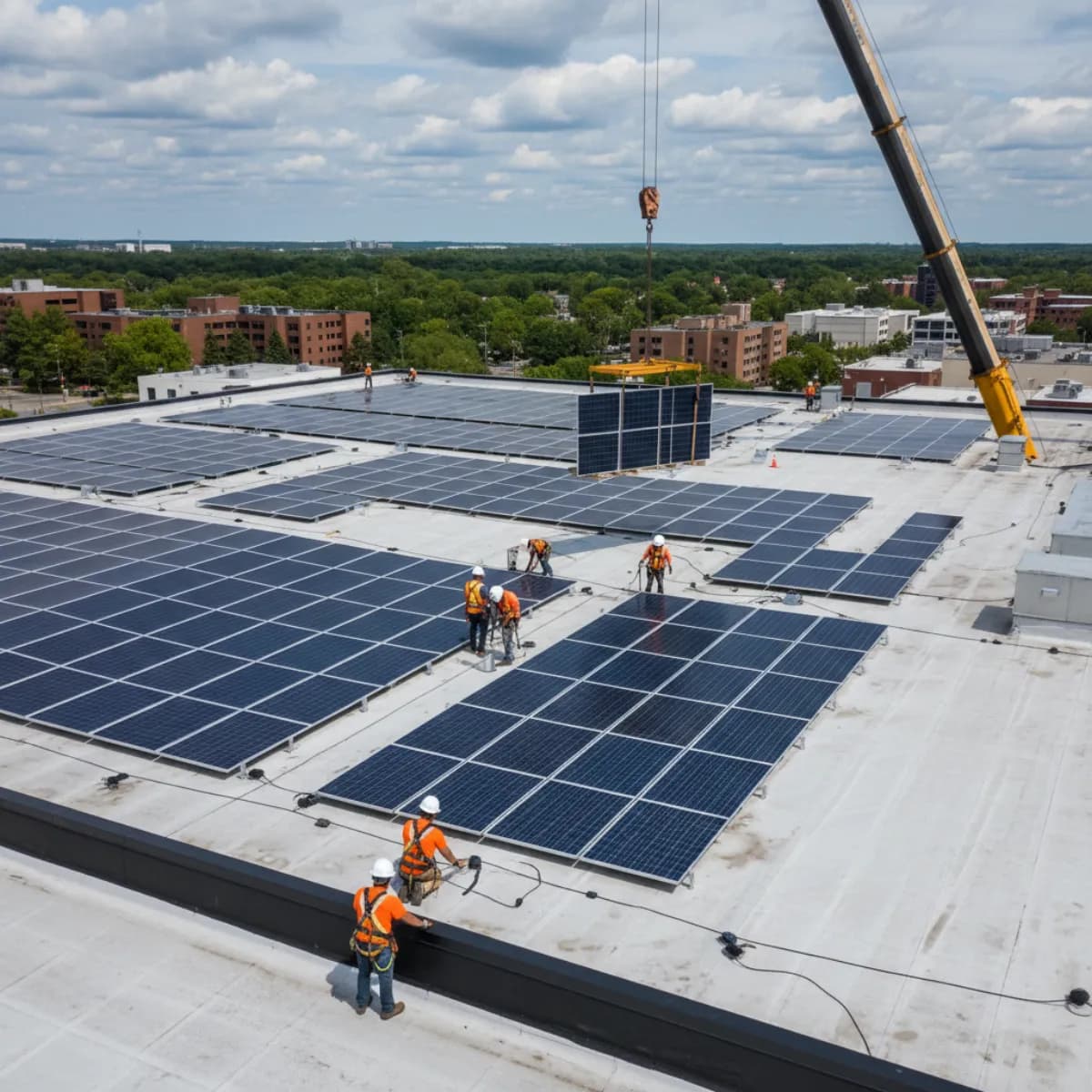
The IRA created a five-to-one ratio between compliant and non-compliant ITC rates. Every component of the ITC — base rate and all bonus adders — is reduced by 80% without prevailing wage and apprenticeship compliance. The table below shows the complete picture.
| Scenario | Base ITC | Domestic Content | Energy Community | Low-Income | Max ITC |
|---|---|---|---|---|---|
| Compliant (>1MW) | 30% | +10% | +10% | +10-20% | Up to 70% |
| Non-Compliant (>1MW) | 6% | +2% | +2% | +2-4% | Up to 14% |
| Under 1MW (exempt) | 30% | +10% | +10% | +10-20% | Up to 70% |
Difference: $576,000 in lost ITC value — far exceeding any prevailing wage premium.
The prevailing wage and apprenticeship requirements apply based on two factors: system size and construction start date. Understanding these thresholds is critical for determining whether your project needs a compliance plan.
The IRS defines "beginning of construction" using two tests (either one is sufficient): (1) Physical Work Test — starting physical work of a significant nature at the project site or at a factory (e.g., pouring foundations, installing racking), or (2) Five Percent Safe Harbor — incurring 5% or more of total project costs. Once construction begins, the project must be placed in service within 4 years (the Continuity Requirement). For MA commercial solar projects in 2026, the construction start date is critical for both ITC qualification and the July 4, 2026 FEOC deadline.
Prevailing wage rates for solar projects are determined by the Davis-Bacon Act and vary by trade classification and county. Massachusetts rates are among the highest in the nation due to the state's strong union labor presence. The rates below include both base hourly pay and fringe benefits (health insurance, pension, apprenticeship fund, annuity, and other benefits required under the prevailing wage determination).
| Trade Classification | Base Pay | Fringe | Total/Hr | Counties |
|---|---|---|---|---|
| Electrician (Inside Wireman) | $62.50/hr | $38.75/hr | $101.25/hr | Suffolk, Middlesex, Norfolk |
| Electrician (Inside Wireman) | $56.80/hr | $35.20/hr | $92.00/hr | Worcester, Hampshire, Hampden |
| Ironworker (Structural) | $52.40/hr | $42.10/hr | $94.50/hr | Suffolk, Middlesex, Norfolk |
| Ironworker (Structural) | $48.60/hr | $38.90/hr | $87.50/hr | Worcester, Hampshire, Hampden |
| Laborer (General) | $42.30/hr | $28.70/hr | $71.00/hr | Suffolk, Middlesex, Norfolk |
| Laborer (General) | $38.50/hr | $25.50/hr | $64.00/hr | Worcester, Hampshire, Hampden |
| Operating Engineer (Crane) | $58.90/hr | $36.10/hr | $95.00/hr | All MA counties |
| Roofer | $50.20/hr | $32.80/hr | $83.00/hr | All MA counties |
Rates are approximate and subject to annual updates. Always verify current rates at the Department of Labor SAM.gov wage determination database for the specific project location and trade. Massachusetts projects may also be subject to state prevailing wage requirements under M.G.L. c. 149 for publicly funded projects.
The Inflation Reduction Act requires that a minimum percentage of total labor hours on applicable solar projects be performed by qualified apprentices enrolled in registered apprenticeship programs. This ratio has increased over time and reaches 15% in 2026 and beyond.
2022-2023
10%
2024-2025
12.5%
2026+
15%
CurrentIf qualified apprentices are unavailable, contractors can meet the requirement through documented good faith efforts:
The IRA includes specific penalty provisions for prevailing wage and apprenticeship violations, along with cure provisions that allow taxpayers to correct non-intentional violations before claiming the ITC. Understanding these provisions is essential for risk management and compliance planning.
For each worker paid below the prevailing wage rate, the taxpayer owes $5,000 per worker PLUS the difference in pay (back wages) for all hours worked below the required rate.
If the IRS determines the underpayment was intentional, penalties triple: $10,000 per worker plus three times the back pay owed. No cure provision for intentional violations.
For each hour of apprentice labor required but not provided, the taxpayer pays $50. The shortfall is calculated as total labor hours x required ratio minus actual apprentice hours.
Non-compliance with either prevailing wage or apprenticeship requirements reduces the base ITC from 30% to 6% and all bonus adders from 10% to 2%. This is by far the largest financial consequence.
For non-intentional violations, the taxpayer can cure the violation and retain the full ITC by completing these steps before filing the tax return claiming the ITC:
Robust recordkeeping is your best defense against compliance challenges. The IRS expects taxpayers claiming the full ITC to maintain detailed documentation proving prevailing wage and apprenticeship compliance throughout the construction period and beyond. Here are the essential records every project should maintain.
Weekly certified payroll for all workers on-site, including wage rates, fringe benefits, hours worked, and job classifications.
The applicable wage determination for each trade and county where work is performed. Must be locked at project start.
Registered apprenticeship program documentation for all apprentices, including program registration number and sponsoring organization.
Evidence of requests to registered apprenticeship programs for apprentice labor, including dates, programs contacted, and responses received.
Written certifications from all subcontractors confirming compliance with prevailing wage and apprenticeship requirements.
Monthly summary reports documenting total labor hours, apprentice hours, ratio compliance, and any corrective actions taken.
For large projects (1MW+), consider engaging a third-party compliance monitor who specializes in Davis-Bacon prevailing wage and apprenticeship requirements. These firms provide weekly payroll review, apprenticeship ratio tracking, and documentation management. The cost is typically $10,000-$25,000 for a project — negligible compared to the hundreds of thousands in ITC value at stake. Your solar developer should either provide this service or recommend a qualified compliance monitor.
Complete commercial solar guide: ITC stacking, SMART 3.0, pricing, financing, and ROI.
5-year MACRS + 100% first-year bonus depreciation. How MACRS interacts with prevailing wage ITC.
Calculate your MACRS tax savings with the full 30% ITC from prevailing wage compliance.
Model your project IRR including prevailing wage labor costs and full ITC value.
If your commercial solar project is over 1MW AC and fails to meet prevailing wage requirements, the base ITC drops from 30% to 6% — an 80% reduction. All bonus adders are similarly reduced (domestic content from +10% to +2%, energy community from +10% to +2%, low-income from +10-20% to +2-4%). For a $1.5M system, this could mean losing $360,000 in ITC value (from $450,000 at 30% to $90,000 at 6%). There is a cure provision that allows you to pay back wages plus a $5,000 per worker penalty to restore the full ITC, but this must be completed before claiming the credit.
Our team works exclusively with prevailing-wage-compliant installers. Get a quote that includes full compliance documentation and apprenticeship coordination.