Loading NuWatt Energy...

We use your location to provide localized solar offers and incentives.
We serve MA, NH, CT, RI, ME, VT, NJ, PA, and TX
Loading NuWatt Energy...
NuWatt designs, installs, and manages solar, battery, heat pump, and EV charger systems across 9 states. One company, one warranty, one point of contact.
Get a Free Quote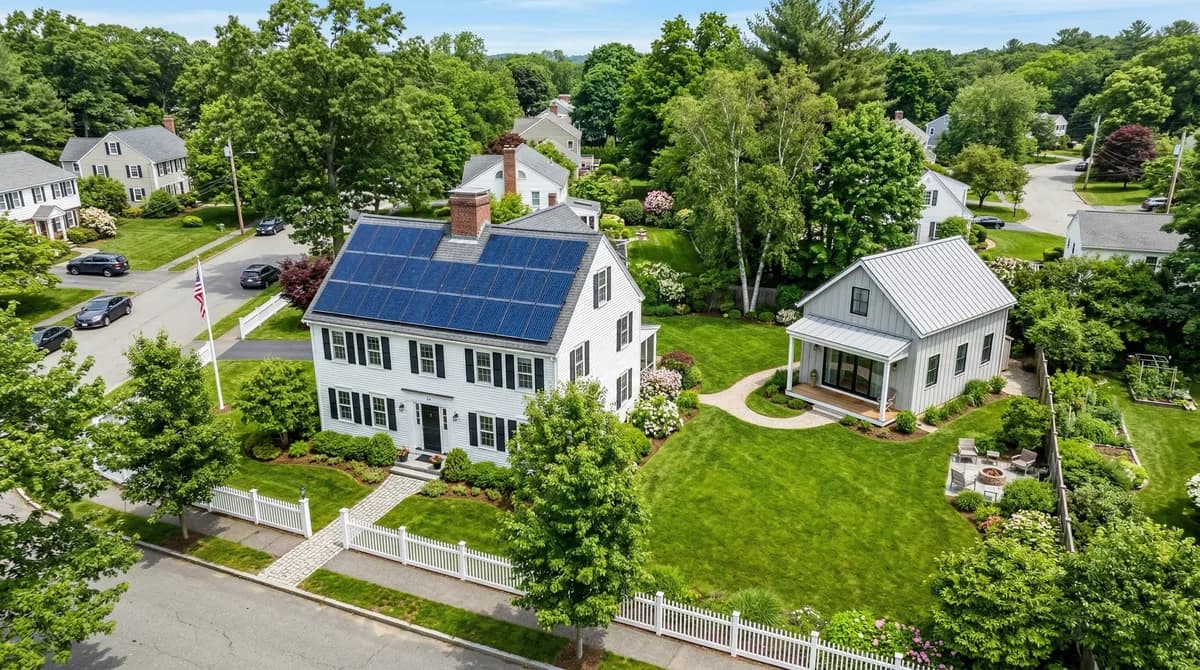
Massachusetts now allows an accessory dwelling unit on every single-family lot. Here is how to size your solar system to power both your main house and ADU, choose the right metering setup, and maximize your return with SMART 3.0 and Mass Save rebates.
Governor Healey signed the Affordable Homes Act in August 2024, making ADUs by-right on every single-family lot in Massachusetts. No special permit, no variance, no town meeting vote. This opens a massive opportunity to combine solar with ADU construction.
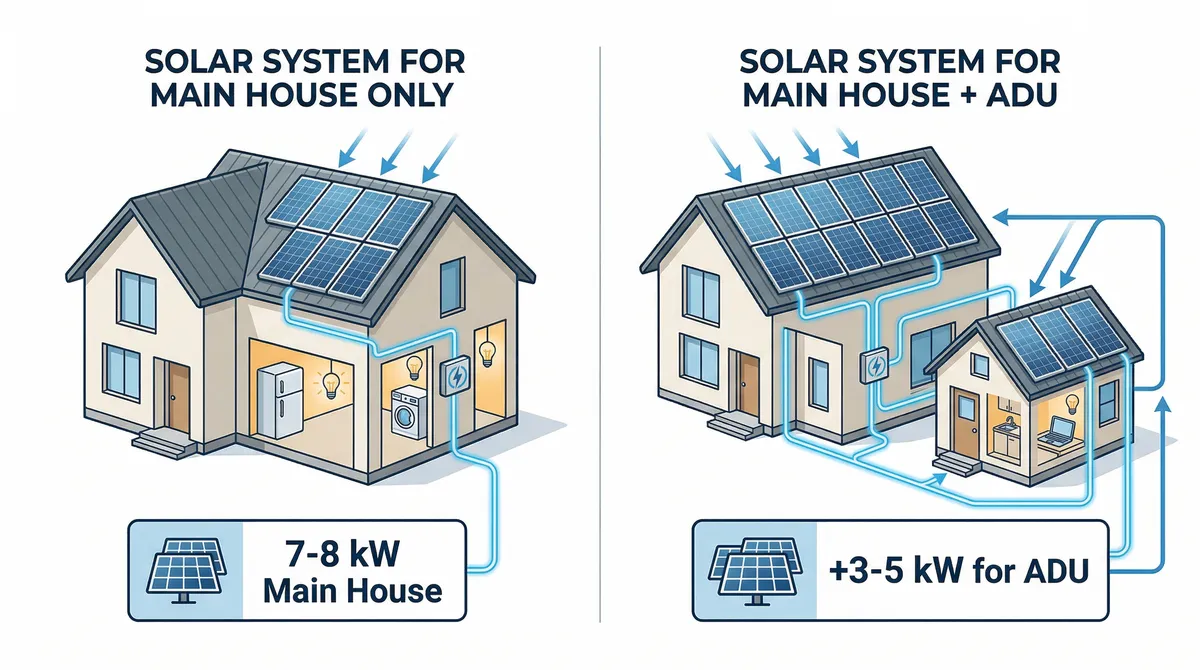
An ADU adds 2,000-5,500 kWh per year to your electric load depending on size and whether it has a heat pump. Here is how system sizing changes for each ADU scenario.
A typical MA single-family home before adding an ADU. This is your baseline electric load for solar sizing.
A studio or 1-bedroom ADU adds roughly 2,000 kWh/year. Mini-split heat pump adds another 1,500 kWh. Size solar to cover both dwellings.
A 1-2 bedroom ADU with full kitchen and heat pump. Additional 4,000 kWh/year. This is the most common ADU size in MA suburbs.
A 2-bedroom ADU at the MA maximum (900 sqft). Full appliance load including heat pump, hot water, cooking. Add 5,500 kWh/year to baseline.
The Section 25D residential solar ITC expired December 31, 2025. All costs shown above are the full price with no federal credit. Massachusetts state incentives (SMART 3.0, net metering, property tax exemption, sales tax exemption) still apply and make solar financially viable. A lease or PPA may offer lower upfront costs since the third-party owner can still claim Section 48E.
Your metering configuration determines how solar credits flow between the main house and ADU. This is one of the most important decisions in your solar + ADU project.
The best panel location depends on your roof areas, orientations, shading, and metering configuration. Most installations put panels on the main house roof.
ADU rental income makes solar loan payments nearly invisible. Here is the math for Greater Boston, where median ADU rents run $1,500-$2,500/month.
Plus SMART income (~$35/mo), net metering savings (~$350/mo), and ConnectedSolutions DR revenue (~$50/mo). Solar + ADU total annual return: $23,000+ per year in combined rental and energy income.
11 kW
12 kW + 13.5 kWh battery
13 kW + 13.5 kWh battery + 12K BTU mini-split
A battery protects both your main house and ADU during Nor'easters, ice storms, and grid outages. Plus, ConnectedSolutions demand response pays $225-$275/kW/summer.
Tesla Powerwall 3 (13.5 kWh)
Enphase IQ 10T (10.5 kWh) or FranklinWH aPower2 (15 kWh)
2x Powerwall 3 (27 kWh) or 2x Enphase IQ 10T (21 kWh)
A ductless mini-split is the ideal HVAC solution for an ADU: compact, efficient, and eligible for Mass Save rebates up to $8,500. Size it right for Massachusetts winters (Climate Zone 5A, design temp 5 degrees F).
| ADU Size | BTU Needed | Recommended Model | Heating @ 5°F | Annual kWh | Cost (Before Rebate) |
|---|---|---|---|---|---|
| 400 sqft (Studio) | 9,000 BTU | Mitsubishi MSZ-FH09NA or Fujitsu 9RLFCD | 12,000 BTU @ 5°F | 1,200-1,500 kWh | $3,500-$5,000 installed |
| 600 sqft (1-Bed) | 12,000 BTU | Mitsubishi MSZ-FH12NA or Daikin FTX12UVJU | 15,400 BTU @ 5°F | 1,500-2,000 kWh | $4,000-$6,000 installed |
| 900 sqft (2-Bed) | 18,000-24,000 BTU | Multi-zone: Mitsubishi MXZ-2C20NA2 + 2 heads | 22,000 BTU @ 5°F | 2,500-3,500 kWh | $7,000-$10,000 installed |
Building an ADU and installing solar can be permitted concurrently in most MA towns. Here is the step-by-step timeline.
Under MA Chapter 40A Section 3 (2024 ADU law), ADUs are by-right on single-family lots. No special permit or variance required. Your town must process the building permit within 60 days.
If adding a separate meter for the ADU, you may need a service upgrade from 100A to 200A, or a new 100A sub-panel. Eversource/NGrid coordinate meter installation.
Solar permit can be submitted concurrently with or after the ADU permit. Many MA towns use SolarAPP+ for expedited solar permits (1-3 business days).
Filed by your solar installer. Eversource: typically 15-30 business days. National Grid: 30-60 business days. Include VNM allocation if using separate meters.
Enroll after Permission to Operate (PTO). SMART 3.0: $0.03/kWh for 20 years. System must be under 25 kW AC to qualify for residential rate.
ADU mini-split is eligible for Mass Save rebates: up to $8,500 for whole-home heat pump conversion. Must use a participating Mass Save contractor.
When solar and ADU permits are submitted concurrently, the total project timeline is typically 12-20 weeks from initial application to Permission to Operate (PTO). Sequential permitting (ADU first, then solar) adds 4-8 weeks. We recommend concurrent filing wherever possible.
Yes. Under the 2024 MA ADU law (Chapter 40A Section 3), every single-family lot can add an ADU by right. You can install solar panels on the main house roof, the ADU roof, or both to power the combined property. Solar and ADU permits can be submitted concurrently to save time. Most MA towns process solar permits through SolarAPP+ in 1-3 business days.
A typical 600-900 sqft ADU with a mini-split heat pump, standard appliances, and LED lighting adds 3,500-5,500 kWh per year to your electric load. That translates to 3-5 kW of additional solar capacity, or roughly 7-12 extra panels. A 400 sqft studio ADU needs fewer panels (5-7 extra) since it has lower heating and appliance loads.
If you live in the main house and the ADU is for family or short-term rental, a shared meter is simpler and cheaper. If the ADU is a long-term rental to an unrelated tenant, Massachusetts landlord-tenant law generally requires the tenant to have their own electric meter. Separate meters cost $500-$1,200 to install but give the tenant an independent electric account. You can use virtual net metering (VNM) to allocate solar credits between both meters.
Yes. Massachusetts allows virtual net metering (VNM), which lets you allocate solar net metering credits between multiple meters on the same property. For example, you could allocate 70% of credits to the main house meter and 30% to the ADU meter. Both Eversource and National Grid support VNM. File the allocation schedule with your interconnection application. Systems under 25 kW AC receive 1:1 retail-rate credits.
Yes. The solar system powering the ADU qualifies for SMART 3.0 incentives at $0.03/kWh for 20 years (residential rate for systems up to 25 kW AC). SMART payments are based on the total solar production of the system, not which meter it serves. A 12 kW system producing 14,000 kWh/year earns approximately $420/year in SMART income.
Yes. Mass Save heat pump rebates apply to the ADU as a dwelling unit. If the ADU uses a mini-split heat pump as its primary heating and cooling system, you may qualify for up to $8,500 in standard rebates. The ADU must be served by a participating utility (Eversource, National Grid, Unitil, or Cape Light Compact). You must use a Mass Save participating contractor for installation.
For Massachusetts climate (Zone 5A), size your mini-split based on ADU square footage: 400 sqft studio needs 9,000 BTU (9K), 600 sqft 1-bedroom needs 12,000 BTU (12K), and 900 sqft 2-bedroom needs 18,000-24,000 BTU (multi-zone). Choose cold-climate rated models (Hyper-Heat or equivalent) that maintain full capacity down to 5 degrees F for reliable winter heating.
Solar significantly improves ADU rental economics. A shared-meter setup means the tenant electricity cost is essentially zero (covered by solar). You can charge $100-$200/month more for a utilities-included rental in the Greater Boston market. Even with separate meters and VNM, allocating 30% of solar credits to the ADU meter reduces tenant bills by $80-$120/month, making your unit more competitive.
You don't need one, but a battery protects both dwellings during outages. A single 13.5 kWh battery (Tesla Powerwall 3) can cover critical loads in both the main house and ADU with load management. For full backup of both dwellings, consider two batteries (27 kWh). Batteries also earn ConnectedSolutions demand response revenue: $225-$275 per kW per summer from Eversource or National Grid.
The 2024 MA ADU law (Chapter 40A Section 3, effective February 2025) requires every municipality to allow one ADU by right on any single-family lot. Key rules: maximum 900 sqft or 50% of main dwelling (whichever is smaller), no additional parking required, owner occupancy not required, one ADU per lot, must comply with building code, and the town must process the permit within 60 days. Towns cannot impose special permits, site plan review, or age restrictions.
Full MA pricing breakdown by city
Read guideHow VNM credits work with two meters
Read guide$0.03/kWh for 20 years — enrollment guide
Read guideEarn $225-$275/kW/summer with DR
Read guideManual J for MA climate zones
Read guideSolarAPP+ and town-by-town tips
Read guideCommunity solar and VNM options
Read guideMulti-unit solar for MA triple-deckers
Read guideGet a free solar + ADU sizing consultation from NuWatt Energy. We design systems for main house + ADU in Greater Boston, the South Shore, North Shore, Metro West, and all of Massachusetts.