Loading NuWatt Energy...

We use your location to provide localized solar offers and incentives.
We serve MA, NH, CT, RI, ME, VT, NJ, PA, and TX
Loading NuWatt Energy...
NuWatt designs, installs, and manages solar, battery, heat pump, and EV charger systems across 9 states. One company, one warranty, one point of contact.
Get a Free QuoteThe residential solar tax credit is dead. But for Massachusetts small businesses, the Section 48/48E commercial ITC is very much alive — 30% base, up to 70% with bonus adders. Combined with MACRS depreciation and SMART program payments, 2026 is a strong year for commercial solar — projects that began construction by July 4, 2026 locked in the full credit timing; projects that start later still qualify if placed in service by December 31, 2027.
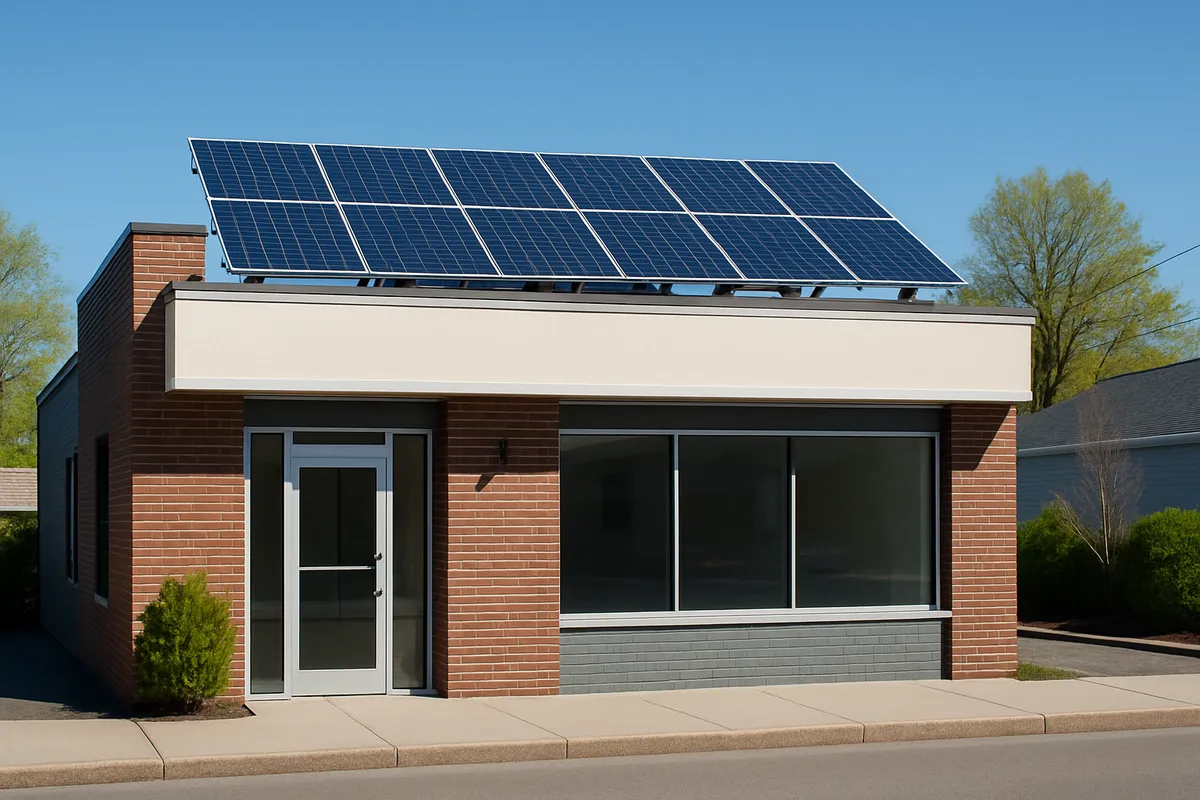
Massachusetts has the highest commercial electric rates in the continental US, averaging $0.25-$0.32/kWh depending on your utility. Combined with the still-available commercial ITC, MACRS depreciation, and SMART program production payments, small business solar in Massachusetts offers some of the fastest payback periods in the country.
Projects that began constructionby July 4, 2026 locked in the full Section 48/48E timing; projects that start later still qualify if placed in service by December 31, 2027. “Begin construction” means either: (1) physical work of a significant nature begins (excavation, foundation, panel delivery), or (2) you incur 5%+ of the total project cost (a signed contract with a deposit typically qualifies). To capture the most flexible window, do not wait — permitting, utility interconnection, and equipment procurement in Massachusetts can take 8-12 weeks.
MA commercial rates $0.25-$0.32/kWh. Higher rates = more savings per kWh of solar production.
30-70% ITC + 5-year MACRS depreciation + SMART production payments. Three separate incentive streams.
Eversource and National Grid commercial rates have increased every year. Solar locks in your energy cost.
The commercial ITC is a direct tax credit — it reduces your federal tax bill dollar-for-dollar. The base credit is 30%, with bonus adders that can push it to 50-70%.
Base ITC (30%)
Available for all qualifying commercial projects; projects that began construction by July 4, 2026 kept full timing, or place in service by Dec 31, 2027 if starting later
Domestic Content Bonus (+10%)
Panels, inverters, and racking manufactured or assembled in the US
Energy Community Bonus (+10%)
Project located in a brownfield, former fossil fuel employment area, or retired coal community
Low-Income Bonus (+10-20%)
+10% for projects in low-income census tracts; +20% for qualified low-income residential or economic benefit projects
In addition to the ITC, businesses can depreciate the solar system using MACRS. Under OBBBA, there is a permanent 100% first-year bonus depreciation, so the entire depreciable basis is expensed in year one. The depreciable basis is the system cost minus 50% of the ITC.
Example: $100,000 system with 30% ITC
The SMART (Solar Massachusetts Renewable Target) 3.0 program pays commercial solar systems a per-kWh rate for every kWh produced, for 20 years. This is on top of your net metering credits and ITC — it is a separate production incentive.
Important: Demand Charges
Commercial electric bills in MA include demand charges ($5-$15/kW of peak demand per month). Solar panels reduce your energy charges but do NOT significantly reduce demand charges. To reduce demand charges, you need battery storage. Factor this into your ROI calculation.
Based on actual MA commercial electric rates, 2026 ITC rates, and current equipment pricing. System sizes under 100 kW qualify as small commercial.
30 kW system — 30% ITC
Single-story commercial building in a mixed-use zone. Flat roof with 2,400 sq ft available. Eversource commercial rate $0.28/kWh. SMART 3.0 rate $0.03/kWh. Net metering credits for any excess. 30% base ITC only (no bonus adders in this location).
Cash purchase using business reserves. ITC and MACRS offset 47% of cost in year 1.
60 kW system — 40% (base + domestic content) ITC
Large flat-roof garage with 5,000+ sq ft of unshaded space. National Grid commercial rate $0.32/kWh (among the highest in MA). Uses Silfab 440W panels (FEOC-compliant for domestic content bonus). Energy community bonus NOT applicable in this location.
C-PACE financing — no money down. $8,400/year C-PACE payment vs $22,320/year savings = cash-flow positive from day 1.
45 kW system — 50% (base + domestic + energy community) ITC
Medical practice on Cape Cod with Eversource commercial rate $0.28/kWh. Roof-mounted with high sun exposure. Located in an energy community qualifying area. Silfab 440W FEOC-compliant panels. Stacks base ITC (30%) + domestic content (10%) + energy community (10%) = 50% total ITC.
SBA 7(a) loan at 7.5% APR, 10-year term. Monthly payment $1,190 vs $1,395/month savings = cash-flow positive immediately.
Best for: Businesses with cash reserves, maximum long-term savings
Pros
Cons
Typical Terms: Full payment at installation. ITC claimed on next tax return. MACRS depreciation over 5 years.
Best for: Property owners who want no money down with long-term fixed rates
Pros
Cons
Typical Terms: Through MassDevelopment Finance Agency. 20-25 year repayment via property tax assessment. Rates typically 5-7%.
Best for: Small businesses that want shorter term financing with SBA backing
Pros
Cons
Typical Terms: Up to 25 years for real estate, 10 years for equipment. Current rates ~7-9% depending on lender.
Best for: Quick funding with solar-specific terms
Pros
Cons
Typical Terms: 7-15 year terms, 6-10% APR depending on credit. Monthly payments designed to be less than electric savings.
Best for: Businesses that want zero upfront cost and no maintenance responsibility
Pros
Cons
Typical Terms: Third-party owner installs, operates, and maintains. You buy power at $0.12-0.18/kWh (below retail). The system owner claims the 48/48E ITC.
Yes. The Section 48/48E commercial Investment Tax Credit (ITC) is still available for business solar. Projects that began construction by July 4, 2026 locked in the full credit timing; projects that start later still qualify if placed in service by December 31, 2027. The base credit is 30% of the total installed cost. With bonus adders for domestic content (+10%), energy community (+10%), and low-income (+10-20%), the total credit can reach 50-70%. This is a direct tax credit — it reduces your federal tax bill dollar-for-dollar.
Small business solar systems (25-100 kW) in Massachusetts cost $1.80-$2.55 per watt installed in 2026. A typical 50 kW system for a small retail or office building runs $90,000-$127,500 before incentives. After the 30% base ITC ($27,000-$38,250) and MACRS depreciation (~20% tax benefit), the effective net cost is roughly $45,000-$70,000.
MACRS (Modified Accelerated Cost Recovery System) allows businesses to depreciate solar equipment over 5 years. Under OBBBA, 100% first-year bonus depreciation is permanently restored, so the entire depreciable basis is expensed in year one. You depreciate the cost basis minus 50% of the ITC. For a $100,000 system with 30% ITC, you depreciate $85,000 ($100K minus $15K which is half the $30K ITC) — all in year one — generating approximately $20,000-$25,000 in additional tax savings.
Yes. The SMART 3.0 program pays commercial solar systems (25 kW - 500 kW) a declining block rate for every kWh produced over 20 years. The exact rate depends on which capacity block your project falls into — earlier projects get higher rates. SMART payments are in addition to net metering credits and the federal ITC. This is a significant revenue stream for commercial installations.
C-PACE (Commercial Property Assessed Clean Energy) is a financing mechanism where the solar system cost is repaid through a special assessment on the property tax bill. It offers 100% financing with no money down, 20-25 year terms, fixed rates, and the loan transfers with the property if sold. Massachusetts has an active C-PACE program available through the MassDevelopment Finance Agency.
Commercial net metering in Massachusetts credits your business for excess solar production at close to the full retail rate. Systems under 60 kW on single-phase (or under 25 kW on three-phase for certain utilities) get full retail credit. Larger systems may receive a reduced credit. Excess credits roll month-to-month and can offset bills year-round.
With the 30% ITC, MACRS depreciation, SMART payments, and net metering, most small business solar systems in Massachusetts achieve payback in 4-7 years. Higher ITC percentages (with bonus adders) shorten this to 3-5 years. After payback, the system generates free electricity and SMART revenue for the remaining 15-18 years of its productive life.
Projects that began construction by July 4, 2026 locked in the full Section 48/48E timing; projects that start later still qualify if placed in service by December 31, 2027. Permitting and procurement take 8-12 weeks in Massachusetts. Contact NuWatt now for a free commercial site assessment and ROI analysis.