Loading NuWatt Energy...

We use your location to provide localized solar offers and incentives.
We serve MA, NH, CT, RI, ME, VT, NJ, PA, and TX
Loading NuWatt Energy...
NuWatt designs, installs, and manages solar, battery, heat pump, and EV charger systems across 9 states. One company, one warranty, one point of contact.
Get a Free Quote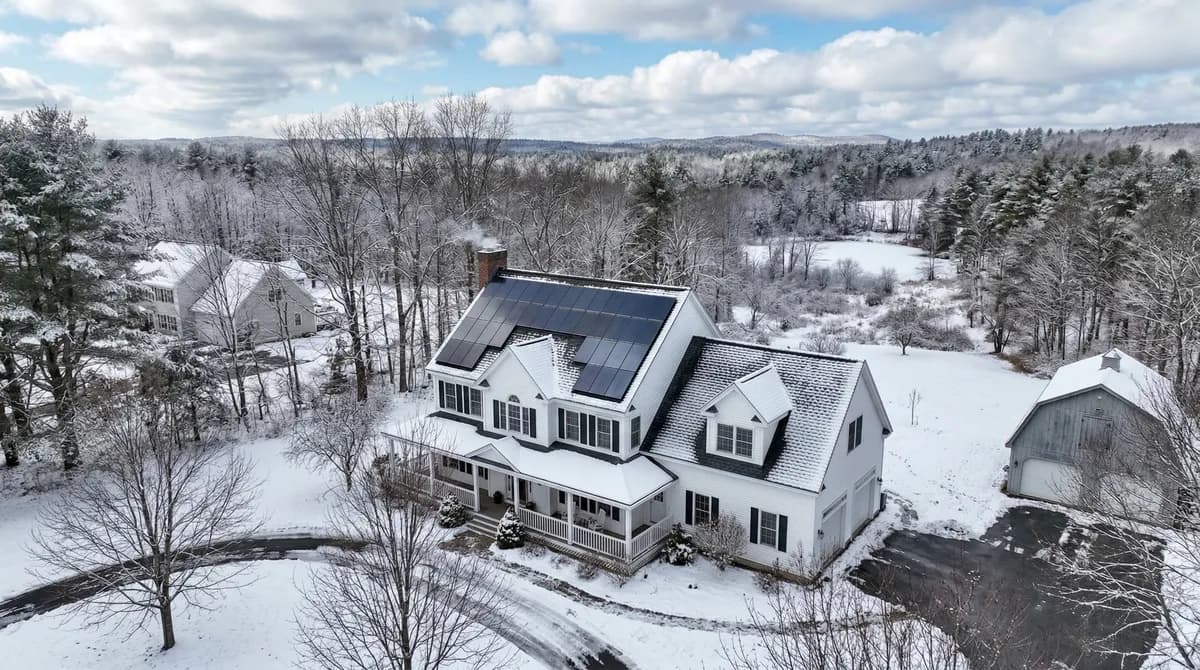
Snow, clouds, cold, rain, and storms — Massachusetts gets them all. Here is exactly how each weather condition affects your solar panels, backed by real production data from thousands of New England systems.
Yes. Massachusetts solar panels produce 85% as much energy per installed kilowatt as Arizona panels because cold weather boosts panel efficiency and long summer days compensate for shorter winters. Boston averages 200+ sunny days per year. Snow slides off panels in 1-3 days. A 10 kW system produces approximately 11,500 kWh annually — enough to offset most household electricity at $0.38/kWh on Eversource. With SMART 3.0 incentives and the highest electric rates in the continental US, Massachusetts is one of the best states for solar return on investment.
Solar panels do not need direct sunlight to generate electricity. They convert photons from any light source — including the diffused light that passes through clouds. On a fully overcast day, panels still produce 10-25% of their rated output.
This matters because Massachusetts is not as cloudy as most people assume. Boston averages 200+ sunny or partly sunny days per year, which is comparable to Houston and better than Seattle (152 days), Portland (144 days), or much of the Pacific Northwest.
Consider Germany: it gets lesssun than Massachusetts and was the world's leading solar producer for over a decade. If solar works in Berlin, it works in Boston.
Modern monocrystalline panels (the type installed by NuWatt) are specifically engineered to perform well in low-light conditions. Their light-harvesting efficiency in diffused light has improved by 15-20% over the past five years compared to older polycrystalline technology.
Even on the cloudiest day, your panels are generating electricity. Annual production estimates already account for MA's weather patterns.
This is the most counter-intuitive fact about solar energy: cold weather makes panels MORE efficient. Solar panels are semiconductor devices, and like all semiconductors, they perform better at lower temperatures.
Every solar panel has a temperature coefficient — the rate at which its output changes per degree of temperature change. A typical modern panel loses about 0.3-0.4% of its output for every degree Celsius above 25°C (77°F). This means:
This is why Massachusetts production per peak sun hour is higher than Phoenix, Houston, or Miami. The only reason sunbelt states produce more annually is they get more hours of sunlight — not because their panels work harder.
Bitter cold — peak electrical efficiency
Typical MA winter day
Cool spring/fall day
Standard test conditions (STC)
Hot summer in TX/AZ
Phoenix extreme heat
Solar panels are mounted at 20-40 degrees and have a smooth, dark glass surface that absorbs heat. Snow typically slides off within 1-3 days — much faster than it melts off your roof shingles. The dark surface creates a micro-warming effect that accelerates clearing.
Ground snow acts as a giant reflector (called albedo), bouncing sunlight back up onto your panels from below. Studies show ground-reflected light can boost winter output by 5-15%. This is why February and March production in New England often exceeds forecast.
Never climb on your roof to brush snow off solar panels. The production lost during a few snowy days is negligible over a year (less than 2% of annual output). Roof climbing in winter is dangerous, and you risk scratching panel glass or damaging mounting hardware.
Boston averages 49 inches of snow per year spread across roughly 15-20 snow events. Most events are 2-4 inches that clear from panels within 24 hours. Even major storms (12+ inches) clear within 2-3 days. The total annual production loss from snow cover is estimated at 1.5-3% — already factored into system production estimates.
Massachusetts building code (780 CMR) requires all solar racking systems to be engineered for local ground snow loads specified in ASCE 7 (Minimum Design Loads for Buildings and Other Structures). Ground snow load is the reference weight of snow on flat ground — rooftop and panel loads are calculated from this number using slope factors and exposure coefficients.
Solar panels themselves are independently rated for mechanical load. The IEC 61215 international standard requires panels to withstand 5,400 Pa (~113 psf) of uniformly distributed front-side pressure — far exceeding any realistic Massachusetts snow accumulation on a tilted panel surface.
The racking system — not the panel glass — is the engineered structural component. All racking used by MA-licensed solar installers must be designed by or reviewed by a licensed structural engineer and stamped for the specific roof structure and local snow zone as a condition of the building permit.
| Region | Ground Snow Load |
|---|---|
Boston Metro / South Shore Coastal zone, ASCE 7 ground snow load | 40 psf |
Worcester / Central MA Inland elevation increases load requirement | 50 psf |
Pioneer Valley / Springfield Connecticut River valley microclimate | 45 psf |
Berkshires / Western MA Highest ground snow loads in the state | 60 psf |
North Shore / Merrimack Valley Lake-effect moisture from Atlantic | 45 psf |
Cape Cod / Islands Lowest in MA — milder maritime climate | 35 psf |
Source: ASCE 7-22 Figure 7.2-1, Massachusetts-specific values. Your installer's structural engineer will specify the exact design load for your municipality.
Panels mounted at 25-35 degrees are the sweet spot for Massachusetts: they shed snow naturally within 24-48 hours while maintaining near-optimal annual energy production.
The honest answer is: very little. Solar panels are designed to operate unattended through New England winters. The six steps below cover everything a Massachusetts homeowner needs to do to keep their system healthy through winter — most take under five minutes.
Log into Enphase Enlighten or your system's monitoring app after each significant snowfall. Look for production dropping to near-zero (panels covered) and then recovering — this tells you the panels are self-clearing without any action needed.
Never attempt to manually remove snow from solar panels. The production lost during 1-3 days of snow cover is less than 2% of annual output. Roof climbing in winter conditions causes far more injuries and damage than the minimal production loss justifies.
Schedule a fall pre-winter inspection (or DIY visual from the ground with binoculars). Look for any loose flashing, separated sealant, or visible corrosion on mounting hardware. Address any issues before the first freeze to prevent ice-related expansion damage.
After any significant nor'easter, do a visual inspection to confirm no racking components have shifted. IEC 61215-rated panels survive 140 mph winds, but mechanical connections benefit from a periodic check, especially in the first few years after installation.
Ice dams form at roof edges and gutters, not on the panel surface itself (panels are too warm). If ice dams are building at roof edges near your array, contact a roofing professional — this is a roof ventilation issue, not a solar issue.
Most monitoring platforms generate a yearly summary. Review it in January to confirm winter production matched your system's estimated output. A 10-15% variance is normal; larger drops may indicate a faulty microinverter or shading issue that should be investigated.
This table shows estimated monthly production for a 10 kW solar system in the Boston metro area, oriented south at a 30-degree tilt. Production varies by location within Massachusetts — Cape Cod gets slightly more sun, the Berkshires slightly less — but the pattern is consistent statewide.
| Month | Est. kWh | Peak Sun Hours |
|---|---|---|
| January | 550 | 2.9 |
| February | 650 | 3.5 |
| March | 900 | 4.2 |
| April | 1,050 | 4.8 |
| May | 1,150 | 5.3 |
| June | 1,200 | 5.7 |
| July | 1,200 | 5.6 |
| August | 1,100 | 5.1 |
| September | 950 | 4.5 |
| October | 750 | 3.7 |
| November | 550 | 2.8 |
| December | 450 | 2.5 |
| Annual Total | 10,500 | 4.2 avg |
Arizona produces more raw kilowatt-hours per panel, but Massachusetts homeowners save more money because of higher electricity rates. When you factor in rates and incentives, MA solar ROI is among the best in the country.
| State | Peak Sun Hours | Electric Rate | 10kW Annual kWh | Annual Savings |
|---|---|---|---|---|
| Arizona | 6.5 | $0.10 | 15,600 | $1,560 |
| California | 5.8 | $0.22 | 13,900 | $3,058 |
| MassachusettsBest ROI | 4.2 | $0.38 | 11,500 | $4,326 |
| New York | 3.8 | $0.24 | 10,500 | $2,520 |
| Oregon | 3.5 | $0.14 | 9,800 | $1,372 |
Massachusetts sees nor'easters, ice storms, occasional hurricanes, and hail. Modern solar panels are engineered to survive all of them. Here is how each event affects your system.
Panels survive 140 mph winds (IEC 61215 rated). Snow accumulation clears in 1-3 days. Battery backup keeps lights on.
Ice layer melts faster on dark panel surface than on shingles. Panels rated for ice loading. No structural risk when properly mounted.
MA panels rated for 140+ mph winds per IEC 61215. Post-storm inspection recommended but damage is rare. Insurance covers weather damage.
Panels rated for 1-inch hail at 50 mph (UL 61730). MA hail events are mild compared to Midwest. No special protection needed.
Rain cleans panels naturally, improving output. Panels are waterproof — no risk of water damage. Rain ≠ zero production (10-25% output on rainy days).
Panels GAIN efficiency in cold. Silicon solar cells produce more voltage at lower temperatures. A 30°F day outperforms a 95°F day per hour of sunlight.
Solar panels sold and installed in Massachusetts must be rated for at least 5,400 Pa (about 113 psf) of front-side mechanical load per IEC 61215. Massachusetts ground snow loads range from 35 psf (Cape Cod) to 60 psf (Berkshires). When combined with the racking system — which is engineered specifically for the roof structure and local ground snow load — a properly installed array comfortably exceeds even the highest MA building code requirements. No Massachusetts snow event has ever exceeded the structural capacity of a code-compliant solar installation.
Yes. Massachusetts requires solar racking systems to be engineered for local ground snow loads per ASCE 7 and the Massachusetts State Building Code (780 CMR). Penetrating racking systems (which bolt through the roof deck into rafters) are the standard for pitched residential roofs. Ballasted systems (which use weight, not penetrations) are limited to flat commercial roofs with sufficient load-bearing capacity. All racking must be stamped by a licensed MA structural engineer for permit approval.
Panels mounted at 25-35 degrees typically shed snow within 24-48 hours after a storm, as the combination of panel angle and the smooth, dark glass surface creates a natural slide. Shallower pitches (15 degrees or less) may retain snow longer, which can add up to 2-3 days of lost production in heavy-snow years. Steeper pitches (40+ degrees) shed fastest but may reduce annual production due to suboptimal sun angle for summer months.
Yes. Solar panels produce 10-25% of their rated output on overcast days because they convert diffused light, not just direct sunlight. Even fully cloudy days generate meaningful electricity. Germany, which gets less sun than Boston, is one of the top solar-producing countries in the world. A well-sized MA system accounts for cloudy days in its annual production estimate.
Snow typically slides off solar panels within 1-3 days. Panels are mounted at a 20-40 degree angle, and the dark glass surface absorbs heat even through a thin snow layer, accelerating melt. Do not climb on your roof to clear panels — the production lost during a few snowy days is negligible compared to annual output, and roof climbing is dangerous.
No. Rain and snowmelt naturally clean panels. Manual cleaning in winter is not recommended due to roof safety risks and minimal production benefit. Studies show that cleaning provides only a 1-3% production increase in climates like Massachusetts. Your installer will advise on any maintenance needs during annual inspections.
A 10 kW system in Boston produces approximately 550-650 kWh per month in December-February, compared to 1,100-1,200 kWh per month in June-July. Winter production is lower due to shorter days, not cloud cover or cold. Over the full year, MA systems produce about 11,000-11,500 kWh — enough to offset most household electricity consumption.
Yes. The federal 25D residential tax credit expired December 31, 2025, but Massachusetts solar remains financially strong. High electricity rates (Eversource bundles to about $0.38/kWh and National Grid to about $0.42/kWh), SMART 3.0 incentives ($0.03/kWh for 20 years), net metering credits, and property/sales tax exemptions deliver a payback period of 6-8 years for most homeowners — among the best in the country.
Yes. Solar panels are tested to withstand 140 mph winds per IEC 61215 international standards. Massachusetts storms rarely exceed this threshold. Properly installed panels with code-compliant racking have survived Category 3+ hurricanes in Florida and the Gulf Coast. Your homeowner insurance typically covers any weather-related panel damage.
No. Massachusetts gets 4.2 peak sun hours per day on average — sufficient for excellent solar production. Latitude affects winter day length but not annual viability. MA compensates with long summer days (15+ hours), cold-weather efficiency gains, and electricity rates 3x higher than sunbelt states. MA homeowners save more money per kWh produced than most sunbelt states.
Yes. Snow on the ground acts as a reflective surface (called albedo), bouncing sunlight back up onto your panels. Studies show that ground snow can increase winter panel output by 5-15% compared to bare ground. This is one reason why Massachusetts solar production in February and March often exceeds expectations.
Current pricing per watt and total system costs for Massachusetts.
How SMART works, current rates, adders, and enrollment.
How panels hold up to hail, ice loads, and Nor’easters.
Next-gen cell tech and where it stands for MA homes.
How net metering credits work and what your utility pays.
Alternative to roof-mount for shaded or historic properties.
Get paid $225-$275/kW for battery demand response in MA.
Get a personalized estimate based on your roof, electric bill, and local weather data. Takes 2 minutes. No commitment.
Get Your Free Solar EstimateA 10 kW Eversource home offsets roughly $4,350/year in electricity with solar