Loading NuWatt Energy...

We use your location to provide localized solar offers and incentives.
We serve MA, NH, CT, RI, ME, VT, NJ, PA, and TX
Loading NuWatt Energy...
NuWatt designs, installs, and manages solar, battery, heat pump, and EV charger systems across 9 states. One company, one warranty, one point of contact.
Get a Free Quote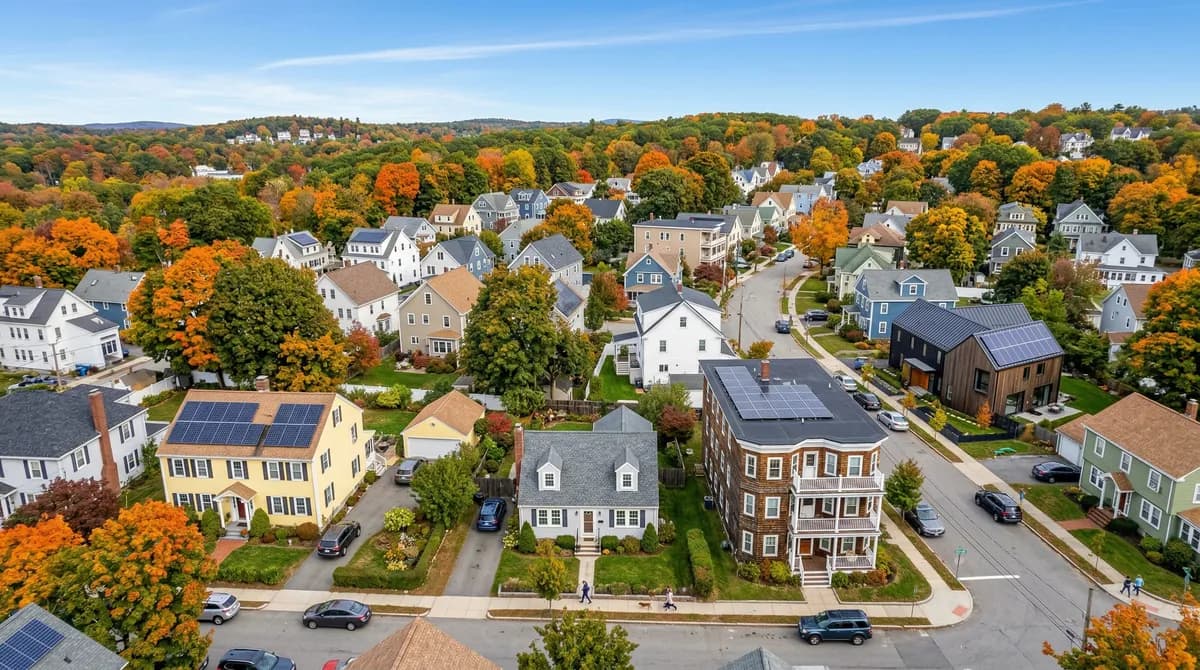
Massachusetts has one of the most diverse housing stocks in America — colonials, cape cods, victorians, triple-deckers, ranches, and modern builds — each with different roof materials. Your roof type affects solar mounting method, installation cost, and long-term performance. Here is every roof type ranked from best to worst.
Every roof can support solar — but some are dramatically easier, cheaper, and more reliable than others. This table summarizes the key differences.
| Rank | Roof Type | Solar Rating | Mounting Method | Extra Cost (10 kW) | Roof Lifespan |
|---|---|---|---|---|---|
| #1 | Standing Seam Metal | Excellent | Clamp-on (no penetrations) | Saves $500–$1,000 | 50–70 years |
| #2 | Composite / Asphalt Shingle | Good | Standard penetration (lag bolts + flashing) | Baseline — no premium | 20–30 years (architectural) |
| #3 | Rubber / EPDM Flat Roof | Good | Ballasted or penetration with flashing | +$0.10–$0.30/W (tilt racks + ballast) | 20–30 years |
| #4 | Clay / Concrete Tile | Challenging | Tile hooks or tile replacement brackets | +$1,000–$2,500 | 50–100 years |
| #5 | Wood Shake / Shingle | Poor | Standard penetration — but fire code concerns | +$1,500–$3,000 (often includes partial re-roofing) | 15–25 years |
| #6 | Slate | Most Challenging | Specialized slate hooks or slate replacement with dummy tiles | +$2,000–$3,500 | 75–150+ years |
Cost note: All costs are additional to the base MA solar installation price of ~$3.00–$3.30/W on standard asphalt shingle. Standing seam metal is the only roof type that actually reduces solar installation cost.
Below is everything you need to know about each roof type — pros, cons, mounting method, cost impact, and Massachusetts-specific considerations.
NuWatt’s take: If you are replacing your roof anyway, upgrading to standing seam metal before solar is the single best long-term investment. Zero penetrations means zero leak risk from mounting.
NuWatt’s take: This is the default. If your asphalt shingles were installed within the last 15 years and are in good condition, go solar now. If they are 15+ years old, replace them first — NuWatt coordinates roof + solar bundles.
NuWatt’s take: If your building has a flat EPDM, TPO, or PVC roof, read our dedicated flat-roof solar guide for detailed membrane compatibility, snow load, and setback information.
NuWatt’s take: Clay and concrete tile roofs are rare in MA but do exist on higher-end homes in Newton, Wellesley, and the MetroWest area. Only use an installer with documented tile roof experience.
NuWatt’s take: If your home has wood shake, the honest recommendation is: replace the roof with architectural asphalt or standing seam metal first, then install solar. The combined project is more cost-effective than installing solar on shake and re-roofing in 10 years.
NuWatt’s take: Slate is the hardest roof type for solar in Massachusetts. It is absolutely possible — but you must find an installer with specific slate roof experience. Do NOT hire a standard solar installer and hope for the best. Cracked slates leak, and slate repair is expensive.
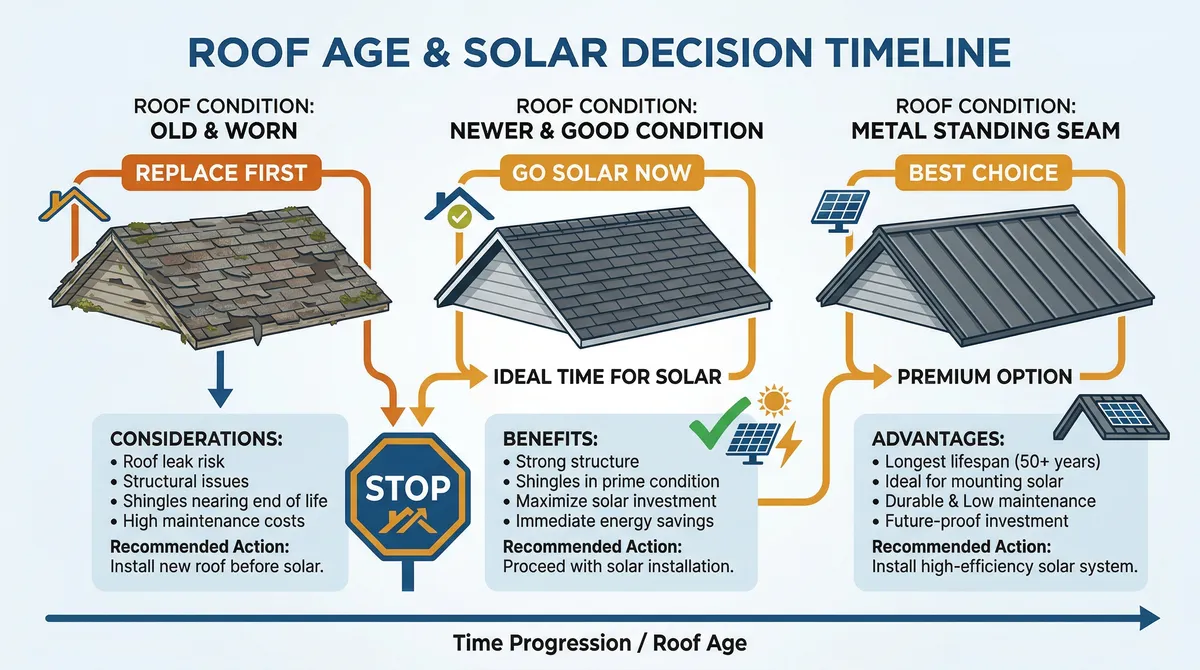
Solar panels last 25–30 years. If your roof fails halfway through, removing and reinstalling panels costs $2,000–$6,000 in Massachusetts — plus you lose net metering production during the work. Worse, a mid-life roof replacement often voids the original roofing warranty if panels were mounted on it.
Typical life: 20–30 years
If installed before 2016, get a professional inspection before solar
Typical life: 50–70 years
Almost never a concern — most metal roofs outlast solar panels
Typical life: 20–30 years
Check membrane for bubbling, cracks, or ponding water before install
NuWatt Roof + Solar Bundles: If your roof needs replacement, we coordinate the entire project — roofing contractor goes first, solar follows within weeks. One project manager, one timeline, and you can finance both together.Read our full roof + solar guide →
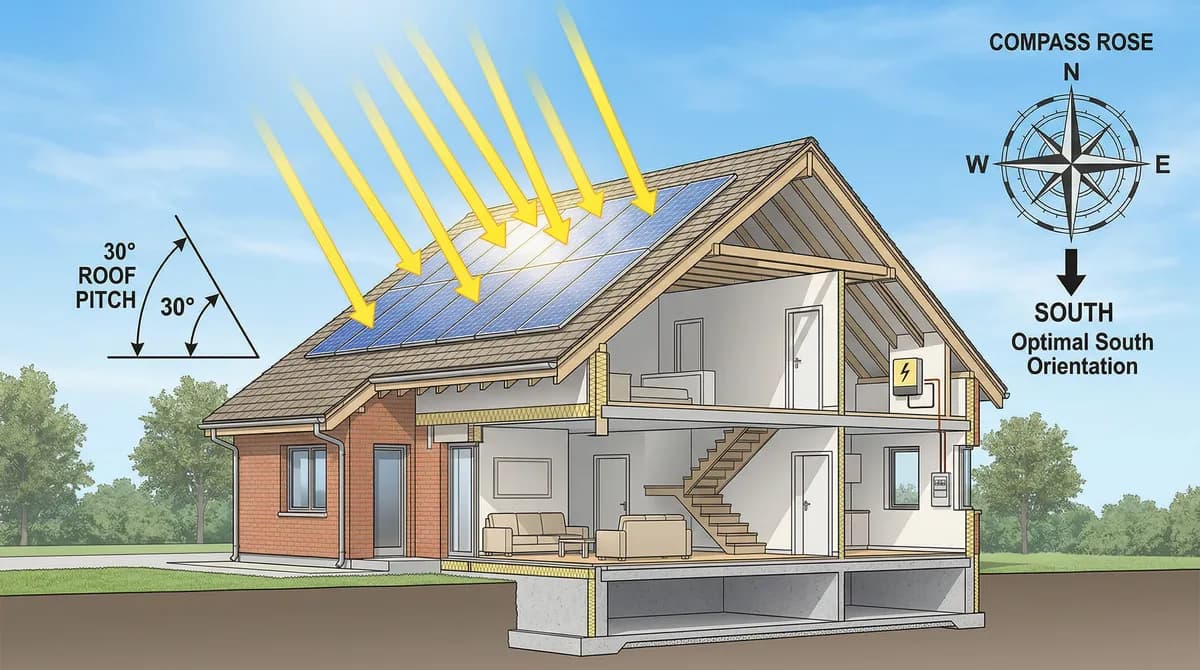
Massachusetts sits at approximately 42° North latitude. The optimal tilt angle for year-round solar production is 25–35 degrees (roughly 6:12 to 8:12 roof pitch).
The direction your roof faces determines how much sunlight your panels receive throughout the day. South-facing is ideal, but east/west still works.
East + West split: Many MA colonials have usable east AND west roof planes. Installing panels on both sides often produces more total energy than a single south-facing plane with less area, while also spreading production more evenly throughout the day.
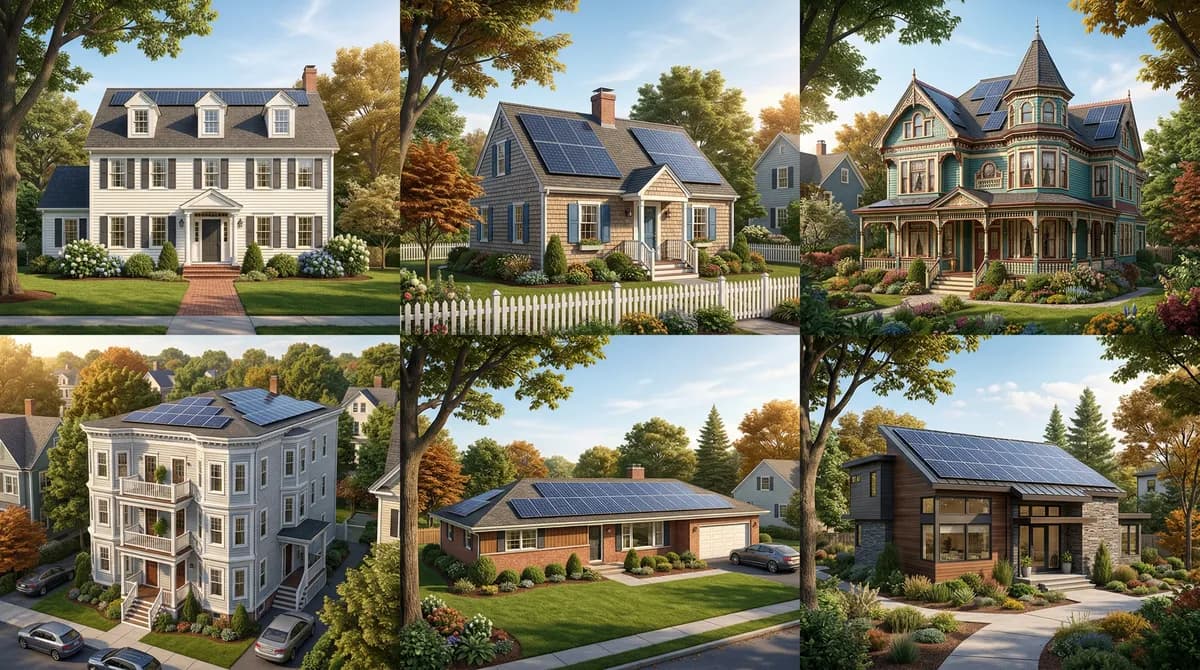
Massachusetts has distinctive housing stock. Here is how each common style performs for solar.
Typical roof: Asphalt shingle or slate
Prevalence: Very common throughout MA suburbs
Two-sided gable roof with large south-facing plane — ideal for solar. Check if slate or shingle.
Typical roof: Asphalt shingle or cedar shake
Prevalence: Extremely common — the signature MA home
Lower roof pitch (6:12 to 8:12) is close to optimal for MA latitude. Dormers reduce usable area.
Typical roof: Slate, asphalt, or wood shake
Prevalence: Common in Cambridge, Somerville, Worcester, Salem
Complex roof geometry with turrets, dormers, and multiple planes reduces usable area. May need ground mount.
Typical roof: Flat EPDM/rubber or asphalt
Prevalence: Common in Boston, Somerville, Worcester, Springfield
Large flat roof is excellent for solar. Ballasted systems work well. Multi-unit ownership may complicate decisions.
Typical roof: Asphalt shingle
Prevalence: Common in 1950s-1970s suburbs — Braintree, Norwood, Weymouth
Low-pitch, wide roof provides maximum solar area. Often the easiest MA home to go solar on.
Typical roof: Standing seam metal, flat, or asphalt
Prevalence: Growing — new construction in MetroWest, Cape Cod
Modern homes often designed with solar in mind. Flat or metal roofs are the easiest to work with.
Solar panels add approximately 2.5–4 lbs per square foot to your roof (panels + mounting hardware). This is equivalent to about one additional layer of asphalt shingles. Most MA homes built to current or recent code handle this without issue.
Homes built before 1970
Older framing may not meet current load requirements
Flat/EPDM roofs with ballasted systems
Ballast adds 5–9 psf total dead load
Visible roof sagging or deflection
Indicates existing structural concerns
Heavy snow load areas (western MA)
Berkshires ground snow load is 70+ psf
Multiple roof layers
Two layers of shingles already add significant weight
Slate or concrete tile roofs
Already heavy — additional load needs verification
A licensed MA structural engineer review typically costs $300–$700. Your solar installer should coordinate this as part of the permitting process.
Massachusetts Snow Load Zones
MA building code references ASCE 7-22. Ground snow loads range from 30 psf (Cape Cod, South Shore) to 70+ psf (Berkshires, northern Worcester County). Solar panels shed snow more easily than bare roofing, but the structural design must account for worst-case snow accumulation plus panel weight.
Massachusetts has more National Register Historic Districts than almost any other state. If your home is in a designated historic district, solar installation requires review by the local Historic Commission — but solar is almost always approved with conditions.
Timeline impact: Historic commission review adds 2–4 weeks to the permitting process. Submit the historic review application in parallel with your building permit to minimize delay. NuWatt handles this for all customers in historic districts.Read our full historic district solar guide →
Massachusetts adopts the International Building Code (IBC) with state-specific amendments. Key solar-relevant requirements that affect roof type decisions:
IFC 2021 requires 3-foot setbacks from roof edges, ridges, and valleys, plus 4-foot-wide firefighter access pathways. This reduces usable roof area by 15–30% depending on roof geometry.
NEC 2020 Section 690.12 requires module-level rapid shutdown — voltages must drop to 80V within 30 seconds of shutoff. This is handled by microinverters (Enphase) or DC optimizers (SolarEdge).
MA building departments require a PE-stamped structural letter for systems over 5 kW on most roof types. Flat roofs and older homes always require structural review. Budget $300–$700.
Racking systems must be designed for MA-specific wind speed (110+ mph coastal) and snow load (30–70+ psf). The installer submits engineering calculations with the permit application.
Not every roof is a good candidate for solar. In these situations, a ground-mounted system eliminates roof-related complications entirely — at a modest cost premium.
Slate or wood shake roof that would cost $2,000+ extra for solar mounting
Roof has fewer than 10 years of life remaining and you don't want to replace it yet
Complex roof geometry (Victorian turrets, multiple dormers) with little usable area
Heavy tree shading on all roof planes but open, sunny yard space
North-facing primary roof plane with no viable south/east/west exposure
Multiple roof layers already present — structural capacity concerns
Ground-mounted systems also make maintenance and snow clearing easier, and can be oriented at the exact optimal angle and direction.Read our full ground mount solar guide →
Base cost for a 10 kW solar system in Massachusetts on standard asphalt shingles is approximately $30,000–$33,000. Here is how each roof type affects that price.
* Wood shake total includes potential roof replacement cost ($8,000–$15,000) when needed. All prices are before MA SMART incentives and any applicable commercial ITC.
NuWatt evaluates your roof type, age, condition, and structural capacity as part of every free solar consultation. If your roof needs work first, we coordinate everything.
The 15-year rule, combined costs, and when to bundle
Ballasted vs penetrating, membrane types, fire setbacks
When rooftop is not ideal — costs, yard space, permitting
Commission review, panel requirements, timeline
Current pricing, incentives, and payback calculations
Building permits, inspections, interconnection timeline