Loading NuWatt Energy...

We use your location to provide localized solar offers and incentives.
We serve MA, NH, CT, RI, ME, VT, NJ, PA, and TX
Loading NuWatt Energy...
NuWatt designs, installs, and manages solar, battery, heat pump, and EV charger systems across 9 states. One company, one warranty, one point of contact.
Get a Free QuoteMassachusetts’ I-495 / I-90 / Route 146 corridor holds the densest concentration of 200,000+ sqft warehouse rooftops in New England — Amazon, UPS, FedEx, and consumer goods distribution centers. These flat TPO-over-metal-deck roofs are the state’s largest untapped commercial solar opportunity. Here is how logistics REITs, triple-net owners, and operating tenants structure winning projects in the post-DPU 25-48 era.
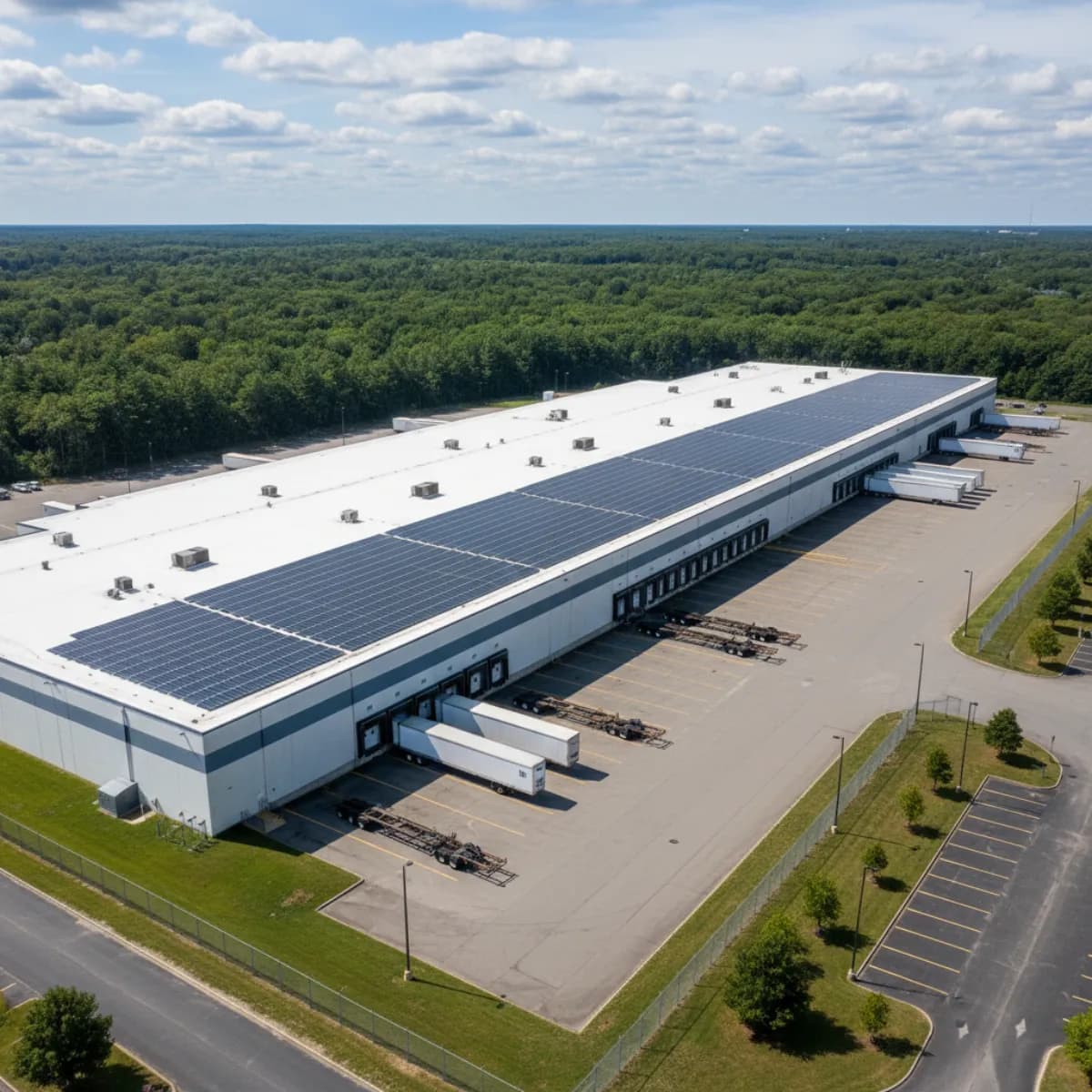
Yes — MA warehouses are one of the highest-value commercial solar opportunities in the state. The I-495 / I-90 corridor alone holds over 100 million square feet of flat TPO-over-metal-deck rooftops on modern (post-2010) warehouse and distribution buildings. Typical systems run 500 kW to 5 MW DC at $1.80-$2.30/W installed. Revenue stacks three ways: behind-the-meter consumption at $0.17-$0.23/kWh retail, SMART 3.0 standalone-export tariff on the balance, and optional ConnectedSolutions battery revenue. Combined with the federal §48E ITC (30% base, up to 50% with energy community + domestic content bonuses through July 4 2026 construction start), MACRS depreciation, and MA’s 20-year property tax exemption for solar, net payback is 4-7 years for most warehouse projects. The main gating factors are roof age (TPO lifetime vs. solar lifetime) and interconnection queue times post-DPU 25-48, both of which NuWatt pre-screens on every project.
Unlike Texas or California, Massachusetts does not have sprawling industrial basins. Nearly all of the state’s modern warehouse stock concentrates along three interstate corridors that together form a rough triangle between Boston, Worcester, and Providence. If your facility is in one of these nodes, solar is almost certainly economic — the only question is which ownership and tariff structure fits best.
Massachusetts' inland logistics spine. Junction of the state's only east-west toll road (I-90) and the orbital beltway (I-495). 90-minute drive radius reaches 20M+ consumers across New England.
Marlborough-Westborough is the highest-density warehouse zone in New England. Post-2015 construction is dominated by 300,000-1,000,000 sqft speculative tilt-up buildings with white TPO membrane over metal deck — the single most solar-ready building stock in the state. SMART 3.0 block availability has tightened significantly in the National Grid service territory as of Block 9.
Route 146 south to Providence and the Port of Providence. Intersection with I-90 and I-290. Fast-growing corridor with multiple 500,000+ sqft fulfillment centers built 2020-2025.
Worcester's industrial corridor saw over 6M sqft of new warehouse construction 2021-2025. Amazon's 3.8M sqft BOS7 fulfillment center alone offers 80+ acres of flat roof. National Grid has been the more constrained of the two major MA IOUs for >500 kW interconnection queue times.
Last-mile delivery to Providence-Worcester-Boston triangle. Route 495 interchanges with Route 109 and Route 140. Strong fit for regional DCs serving all of southern New England.
Mix of 1990s-era metal buildings (often in need of re-roof within the solar decision window) and newer spec construction. Structural review yield rate is lower here than Marlborough-Westborough — budget for roof replacement coordination on ~30% of older stock.
Convergence point for I-495, I-95, and Route 24. Gateway between Boston metro and southeastern MA / Providence. Strong e-commerce last-mile footprint.
Eversource East service territory with some of the highest commercial rates in the state — pushing SMART 3.0 standalone-export economics into the favorable zone even without on-site consumption. Modern spec construction with TPO dominates.
Redeveloped former Fort Devens industrial park. Intersection with Route 2 east-west. Life sciences and medical device distribution hub.
Devens municipal utility territory operates outside the SMART 3.0 program — solar economics rely on behind-the-meter savings rather than state incentives. Net-metering caps and virtual-net-metering rules differ. Always confirm utility territory before pricing a Devens project.
Corridor Scale Perspective
If every warehouse roof along this corridor were built to current TPO-over-metal-deck standards and fully solarized at an average utilization of 6 W/sqft, the raw rooftop potential exceeds 600 MW DC — roughly double the entire SMART 3.0 commercial-scale pipeline currently in queue. The constraint is not roof area or economics. It is interconnection capacity on the local distribution system and the speed at which institutional owners can move through internal capital approval processes.
Warehouse electrical load profiles are dominated by lighting, HVAC, forklift charging, and increasingly by conveyor and robotic sortation systems in modern fulfillment centers. Unlike cold storage — rare in MA — most warehouses have modest on-site consumption relative to their rooftop solar capacity. This drives the SMART 3.0 export decision. Here are the four dominant profile types.
Major loads: Lighting (45%), HVAC (25%), forklift charging (15%), dock doors & strip curtains (15%)
Most prevalent warehouse type in MA older stock (pre-2010). Single-tenant or small-multi-tenant buildings, often owner-occupied by the operating business rather than a REIT. Lighting is typically the largest individual load, and an LED retrofit paired with solar compounds savings. Consumption profile matches solar production better than for a distribution center because forklift charging and dock door operations concentrate in daylight shifts.
Major loads: Lighting (40%), HVAC (20%), conveyors & sortation (20%), dock doors (20%)
The core of the MA warehouse solar opportunity. Most new construction post-2015 in the Marlborough-Worcester corridor falls in this size range. On-site consumption typically absorbs 30-50% of annual solar generation — the remainder is exported under SMART 3.0 with a 10-year tariff or allocated to community solar subscribers. Ownership is almost always a logistics REIT (Prologis, STAG, Link Logistics) or a private industrial REIT rather than the occupying tenant.
Major loads: Conveyors & robotics (30%), lighting (25%), HVAC (25%), IT / fire systems (10%), dock (10%)
Amazon BOS7 (Worcester, 3.8M sqft), Amazon DBO5 (Mansfield), and other mega-facilities define this category. Because these facilities are leased on triple-net terms from institutional owners, the solar decision sits with the landlord, not the operating tenant. Interconnection queue times for single projects >3 MW in National Grid territory now routinely exceed 18-24 months post-DPU 25-48. Third-party ownership via §48E PPA is the dominant structure.
Major loads: Varies by tenant mix; typically lighting + HVAC + material handling dominant
Campus-style industrial parks where a single REIT owns multiple buildings on one parcel or adjacent parcels. Solar is typically installed campus-wide and the output is either retained by the landlord (common area benefit) or allocated to tenants via virtual net metering credits or a sub-metered green-lease structure. Aggregating buildings can push a project above the 5 MW SMART 3.0 project cap, so project sizing often has to be carefully optimized.
Roof membrane type and building structural capacity drive the mount decision, which in turn drives both cost and schedule. In MA, TPO-over-metal-deck dominates post-2010 construction and is the ideal substrate for ballasted systems. Older EPDM and BUR stock typically requires more engineering and sometimes a re-roof coordination effort.
Zero roof warranty impact. White reflective surface boosts panel production 2-4%. Fast install. Fully removable for future roof replacement.
Ballast adds 3-5 psf. Structural review always required for older stock. Wind uplift calculations critical within 1 mile of coast (not typical in the I-495 corridor).
Fastest installation method. No ballast weight added. No warranty impact from penetrations. Seamless future roof replacement.
Seam profile must match clamp system. Some older profiles need custom clamps at higher cost. Snow sliding off smooth metal can damage panels below.
Durable and flexible. Well-suited to ballasted systems if structural capacity exists.
Black EPDM absorbs heat (reduces panel efficiency and adds to cooling load). Many EPDM roofs are approaching or past their 20-25 year service life — roof replacement should be coordinated with solar install.
Multi-layer construction is physically durable. Often over-built for snow load.
Asbestos concerns in pre-1980 BUR. Wood-deck buildings frequently lack structural capacity for ballasted solar. Re-roofing is almost always required before solar install. In many cases solar is not economic on this roof type until the building is re-roofed on its own replacement cycle.
Use this matrix to pre-qualify your building. NuWatt confirms every recommendation with a drone survey and structural engineer review before final design.
| Building Scenario | Recommended Mount | Penetrations | Ballast | Warranty Impact | Re-Roof Coordination |
|---|---|---|---|---|---|
| TPO or PVC membrane, modern (post-2010) building, inland location | Ballasted | No | 3-5 psf | None | Panels and racking can be lifted for re-roof; ballast re-positioned |
| TPO membrane, coastal-zone building (within 1 mile of ocean) | Chemically-adhered baseplates or mechanically attached | No (adhered) or minimal (mechanically attached) | 0-2 psf | Minor — manufacturer approval of adhesive required | More complex removal; re-adhesion required |
| Standing seam metal roof, any age | Clamp-on (no penetration) | No | 0 psf | None | Clamps remove with hand tools; re-attach to new seams |
| EPDM membrane, structural capacity marginal | Penetrating mount with flashed pipe boots | Yes — typically 1 penetration per 4-8 panels | 0-1 psf | Yes — manufacturer-approved flashing required | Penetrations become new roof details; coordinate with re-roof scope |
| Built-Up or wood deck, older building | Defer solar until re-roof; install racking embedded in new roof system | Yes — integrated with new roof | 0 psf (structural capacity usually insufficient for ballast) | Covered by new-roof solar-ready warranty | N/A — solar installed as part of re-roof project |
Warehouse solar in MA almost always produces more energy than the facility consumes. The question is not whether to export — it is how. SMART 3.0 offers two primary pathways for commercial-scale rooftop projects: standalone export with a 10-year fixed tariff, or allocation to community solar subscribers with bonus adders. Each fits a different project profile.
The majority of modern MA warehouse stock is leased on triple-net terms, meaning the tenant pays utilities but the landlord owns the roof. This creates a split-incentive problem: the party with the roof rights does not pay the electricity bill, and the party paying the bill does not own the roof. These are the five most common scenarios and the structures that make each work.
Why it works: All ITC/MACRS benefits, on-site energy savings, and SMART 3.0 tariff revenue flow to the same entity. Simplest deal structure.
Why it works: Tenant sees lower all-in energy cost (often 10-25% below utility retail). Landlord keeps tax benefits and 10-year SMART revenue. Requires green-lease amendment or rider to allocate benefits.
Why it works: Tenant captures ITC/MACRS and energy savings during lease term. Landlord gets a solar-ready building and option to acquire the system at lease end.
Why it works: All savings accrue to the utility-paying party. Simplest after owner-occupied.
Why it works: Portfolio aggregation reduces per-project soft costs. REIT sustainability commitments create internal pressure to deploy. Standardized lease amendments deploy across multiple tenants.
Green Lease Rider: The Missing Piece
Most standard NNN lease forms predate commercial rooftop solar and are silent on roof rights, solar revenue allocation, and removal obligations. A short green-lease rider (typically 3-6 pages) addresses roof access, solar easement, benefit allocation, and end-of-lease transfer/removal. NuWatt can provide a template rider that has been reviewed by MA commercial real estate counsel — your legal team adapts it to your specific lease. This single document removes the biggest friction point in triple-net warehouse solar.
Real-world pro forma for two representative MA warehouse solar projects. Both assume §48E ITC at 40% (30% base + 10% energy community or domestic content bonus), prevailing-wage/apprenticeship compliance, MACRS depreciation, and SMART 3.0 standalone export for generation in excess of on-site load.
150,000 sqft dry warehouse, Marlborough, National Grid territory
Ballasted TPO install with no interconnection study beyond standard screening. Connects in 10-14 months typical end-to-end. SMART 3.0 tariff locked for 10 years; residual 15 years are on-site savings + merchant export value.
400,000 sqft distribution center, Worcester corridor, National Grid territory
Requires full interconnection study; 18-24 months from engineering start to PTO in current National Grid queue. Typically structured as third-party §48E PPA when the owner is a REIT, or direct capital deployment when owner-occupied. Prevailing wage + apprenticeship compliance mandatory for full bonus ITC.
Solar is the foundation, but the best-performing MA warehouse projects layer on three additional value streams. These are what separate a 7-year payback from a 4-year payback.
Eversource and National Grid’s commercial battery demand-response program pays $200-$275/kW-summer for batteries dispatched during peak demand events. A 1 MW commercial battery pairs with the rooftop solar to earn $200,000-$275,000/year plus ongoing demand charge reduction. Especially compelling for 24/7 fulfillment centers where robotic systems create sustained peak demand.
Best for: fulfillment centers, distribution centers with demand charges >$10K/month
MA commercial demand charges range from $10-$20/kW/month. Solar + battery paired with load management (soft-start conveyor controls, staggered forklift charging, pre-cooling office HVAC) can reduce peak demand by 20-40%, saving an additional $50,000-$200,000/year for a large warehouse. Often the single largest optimization opportunity outside of the solar system itself.
Best for: facilities with peak demand >500 kW
Under M.G.L. Chapter 59, Section 5, Clause 45, commercial solar systems are exempt from local property taxation for 20 years from installation. A 2 MW system carrying an otherwise-taxable value of $2-3M would add $30,000-$60,000/year to the property tax bill in most MA municipalities — this exemption is worth $600K-$1.2M over the exemption period on a single large project.
Applies to: all MA commercial solar; confirm with local assessor
To claim the full §48E ITC (including the 10% energy community and 10% domestic content bonuses) on projects above 1 MW AC, federal rules require payment of prevailing wage rates and use of qualified apprentices for a specified percentage of labor hours. Non-compliance reduces the base ITC from 30% to 6% — a catastrophic hit to project economics. NuWatt operates under a prevailing-wage-by-default framework so bonus compliance is never at risk.
Required for: §48E ITC on projects >1 MW AC
Questions we hear from logistics REIT asset managers, distribution facility operators, CFOs, and triple-net property owners considering rooftop solar.
The I-495 beltway and I-90 (Mass Pike) intersect in Marlborough and Westborough, creating the densest cluster of 200,000+ sqft warehouse and distribution rooftops in New England. Add Route 146 south through Worcester-Millbury and Route 24 through Mansfield-Taunton, and the corridor holds over 100 million square feet of warehouse space on modern TPO-over-metal-deck roofs. A single Amazon fulfillment center like BOS7 in Worcester has more solar-ready flat roof than the combined rooftops of downtown Boston. Most of this stock is owned by institutional industrial REITs with sustainability commitments, yet solar penetration on these roofs is under 5% — making this MA's largest untapped commercial solar opportunity by raw installable megawatts.
NuWatt designs and installs commercial solar for warehouses, distribution centers, and fulfillment facilities along the I-495, I-90, and Route 146 corridors. Every proposal includes a drone roof survey, structural screening, SMART 3.0 modeling, tenant-vs-landlord benefit analysis, and full §48E ITC stack optimization.