Loading NuWatt Energy...

We use your location to provide localized solar offers and incentives.
We serve MA, NH, CT, RI, ME, VT, NJ, PA, and TX
Loading NuWatt Energy...
NuWatt designs, installs, and manages solar, battery, heat pump, and EV charger systems across 9 states. One company, one warranty, one point of contact.
Get a Free Quote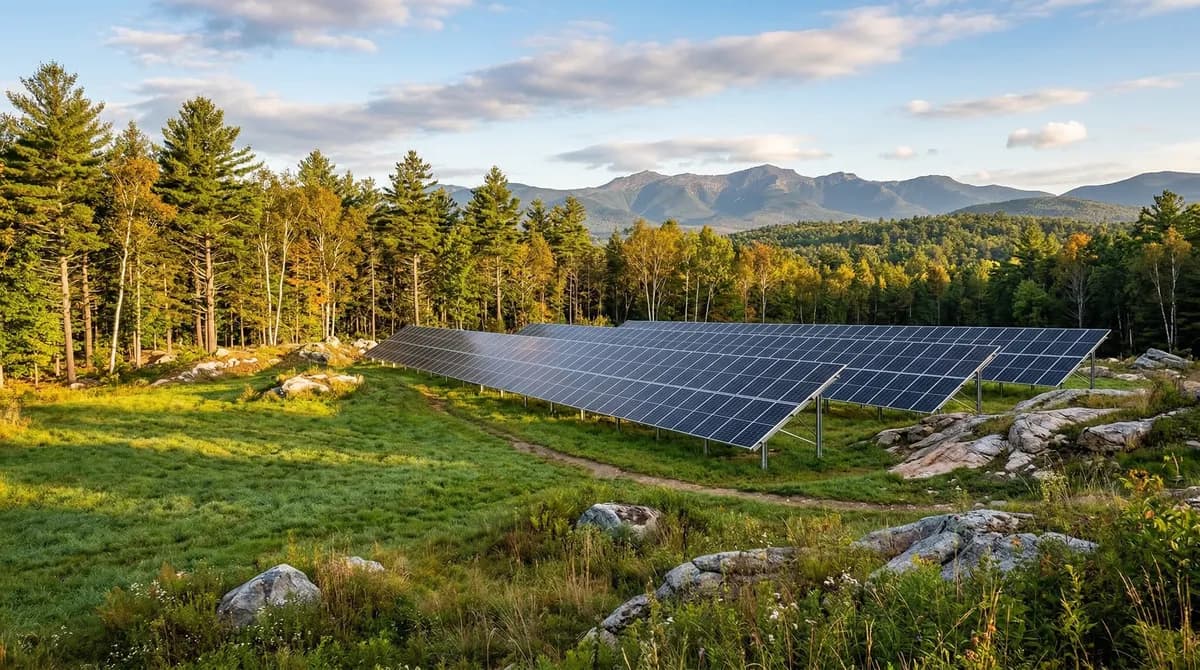
Rocky terrain, large lots, and 234 different town zoning codes. Here is what New Hampshire homeowners need to know about ground-mount solar in 2026 — without the federal tax credit.
Ground-mount is not just a backup plan when your roof does not work. For many rural NH properties, it is the better option from the start.
NH has thousands of homes with roofs over 20 years old. A roof replacement ($8,000-15,000) plus roof-mount solar versus ground-mount on your property is often comparable in cost. Ground-mount avoids the double-project headache.
New Hampshire is 84% forested — the second most forested state in the US. Many properties have mature pines, oaks, and birches shading the roof. A ground-mount system can be sited in an open section of your yard where sun exposure is optimal.
Rural NH properties in counties like Grafton, Carroll, and Belknap average 2-5+ acres. You only need roughly 400-600 sq ft of open ground per 5 kW of solar — a small fraction of your total lot.
NH has numerous historic districts (Portsmouth, Exeter, Hanover, Concord) where roof alterations face heritage commission review. Ground-mount systems placed behind the primary structure often bypass these restrictions entirely.
Many rural NH properties have barns, sheds, or garages with structural limitations. Rather than reinforcing an old barn roof, a ground-mount array adjacent to the building is simpler and more cost-effective.
Ground-mount racking allows precise south-facing orientation at the ideal tilt angle (35-42 degrees for NH latitude of 43-44N). Roof-mount systems are constrained by existing roof angle and direction, often sacrificing 5-15% of production.
New Hampshire has no statewide solar permitting standard. Each of the state's 234 towns sets its own zoning and building permit rules. Here is the general process — always start with your town building department.
NH towns regulate ground-mount solar through local zoning. Most classify ground-mount arrays as accessory structures. Key items: setback requirements (typically 15-50 ft from property lines), maximum height (usually 12-15 ft), lot coverage limits, and whether a special exception or conditional use permit is needed.
Contact: Town Planning / Zoning Office
Most NH towns require a building permit for ground-mount systems. The application typically includes a site plan showing array location, setbacks, access, and foundation type. Engineering drawings may be required for systems over 10 kW.
Contact: Town Building Department
A separate electrical permit covers the wiring from the array to your electrical panel. NH requires a licensed electrician for the interconnection. The state electrical inspector (or town inspector in larger municipalities) must sign off.
Contact: State or Town Electrical Inspector
File a net metering interconnection application with your utility (Eversource, Liberty, Unitil, or NHEC). For systems under 100 kW, this is a standard Level 1 review. The utility has 15 business days to respond under NH PUC rules.
Contact: Your Utility Provider
After installation, both building and electrical inspections must pass. Your installer submits the final interconnection paperwork. The utility installs a bi-directional meter and grants Permission to Operate (PTO).
Contact: Inspectors + Utility
These are representative examples — always verify with your specific town. Setbacks can change at town meeting.
| Town | Front | Side | Rear | Max Height | Notes |
|---|---|---|---|---|---|
| Concord | 30 ft | 15 ft | 15 ft | 15 ft | Accessory structure rules apply |
| Laconia | 35 ft | 15 ft | 20 ft | 12 ft | Special exception if >500 sq ft |
| Plymouth | 25 ft | 10 ft | 10 ft | 15 ft | Solar-friendly ordinance (2023) |
| Wolfeboro | 40 ft | 20 ft | 20 ft | 12 ft | Planning board review required |
| Meredith | 30 ft | 15 ft | 15 ft | 15 ft | Must screen from road if visible |
| Hanover | 30 ft | 20 ft | 15 ft | 15 ft | Historic district check if applicable |
Wetland and Shoreland Buffers
If your property is near wetlands, rivers, or lakes, NH DES shoreland and wetland buffers may restrict where you can place a ground-mount array. The Shoreland Water Quality Protection Act (RSA 483-B) requires a 250-ft protected shoreland zone around qualifying water bodies. Check with NH DES before siting your array.
NH sits on some of the oldest rock in North America — granite, gneiss, and glacial till deposited 15,000 years ago. Here is how experienced installers handle it.
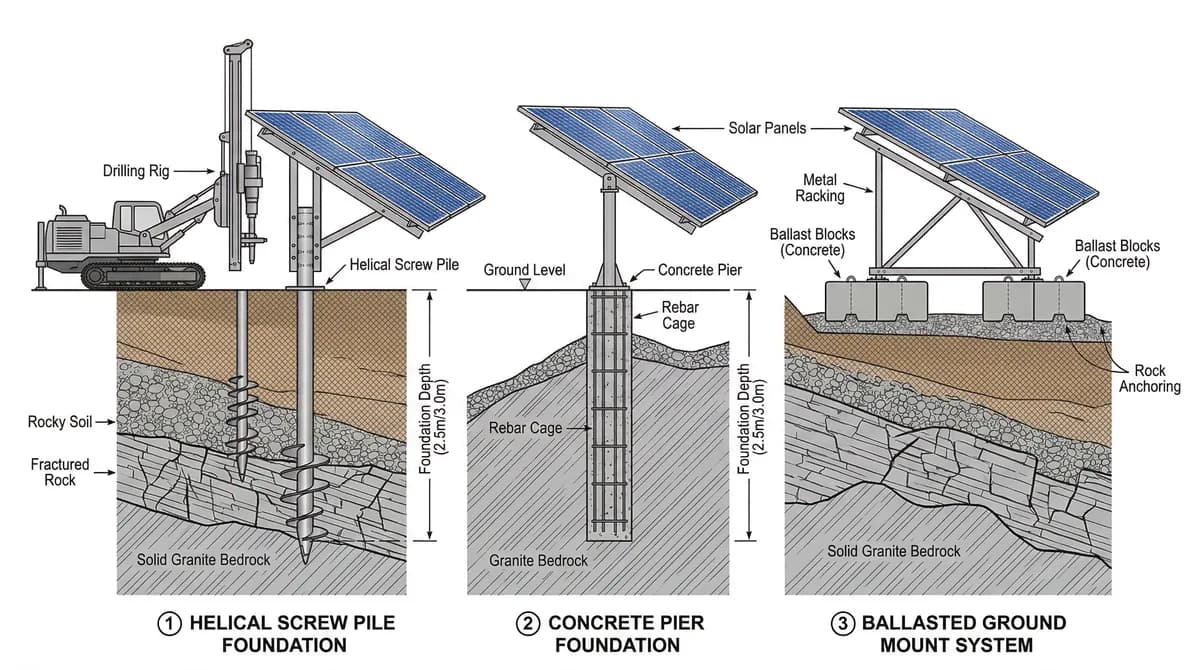
Steel piles with helical plates screwed into the ground using specialized equipment. The go-to solution for NH rocky soil — they can thread between boulders and find purchase in glacial till. No excavation, no concrete, minimal site disturbance.
Best for: Most NH sites, especially rocky or sloped terrain
Advantages
Limitations
When you hit solid granite ledge within 2-3 feet of the surface — common in the White Mountains region, Lakes Region, and along the Merrimack Valley — concrete piers are the standard solution. Holes are drilled or blasted, then filled with reinforced concrete.
Best for: Shallow bedrock / granite ledge sites
Advantages
Limitations
Pre-cast concrete blocks sit on the ground surface, weighted to resist wind loads. No digging, no drilling. Best for flat areas where you want zero ground penetration — popular for properties with well or septic concerns.
Best for: Flat lots, well/septic buffer zones, temporary installations
Advantages
Limitations
Ground-mount adds $0.20-0.50/W over roof-mount, but better production and easier maintenance narrow the gap over 25 years. No federal tax credit for either option (25D expired December 2025).
| Category | Roof-Mount | Ground-Mount | Notes |
|---|---|---|---|
| System Cost (8 kW) | $24,240 | $26,000-28,000 | Ground-mount adds $0.20-0.50/W for racking + foundation |
| Foundation Work | Included (roof attachments) | $1,500-4,000 | Helical piles: ~$1,500 | Concrete piers: ~$3,000-4,000 |
| Trenching & Conduit | $0 | $500-2,000 | Depends on distance from array to electrical panel |
| Permitting | $150-300 | $200-500 | Ground-mount may need planning board review in some towns |
| Annual Production (8 kW) | 8,500-9,400 kWh | 9,400-10,200 kWh | Ground-mount: optimal tilt = 5-10% more production |
| Maintenance Access | Requires ladder/roof access | Walk-up access, snow clearing easy | Ground-mount significantly easier for panel cleaning and snow removal |
| Federal ITC (25D) | $0 | $0 | Expired Dec 31, 2025 — no federal credit for cash/loan purchases |
| Payback Period | ~7.9 years | ~10.5-12 years | Higher upfront cost offset partially by better production |
An 8 kW ground-mount system costs $26,000-28,000 and produces ~9,800 kWh/year. At NH's average $0.27/kWh rate, that is ~$2,400-2,600 in year-one savings. Payback lands around 10.5-12 years — roughly 1-2.5 years longer than roof-mount. But you avoid a potential $10,000+ roof replacement, and the system produces 5-10% more over its 25-year lifetime.
Rural counties with large lots, open acreage, and cooperative zoning make the strongest candidates for ground-mount. Here is a county-by-county breakdown.
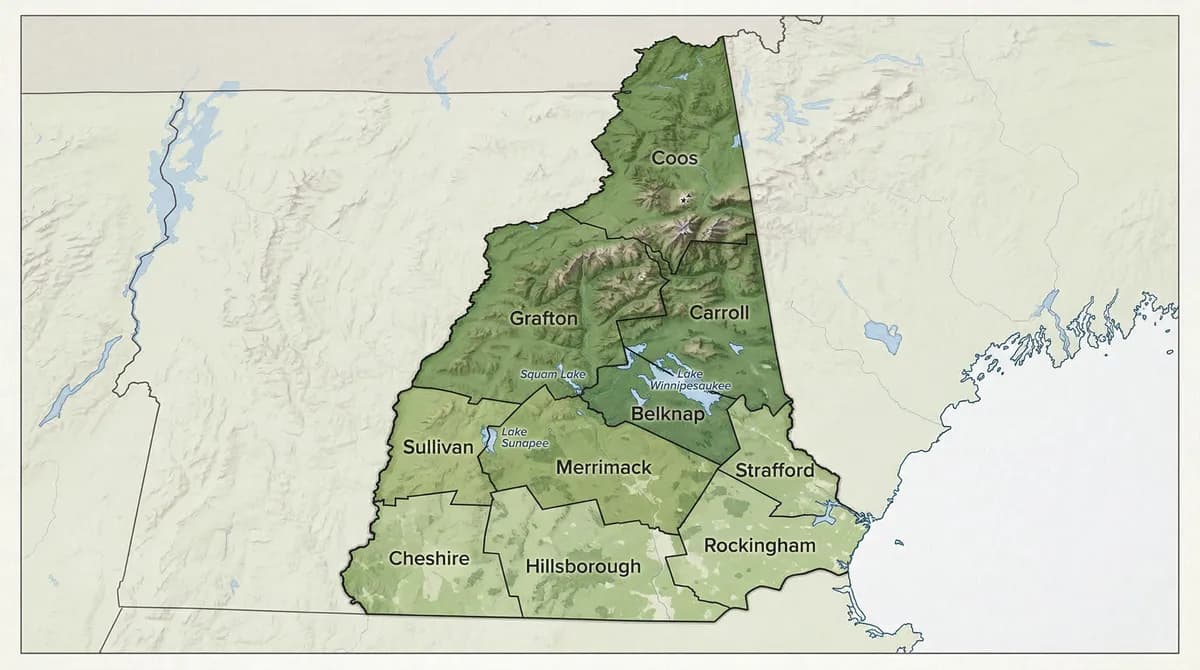
Plymouth, Hanover, Lebanon, Littleton, Canaan
Wolfeboro, Conway, Ossipee, Tamworth, Madison
Laconia, Gilford, Meredith, Tilton, Belmont
Concord, Bow, Hopkinton, Warner, Pittsfield
Claremont, Newport, Sunapee, Charlestown
Berlin, Lancaster, Colebrook, Gorham, Whitefield
Ground-mount solar receives identical net metering treatment as roof-mount in NH. Credits are utility-specific and calculated as 100% supply + 100% transmission + 25% distribution, not as a fixed percentage of retail.
Ground-mount solar systems qualify for the same property tax exemption as roof-mount under RSA 72:62. About 66% of NH towns (~200 of 300+ municipalities) have adopted this exemption at town meeting.
The residential solar tax credit (Section 25D) expired December 31, 2025. But Section 48/48E is still available for third-party-owned systems — and it works with ground-mount.
July 4, 2026 is the begin-construction safe harbor, not an end date. If the financing company begins construction on or before it, the project locks in the full 48E timing pathway (placed in service through roughly 2030). If construction begins after, the project still qualifies for the 30% credit but generally must be placed in service by December 31, 2027.
| Cash | Solar Loan | Lease / PPA | |
|---|---|---|---|
| Upfront Cost (8 kW) | $26,000-28,000 | $0-1,000 down | $0 |
| Federal ITC | None (25D expired) | None (25D expired) | 30% — claimed by system owner |
| System Ownership | You own it | You own it | Financing company owns |
| 25-Year Savings | Highest (~$65,000-80,000) | $45,000-60,000 | $30,000-45,000 |
| 48E Timing | N/A (25D expired) | N/A (25D expired) | Safe harbor July 4, 2026 |
Get a free site assessment for your NH property. We evaluate your lot, soil conditions, and local zoning to design the optimal ground-mount system.
NH Solar Panel Cost 2026
Average costs by city and utility territory
Solar Without the Tax Credit
How NH solar works post-25D
Cash vs Loan vs Lease
Compare financing options for 2026
NH Net Metering Guide
NEM 2.0 credits and how they apply
Section 48 Homeowner Guide
Third-party ownership ITC explained
Solar Lease & PPA 2026
Lease and PPA options in NH
NH Solar Tax Benefits
RSA 72:62 and property tax exemption
Community Solar NH
CPCNH and shared solar options