Loading NuWatt Energy...

We use your location to provide localized solar offers and incentives.
We serve MA, NH, CT, RI, ME, VT, NJ, PA, and TX
Loading NuWatt Energy...
NuWatt designs, installs, and manages solar, battery, heat pump, and EV charger systems across 9 states. One company, one warranty, one point of contact.
Get a Free Quote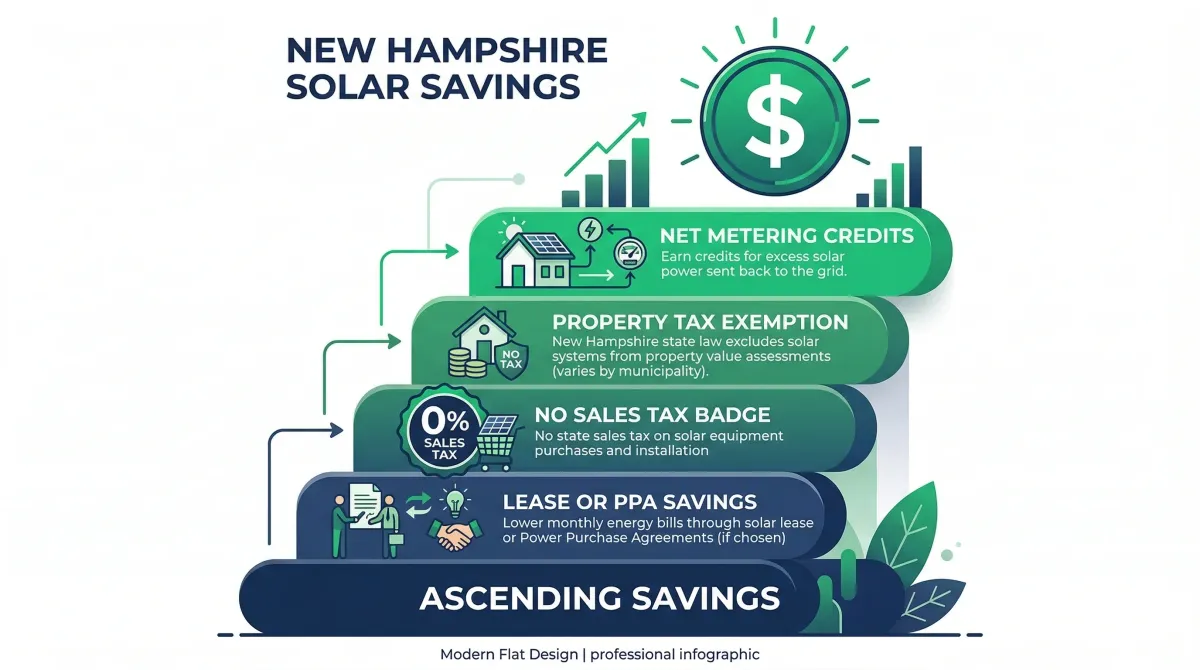
No federal credit. State rebate repealed. But NH homeowners can still save $54,000+ over 25 years by stacking five remaining incentive layers. Here is exactly how.
EXPIRED — December 31, 2025
$0 for homeowner cash or loan purchases. The 30% residential tax credit is gone. Any installer quoting you a 30% federal credit on a cash/loan purchase is using expired data.
REPEALED — SB 303 (2024)
Previously offered $0.20/W up to $1,000. Permanently repealed by the NH Legislature. There is no state solar rebate in New Hampshire. Period.
EXPIRED — December 31, 2025
$0 for heat pumps, insulation, and energy efficiency improvements. Does not apply to solar, but worth noting if you are considering a solar + heat pump bundle.
Each layer adds value. Stack all five for maximum savings. Total potential: $15,000-$25,000+ in direct savings plus $50,000-$75,000 in NEM 2.0 credits over 25 years.
NH NEM 2.0 credits exported solar using utility-specific tariff components. Self-consumed solar avoids the customer's current import rate. Verify the utility, supplier, rate class, and effective tariff before modeling either value.
NH charges 0% sales tax on all purchases, including solar equipment, inverters, racking, and installation labor. This is not an exemption — it is the absence of any sales tax. No forms, no expiration, no risk of policy change.
Towns that adopt RSA 72:62 at town meeting exempt solar energy systems from property tax assessment. Your solar panels add value to your home but do not increase your property tax bill. Approximately 200 of 300+ NH municipalities have adopted this exemption.
Community Power Coalition of NH (CPCNH) allows towns to buy electricity at competitive rates, often 5-15% below utility default. While this may slightly reduce the supply component of your NEM 2.0 credit, it lowers your overall bill. Some CPCNH plans offer 100% renewable supply.
The Section 48/48E commercial ITC is still available for third-party owned systems. With a Propel lease, a financing company owns the panels on your roof, claims the 30% ITC, and passes savings to you as lower monthly payments. This is the ONLY way to access federal solar incentives in 2026 for residential customers.
The honest truth:Without the ITC or state rebate, you pay the full $24,240. No one is subsidizing your system. But NH's high rates and locked NEM 2.0 make the payback compelling even at full price.
~$2,030/yr × 25yr with 2.5% escalation
~$584/yr × 25yr (if town adopted RSA 72:62)
$78,300 savings - $24,240 cost
Call your town assessor or check your town meeting warrant to confirm your town has adopted the solar property tax exemption. If not, consider advocating at the next town meeting.
Determine if your town is on Community Power. This affects your NEM 2.0 credit value calculation. NuWatt can run both scenarios for you.
Cash/loan = you pay full price but own the system. Propel lease = lower payments via Section 48 ITC (new starts placed in service by Dec 31, 2027). Get quotes for both.
Target annual production from site load and tariff evidence. Self-consumed and exported solar have different utility-specific values; do not over-size from a statewide assumption.
After installation, file the RSA 72:62 exemption form with your town assessor. Keep your installation invoice as proof of cost.
NuWatt handles all utility interconnection and net metering enrollment paperwork. Confirm your NEM enrollment is active before relying on credit values.
The commercial investment tax credit (Section 48/48E) is still available for third-party owned solar systems. Through a Propel lease, a financing company owns the panels on your roof, claims the 30% ITC, and passes savings to you as lower monthly payments.
Financing company installs solar on your roof
They claim the 30% Section 48 commercial ITC
Your monthly payment is lower because of the credit
You get solar electricity at a fixed, reduced rate
We check your town's RSA 72:62 status, CPCNH enrollment, utility territory, and run cash vs. Propel comparisons. No fake incentives in our estimates — just what is real in 2026.