Loading NuWatt Energy...

We use your location to provide localized solar offers and incentives.
We serve MA, NH, CT, RI, ME, VT, NJ, PA, and TX
Loading NuWatt Energy...
NuWatt designs, installs, and manages solar, battery, heat pump, and EV charger systems across 9 states. One company, one warranty, one point of contact.
Get a Free Quote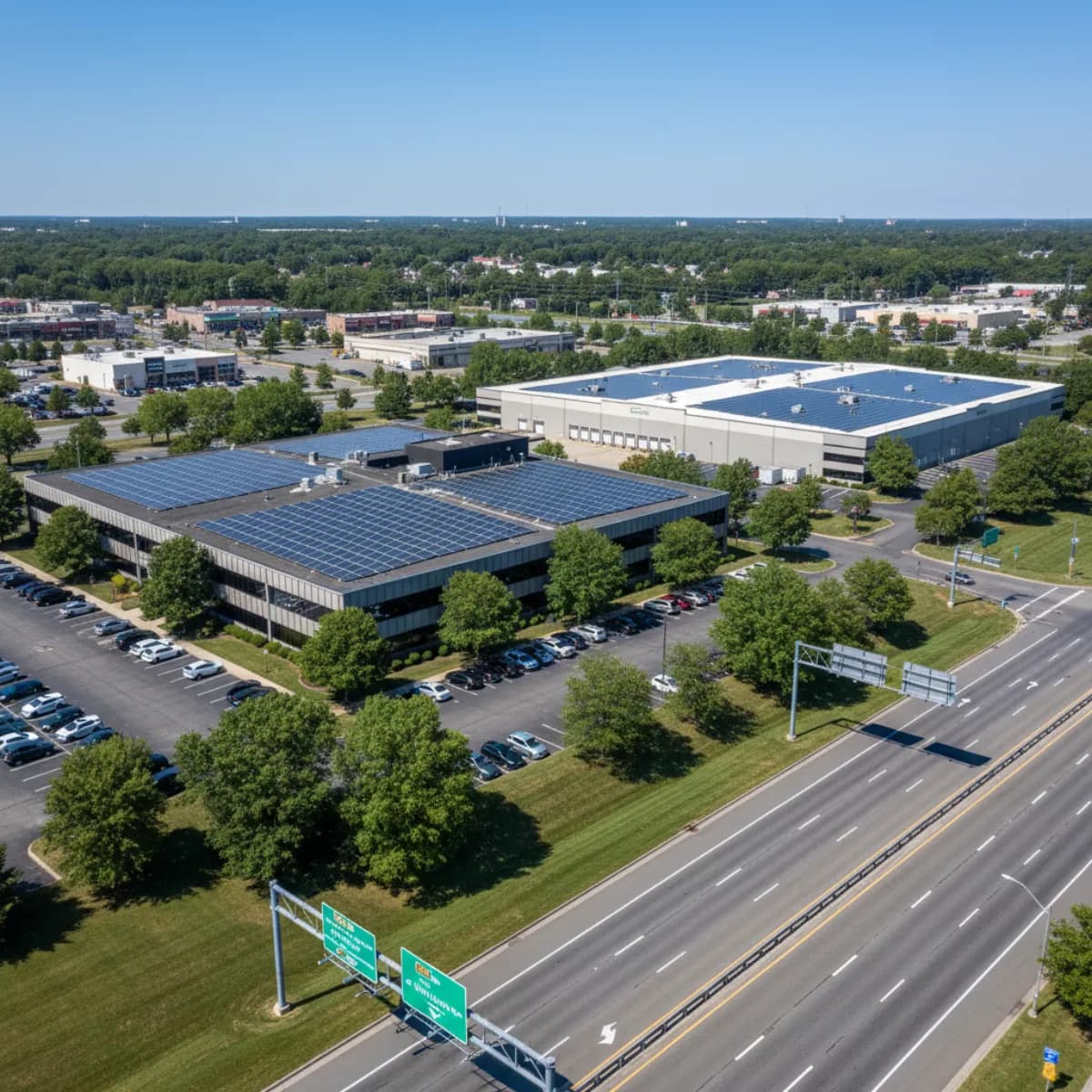
Start with the actual building. Screen preliminary roof capacity and production first, then model the facility's utility tariff, load profile, roof and electrical scope, interconnection, financing, tax position, and confirmed NJ program lane. Offices, warehouses, and retail properties do not share one defensible statewide price or payback.
Address-based
First screen
Site-specific
System capacity
Quote-specific
Installed cost
ADI or CSI
NJ program lane
Quick Answer
For an NJ office, warehouse, or retail property, start with an address-based capacity and production screen. A decision-ready commercial solar quote then requires the facility load and tariff, roof and electrical scope, interconnection, financing and tax inputs, plus verified ADI or CSI eligibility. Building type alone cannot establish cost or payback.
Free address-based tool
Enter the commercial address to review roof capacity, system size, production range, and confidence first. Contact details remain optional until you want the result reviewed.
No account required to see your roof result
The serving utility, rate class, interval load, export treatment, and demand charges determine the value of each solar kilowatt-hour. A statewide rate average cannot replace the facility's bills and tariff, and a monthly bill total cannot show when the building uses power.
The economics are especially compelling in 2026 because the federal Section 48E Investment Tax Credit remains available at 30-50%. Projects that began construction on or before July 4, 2026 locked in the full timing pathway; projects that begin after that date can still qualify but generally must be placed in service by December 31, 2027. Unlike the now-expired residential Section 25D credit, the commercial ITC is part of the Inflation Reduction Act's technology-neutral clean energy credit structure and remains active for commercial installations. This is a critical distinction: NJ homeowners lost their federal tax credit on December 31, 2025, but NJ businesses still have access to the most valuable solar incentive in the federal tax code.
Federal tax treatment, NJ program eligibility, depreciation, and financing must be tested separately for the project owner. Do not add every headline percentage to a quote: each item has its own ownership, timing, labor, location, tax, and documentation conditions.
July 4, 2026 Begin-Construction Safe Harbor (closed)
Projects that began construction on or before July 4, 2026 locked in the full Section 48E timing pathway (placed in service through roughly 2030). Projects that begin construction after that date can still qualify but generally must be placed in service by December 31, 2027. "Begin construction" means either (1) physical work of a significant nature starts on-site, or (2) for low-output solar (1.5 MW AC or less), 5% or more of the total project cost is incurred (the "5% safe harbor"). For many smaller NJ commercial projects, the 5% safe harbor is the practical path — placing an equipment deposit of 5%+ of system cost establishes the start date.
The expiration of the Section 25D residential ITC on December 31, 2025 created a significant divergence between commercial and residential solar economics in NJ. Residential homeowners now rely entirely on state incentives (ADI, net metering, tax exemptions) with no federal tax credit. Commercial businesses, however, retain access to the Section 48E ITC — the most powerful solar incentive — plus MACRS depreciation that residential customers cannot use. This makes 2026 arguably the best year in history for NJ commercial solar investment.
Commercial projects can benefit from scale, but switchgear, structural reinforcement, interconnection work, roof replacement, labor requirements, and site logistics can reverse a generic per-watt assumption. Use the engineered scope and EPC quote for the property.
Building type helps identify the questions to ask. Capacity, price, savings, and payback still come from the specific property and its operating data.
Consistent weekday load profile, strong peak demand overlap with solar production.
System Size
Sized from roof + load
Installed Cost
EPC quote required
Annual Savings
Tariff model required
Payback Period
Project-specific
Roof Type: Flat (TPO/EPDM membrane)
Key Considerations:
Large roof area can create capacity, but load shape, roof condition, obstructions, and interconnection still control value.
System Size
Sized from roof + load
Installed Cost
EPC quote required
Annual Savings
Tariff model required
Payback Period
Project-specific
Roof Type: Flat metal or membrane, large unobstructed area
Key Considerations:
Strong daytime load from lighting, HVAC, and refrigeration. Multi-tenant buildings may require sub-metering.
System Size
Sized from roof + load
Installed Cost
EPC quote required
Annual Savings
Tariff model required
Payback Period
Project-specific
Roof Type: Flat membrane, often with rooftop HVAC units
Key Considerations:
Bring the EPC quote, site-specific production, utility tariff and load, operating cost, financing terms, tax assumptions, and confirmed program eligibility. The calculator keeps those inputs visible instead of presenting a made-up office or warehouse outcome as typical.
Open the commercial ROI calculatorNJ commercial solar projects can stack eight separate incentives. Understanding each one — and how they interact — is key to maximizing your return.
Base ITC for commercial solar. Requires prevailing wage + apprenticeship for systems >1 MW. Projects that began construction on or before July 4, 2026 locked in the full timing pathway; later starts still qualify but generally must be placed in service by Dec 31, 2027.
Use US-manufactured steel, iron, and manufactured products. Combined ITC reaches 40%. Same July 4, 2026 begin-construction safe-harbor date.
Projects in brownfields, former coal communities, or areas with high fossil fuel employment. Several NJ ZIP codes qualify.
ITC reduces depreciable basis by half the credit (e.g., 30% ITC means 85% depreciable). 100% first-year bonus depreciation, made permanent by OBBBA (IRC §168(k)).
NJ Administratively Determined Incentive provides guaranteed income per MWh produced for 15 years. Commercial rates depend on system size and type.
Solar energy systems are exempt from NJ sales tax (N.J.S.A. 54:32B-8.36). This applies to equipment, installation labor, and materials.
Solar installations are fully exempt from NJ property tax assessment (N.J.S.A. 54:4-3.113a). Your property value increases but taxes do not.
NJ commercial net metering credits excess solar production at the full retail electricity rate. Credits roll over month-to-month and are trued up annually.
Most NJ commercial buildings have flat roofs (TPO, EPDM, or modified bitumen membrane), which are ideal for solar. Flat roofs allow ballasted racking systems that use weighted blocks instead of roof penetrations, preserving your roof warranty and simplifying installation. Panels are mounted on tilted racks at 15-25 degrees, optimized for NJ's latitude (40.2 degrees N).
NJ commercial electricity rates include demand charges — fees based on your highest 15-minute power draw during the billing period. For many businesses, demand charges represent 30-50% of total electricity costs. Solar production during peak daytime hours directly reduces demand charges by lowering the building's net draw from the grid. A 200 kW warehouse solar system can reduce peak demand by 100-150 kW, saving $1,500-$3,000 per month in demand charges alone.
Adding battery storage to a commercial solar system amplifies demand charge savings by storing solar energy and dispatching it during peak demand periods — even on cloudy days or during late afternoon demand spikes that occur after solar production declines. Commercial battery systems paired with solar can reduce demand charges by 50-70%.
| Factor | Commercial | Residential |
|---|---|---|
| Federal Tax Credit | Section 48E ITC: 30-50% (projects that began construction by Jul 4, 2026 locked in the full timing) | Section 25D ITC: EXPIRED Dec 31, 2025 |
| MACRS Depreciation | 5-year accelerated + 100% bonus (permanent, OBBBA) | Not available to homeowners |
| System Size | Sized from facility load, site, and tariff | Sized from household usage and roof |
| Installed Cost | Project-specific EPC quote | Home-specific quote |
| NJ ADI Rate | $110/MWh rooftop under 1 MW ($100/MWh at 1-5 MW); +$20/MWh for public entities | $77/MWh for registrations on or after Jul 27, 2026 ($85/MWh locked in before that) |
| Payback Period | Modeled from quote, tariff, production, and confirmed benefits | Modeled from quote, utility value, and production |
| Net Metering | Full retail, annual true-up | Full retail, annual true-up |
| Property Tax Exempt | Yes | Yes |
| Sales Tax Exempt | Yes (6.625% savings on larger systems) | Yes |
NJ commercial solar permitting is more complex than residential. Commercial projects require structural engineering reports (stamped by a NJ-licensed PE), fire department review for rooftop access pathways, electrical single-line diagrams, and often site plan review by the local planning board. The NJ Uniform Construction Code (UCC) applies statewide, but municipalities add their own requirements on top.
Residential solar permits in NJ are streamlined through the Solar Act of 2021, which limits municipal permit fees and requires 15-business-day turnaround. Commercial solar does not benefit from these streamlined rules. Commercial permit timelines are typically 4-8 weeks depending on municipality, and fees can be significantly higher. Some municipalities require planning board review for rooftop solar on commercial buildings — even when no variance is needed — adding 30-60 days to the timeline.
NJ commercial rooftop solar must comply with NJ Fire Code requirements for pathways and setbacks. Arrays must maintain clear access paths (minimum 36 inches wide) along the roof perimeter and around rooftop equipment (HVAC units, vents). Setbacks from roof edges and parapets are typically 3-6 feet. These requirements reduce the usable roof area by 15-25% on most commercial buildings. Your solar installer should model these setbacks in the initial design to provide accurate system size and production estimates.
Northern & Central NJ (Newark, Jersey City, New Brunswick, Trenton)
Largest NJ utility. Level 1 interconnection for <25 kW is fast-tracked. Level 2/3 requires engineering study.
Central NJ & Shore (Monmouth, Ocean, Hunterdon, Morris, Sussex)
Slightly longer timelines than PSE&G. Shore-area projects may require coastal zone review coordination.
South Jersey (Atlantic, Cape May, Cumberland, Salem, Gloucester)
Smallest NJ utility. Generally faster interconnection due to lower queue volume. Southern NJ has strong solar irradiance.
Common questions about NJ commercial solar for offices, warehouses, and retail.
A defensible NJ commercial solar price comes from a site-specific EPC quote. The roof or land, structural and electrical work, switchgear, labor rules, interconnection scope, schedule, and system size all change cost. Model payback only after combining that quote with site-specific production, the facility tariff and load, financing, tax position, and confirmed program eligibility.
Yes, the Section 48E Investment Tax Credit is available for commercial solar through two pathways. Projects that began construction on or before July 4, 2026 locked in the full timing pathway (placed in service through roughly 2030). Projects that begin construction after that date can still qualify but generally must be placed in service by December 31, 2027. The base credit is 30% of the installed cost when prevailing wage and apprenticeship requirements are met (mandatory for systems >1 MW). Additional bonuses of +10% each for domestic content and energy community location can bring the total ITC to 40-50%. This is a different credit from the now-expired Section 25D residential ITC.
Building type alone does not determine ROI. A warehouse may offer more roof area, while an office may have strong daytime HVAC load; either can be limited by roof condition, obstructions, export value, demand charges, interconnection, or tenant allocation. Compare the two using the actual load profile, tariff, site-specific production, and EPC scope.
MACRS (Modified Accelerated Cost Recovery System) allows businesses to depreciate 85% of the solar system cost using an accelerated schedule. Under OBBBA, 100% first-year bonus depreciation is permanent (IRC §168(k)), so the entire depreciable basis can be deducted in year one. The depreciable basis is reduced by half the ITC amount. For a $400,000 system with a 30% ITC ($120,000 credit), you depreciate $340,000. At a combined federal/state tax rate of 28-32%, that generates $95,000-$109,000 in tax savings.
NJ commercial solar requires: (1) local building permit with structural engineering review, (2) electrical permit, (3) utility interconnection application (PSE&G, JCP&L, or ACE), (4) NJ Uniform Construction Code compliance, (5) fire department review for roof access pathways and setbacks, and (6) zoning approval if the project involves ground-mount or carport structures. Projects in flood zones, coastal areas, or historic districts may require additional reviews.
Yes. NJ commercial net metering allows businesses to offset their electric bill with solar production. Excess energy produced during sunny hours generates credits at the full retail electricity rate. Credits roll over month-to-month and are trued up annually in April. Systems can be sized up to the customer annual consumption. Multi-meter and virtual net metering options are available for businesses with multiple accounts on the same property.
The Administratively Determined Incentive is one New Jersey SuSI program lane for eligible net-metered projects at or below 5 MW DC. The schedule varies by size and mount type, so an office roof, carport, and ground mount must be matched to the current BPU segment before any revenue is modeled. Projects outside ADI segments must be screened under current CSI rules.
If your commercial roof is more than 10 years old or has known issues, re-roofing before solar installation is strongly recommended. Solar panels have a 25-30 year lifespan, and removing them for a mid-life roof replacement costs $5,000-$15,000 or more depending on system size. A pre-solar roof inspection and membrane assessment by a commercial roofing contractor should be part of every commercial solar proposal. Some installers partner with roofing companies to bundle both projects.
Start with the office, warehouse, or retail address. Review preliminary roof capacity, system size, production range, and confidence before deciding whether to share contact details or request an engineering and tariff review.
Related: NJ Commercial Solar • MACRS Depreciation Guide • ADI Program Guide