Loading NuWatt Energy...

We use your location to provide localized solar offers and incentives.
We serve MA, NH, CT, RI, ME, VT, NJ, PA, and TX
Loading NuWatt Energy...
NuWatt designs, installs, and manages solar, battery, heat pump, and EV charger systems across 9 states. One company, one warranty, one point of contact.
Get a Free Quote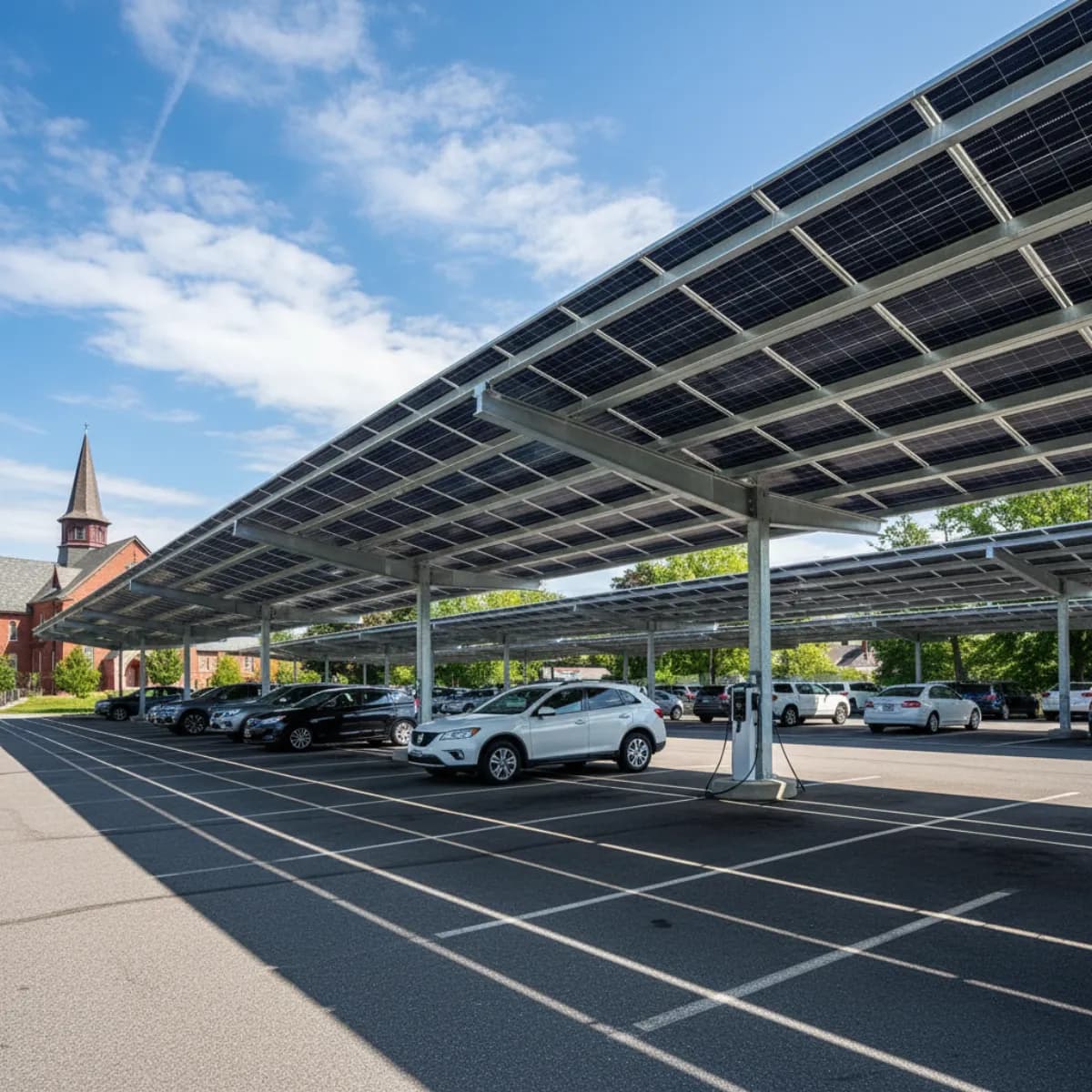
A parking-lot canopy registers in New Jersey's top ADI tier — $ 110/MWh for 15 years under 1 MW, the same rate a rooftop array of that size earns and $20/MWh more than a ground mount on open land. Stack Section 48E ITC (30%+) and MACRS on top, add the +$20/MWh public-entity adder if you're a town or school district, and you fund it without touching your roof or buying land. Here's the complete guide.
Quick Answer
NJ solar carports earn $110/MWh under the ADI program for 15 years — the same rate as a rooftop array of the same size, because the BPU treats rooftop, carport, canopy and floating solar as one market segment priced by size (under 1 MW $110/MWh, 1-5 MW $100/MWh). Carports out-earn ground mount by $20/MWh, and public entities add +$20/MWh. Section 48E ITC, MACRS depreciation and the NJ sales tax exemption stack on top.
New Jersey has over 3 billion square feet of parking lot surface. Most of it sits empty and baking in the sun. Solar carports turn that underutilized space into generation while providing covered parking and EV charging infrastructure — and they do it inside the NJ Board of Public Utilities’ top-paying ADI tier.
One point is worth getting right before you model anything, because it is widely misreported: a carport does notearn a premium over rooftop. The BPU groups “rooftop, carport, canopy and floating solar” into a single net-metered non-residential market segment and prices it by size— $110/MWh under 1 MW, $100/MWh from 1 MW to 5 MW. A 200 kW canopy and a 200 kW roof array earn the identical rate. The premium the Board actually pays is for built-environment siting: putting the array on a surface that is already developed rather than on open land. That is worth $20/MWh against ground mount, and it is the reason a parking lot is such a good host.
A canopy over your existing lot earns $110/MWh; the same system on open ground earns $90/MWh. On the 100 kW example below that gap is $36,000 across the 15-year term — and you keep the land. Rooftop earns the same $110/MWh; a carport wins on siting, not on rate.
Carports don't touch your building roof. No penetrations, no structural loading concerns, no interference with roof maintenance or replacement. The solar system and building are completely independent.
Solar carports provide an ideal platform for EV charging stations. Short conduit runs, direct power connection, and covered charging — all in one structure. The Section 30C EV credit expired June 30, 2026; utility EV programs and MACRS depreciation remain.
Carport solar costs more per watt and earns the sameper MWh. The case for it is not the incentive rate — it is that the array does not consume your roof, does not wait on a roof replacement, is not constrained to your roof's pitch and azimuth, and leaves the parking underneath fully usable. If your roof is young, unshaded, structurally sound and big enough, rooftop is the cheaper way to the same ADI rate. If it is not, the lot is the next best surface in the schedule.
| Feature | Carport Solar | Rooftop Solar |
|---|---|---|
| NJ ADI Rate Identical — one BPU market segment covers rooftop, carport, canopy and floating solar. Size sets the rate, not mount type. | $110/MWh (under 1 MW) | $110/MWh (under 1 MW) |
| Installed Cost ($/W) Steel structure adds cost | $3.50-$5.00/W | $2.50-$3.50/W |
| Structural Impact No roof penetrations | None (ground-mounted) | Roof loading concerns |
| Parking Revenue Covered parking is a customer amenity | Continues + shade value | No impact |
| EV Charging Integration Shorter conduit = lower cost | Direct conduit to chargers | Long wire runs |
| Snow Management Tilted panels shed snow | Shed design clears automatically | May need manual clearing |
| Panel Orientation Engineer optimal angle | Optimal tilt/azimuth | Limited by roof angle |
| Building Interruption No roof access needed | Zero — install in parking lot | May disrupt building operations |
| Section 48E ITC Same ITC for both | Yes (new starts by Dec 31, 2027) | Yes (new starts by Dec 31, 2027) |
| MACRS Depreciation Same MACRS for both | 5-year accelerated | 5-year accelerated |
Every non-residential ADI figure on this page comes from this table. Read it the way the BPU wrote it: the first column is the market segment, and rooftop and carport share one. Your rate is determined by which segment you register in and how big the project is — nothing else.
| Market Segment | Size | Rate | Public Entity |
|---|---|---|---|
| Rooftop, carport, canopy & floating solarBuilt environment | Under 1 MW | $110/MWh | $130/MWh |
| Rooftop, carport, canopy & floating solarBuilt environment | 1 MW to 5 MW | $100/MWh | $120/MWh |
| Ground mount | Under 1 MW | $90/MWh | $110/MWh |
| Ground mount | 1 MW to 5 MW | $85/MWh | $105/MWh |
NJ solar carports qualify for a powerful stack of federal and state incentives that can recover 50-80% of the installed cost within the first 5 years. For a 100 kW carport system, here's what the incentive stack looks like.
Section 48E ITC deadline:The begin-construction window closed July 4, 2026; projects starting now generally must be placed in service by December 31, 2027. For carports, “beginning of construction” means 5% of total costs incurred (safe harbor) or physical work of a significant nature started (e.g., foundation drilling). Section 25D (residential) expired Dec 31, 2025 and does not apply to commercial.
| Incentive | Rate/Value | Annual | Total Value |
|---|---|---|---|
| NJ ADI (built-environment tier, under 1 MW) | $110/MWh for 15 years | $13,200/year | $198,000 |
| NJ ADI public-entity adder | +$20/MWh (municipal, school district, government) | $2,400/year | $36,000 |
| Section 48E ITC | 30% of installed cost | Year 1 credit | $105,000-$150,000 |
| MACRS Depreciation | 5-year accelerated | Years 1-5 | $70,000-$100,000 |
| Net Metering Credits | Varies by utility | Depends on your rate | Model it below |
| NJ Sales Tax Exemption | 0% on solar equipment | One-time | $23,000-$33,000 |
Solar carports work best for properties with large parking areas that sit empty during daylight hours. These organizations see the fastest payback and highest return.
Large parking lots with consistent daytime foot traffic. Covered parking is a competitive amenity that attracts customers. Solar offsets high commercial electric rates during business hours.
Large parking lots used primarily on weekends. Solar generates income Monday-Friday when the lot sits empty. Section 48E direct pay allows tax-exempt organizations to receive the ITC as a cash refund.
Faculty and student parking lots with reliable daytime usage. NJ school districts benefit from Section 48E direct pay (tax-exempt), ADI revenue, and reduced electricity costs. Educational opportunity for students.
Employee parking lots with weekday daytime usage perfectly matching solar production. Covered parking is an employee benefit. ESG and sustainability reporting value. EV charging integration for employee vehicles.
Hospitals and medical offices with large visitor and staff parking. 24/7 energy demand. Battery-integrated carports provide backup power for critical facilities. NJ hospitals pay $0.14-$0.18/kWh — high savings potential.
Town halls, libraries, community centers with public parking. Section 48E direct pay for tax-exempt entities. Demonstrates municipal climate commitment. Often the largest underutilized surfaces in a town.
NJ solar carports must withstand nor'easters, snow loads, and coastal wind exposure. Here are the engineering requirements specific to New Jersey installations.
Solar carports are the ideal platform for EV charging. The carport structure provides covered charging, short conduit runs, and direct solar-to-vehicle energy transfer. NJ is aggressively expanding its EV charging network, and businesses with solar carport + EV charging become destination charging locations.
$3,000-$6,000 per station installed. Ideal for employee parking (8-hour charge) and retail (2-4 hour charge). Direct conduit from carport panel output.
$50,000-$150,000 per station. Ideal for highway-adjacent locations and high-traffic retail. Requires dedicated transformer but carport provides weather protection.
NJ EV charging rates: $0.30-$0.50/kWh (Level 2) to $0.40-$0.65/kWh (DCFC). With solar-generated power at $0.00/kWh marginal cost, every kWh sold is high-margin revenue.
From engineering to interconnection, a NJ solar carport project takes 4-8 months. Here's the step-by-step permitting process.
Licensed NJ PE stamps structural drawings for carport system. Must meet NJ building code for 30 psf ground snow load and 110 mph wind exposure.
Most NJ municipalities allow solar carports by right in commercial zones. Some require site plan review for height variances (typically 14-18 feet clearance).
NJ S.4100 streamlined permitting applies to carports under 500 kW. Larger systems may need full commercial permit review. Includes structural, electrical, and fire department review.
PSE&G, JCP&L, or ACE interconnection application. Systems over 25 kW require an interconnection study ($1,000-$5,000). Larger systems (>200 kW) may need substation upgrades.
Register with NJ Clean Energy under the net-metered non-residential "rooftop, carport, canopy and floating solar" market segment — $110/MWh under 1 MW, $100/MWh from 1 to 5 MW. Co-located projects are aggregated for the size test, so two adjacent canopies totalling over 1 MW register at the larger-project rate. Must complete within 12 months of interconnection to qualify.
The begin-construction window closed July 4, 2026; to qualify for the Section 48E ITC, projects starting now generally must be placed in service by December 31, 2027. For carport projects, filing for permits and paying the 5% safe harbor deposit counts as “beginning of construction.” Starting the permitting process early keeps the placed-in-service timeline comfortable.
These four numbers are the part of the return that does notdepend on which utility serves you: the installed cost, the federal tax benefits, the ADI stream, and what is left over. Electricity savings — the other half of the return — are a function of the rate on your own bill, which differs materially between PSE&G, JCP&L, Atlantic City Electric and Rockland Electric. Model that half with your own rate in the calculator directly below rather than trusting a statewide average.
A municipal or school-district host registering the same system earns $130/MWh with the public-entity adder — $234,000 over the term instead of $198,000. Tax-exempt hosts take the ITC as a Section 48E direct payment but do not capture the MACRS portion of the year-one figure above.
Enter your lot size (or system kW), your installed cost, and the electricity rate from your own utility bill. The model returns a live net cost after the Section 48E ITC and MACRS, simple payback, 25-year cumulative value, and cost per parking space. It starts on the 100 kW example above. ADI revenue is a separate 15-year payment stream and is not included here — read the payback below as the electricity-only case and add the $198,000 ADI line from the incentive stack on top.
Enter your parking size and your own electricity rate for a live result.
Spaces and kW are linked at ~2.2 kW per covered space (a 200 kW canopy covers roughly 91 spaces at that density). Edit either field.
Published carport range $4.20-$7.55/W — carports run higher than rooftop for the steel structure. Adjust to your quote.
Enter the blended rate from your own utility bill — the placeholder is only an example, not a default.
Payback
—
Net cost
$221,637
25-yr value
—
Total installed cost
$425,000
45 spaces · 100 kW
Federal ITC (30%)
$127,500
on full carport cost
MACRS tax value
$75,863
Cost per space (net)
$4,925
$9,444 before incentives
Cumulative net cash position (25 yr)
Enter your electricity rate to see payback, 25-year value, and the cash-flow curve.
The carport premium over rooftop is not pure cost: it converts otherwise idle parking into covered, EV-charging-ready space you already own — value this model does not monetize.
These results are estimates driven entirely by the values you enter above — not a quote. Cash flows assume 0.5% annual panel degradation, upfront ITC and MACRS present value netted into the cost, and 25-year straight electricity escalation. The MACRS shield assumes a taxable owner; state conformity to federal bonus depreciation varies (Massachusetts, for example, decouples), and tax-exempt entities use Direct Pay for the ITC and cannot claim MACRS. Confirm structural cost, bonus eligibility, ITC adders, interconnection, and your actual tax position with a professional.
Turn this model into an engineer-reviewed carport proposal
We size the canopy to your lot, confirm the structural cost, and build your 25-year cash flow on your real utility tariff.
A commercial solar carport in NJ costs $3.50-$5.00 per watt installed, compared to $2.50-$3.50/W for rooftop solar. The higher cost is due to the steel canopy structure, foundations, and engineering. A 100 kW carport system costs approximately $350,000-$500,000. That premium is real and the ADI does not erase it: a carport and a rooftop array of the same size earn exactly the same ADI rate ($110/MWh under 1 MW). What justifies a carport is not a better incentive rate but the fact that it needs no roof and no new land — and, for municipal, school-district and government hosts, the +$20/MWh public-entity adder that lifts the rate to $130/MWh.
No. This is a common misreading of the ADI schedule. The NJ BPU puts rooftop, carport, canopy and floating solar in a single net-metered non-residential market segment, and the rate is set by project SIZE, not by mount type: $110/MWh under 1 MW and $100/MWh from 1 MW to 5 MW. A 200 kW canopy and a 200 kW rooftop array earn the same $110/MWh. Where a carport genuinely earns more is against GROUND MOUNT: the Board deliberately pays a premium for "built environment" siting on already-developed surfaces, so a canopy over an existing parking lot earns $20/MWh more than an equivalent ground-mount array on open land ($90/MWh under 1 MW).
Yes. Tax-exempt organizations (churches, schools, municipalities, nonprofits) qualify for Section 48E "direct pay" — they receive the 30%+ ITC as a cash refund from the IRS instead of a tax credit. This makes carport solar financially viable even for organizations with no tax liability. The July 4, 2026 begin-construction window has closed; new starts generally must be placed in service by December 31, 2027.
NJ solar carports must meet NJ building code requirements: 30 psf ground snow load, 110 mph wind speed exposure (higher for shore towns), minimum 14-foot vehicle clearance, and ADA-compliant access. Foundations typically require concrete footings or drilled piers depending on soil conditions. A licensed NJ Professional Engineer (PE) must stamp the structural design.
Yes, and this is one of the biggest advantages of solar carports. The carport structure provides a direct conduit path for EV charging cables — much shorter and cheaper than running conduit from a rooftop array. NJ's Section 30C EV charger tax credit expired June 30, 2026 and is no longer available, but NJ businesses can still offset charger costs with utility EV programs (PSE&G, JCP&L, ACE) and MACRS depreciation on the equipment. Many NJ businesses are combining solar carports with Level 2 and DC fast chargers.
NJ solar carports are engineered for a 30 psf ground snow load (higher in northern NJ mountain areas). The tilted panel surface naturally sheds snow, and the elevated structure means snow falls to the ground below rather than accumulating. Most NJ carport designs use a single-slope (mono-pitch) or dual-slope layout that clears snow automatically. No manual snow removal is needed.
Payback depends on the electricity rate on your own bill, which in New Jersey varies materially between PSE&G, JCP&L, Atlantic City Electric and Rockland Electric — so any single statewide payback figure is guesswork. What can be stated without assuming a rate: on the 100 kW example on this page, the Section 48E ITC plus 100% first-year bonus MACRS returns about $203,363 in year one, leaving roughly $221,637 net, and the ADI stream alone pays $13,200/year for 15 years — $198,000, or about 89% of that net cost — before a single kWh of electricity savings. Enter your own rate in the calculator on this page to get the rest. Tax-exempt organizations using Section 48E direct pay recover the ITC as cash but not the MACRS half, so their net cost after year one is higher.
Yes. NJ solar carports require a building permit (structural review for the canopy), electrical permit (for the solar system), and potentially a site plan review if the carport changes the lot layout. NJ S.4100 streamlined permitting applies to systems under 500 kW. Larger systems need full commercial permit review. Shore towns may have additional wind load and flood zone requirements.
The Section 48E ITC begin-construction safe harbor closed July 4, 2026; new starts still capture the 30%+ federal credit if placed in service by December 31, 2027 — stacked with the $110/MWh ADI rate for projects under 1 MW ($130/MWh for public entities) and MACRS depreciation. Free site assessment for NJ commercial properties.