Loading NuWatt Energy...

We use your location to provide localized solar offers and incentives.
We serve MA, NH, CT, RI, ME, VT, NJ, PA, and TX
Loading NuWatt Energy...
Use the free estimator for a preliminary layout, or share your preferred response method with the commercial team. Final feasibility still requires site, utility, and engineering review.
A commercial battery is not one investment with one payback. It earns from a demand charge, from a utility program, and from the federal tax code at the same time — and each of those is a different number with a different source. This page publishes the ones we can trace, and says plainly where a figure does not exist.
$200/kW
National Grid MA Daily Dispatch
$325/kW
CT ESS small/medium C&I, yrs 1-5
30%
Modeled Section 48E increased-credit amount
100%
First-year bonus depreciation
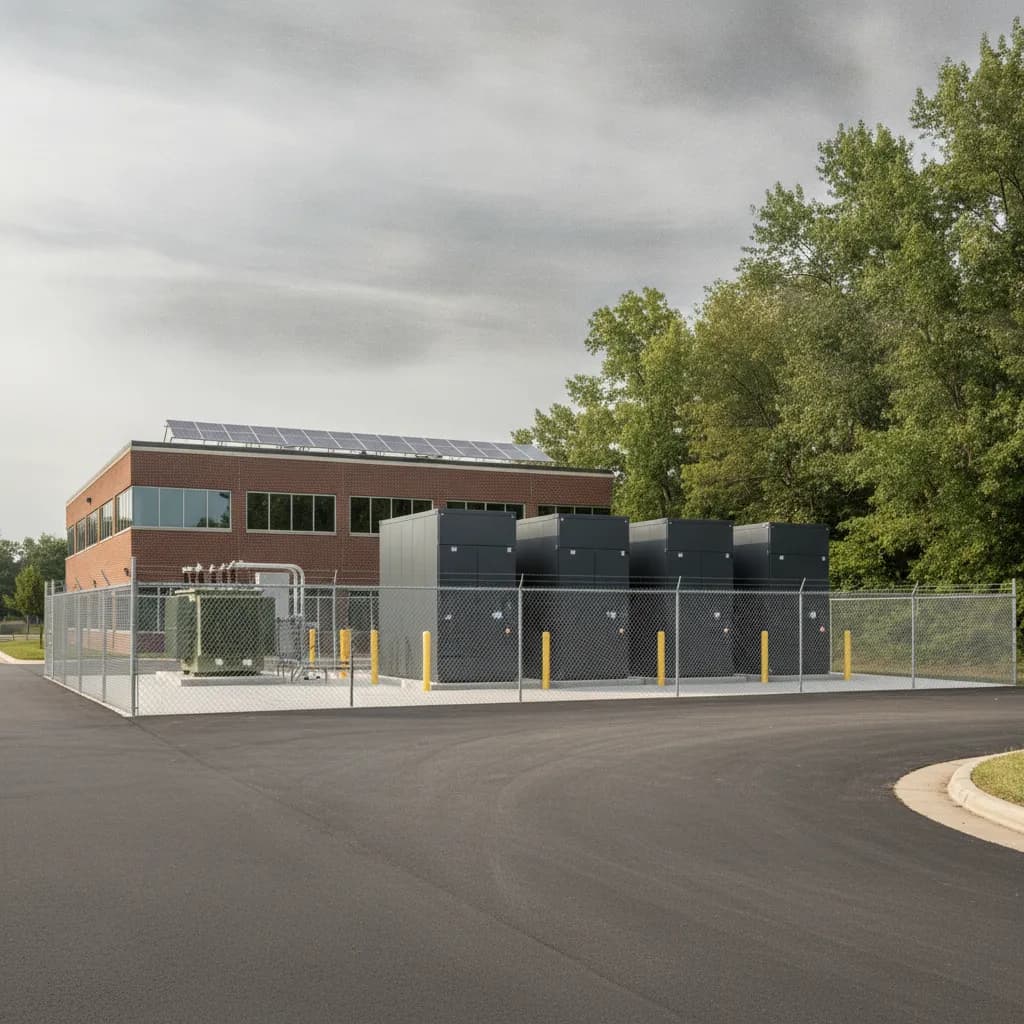
Three lines at once. Demand-charge savings, set by the facility's own tariff and load shape — Eversource Eastern Massachusetts G-2 bills $33.95/kW of measured peak. Demand-response revenue: both National Grid Daily Dispatch and Eversource Daily Curtailment publish $200/kW in Massachusetts; Connecticut Energy Storage Solutions publishes $325/kW for small and medium C&I in years one through five. Federal tax modeling can use the 30% Section 48E increased-credit amount when labor rules or an applicable exception are satisfied; the statutory base is 6%.
The short version
Every published number on this page traces to a utility's own rate table, a program manual, or the Internal Revenue Code — with the source and its effective date next to it. Where a figure has not been published by the body that sets it, we say so instead of borrowing one from a summary site. That applies to the still-unpublished Rhode Island large-C&I dispatch rate and to installed cost per kilowatt-hour.
We are not going to give you a dollar-per-kilowatt-hour figure, and it is worth explaining why rather than quietly leaving a gap. The commercial storage cost results published online often omit scope, power rating, duration, siting, interconnection, taxes, and date. A cell price and a turnkey installed project price are not the same measurement. Without a normalized first-party dataset, publishing one generic range would hide more than it explains.
What actually determines a commercial quote is below. When NuWatt has a defensible installed range sourced from its own completed commercial storage work, it will be published here with its basis and its date, the same way the tariff figures are.
A battery is quoted as two numbers: kW (how hard it can push) and kWh (how long it can push for). Power capacity drives the inverter, the switchgear and the interconnection study. Energy capacity drives the cells and the enclosure. A 250 kW / 500 kWh system and a 250 kW / 1,000 kWh system share a power train and differ almost entirely in cell cost, which is why "$/kWh" alone tells you very little about a commercial quote.
Demand-charge shaving needs very little energy — trimming a 15-minute billing peak is a short, sharp discharge. Demand-response dispatch is the opposite: programme events run for hours, so the enrolled kW is limited by stored energy. The duration you buy should follow which of those two you are chasing, and a battery sized only for one will not earn both.
Where the enclosure goes decides much of the price: pad and conduit runs, distance to the service entrance, transformer and switchgear work, spill containment, fire-code separation and local approvals. Indoor installations and tight urban sites carry meaningfully more construction than a pad on a suburban distribution lot.
A commercial battery is a generation-class interconnection. The study, any distribution upgrades identified by it, and the queue itself are all live cost and schedule variables. On the current federal timing this matters twice over: the credit is claimed when the system is placed in service, not when it is ordered.
The revenue side of the stack does not need a cost figure at all. Your demand charge is on your bill, the program rates are published, and the tax treatment is a percentage. That is enough to tell you what a battery would have to cost for the numbers to work at your site — which is a more useful question than what a battery costs on average.
Model your own revenue stackDemand charges are billed on your highest measured power draw in the month, not on how much electricity you used. That is the line a battery attacks. Below are the published Massachusetts and Connecticut commercial demand charges, read off each utility's own rate summary.
| Utility | Rate class | Demand charge components | Total per billing unit | Source date |
|---|---|---|---|---|
| EversourceMA | G-1 Small General Service (Demand Price Option) | Distribution demand charge (above 10 kW) $22.31 + Transmission demand charge (above 10 kW) $19.34 | $41.65per kW-month | Effective July 1, 2026 |
| EversourceMA | G-2 Medium General Service | Distribution demand charge $20.21 + Transmission demand charge $13.74 | $33.95per kW-month | Effective July 1, 2026 |
| EversourceMA | G-3 Large General Service | Distribution demand charge $15.97 + Transmission demand charge $14.08 | $30.05per kW-month | Effective July 1, 2026 |
| National GridMA | G-2 (Medium commercial and industrial) | Demand charge $15.24 | $15.24per kW-month | Effective October 1, 2026 |
| National GridMA | G-3 (Large commercial and industrial, time of use) | Demand charge $10.61 | $10.61per kW-month | Effective October 1, 2026 |
| Eversource ConnecticutCT | Rate 30 — Small General Electric Service | Distribution demand charge (over 2 kW) $14.22 + Electric System Improvements demand charge (over 2 kW) $3.78 + Transmission demand charge (over 2 kW) $12.84 + Competitive Transition Assessment demand charge (over 2 kW) $1.47 | $32.31per kW-month | Last updated May 1, 2026 |
| Eversource ConnecticutCT | Rate 35 — Intermediate General Electric Service | Distribution demand charge $8.69 + Electric System Improvements demand charge $2.22 + Transmission demand charge $14.58 + Competitive Transition Assessment demand charge $1.78 | $27.27per kW-month | Last updated May 1, 2026 |
| Eversource ConnecticutCT | Rate 37 — Intermediate Time-Of-Day General Electric Service | Distribution demand charge $8.69 + Electric System Improvements demand charge $2.22 + Transmission demand charge $7.29 + Competitive Transition Assessment demand charge $1.78 | $19.98per kW-month | Last updated May 1, 2026 |
| Eversource ConnecticutCT | Rate 56 — Intermediate Time-Of-Day Electric Service, Non-Manufacturers | Distribution demand charge $7.91 + Electric System Improvements demand charge $1.86 + Transmission demand charge $14.93 + Competitive Transition Assessment demand charge $1.85 | $26.55per kVA-month | Last updated May 1, 2026 |
| United IlluminatingCT | Rate GST — General Service Time-of-Use (demand metered) | Transmission $12.94 + Local delivery distribution $5.19 + New England Grid Operator cost $0.28 + Customer Produced Energy $0.59 + Miscellaneous and other mandates $0.19 + State Mandated Energy Purchases credit −$6.23 | $12.96per kW-month | Effective July 1, 2026 |
Do not read this table as a price comparison
Eversource and National Grid do not build their demand charges the same way. Eversource bills a distribution demand charge and a transmission demand charge, both on your measured peak kW. National Grid bills a distribution demand charge only and recovers transmission through a per-kWh energy charge. The two $/kW figures therefore measure different things and cannot be compared directly, and a peak-shaving battery reaches a larger share of the bill on the Eversource structure for that structural reason rather than because power is simply dearer.
Connecticut’s two electric distribution companies do not build a demand charge the same way as each other, and neither builds it the way the Massachusetts utilities do. Eversource Connecticut states four separate delivery demand components — distribution, Electric System Improvements, transmission and the Competitive Transition Assessment — and bills its 350-to-1,000 kW classes per kVA of apparent power rather than per kW. United Illuminating states a shorter list of per-kW components and then subtracts a published State Mandated Energy Purchases credit, while recovering much of its distribution revenue through a per-kWh charge that no per-kW total can show. Read each row against its own bill, and never rank these totals against one another or against a Massachusetts total as though they were prices for the same thing.
Verified October 12, 2026 against: Eversource, 2026 Summary of Eastern Massachusetts Electric Rates for Greater Boston Service Area (effective July 1, 2026); National Grid, Massachusetts Electric Company Summary of Electric Delivery Service Rates, M.D.P.U. No. 1-26-I (effective October 1, 2026); Eversource, Summary of Connecticut Electric Rates (last updated May 1, 2026); The United Illuminating Company, General Service Time-of-Use Rate GST, C.P.U.C.A. No. 2508 (Docket No. 26-01-02) (effective July 1, 2026). Rhode Island commercial demand charges are not published here because they were not read off a primary source — a battery's demand-charge saving there has to start from the customer's own bill.
The mechanics of peak shaving — ratchet clauses, the 15-minute billing interval, and how solar and a battery split the work — are covered in depth on commercial battery peak shaving.
Northeast storage programs are not variations on one design. Massachusetts pays per dispatch event through a summer season. Connecticut pays a ten-year performance schedule. Texas has no statewide program at all and the value comes from avoiding a transmission cost. Getting these confused is the single most common error in commercial storage content.
Paid per kilowatt of average dispatched capacity across the summer season. Verified August 3, 2026.
| National Grid offering | $/kW | Events | Who it fits |
|---|---|---|---|
| Daily Dispatch (Battery) | $200 | 30-60 events, 2-3 hours | Batteries above 50 kW — the default commercial enrolment |
| Small Scale Batteries (under 50 kW) | $275 | 30-60 events, 2-3 hours | Systems with inverter capacity under 50 kW |
| Targeted Dispatch | $45 | 2-8 events, 3 hours | Sites that want minimal cycling and can only commit to a handful of calls |
Season runs June through September. Enrolled capacity is capped at 1.5times the site's peak load.
| Eversource offering | $/kW-season | Events | Who it fits |
|---|---|---|---|
| Daily Curtailment | $200 | 30 to 60 events, 2-3 hours | The default Eversource commercial enrolment — a site that can deliver a reduction on every called event |
| Targeted Dispatch | $45 | three to eight events, 2-3 hours | Sites that can only commit to a handful of calls; the weekend bonus is averaged across all weekend events |
Statewide Eversource figures verified August 5, 2026. Eversource does not publish an equivalent of National Grid's higher small-battery tier.
Greater Boston Daily Battery
$250/kW summer. Up to 60 events per year.
Enrolment limited to Alewife, Dorchester, Mattapan, West Roxbury, Milton.
Southeastern Massachusetts Daily Battery Curtailment
$275/kW summer, $100/kW shoulder season. Up to 150 events per season.
Enrolment limited to Freetown, Lakeville, New Bedford, Dartmouth, Acushnet.
ConnectedSolutions is not the only Massachusetts line a battery reaches. Where the storage is paired with new solar under SMART 3.0, the Department of Energy Resources lists an Energy Storage Multiplier of $0.04/kWh in the Program Year 2026 adder-rate table, paid on top of the base compensation rate for the full 20-year term. Treat that as the published rate rather than as a quote: what a specific project earns is settled by DOER's Program Year 2026 Energy Storage Adder Calculator workbook, which weighs the battery's power and duration against the solar it is attached to. Source: mass.gov SMART 3.0 Program Details. It stacks with the ConnectedSolutions payments above — the programmes pay for different things.
Full Massachusetts business battery ratesRestructured April 1, 2026 (the program calls the new design Construct 5). Paid as a 10-year performance schedule on measured seasonal contribution, not as an upfront rebate. Verified August 3, 2026.
| Customer class | Years 1-5 ($/kW) | Years 6-10 ($/kW) |
|---|---|---|
| Small or Medium C&IAnnual peak demand under 500 kW | $325 | $175 |
| Large C&IAnnual peak demand of 500 kW or more | $275 | $175 |
Energy Storage Solutions is the programme revenue. The other Connecticut line a battery reaches is the delivery demand charge, and both Connecticut utilities now appear in the table above with every component stated: from $12.96 per kW-month on United Illuminating Rate GST up to $32.31 per kW-month on Eversource Connecticut Rate 30. Those figures come off Eversource's Summary of Connecticut Electric Rates and United Illuminating's Rate GST tariff, not from an aggregator — but the structures differ so sharply between the two that they cannot be ranked against each other, and a battery's saving still has to start from the rate code printed on the customer's own bill.
Full Connecticut C&I storage guideRhode Island Energy's published battery rates cover its Residential & Small Business track, which admits the small-commercial rate class. A customer enrolling today earns $225/kW, dropping to $200/kW after the fifth summer of participation. Above 50kW of inverter capacity the utility directs systems to a separate C&I pathway whose rate it does not publish.
ERCOT is deregulated and there is no statewide commercial storage incentive to enrol in. The value sits somewhere different: transmission cost is allocated to large commercial customers on their demand during four coincident peak intervals across the summer, so discharging into those specific intervals reduces the following year's transmission charges. That is a forecasting and dispatch strategy rather than a program with a published $/kW.
Texas 4CP demand strategyThis commercial demand-response rate is quoted freely on summary sites and has not been published by the utility that sets it. It is absent here on purpose, so that silence is not mistaken for zero.
Rhode Island Energy C&I Daily Dispatch and Targeted Dispatch rates
Rhode Island Energy’s published battery programme guide covers the Residential & Small Business track and directs systems above 50 kW to a C&I Daily Dispatch Pathway without stating its incentive rate. Figures circulating on third-party sites are not sourced to the utility.
Closed since the last revision
Storage is treated differently from solar in a way that matters a great deal right now, and most pages on the subject miss it because they were written about solar and had storage bolted on.
Energy storage technology is not subject to the December 31, 2027 placed-in-service deadline or the July 4, 2026 begin-construction trigger — both apply to applicable wind and solar facilities only, and Section 48E(e)(4)(C) expressly excepts energy storage technology (IRS Notice 2025-42, section 2.02). A standalone commercial battery remains eligible for the statutory 6% Section 48E credit, increased to 30% when the applicable wage and apprenticeship requirements are met, under the standard clean-electricity phase-out that starts at the later of 2032 or when U.S. greenhouse gas emissions from electricity are 25% of 2022 emissions or lower.
One caveat travels with this: the OBBBA prohibited-foreign-entity and material-assistance rules do apply to storage for construction beginning after December 31, 2025 (IRS Notice 2026-15). Component sourcing has to be documented at procurement, not at filing.
Energy storage technology is its own qualifying category under Section 48E(c)(2). There is no requirement that a commercial battery be paired with solar or charged from a renewable source to claim the credit.
Energy storage is 5-year MACRS property and currently carries 100% first-year bonus depreciation under IRC Section 168(k) (IRS Notice 2026-11). Because we do not publish an installed price, the example below is normalised to a $100,000 unit of cost — scale it to your own quote.
This worked example uses the 30% increased-credit amount. The statutory base is 6%; confirm prevailing-wage and apprenticeship compliance or an applicable exception before using the increased amount.
| Installed cost (the unit everything below scales to) | $100,000 |
| Section 48E increased-credit scenario at 30% | $30,000 |
| Depreciable basis, reduced by 50% of the credit | $85,000 |
| First-year deduction at 100% bonus depreciation | $85,000 |
| Federal tax saved by that deduction at 21% | $17,850 |
| Present value of the whole depreciation schedule | $17,850 |
| Cost remaining after both federal benefits | $52,150 |
Depreciation timing and tax position are specific to your entity — confirm with a tax professional. Tax-exempt owners take the credit as elective (direct) pay and do not use depreciation.
Twelve months of interval data tells you how sharp your peaks are, how often they repeat, and what time of day they land. A facility with one tall spike a month is a very different battery from one that sits near its peak all afternoon — the first needs power, the second needs energy. Sizing off nameplate load or square footage produces a system that misses the peak it was bought to shave.
Programs pay on sustained dispatch. National Grid's battery events run 2-3 hours and Connecticut's Active Dispatch runs 1 to 3 hours, so the kilowatts you can enrol are bounded by the energy you can hold up for a whole event, not by the inverter rating on the datasheet. An oversized inverter behind a small pack enrols at the small number.
A battery bought for demand-charge work can also carry a critical panel through an outage, but only the loads you deliberately put on that panel and only for as long as the stored energy lasts. Refrigeration, process controls, servers, egress lighting and life-safety systems are the usual candidates. The way to value it is to cost your own downtime per hour — spoiled stock, a stalled production line, a closed storefront — and then decide how many hours of which circuits you are buying. Whole-facility backup for days is a generator conversation, not a battery one.
Plan commercial battery backup powerNote that enrolling in a dispatch program and holding a full reserve for backup pull in opposite directions: a battery discharged for a program event is not a battery at full state of charge when the storm arrives. Programs allow a reserve to be held back, at the cost of enrolled capacity, and that trade-off should be set deliberately at design time.
Start with the bill-based value stack, or upload CSV / Green Button interval data to test multiple power-and-duration combinations against the facility's actual peaks. The studio shows the assumptions, confidence, monthly result, and the maximum installed cost the selected return target can support.
Open the storage feasibility studioEnergy storage technology is its own qualifying category under Section 48E(c)(2). There is no requirement that a commercial battery be paired with solar or charged from a renewable source to claim the credit. The statutory base amount is 6%. The 30% increased-credit amount modeled here requires applicable prevailing-wage and apprenticeship compliance or a statutory exception; tax-exempt owners should separately confirm elective-pay eligibility and procedure.
Bring twelve months of interval data and your current tariff. We will size against your actual peaks and show the program enrolment you qualify for.