Loading NuWatt Energy...

We use your location to provide localized solar offers and incentives.
We serve MA, NH, CT, RI, ME, VT, NJ, PA, and TX
Loading NuWatt Energy...
NuWatt designs, installs, and manages solar, battery, heat pump, and EV charger systems across 9 states. One company, one warranty, one point of contact.
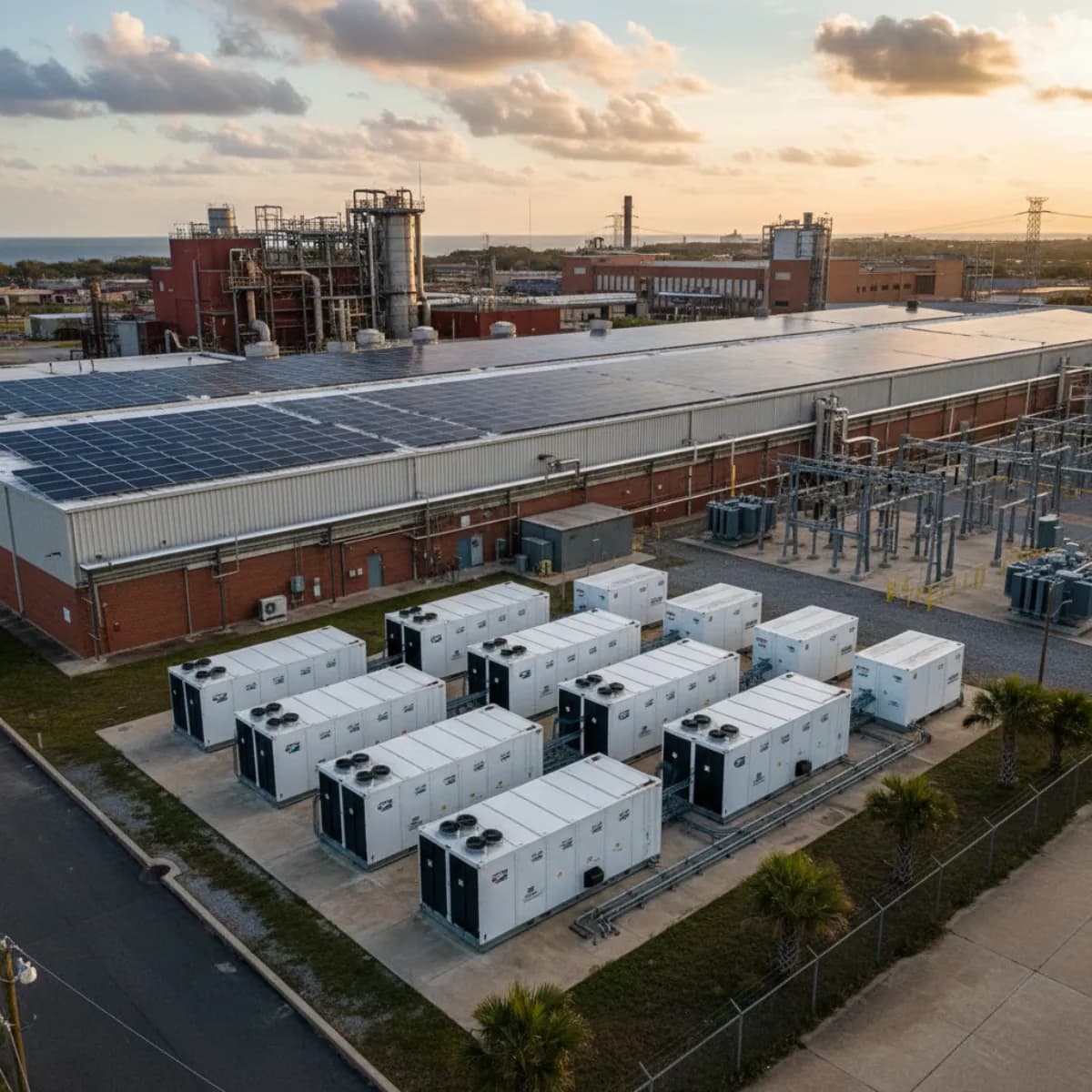
Get a Free QuoteTexas demand charges ($7-$15/kW) represent 30-50% of commercial electricity bills. Add ERCOT 4CP transmission charges and the potential for wholesale price spikes ($1-$9/kWh during extreme events), and commercial batteries become a compelling investment. Calculate your peak shaving savings by TDU territory, ERCOT 4CP reduction, and arbitrage potential.
TX Demand Charges
$7-$15/kW
By TDU territory
Bill Share
30-50%
Demand charges
ERCOT Spike Prices
$1-$9/kWh
Extreme events
Battery Payback
3-7 Years
With demand + 4CP + ITC
A properly sized commercial battery reduces Texas demand charges by 40-80%, saving $6,000-$90,000 per year depending on facility size and TDU territory (Oncor $8-$15/kW, CenterPoint $7-$14/kW, AEP $7-$12/kW). Additional savings come from ERCOT 4CP transmission charge reduction ($6,000-$30,000/year) and wholesale price arbitrage during extreme events. A 250 kWh / 125 kW battery system costs $125,000-$200,000 before the 30% federal ITC ($37,500-$60,000 credit). Combined peak shaving + 4CP + arbitrage revenue achieves 4-7 year payback. Unlike Connecticut or Massachusetts, Texas has no state battery incentive — but ERCOT price volatility and high demand charges create strong standalone economics.
Enter the numbers from your own utility bill to model your facility.
Enter your utility or ISO demand-response rate, or leave 0 if none.
From your bill (highest 15-minute kW).
From your utility tariff or bill. Example shown — enter your own.
Capped at 40% — real-world peak shaving rarely exceeds this without oversizing the battery.
Peak reduction
50 kW
25% of 200 kW peak
Annual demand-charge savings
$7,500
50 kW × $13/kW-mo × 12
Annual DR revenue
$0
50 kW dispatch × $0/kW-yr
Net cost after ITC (30%)
$113,750
$162,500 − $48,750 ITC
Simple payback
> 10 yrs
demand savings + DR revenue
10-year net value
-$38,750
cumulative savings + DR − net cost
Estimates only, built entirely from the values you enter — confirm against your utility tariff and a tax professional. Demand-charge savings use your billed peak demand, your demand rate, and your expected peak-shaving fraction. Demand-response revenue uses published Custom program program incentive rates and requires enrollment plus dispatch participation; actual payments depend on your dispatched performance and are capped here at the capacity your entered battery energy can sustain. Massachusetts and Rhode Island publish different ConnectedSolutions rates for business batteries, and this calculator keeps them separate. The federal ITC (30% base plus site-specific adders) applies to the battery cost; tax-exempt entities use elective (Direct) Pay.
Texas has no statewide storage-performance program, so the demand-response field starts at zero and takes whatever rate you are actually offered. Use the VPP and REP demand-response table further down to find a rate to test, and replace the demand rate with the one on your own TDU tariff.
Demand charges are billed based on your highest 15-minute average power draw in each billing cycle, measured in kilowatts (kW). Unlike energy charges ($/kWh) that reward total consumption reduction, demand charges penalize peak spikes — even a single 15-minute peak sets your demand charge for the entire month. This makes demand charges uniquely addressable with battery storage, which can shave peaks to a targeted threshold.
In Texas, demand charges are set by the TDU (not the REP) and are non-negotiable — they are part of the regulated delivery portion of your bill. The table below shows current demand charge rates by TDU and rate class. For many commercial customers, demand charges represent 30-50% of the total electricity bill.
| TDU | Rate Class | $/kW | Peak $/kW | Territory | % of Bill |
|---|---|---|---|---|---|
| Oncor | BUSIDMND | $12.50 | $15.00 | DFW, Waco, Midland-Odessa | 35-50% |
| Oncor | BUSLRGDMND | $10.00 | $14.00 | Large commercial (>100 kW) | 40-55% |
| CenterPoint | LGS | $11.00 | $14.00 | Houston, The Woodlands, Galveston | 35-45% |
| CenterPoint | LGSP | $9.00 | $12.00 | Large primary service | 35-50% |
| AEP Texas | LPL | $9.50 | $12.00 | Corpus Christi, McAllen, Laredo | 30-45% |
| AEP Texas | SPL | $7.50 | $10.00 | Small primary service | 25-40% |
| TNMP | GSD | $10.50 | $13.00 | Parts of DFW suburbs, Temple | 35-45% |
Texas commercial buildings have AC-driven peak demand that runs 8-10 months per year. Summer peaks typically occur between 2-6 PM when AC compressors run at full capacity. A battery that discharges during these peak hours can reduce measured peak demand by 40-80%. The peak is predictable (hot afternoon = high AC) and consistent (every business day in summer), making battery dispatch straightforward to optimize. Unlike the Northeast where peaks are erratic (cold snaps, heat waves), Texas peaks are reliably solar-coincident, making solar + battery combinations particularly effective.
Beyond the standard TDU demand charges, Texas commercial customers face an additional layer of demand-based costs: ERCOT 4CP (Four Coincident Peak) transmission charges. This charge is unique to ERCOT and is one of the most valuable targets for commercial battery storage.
ERCOT measures your facility peak demand during the four highest system-wide peak events each summer (typically June-September, 2-5 PM). Your average demand across these four 15-minute windows determines your share of ERCOT transmission costs for the following calendar year.
Annual 4CP Cost
$2-$5/kW/month in transmission charges
A facility with 500 kW 4CP demand pays $12,000-$30,000/year in 4CP-related transmission charges.
Battery Reduction Strategy
Battery dispatch during predicted 4CP events can reduce your 4CP allocation by 50-80%. Events are predictable (hottest summer afternoons) and last only 15 minutes each.
Reducing 4CP from 500 kW to 200 kW saves $7,200-$18,000/year in transmission charges alone.
The four 4CP events occur during the highest system-wide demand, which correlates with the hottest summer afternoons. ERCOT publishes real-time demand data and forecasts, making it possible to predict 4CP events with 80-95% accuracy 24 hours in advance. Each event is only a 15-minute window — your battery only needs to discharge for 15 minutes to reduce your 4CP allocation. This means even a small battery can have an outsized impact on 4CP-related transmission charges.
ERCOT is unique among US grid operators for its extreme wholesale price volatility. Normal wholesale prices range from $30-$70/MWh ($0.03-$0.07/kWh). During grid stress events, prices can spike to $1,000-$9,000/MWh ($1-$9/kWh) — a 30-300x multiplier over normal prices. These spikes create extraordinary, if intermittent, revenue opportunities for battery storage.
| Event | Duration | Peak Price | Multiplier | Impact |
|---|---|---|---|---|
| Winter Storm Uri (Feb 2021) | 4 days | $9,000/MWh ($9/kWh) | 130-300x normal | Massive commercial bills. Some facilities saw $50K-$500K bills for a single week. Led to REP bankruptcies. |
| Summer 2023 Heat Wave | 3 weeks | $5,000/MWh ($5/kWh) | 60-125x normal | Sustained high prices. ERCOT reserve margins dropped below 3%. Commercial demand charges spiked due to system-wide peak. |
| Summer 2024 Grid Stress | 5 days | $3,000/MWh ($3/kWh) | 45-85x normal | Battery storage systems that dispatched during peaks earned 6-12 months of typical revenue in a single week. |
| Typical Summer Peak Day | 3-5 hours | $200-$500/MWh | 3-12x normal | Occurs 20-40 days/year. Battery arbitrage opportunity between off-peak charging and peak discharge. |
The ERCOT Distributed Resource Registration System (DRRS) launching in 2026 will create a formal framework for commercial batteries to participate in wholesale markets. Currently, most behind-the-meter batteries can only reduce their own facility demand. With DRRS, registered batteries may be able to sell capacity and energy directly into ERCOT during price spike events. A 250 kWh battery discharging at $5,000/MWh earns $1,250 in a single hour — equivalent to 2-3 months of normal peak shaving revenue. Early registration gives Texas commercial battery owners first-mover access to this revenue stream.
Battery sizing depends on your peak demand, load profile, and the value streams you want to capture. The table below shows four common sizing tiers with expected savings and payback for Texas commercial facilities.
$50,000-$80,000 installed | Peak shaving: 50 kW
Demand Savings
$6,000-$9,000/yr
4CP Savings
$1,200-$3,000/yr
Arbitrage Revenue
$2,000-$5,000/yr (typical), $10,000-$50,000/yr (extreme events)
Best for: Small commercial 50-150 kW demand, office buildings, small retail
$125,000-$200,000 installed | Peak shaving: 125 kW
Demand Savings
$15,000-$22,500/yr
4CP Savings
$3,000-$7,500/yr
Arbitrage Revenue
$5,000-$12,500/yr (typical), $25,000-$125,000/yr (extreme events)
Best for: Mid-size commercial 150-400 kW demand, warehouses, large retail
$250,000-$400,000 installed | Peak shaving: 250 kW
Demand Savings
$30,000-$45,000/yr
4CP Savings
$6,000-$15,000/yr
Arbitrage Revenue
$10,000-$25,000/yr (typical), $50,000-$250,000/yr (extreme events)
Best for: Large commercial 400-1,000 kW demand, manufacturing, data centers
$500,000-$800,000 installed | Peak shaving: 500 kW
Demand Savings
$60,000-$90,000/yr
4CP Savings
$12,000-$30,000/yr
Arbitrage Revenue
$20,000-$50,000/yr (typical), $100,000-$500,000/yr (extreme events)
Best for: Industrial facilities, large campus, utility-scale behind-the-meter
Solar and battery each address different parts of the demand charge problem. Solar reduces daytime peaks (when the sun shines). Battery reduces peaks at any time (including evenings, cloudy periods, and morning ramp-ups). Together, they achieve 60-80% demand charge reduction — more than either alone.
| Scenario | Cost | Annual Savings | Demand Reduction | Payback |
|---|---|---|---|---|
| Solar Only (200 kW) | $240,000 | $29,450 | 35-50% (sunny hours only) | 5.5 years |
| Battery Only (250 kWh / 125 kW) | $162,500 | $18,000-$30,000 | 40-60% (any time of day) | 5-7 years |
| Solar + Battery (200 kW + 250 kWh) | $402,500 | $47,450-$59,450 | 60-80% (comprehensive) | 5-6 years |
Standalone commercial batteries qualify for the 30% Section 48E ITC on their own — energy storage is its own qualifying category under Section 48E(c)(2), with no solar-pairing and no solar-charging requirement. Both solar and battery qualify for MACRS 5-year depreciation. A combined $402,500 solar + battery system with 30% ITC receives $120,750 in tax credits. With MACRS at the 21% federal rate, an additional $71,400+ in depreciation savings over 5 years. No Texas state battery incentive exists (unlike CT ESS or MA ConnectedSolutions), but federal benefits + ERCOT economics provide strong standalone ROI.
Beyond peak shaving and arbitrage, Texas commercial batteries can earn additional revenue through virtual power plant (VPP) programs and demand response participation. These revenue streams are still emerging in Texas but growing rapidly as ERCOT integrates more distributed resources.
The Distributed Resource Registration System will allow commercial batteries to register as distributed resources and potentially participate in ERCOT wholesale markets and ancillary services.
Estimated Revenue
TBD — potentially $50-$200/kW/year based on pilot data
Status
Launching 2026 — registration framework under development
Opportunity
First-mover advantage for commercial batteries that register early. Potential for wholesale market arbitrage during price spikes.
Several Texas REPs offer demand response programs where commercial batteries dispatch during system peaks in exchange for bill credits or payments.
Estimated Revenue
$50-$150/kW/year
Status
Active (multiple REPs)
Opportunity
Stacks with peak shaving — dispatch battery during system peaks for REP payment while simultaneously reducing your own demand charges.
Austin Energy and CPS Energy have virtual power plant pilot programs for commercial battery aggregation.
Estimated Revenue
$30-$100/kW/year (pilot rates)
Status
Pilot phase (limited enrollment)
Opportunity
Municipal utility customers can earn additional revenue from battery capacity while maintaining backup power capability.
Complete commercial solar guide for Texas businesses.
How solar + battery protects TX businesses during grid outages.
Guide to VPP programs and battery revenue opportunities in Texas.
Top residential and small commercial battery options for Texas.
The four summer peaks that set your transmission bill, and how to play them.
The PUCT docket that could change how 4CP is allocated.
Peak shaving, 4CP avoidance and outage cover from the same battery.
National C&I storage guide plus the stacked-revenue calculator.
See your demand-charge savings with solar + storage
We analyze your interval data and demand profile to size the system.
A properly sized commercial battery can reduce demand charges by 40-80% in Texas. Demand charges range from $7 to $15 per kW depending on TDU territory (Oncor: $8-$15/kW, CenterPoint: $7-$14/kW, AEP Texas: $7-$12/kW). A 250 kWh / 125 kW battery system that reduces peak demand by 125 kW saves $10,500-$22,500 per year in demand charges alone. The key is sizing the battery to your peak demand profile — analysis of 12 months of 15-minute interval data reveals the optimal battery size and duration. Most Texas commercial buildings peak due to AC load in summer afternoons.
Our team will analyze your 12-month interval data, model peak shaving + 4CP reduction by TDU territory, and recommend the optimal battery size for your Texas facility.