Loading NuWatt Energy...

We use your location to provide localized solar offers and incentives.
We serve MA, NH, CT, RI, ME, VT, NJ, PA, and TX
Loading NuWatt Energy...
NuWatt designs, installs, and manages solar, battery, heat pump, and EV charger systems across 9 states. One company, one warranty, one point of contact.
Get a Free Quote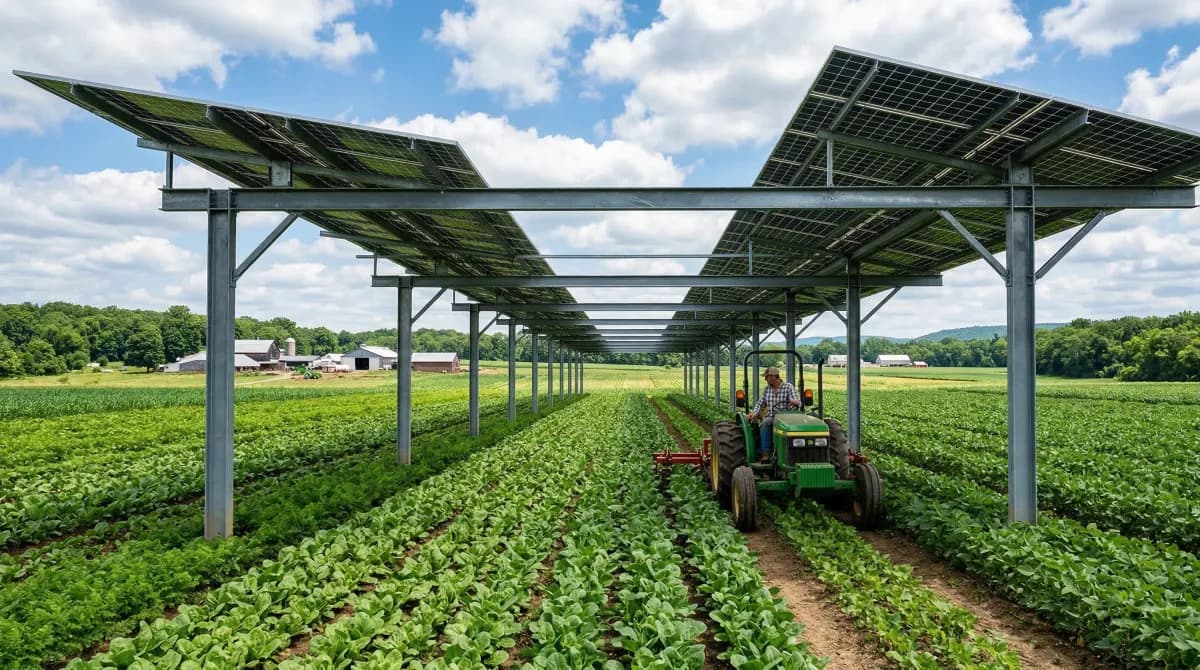
New Jersey's Dual-Use Solar Energy Pilot Program lets farmers install solar on preserved farmland while keeping crops growing underneath. With 720,000+ acres of preserved farmland, ADI incentives at $85.00/MWh, and the Section 48/48E commercial ITC still available (new starts placed in service by December 31, 2027), agrivoltaics is the biggest revenue opportunity for NJ farmers in a generation.
Preserved Farmland
720K+ ac
Land Lease Income
$800-1,500/ac
ADI Incentive
$85.00/MWh
Commercial ITC
30-70%
Important 2026: The residential 25D tax credit is DEAD (expired Dec 31, 2025). But the Section 48/48E commercial ITC is STILL available for agricultural and commercial solar projects. The begin-construction safe harbor closed July 4, 2026; new starts generally place in service by December 31, 2027. The third-party system owner (developer/financing company) claims the ITC, NOT the farmer or installer.
New Jersey's Dual-Use Solar Energy Pilot Program allows solar panels on preserved farmland with at least 8-foot ground clearance and 80%+ land remaining agriculturally viable. Farmers earn $800-1,500/acre/year in lease income on top of crop revenue. Projects qualify for SuSI ADI incentives ($85.00/MWh for 15 years) and the Section 48/48E commercial ITC (30% base, up to 70% with adders). The begin-construction safe harbor closed July 4, 2026; new starts generally place in service by December 31, 2027. The system owner claims the ITC. NJ has 720,000+ preserved farmland acres, the strongest farmland preservation program in the nation.
Agrivoltaics -- also called dual-use solar -- is the practice of co-locating solar panels and agriculture on the same land. Unlike traditional ground-mount solar farms that replace farming entirely, agrivoltaic systems are specifically designed so that crops, grazing, or other agricultural activities continue underneath and between the panels.
The concept has been studied since the 1980s, but it has exploded in the past five years as land-use conflicts between solar development and agriculture have intensified. For New Jersey -- a state that has invested billions in farmland preservation while also pursuing aggressive clean energy goals -- agrivoltaics offers a way to do both without compromise.
Solar panels are mounted at least 8 feet above ground level, allowing tractors, harvesters, and even small trucks to pass underneath. Standard ground-mount systems sit just 2-4 feet high.
At least 80% of the land area must remain in active agricultural production. This includes row crops, specialty crops, grazing, beekeeping, and pollinator habitat establishment.
Panels are spaced wider apart than traditional arrays to balance solar energy production with adequate sunlight for crops. This typically results in 50-70% of standard solar density per acre.
| Feature | Traditional Ground-Mount | Agrivoltaic Dual-Use |
|---|---|---|
| Panel Height | 2-4 feet | 8+ feet |
| Farming Underneath | No | Yes |
| NJ Preserved Farmland | Prohibited | Allowed (pilot) |
| Land Use | Solar only | Solar + agriculture |
| Cost per Watt | $1.00-1.40/W | $1.10-1.80/W |
| Revenue Streams | Solar only | Solar + crops + lease |
New Jersey's Dual-Use Solar Energy Pilot Program was established by the Board of Public Utilities (BPU) to address a fundamental tension: the state has some of the most aggressive clean energy goals in the nation (100% clean energy by 2035) while also maintaining the strongest farmland preservation program in the country, with 720,000+ acres of deed-restricted preserved farmland.
Traditionally, these two goals have been at odds. Solar developers want large, flat parcels of land -- exactly what farms are. Preserved farmland is, by law, restricted from development. The dual-use pilot program resolves this by allowing solar installations that are specifically designed to maintain farming as the primary land use.
New Jersey has invested over $2 billion in farmland preservation since 1983, protecting 720,000+ of the state's 985,000 total farmland acres. That makes NJ the #1 state in the nation for farmland preservation as a percentage of total agricultural land. The dual-use pilot is the only way to unlock solar on this massive land base without compromising the preservation investment. No other state has this combination of preserved acreage and a formal pilot program authorizing solar on it.
The BPU has established specific requirements to ensure dual-use solar projects maintain agricultural viability. Every project must meet all of the following:
8 feet from ground to lowest panel edge
Allows farming equipment and livestock access underneath panels
80%+ of land must remain agriculturally viable
Ensures farming continues as the primary land use
Detailed plan for continued agricultural operations
Demonstrates how farming will coexist with solar infrastructure
BPU must approve each dual-use project individually
State oversight ensures compliance with farmland preservation goals
Projects allowed on deed-restricted preserved farmland
NJ is the only state explicitly permitting solar on preserved farmland through a pilot
Annual agricultural productivity reports required
Verifies that farming operations remain viable alongside solar production
Elevated racking systems required for dual-use solar cost approximately 10-20% more per watt than standard ground-mount installations. This premium is offset by dual revenue streams (solar + agriculture), ADI incentives, and the ability to develop otherwise restricted preserved farmland. A typical agrivoltaic system costs $1.10-1.80/W versus $1.00-1.40/W for standard ground-mount.
Our commercial solar team can assess your land, estimate production, and connect you with developers experienced in NJ dual-use solar projects.
Get a Farm Solar AssessmentNot all crops perform equally under solar panels. Research from Rutgers University and other institutions has identified the crops best suited for agrivoltaic production in New Jersey's climate. Shade-tolerant and heat-sensitive crops tend to perform best, and some actually produce higher yields under panels than in full sun.
Reduced sunscald, higher sugar content
NJ is #1 blueberry state in the Northeast
Less bolting, extended growing season
Garden State staple, thrives with 20-40% shade
Slower bolting, larger leaves, better flavor
High-value crops for NJ farm stands and restaurants
Ideal shade environment, moisture retention
NJ has growing specialty mushroom market
Cooler pasture, less heat stress on livestock
Sheep and poultry grazing under panels is BPU-approved
Wildflowers and native plants support biodiversity
Meets NJ pollinator habitat goals, supports bee populations
Contrary to what many assume, partial shade from solar panels can actually improve crop yields for certain species. Leafy greens like lettuce and spinach are prone to "bolting" (going to seed prematurely) in hot, direct sun. The 20-40% shade from agrivoltaic panels keeps soil temperatures 5-10 degrees cooler, reduces water evaporation by up to 30%, and extends the growing season for cool-weather crops. In New Jersey's increasingly hot summers, this can mean an extra 2-3 weeks of productive growing time.
The economics of agrivoltaics in New Jersey are compelling because farmers stack multiple revenue streams on the same land. Here is how the money works:
$800-1,500/acre/year from the solar developer for use of your land
Typical 20-30 year lease terms with annual escalators
80%+ of your land stays in production -- keep earning from crops, grazing, or specialty agriculture
Some shade-tolerant crops actually yield better under panels
$85.00/MWh for 15 years -- paid on actual electricity production
Revenue goes to the system owner (developer), who factors it into lease terms
1:1 retail rate credits for excess electricity exported to the grid (up to 5 MW)
Applies to PSE&G, JCP&L, and ACE service territories
| Item | Value |
|---|---|
| System Size | 3 MW (3,000 kW) |
| System Cost (at $1.40/W) | $4,200,000 |
| Section 48 ITC (30%) | -$1,260,000 |
| Annual ADI Revenue ($85.00/MWh x ~3,600 MWh) | $309,240/yr |
| Annual Land Lease to Farmer (50 ac x $1,000/ac) | $50,000/yr |
| Farmer's Annual Crop Revenue (80% of 50 ac) | Varies by crop |
| Farmer's Total New Income | $50,000/yr + crops |
* ITC and ADI incentives accrue to the system owner (developer/financing company), not the farmer. The farmer benefits through lease payments and continued crop revenue. Domestic content (+10%) and energy community (+10%) bonuses can increase the ITC.
The residential Section 25D tax credit expired December 31, 2025. It provides $0 for individual homeowner purchases. However, the commercial Section 48/48E ITC is STILL available -- the begin-construction safe harbor closed July 4, 2026, and new starts generally place in service by December 31, 2027 -- and agricultural solar projects qualify.
Agrivoltaic dual-use solar projects in NJ qualify for the Section 48/48E Investment Tax Credit as commercial solar installations. This is the most significant federal incentive still available for solar in 2026. The ITC is claimed by the system owner (developer or financing company), not by the farmer whose land is being used.
Maximum possible ITC: 70% -- for projects that meet all bonus criteria. Most NJ agrivoltaic projects will qualify for at least the 30% base rate. Domestic content and energy community bonuses are subject to additional verification requirements.
The §48E begin-construction window closed July 4, 2026; projects that began on or before that date secured the widest placed-in-service window for the 30% commercial ITC. Later starts still qualify if placed in service by December 31, 2027. Start your farm solar assessment now.
Talk to Our Commercial TeamBeyond the financial case, agrivoltaics delivers measurable environmental benefits that align with New Jersey's climate and sustainability goals. Research has documented advantages for soil health, water conservation, biodiversity, and crop resilience.
Solar panels reduce direct solar radiation on soil, lowering evapotranspiration by up to 30%. This means crops need significantly less irrigation. In a state that increasingly faces summer drought conditions, this water savings is both environmentally and economically significant. Studies have shown soil moisture retention improves by 15-20% under agrivoltaic systems.
Panels create a cooler microclimate underneath, reducing peak temperatures by 5-10 degrees Fahrenheit. This protects heat-sensitive crops from sunscald and premature bolting. For livestock (sheep, poultry), the shade provides natural cooling that improves animal welfare and productivity. NJ summers are getting hotter due to climate change, making shade management increasingly valuable.
Dual-use solar sites can incorporate native wildflower plantings between panel rows, creating pollinator habitat that supports bees, butterflies, and other beneficial insects. This aligns with NJ's pollinator protection goals and can improve pollination of nearby crops. Some NJ projects have partnered with beekeepers to place hives on-site, adding another revenue stream.
Unlike traditional solar farms where the ground is often graded and compacted, agrivoltaic sites maintain active soil biology through continued cultivation. The shade from panels also reduces soil temperature extremes and helps maintain organic matter. Cover crops planted between rows prevent erosion and fix nitrogen, improving long-term soil fertility.
There is a reciprocal benefit: the panels themselves perform better. Crops and vegetation underneath create a cooler microclimate through evapotranspiration, reducing panel operating temperatures by 3-5 degrees Celsius. Since solar panel efficiency drops approximately 0.3-0.5% per degree above 25 degrees Celsius, the cooler environment from active agriculture can increase annual energy production by 1-3% compared to panels over bare ground or gravel.
New Jersey's regulatory framework for dual-use solar involves several layers -- state BPU approval, county agricultural boards, and local municipal zoning. Understanding this landscape is critical for a smooth project development process.
New Jersey's Right to Farm Act (N.J.S.A. 4:1C-1 et seq.) provides strong protections for agricultural operations. Dual-use solar projects approved through the BPU pilot maintain farming as the primary land use, preserving these protections. The State Agriculture Development Committee (SADC) oversees compliance for preserved farmland.
Each dual-use project must receive individual approval from the Board of Public Utilities. This involves submitting detailed project plans including the agricultural management plan, engineering specifications, and environmental impact assessment. The BPU review process typically takes 3-6 months.
For projects on preserved farmland, the County Agriculture Development Board (CADB) must review and approve the solar installation to ensure it is consistent with the farmland preservation deed restriction. This is a separate process from BPU approval and typically runs concurrently.
Local municipal zoning ordinances may require variances or conditional use permits for solar installations in agricultural zones. However, NJ's Municipal Land Use Law limits municipalities' ability to prohibit solar on agricultural land when the project has state BPU approval. Some municipalities have adopted "solar-friendly" ordinances that explicitly permit dual-use installations.
Solar installations in NJ are 100% exempt from property tax increases. This means a $4 million agrivoltaic system adds $0 to your property tax bill. In a state where property taxes average $9,500/year, this exemption is extremely valuable. The farmland assessment (reduced property tax for agricultural land) also remains intact.
Solar equipment in NJ is exempt from the 6.625% state sales tax. For a $4 million agrivoltaic project, this saves approximately $265,000 in sales tax. This exemption applies to panels, inverters, racking, wiring, and other solar-specific equipment.
New Brunswick, NJ
Rutgers University's Department of Environmental Sciences has been at the forefront of agrivoltaics research in the Northeast. Their studies on dual-use solar in New Jersey's climate zone have provided critical data on crop performance under panels, including findings that leafy greens and herbs maintain or improve yields in the shade of elevated solar panels. Rutgers' research has been instrumental in shaping the BPU pilot program requirements.
Key findings include: lettuce yield maintained at 90-100% of open-field production, reduced water usage by 20-30%, and extended growing season for cool-weather crops by 2-3 weeks in summer. Their ongoing multi-year study continues to build the evidence base for NJ agrivoltaics.
Various locations across New Jersey
The BPU has approved several pilot projects across the state to test different agrivoltaic configurations, crop types, and panel arrangements. These pilot sites span South Jersey farmland (Burlington, Salem, and Cumberland counties) and include both row crop and grazing applications. The pilots are generating real-world data on construction costs, crop performance, and energy production in NJ's specific soil and climate conditions.
Early results from pilot sites have shown that agrivoltaic systems can generate 400-600 MWh per acre per year while maintaining productive agriculture, validating the dual-use concept in NJ conditions.
National studies with NJ applicability
The USDA and Department of Energy's National Renewable Energy Laboratory (NREL) have published extensive research supporting agrivoltaics. NREL's InSPIRE project tracks agrivoltaic installations nationwide and has documented positive outcomes for water conservation, soil health, and crop performance. The USDA Rural Energy for America Program (REAP) provides additional grant and loan guarantee support for agricultural solar projects, including dual-use installations. NJ farmers may be eligible for REAP grants covering up to 50% of project costs (subject to funding availability).
Evaluate your acreage, soil type, current crop plan, and sun exposure. Ideal sites have at least 10 acres of relatively flat, unshaded farmland with good road access for construction equipment. South-facing orientation is preferred but not required.
Work with a developer experienced in NJ agrivoltaics. They will conduct a site assessment, evaluate interconnection capacity with your local utility (PSE&G, JCP&L, or ACE), and provide preliminary economics including lease rate, system size, and projected energy production.
The BPU requires a detailed plan showing how farming will continue under and around the panels. This should identify specific crops or grazing plans, equipment access paths, and maintenance schedules. Rutgers Cooperative Extension can provide guidance.
The developer will prepare and submit the dual-use pilot application to the Board of Public Utilities. This includes engineering plans, the agricultural management plan, environmental assessments, and interconnection studies. For preserved farmland, concurrent CADB approval is needed.
The BPU reviews the application, may request additional information, and issues approval. This process typically takes 3-6 months. During this time, the developer can begin equipment procurement and finalize financing arrangements.
Once approved, construction typically takes 2-4 months depending on system size. The elevated racking system is installed first, followed by panels, inverters, and electrical interconnection. Agricultural operations resume immediately after construction is complete.
The Section 48/48E begin-construction safe harbor closed July 4, 2026. Projects that "began construction" on or before that date -- through either the "physical work test" (beginning physical construction on-site) or the "5% safe harbor" (incurring at least 5% of total project cost in equipment or services) -- locked in the full timing pathway. New starts still qualify for the 30% credit but generally must be placed in service by December 31, 2027, so given the 6-10 month development timeline for agrivoltaic projects, farmers should not delay.
Research
You just did this
Calculate
See your savings
Save
Lock in your price
You've done the research on NJ dual-use solar. Now let our commercial team assess your specific farm and provide a customized project analysis.
Get a Farm Solar AssessmentTalk to an expertNo credit card required. 100% free. Takes about 2 minutes.
Section 48 ITC, MACRS, and SuSI guide for NJ businesses
Read moreNJ production-based incentive for solar up to 5 MW
Read moreCommunity solar subscription program for NJ
Read moreSales tax and property tax exemptions for NJ solar
Read more1:1 net metering for NJ solar systems up to 5 MW
Read more5-year MACRS with 100% first-year bonus depreciation (permanent under OBBBA)
Read moreThe NJ Dual-Use Solar Energy Pilot Program is a state-authorized program administered by the Board of Public Utilities (BPU) that allows solar installations on preserved farmland, provided that at least 80% of the land remains agriculturally viable. Panels must be elevated at least 8 feet to allow farming equipment and livestock access underneath. NJ is one of the first states to explicitly permit solar on deed-restricted preserved farmland through a formal pilot program. The program requires BPU approval for each project and annual agricultural productivity reporting.
Yes, through the NJ Dual-Use Solar Energy Pilot Program. New Jersey has over 720,000 acres of preserved farmland, making it the strongest farmland preservation program in the country. The pilot program explicitly permits solar on this preserved land, provided the project meets all requirements: 8-foot minimum ground clearance, 80%+ land remaining viable for farming, BPU approval, and an agricultural management plan. This is a unique opportunity because most states prohibit any development on preserved farmland.
Several crops thrive under the partial shade of elevated solar panels in New Jersey. The best performers include blueberries (NJ is a top blueberry-producing state), leafy greens like lettuce, spinach, and kale (which benefit from reduced bolting), herbs such as basil and cilantro (which grow larger leaves in partial shade), and specialty mushrooms. Pasture grazing for sheep and poultry is also BPU-approved. Research from Rutgers University has shown that certain shade-tolerant crops can actually produce equal or better yields under solar panels compared to full sun, particularly during hot summers.
NJ farmers can earn $800-1,500 per acre per year from land lease payments for dual-use solar installations, on top of their existing agricultural income. Additionally, projects qualify for SuSI ADI incentives at $85.00/MWh for 15 years, and the Section 48/48E commercial ITC provides a 30% base credit (with bonus adders up to 70%). The begin-construction safe harbor closed July 4, 2026; new starts still qualify but generally must be placed in service by December 31, 2027. The third-party system owner (developer or financing company) claims the ITC, not the farmer. Combined with continued crop revenue, dual-use solar can more than double a farm's per-acre income.
The Section 48/48E Investment Tax Credit is a federal commercial tax credit still available for solar projects (including agrivoltaic installations). The begin-construction safe harbor closed July 4, 2026; new starts still qualify but generally must be placed in service by December 31, 2027. The base rate is 30%, with bonus adders for domestic content (+10%), energy community (+10%), and low-income projects (+10-20%), potentially reaching 70%. For dual-use solar projects, the third-party system owner (the solar developer or financing company) claims the ITC, not the farmer or landowner. This is different from the residential 25D credit which expired December 31, 2025. Farmers benefit through higher lease payments and lower PPA rates.
No. New Jersey's Right to Farm Act (N.J.S.A. 4:1C-1 et seq.) protects farmers from nuisance lawsuits related to normal agricultural operations. Dual-use solar installations approved through the BPU pilot program are designed to maintain farming as the primary land use, so right-to-farm protections remain intact. The 80%+ agricultural viability requirement specifically ensures that the land continues to function as farmland. Additionally, NJ solar installations benefit from property tax exemptions, so your property taxes will not increase due to the solar equipment.
Agrivoltaic (dual-use) solar differs from traditional ground-mount solar in several key ways: (1) Panels are elevated at least 8 feet off the ground versus 2-4 feet for standard ground-mount, (2) Panels are spaced wider apart to allow more light to reach crops, (3) The land continues active agricultural use underneath the panels, (4) Specialized racking and tracking systems are used to optimize both solar production and crop growth. While agrivoltaic systems typically cost 10-20% more per watt than standard ground-mount due to the elevated racking, the dual revenue stream (solar + farming) and eligibility for NJ's pilot program make them economically attractive.
Our commercial solar team specializes in NJ agricultural projects. We will assess your land, connect you with experienced dual-use developers, and help you navigate the BPU pilot program application process.