Loading NuWatt Energy...

We use your location to provide localized solar offers and incentives.
We serve MA, NH, CT, RI, ME, VT, NJ, PA, and TX
Loading NuWatt Energy...
NuWatt designs, installs, and manages solar, battery, heat pump, and EV charger systems across 9 states. One company, one warranty, one point of contact.
Get a Free Quote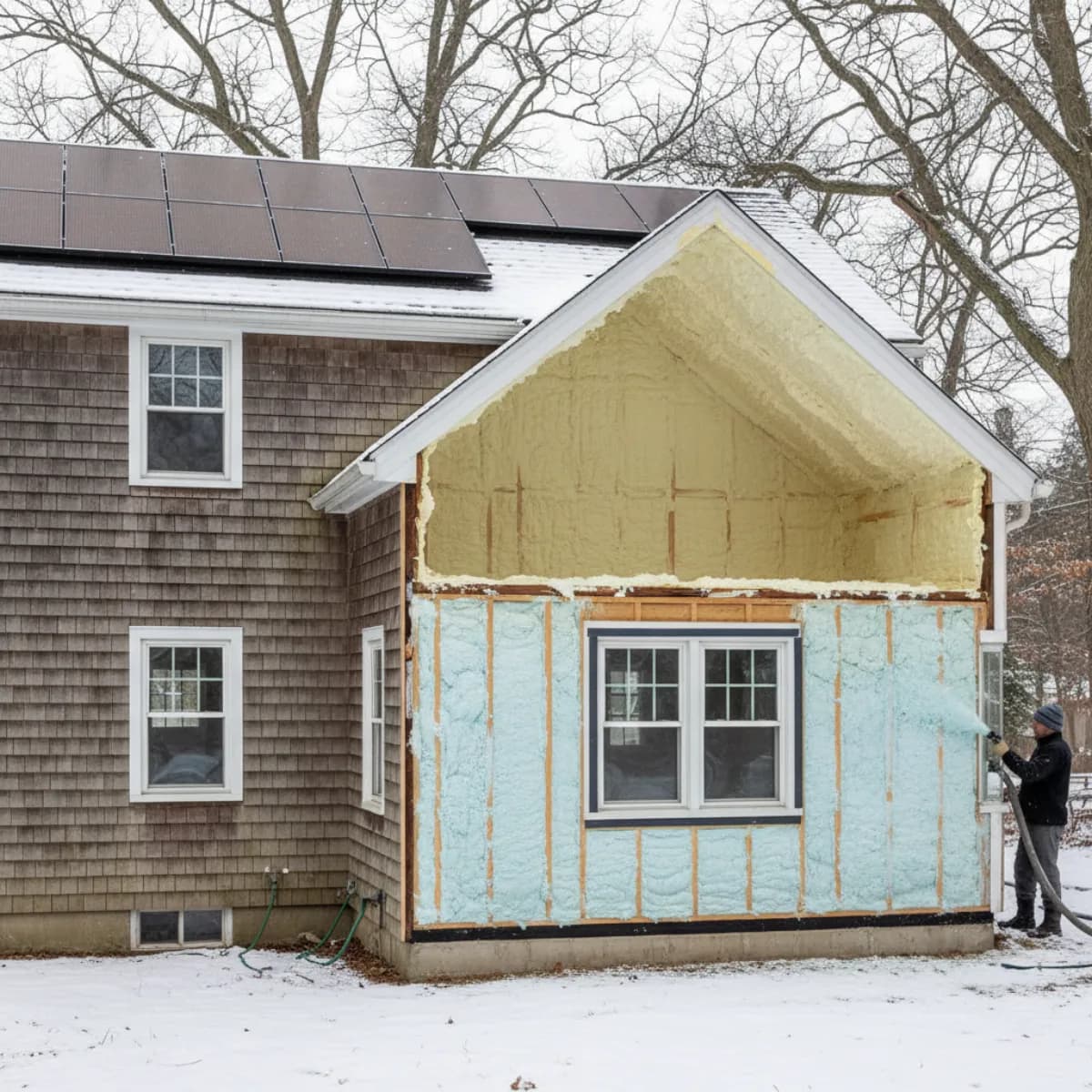
The average NJ home wastes 30-40% of its energy through air leaks and insulation gaps. Fixing these problems before going solar reduces the system size you need by 15-25% — saving thousands on your solar investment. NJ Clean Energy rebates cover up to 75% of weatherization costs.
30-40%
Energy Waste
15-25%
Solar Size Reduction
$3K-$10K
Weatherization Cost
Up to 75%
NJ Rebates
Quick Answer
Insulating your NJ home before installing solar reduces your energy load by 15-25%, allowing a smaller and cheaper solar system. NJ Clean Energy's Home Performance with ENERGY STAR program covers up to $5,000 in weatherization costs. The optimal upgrade sequence is: energy audit, air sealing and insulation, then heat pump and solar.
Most NJ homeowners think about solar first and weatherization second — if they think about weatherization at all. This is backwards, and it costs them thousands of dollars. Here is why the insulate-first approach saves more money:
Solar systems are sized to match your energy consumption. If your home uses 12,000 kWh/year, you need roughly a 10 kW solar system ($25,000-$30,000 in NJ). But if you first reduce your consumption to 9,000 kWh/year through weatherization, you only need a 7.5 kW system ($18,750-$22,500). That is $6,250-$7,500 less on solar — often more than the entire weatherization cost.
Put another way: it is cheaper to stop wasting a kWh than to generate a new one. Weatherization costs roughly $0.05-$0.10 per kWh saved over its lifetime. Solar generates electricity at roughly $0.06-$0.08/kWh over 25 years. Both are excellent investments, but weatherization has the lower marginal cost — so do it first to optimize your total investment.
New Jersey's housing stock is particularly leaky. The state has a high proportion of homes built before 1980 (when energy codes were minimal), including many colonial-era, Victorian, and mid-century homes with little or no insulation. Common NJ home types — Cape Cods, split-levels, bi-levels, and colonials — each have specific weak points that trained weatherization contractors know how to address.
NJ spans two IECC climate zones: Zone 4A (southern NJ, including the Shore) and Zone 5A (northern NJ, including Bergen, Passaic, Morris, Sussex, and Warren counties). Zone 5A has colder winters and correspondingly higher insulation requirements. A home in Mahwah (Zone 5A) needs more insulation than a home in Toms River (Zone 4A), and the energy savings from weatherization are proportionally higher in colder areas.
Weatherization does not just save energy — it dramatically improves comfort. After air sealing and insulation, NJ homeowners consistently report: elimination of cold drafts near exterior walls, more consistent room-to-room temperatures (no more "cold rooms"), reduced noise from outside, better indoor air quality (fewer dust and pollen infiltration paths), and reduced ice dams on roofs in northern NJ winters.
These are the most frequent insulation failures we find in New Jersey homes. Each one wastes energy and increases the solar system size you need.
Common in: Cape Cod, 1.5-story homes
NJ's many Cape Cod-style homes have knee walls (short vertical walls where the roof meets the floor) that are typically uninsulated or poorly insulated. These knee walls allow massive heat loss into unconditioned attic spaces behind them. Insulating and air-sealing knee walls is often the single biggest improvement for Cape Cod homes.
Common in: Pre-1960 colonials, Victorian homes
Many NJ colonial homes built before 1960 use balloon-frame construction, where wall studs run continuously from foundation to roof. This creates hidden air channels that carry warm air from living spaces directly into the attic. Without fire-stopping and insulation in these wall cavities, a colonial home bleeds energy continuously.
Common in: Most NJ homes with basements
The majority of NJ homes have basements, and most built before 1990 have uninsulated basement walls and rim joists. In winter, cold basement walls radiate cold into the living space above. The rim joist (where the floor framing meets the foundation wall) is typically the single leakiest point in a NJ home — a continuous crack around the entire perimeter.
Common in: All NJ home types
Attic bypasses are gaps and holes in the ceiling plane that allow conditioned air to leak directly into the attic. Common culprits: recessed lights, plumbing and wiring penetrations, chimney chases, and dropped soffits over kitchen cabinets. A single home can have dozens of bypasses leaking hundreds of CFM of conditioned air.
Common in: Pre-1990 homes
Single-pane windows and deteriorated door weatherstripping are common in NJ homes built before 1990. While window replacement is expensive ($300-$800 per window), improving weatherstripping and adding storm windows can significantly reduce air infiltration at a fraction of the cost.
Common in: Homes with forced-air heating
Ductwork running through unconditioned attics and crawlspaces loses 20-30% of heating/cooling energy through leaks and poor insulation. In NJ, where many homes have forced-air systems with attic-routed ducts, sealing and insulating ductwork often produces immediate, dramatic energy savings.
NJ requires different R-values by climate zone (4A for southern NJ, 5A for northern NJ). Here are the most common insulation types used in NJ weatherization projects.
| Type | R-Value | NJ Target | Cost |
|---|---|---|---|
Blown-In Cellulose (Attic) Most cost-effective attic insulation. Made from recycled newspaper. Excellent for topping up existing insulation. | R-3.5-3.7/inch | R-49 (Zone 4A/5A) | $1.00-$1.50/sq ft |
Blown-In Fiberglass (Attic) Non-combustible. Good for attics near heat sources. Settles slightly less than cellulose over time. | R-2.5-3.0/inch | R-49 (Zone 4A/5A) | $1.20-$1.80/sq ft |
Spray Foam (Rim Joist) Best for rim joist air sealing + insulation in one step. Closed-cell provides moisture barrier. | R-6.5-7.0/inch (closed cell) | R-15+ | $2.50-$4.00/sq ft |
Fiberglass Batt (Walls) Common for wall cavities during renovation. Must be installed carefully to avoid compression and gaps. | R-3.2-3.8/inch | R-20 (Zone 5A), R-13 (Zone 4A) | $0.80-$1.50/sq ft |
Dense-Pack Cellulose (Walls) Installed through small holes drilled in wall. Excellent retrofit insulation for existing walls. | R-3.5/inch | R-20 (Zone 5A), R-13 (Zone 4A) | $2.00-$3.00/sq ft |
Rigid Foam (Basement) XPS or polyiso boards for basement walls. Must be covered with fire-rated material (drywall). | R-5.0-6.5/inch | R-15 (continuous) | $1.50-$3.00/sq ft |
New Jersey offers some of the most generous weatherization incentives in the country. Multiple programs can be stacked to cover 30-75% or more of your weatherization costs.
Home Performance with ENERGY STAR: Up to $5,000
Cash-back rebates for comprehensive weatherization measures (air sealing, insulation, duct sealing) performed by a BPI-certified participating contractor. Requires pre- and post-improvement blower door tests. Rebate amount depends on measures installed and achieved energy savings.
Comfort Partners: FREE (Income-Eligible)
Completely free weatherization for households earning up to 250% of the federal poverty level (approximately $78,000 for a family of 4 in 2026). Includes air sealing, insulation, duct sealing, appliance replacement, and health and safety repairs. No out-of-pocket cost.
Whole Home Program: Weatherization + Heat Pump Bundled
The NJ Whole Home program considers weatherization measures when calculating Total Energy Savings for heat pump rebates (up to $7,500). Combining weatherization with a heat pump installation increases your Whole Home rebate by demonstrating higher total savings.
Utility-Specific Programs
PSE&G, JCP&L, ACE, and RECO each offer additional rebates for insulation and air sealing through their energy efficiency programs. These stack with NJ Clean Energy rebates. Contact your utility or visit NJ Clean Energy's website for current utility-specific offerings.
Federal Section 25C: EXPIRED ($0 in 2026)
The federal energy efficiency tax credit (Section 25C) expired December 31, 2025. There is no federal tax credit for insulation, air sealing, or weatherization in 2026. NJ state rebates remain active and are the primary incentive source.
Weatherization, heat pump, then solar — in that order. Each step optimizes the next, resulting in lower total cost and better performance.
Start with a professional NJ Home Performance with ENERGY STAR audit ($300-$500, often subsidized by utility). The auditor uses a blower door test to measure air leakage and thermal imaging to identify insulation gaps. This reveals exactly where your home is losing energy and prioritizes improvements by cost-effectiveness.
Seal all air leaks identified in the audit. Priority targets: attic bypasses, rim joists, recessed lights, plumbing/wiring penetrations, and duct connections. Air sealing typically costs $500-$2,000 and is the highest-ROI weatherization measure. Many NJ homes reduce air leakage by 30-50% through targeted sealing alone.
Add insulation to areas identified in the audit: attic (blown-in to R-49), basement rim joists (spray foam), walls (dense-pack cellulose if accessible). Insulation costs $2,000-$6,000 depending on scope. NJ Clean Energy rebates cover a significant portion for qualifying work.
With reduced energy load from weatherization, your heat pump can be sized smaller (15-25% reduction). A properly sized heat pump in a weatherized home runs longer at lower capacity — which is more efficient and comfortable than a oversized unit that short-cycles. NJ Whole Home incentive (up to $7,500) applies.
Now size your solar system to match your reduced energy consumption. A home that needed 10 kW of solar before weatherization may only need 7.5-8.5 kW after. The savings on solar system cost ($3,750-$5,250 at $2.50/W) often exceed the total weatherization investment.
Not all insulation contractors in NJ are created equal. For NJ Clean Energy rebate eligibility and quality assurance, look for these qualifications:
Ask every contractor: "Are you a participating contractor in the NJ Clean Energy Home Performance with ENERGY STAR program?" If yes, they are BPI-certified, registered with the state, and their work qualifies for rebates. If no, you may not qualify for NJ Clean Energy rebates on the work they perform.
| Measure | Cost Range | Typical Savings | Payback |
|---|---|---|---|
| Air sealing (whole house) | $500-$2,000 | 10-20% energy reduction | 1-3 years |
| Attic insulation (to R-49) | $1,500-$3,500 | 10-15% energy reduction | 2-5 years |
| Basement rim joist insulation | $500-$1,500 | 5-8% energy reduction | 2-4 years |
| Wall insulation (dense-pack) | $2,000-$5,000 | 5-10% energy reduction | 4-8 years |
| Duct sealing & insulation | $500-$2,000 | 10-20% HVAC savings | 1-3 years |
| Comprehensive package | $3,000-$10,000 | 25-40% total reduction | 3-7 years |
Common questions about weatherization and insulation before solar in NJ.
Insulating first reduces your home's total energy consumption by 15-25%. This means you need a smaller (cheaper) solar system to offset your usage. Example: if weatherization reduces your annual electricity use from 12,000 kWh to 9,500 kWh, you need a 7.9 kW system instead of 10 kW — saving $5,250+ at current NJ prices. The weatherization cost ($3,000-$10,000) is often partially or fully offset by the smaller solar system plus NJ Clean Energy rebates.
NJ Clean Energy offers several weatherization rebate programs: (1) Home Performance with ENERGY STAR — rebates up to $5,000 for comprehensive weatherization through participating contractors. (2) Comfort Partners — free weatherization for income-eligible households (up to 250% of federal poverty level). (3) Whole Home program — weatherization measures can count toward Total Energy Savings percentage for heat pump rebates up to $7,500. (4) Utility-specific programs from PSE&G, JCP&L, ACE, and RECO.
Typical NJ weatherization costs: Air sealing alone: $500-$2,000. Attic insulation (blown-in to R-49): $1,500-$3,500. Basement rim joist insulation: $500-$1,500. Wall insulation (dense-pack cellulose): $2,000-$5,000. Comprehensive weatherization package: $3,000-$10,000. After NJ Clean Energy rebates (which can cover 30-75% of costs depending on program), out-of-pocket costs range from $1,000-$7,000.
Weatherization typically reduces a NJ home's energy consumption by 15-25%, which directly reduces the solar system size needed. A home using 12,000 kWh/year that reduces to 9,000-10,200 kWh/year needs 15-25% fewer solar panels. At NJ solar prices of $2.50-$3.00/W, this saves $3,000-$7,500 on solar system cost. The weatherization investment often pays for itself just through the solar system size reduction.
The most common NJ insulation problems are: (1) Cape Cod knee walls — uninsulated or poorly insulated, causing massive heat loss. (2) Balloon-frame colonials — continuous wall cavities that channel warm air to the attic. (3) Uninsulated basements and rim joists — cold radiating into living spaces. (4) Attic bypasses — gaps around recessed lights, plumbing, and wiring. (5) Leaky ductwork in unconditioned spaces — losing 20-30% of HVAC output.
NJ spans two climate zones: Zone 4A (southern NJ) and Zone 5A (northern NJ). Zone 5A requirements: Attic R-49, walls R-20 or R-13+5 (cavity plus continuous), basement R-15 continuous or R-19 cavity. Zone 4A requirements: Attic R-49, walls R-20 or R-13+5, basement R-10 continuous or R-13 cavity. These are minimums from NJ Uniform Construction Code — more insulation generally provides better returns in NJ's climate.
NJ Home Performance with ENERGY STAR is a whole-house approach to energy efficiency managed through NJ Clean Energy. A BPI-certified contractor performs a comprehensive energy audit (blower door test, thermal imaging, safety checks) and recommends improvements. Qualifying improvements — air sealing, insulation, duct sealing, and equipment upgrades — receive rebates of up to $5,000. The program ensures work is done properly and verified by a post-improvement blower door test.
Always weatherize first, then install the heat pump. Reason: weatherization reduces your home's heating and cooling load, which means the heat pump can be sized smaller. A properly sized heat pump in a well-insulated home runs more efficiently, lasts longer, and provides better comfort. If you install the heat pump first and then weatherize, the heat pump will be oversized for the improved home — leading to short-cycling and reduced efficiency. The NJ Whole Home program encourages this sequence.
NuWatt evaluates your home's insulation, air sealing, and energy performance before recommending solar. We help you weatherize first, right-size your system, and maximize NJ rebates.
Related: NJ Insulation Rebates • NJ Energy Audit Guide • NJ Heat Pump Cost