Loading NuWatt Energy...

We use your location to provide localized solar offers and incentives.
We serve MA, NH, CT, RI, ME, VT, NJ, PA, and TX
Loading NuWatt Energy...
NuWatt designs, installs, and manages solar, battery, heat pump, and EV charger systems across 9 states. One company, one warranty, one point of contact.
Get a Free Quote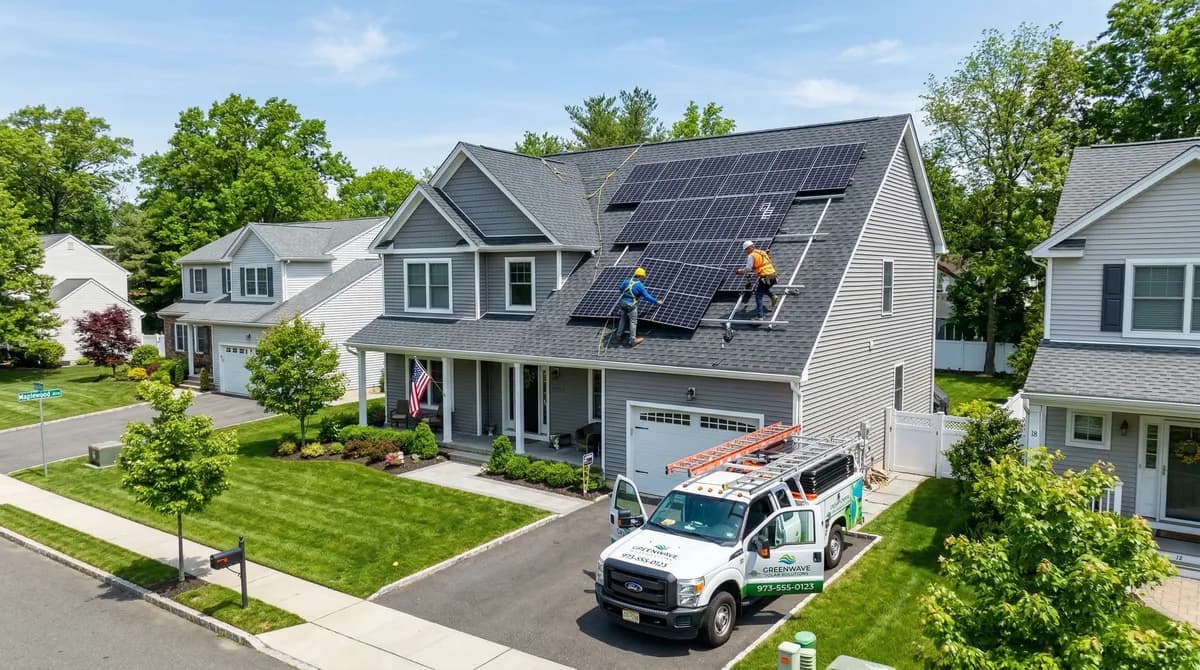
From signing your contract to flipping the switch, NJ solar installation takes 6-10 weeks. The physical install is just 1-2 days — the rest is paperwork. Here's the complete breakdown.
Here's exactly what happens at each stage of a NJ solar installation. The NJ Unified Solar Permit makes permitting faster than most states.
Your installer conducts a site assessment (roof condition, sun exposure, electrical panel capacity). You sign the contract and financing documents. System design begins.
NJ uses a standardized Unified Solar Permit (USP) that streamlines the process across all 564 municipalities. Your installer submits the permit application with engineering drawings.
Crew installs racking, panels, inverter(s), and wiring. A typical 8-10 kW residential system takes 1 day. Larger systems or battery additions may take 2 days.
Your municipality sends an electrical inspector to verify the installation meets code. NJ requires both an electrical inspection and a final building inspection.
Your utility (PSE&G, JCP&L, or ACE) reviews the interconnection application, installs a bi-directional meter, and grants Permission to Operate (PTO).
Register your system with the NJ SuSI/ADI program to start earning SREC-II payments. This can happen in parallel with interconnection.
New Jersey adopted the Unified Solar Permit (USP) to standardize and accelerate residential solar permitting across all 564 municipalities. This is a significant advantage over states where every town has different requirements.
Interconnection (getting utility approval and a net meter) is often the longest wait. Times vary by utility provider.
Largest NJ utility. Online portal for interconnection. Generally efficient process.
Historically slower. FirstEnergy portal. May require transformer review for systems >10 kW.
Exelon subsidiary. Efficient for standard residential. Coastal areas may need additional review.
Small territory in northwest NJ. Orange & Rockland subsidiary. Generally quick turnaround.
These tips can shave 1-3 weeks off your total timeline.
Installers who handle 50+ NJ projects/year know the permitting quirks of each municipality and have relationships with utility contacts.
If you need a panel upgrade (100A to 200A), do it before solar permitting. This avoids a separate permit and inspection cycle.
Your installer can submit the utility interconnection application before installation begins. This runs in parallel with permitting.
Missing documents (utility bills, HOA approval, property survey) cause the most delays. Prepare these before signing.
Spring and summer are peak season — installers and inspectors are busiest. Fall/winter installations often move 1-2 weeks faster.
The total process from contract signing to Permission to Operate (PTO) takes 6-10 weeks in NJ. The physical installation takes only 1-2 days. The rest is permitting (2-3 weeks), inspection (3-7 business days), and utility interconnection (2-4 weeks). SREC-II enrollment adds 1-2 weeks but runs in parallel.
The NJ Unified Solar Permit (USP) is a standardized permitting process adopted across all 564 NJ municipalities. It simplifies residential solar permitting by using a single application form, standardized requirements, and expedited review timelines. Most towns process USP applications within 5-10 business days.
PSE&G and ACE (Atlantic City Electric) are typically the fastest at 2-3 weeks. JCP&L (FirstEnergy) historically takes 3-4 weeks and can be slower for larger systems. RECO is generally quick due to its small service territory. All NJ utilities must comply with the BPU's interconnection standards.
The most common delays are: (1) Electrical panel upgrade needed (adds 1-2 weeks), (2) HOA approval process (adds 2-6 weeks), (3) Historic district review (adds 2-4 weeks), (4) Utility backlog during peak season (adds 1-2 weeks), (5) Roof repair needed before installation. Most delays can be avoided by working with an experienced NJ installer.
The physical installation of solar panels on your roof takes 1-2 days for a typical NJ residential system (8-10 kW). A 3-5 person crew installs racking in the morning, mounts panels in the afternoon, and connects the inverter and wiring. Adding a battery extends installation by 4-6 hours. Your home has power throughout the process.
Start the process in late fall or early winter for the best timeline. You'll avoid peak-season delays, and your system will be operational by spring — capturing the highest production months (April through August). ADI/SREC-II rates are currently $85.00/MWh, so locking in sooner preserves your 15-year rate.
The sooner you start, the sooner you save. NJ's Unified Solar Permit makes the process faster than most states. Get a custom design and timeline for your home.