Loading NuWatt Energy...

We use your location to provide localized solar offers and incentives.
We serve MA, NH, CT, RI, ME, VT, NJ, PA, and TX
Loading NuWatt Energy...
NuWatt designs, installs, and manages solar, battery, heat pump, and EV charger systems across 9 states. One company, one warranty, one point of contact.
Get a Free Quote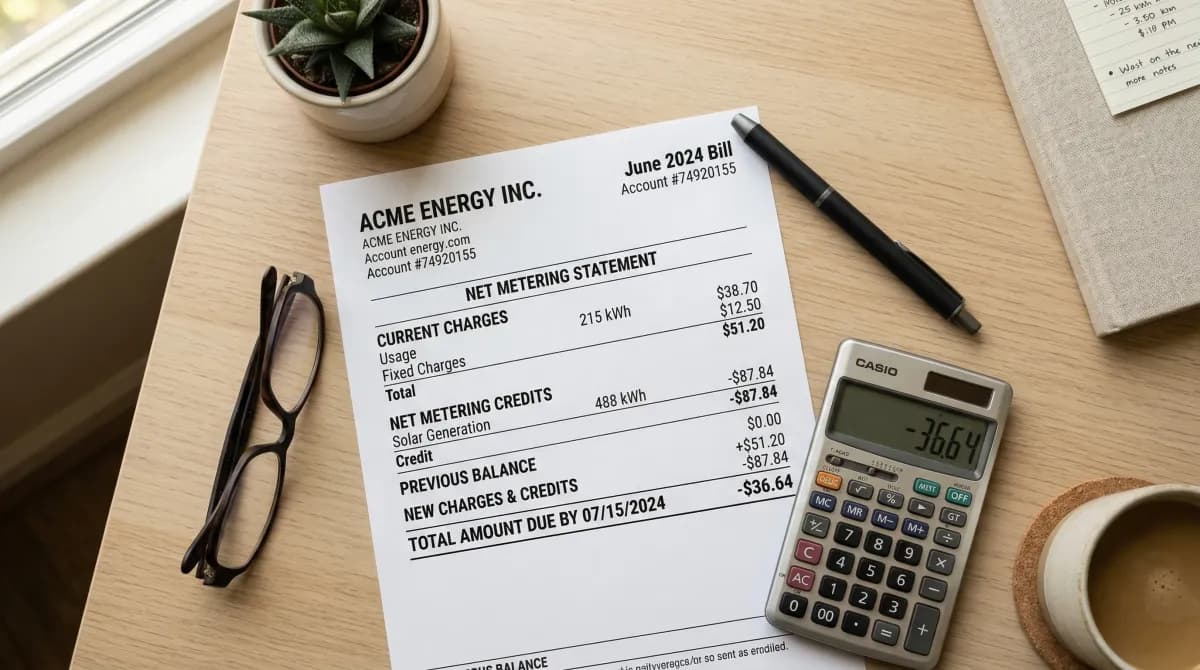
Your bill looks completely different now. Net metering credits, delivery charges, minimum bills. Here is what every line means and why you still get a bill.
Quick Answer
After solar, your supply charges drop to near $0 because your panels produce most of your electricity. You still pay delivery/distribution charges ($25-$55/month) for grid connection. A new line — net metering credits — shows the value of excess solar sent to the grid. These credits roll forward to cover months when you produce less. You will always have a small bill ($10-$35/month) for the minimum charge and delivery fees.
The #1 misconception about solar: "I thought my bill would be $0." Here is why it is not.
Every utility charges $7-$12/month just for being connected. This is non-negotiable for grid-tied solar.
Poles, wires, transformers, and meters cost money to maintain. You pay your share even if you use zero grid electricity.
Solar produces more in summer, less in winter. Winter bills may show net grid usage, offset by banked summer credits.
You only pay for the difference: grid electricity consumed minus solar electricity exported. In summer, this is often negative.
What each line on your post-solar electric bill means, how it changed, and why.
This drops dramatically because your panels produce most or all of the electricity you need. In summer months, this may be $0 with credits rolling forward.
These remain mostly unchanged. You still pay for the grid connection, metering, and infrastructure — even if you use zero grid electricity. Some states reduce distribution charges slightly for solar customers.
NEW line item after solar. Shows the dollar value of excess electricity your panels sent to the grid. Appears as a negative number (credit). Rolls forward if not used in the current billing period.
Fixed monthly charge for being a grid customer. Required by all utilities. Cannot be avoided with solar. Covers meter reading, billing, and customer service.
Charged per kWh consumed. Reduces with solar because you consume fewer grid kWh. This charge pays for decommissioned power plant costs and grid reliability programs.
Per-kWh charge that funds state renewable energy programs. Reduces with solar because it is based on grid consumption. Ironic: you're now a renewable energy producer yourself.
If you are on a TOU rate, solar significantly reduces peak-period charges because panels produce the most during expensive afternoon peak hours.
Here is what a typical Eversource bill looks like after solar installation, annotated with explanations.
EVERSOURCE ENERGY
Monthly Electric Bill — Service Period: June 1-30, 2026
Dramatically reduced — your panels produced most of your electricity
NEW — Value of excess solar sent to the grid. This offsets your charges.
Previous balance: $0.00 | Credit balance carried forward: $18.24
Usage summary: 799 kWh consumed | 487 kWh exported to grid | Net: 312 kWh from grid
Pre-solar bill (same period last year): $187.42 | You saved: $154.95 this month
Key takeaway: This homeowner used 799 kWh but their panels exported 487 kWh back to the grid. They only paid for the net 312 kWh from the grid — plus delivery charges and the minimum customer charge. The net metering credit of -$52.18 slashed the bill from what would have been $84+ to just $32.47. In summer, credits may exceed charges, resulting in a $0 balance with credits banked for winter.
Each utility formats their bill differently. Here is what to look for.
Bill Format
Shows "Generation" and "Distribution" as separate sections. Net metering credits appear under Generation as "Net Metering Credit." Monthly minimum ~$10.
Incentive Payments
SMART payments (MA only) come separately as direct deposit or check. Not on your Eversource bill.
Credit Rollover
Credits roll forward indefinitely in MA. Annual settlement in NH.
Bill Format
Bill splits into "Supply" and "Delivery" sections. Credits show as "Solar Net Metering" line item. May show kWh exported separately.
Incentive Payments
SMART payments deposited separately. National Grid also administers ConnectedSolutions battery payments (separate check).
Credit Rollover
Credits roll forward. RI has different net metering rules (80% retail post-April 2023).
Bill Format
Net energy billing (NEB) credits appear on monthly statement. Shows "kWh Delivered" and "kWh Generated" separately.
Incentive Payments
No SMART program in Maine. Efficiency Maine rebates are separate one-time payments.
Credit Rollover
Monthly rollover. Annual reconciliation with CMP.
Bill Format
Shows "Basic Generation" and "Delivery" charges. Net metering credits appear under Generation. ADI/SREC-II payments come separately from the SREC administrator.
Incentive Payments
SREC-II (now ADI) payments are separate from your utility bill — paid by the program administrator.
Credit Rollover
Credits roll forward within the annual period. Settlement at 12-month anniversary.
These are the questions NuWatt customers ask most in the first 3-6 months after installation.
This is normal. Solar production drops 50-70% in New England winter. Your system is sized for annual offset, not monthly. Summer credits are banked to cover winter usage. Check your annual total, not individual winter months.
Delivery charges, customer charges, and transition charges apply regardless of solar production. You are paying for grid infrastructure, not electricity. Your supply charges should be near $0 in sunny months.
The bill shows total consumption, not net consumption. Your home consumed 800 kWh total — your panels provided 300 kWh directly and you pulled 500 kWh from the grid. The bill charges you for the 500 kWh net difference.
SMART payments (Massachusetts) are completely separate from your electric bill. They are direct deposited or mailed as a check by the SMART program administrator. Check your bank account or watch for a separate mailing. Same applies to SREC-II/ADI payments in NJ.
Your neighbor either (1) has a larger system relative to their usage, (2) is looking at summer bills only, or (3) is not counting delivery charges. No grid-tied solar customer truly pays $0 annually — there is always a minimum charge and delivery fees. Ask them to show you their December bill.
Call your utility for: billing questions, credit balance inquiries, rate plan changes, meter issues. Call your installer for: system performance, monitoring app, production questions, equipment issues. Call NuWatt for both — we handle the full picture.
Here is what a typical New England solar customer's monthly bill looks like throughout the year.
| Month | Solar Production | Net Bill | Notes |
|---|---|---|---|
| January | Low | $80-$130 | Shortest days, snow. Highest grid usage. |
| February | Low | $70-$120 | Still short days, some snow melt. |
| March | Medium | $40-$80 | Production increasing. Equinox. |
| April | High | $15-$35 | Strong production starts. Credits building. |
| May | Very High | $10-$20 | Peak production month. Minimal grid use. |
| June | Very High | $10-$20 | Longest days. Major credit surplus. |
| July | Very High | $15-$35 | AC usage may increase grid pull slightly. |
| August | High | $15-$35 | AC + slightly shorter days. |
| September | Medium-High | $20-$40 | Production declining. AC dropping off. |
| October | Medium | $30-$60 | Fall production, heating starting. |
| November | Low-Medium | $50-$90 | Short days, heating load increasing. |
| December | Low | $80-$130 | Shortest day (Dec 21). Highest bills. |
Annual total: Pre-solar bill ~$2,400-$3,200/year. Post-solar bill ~$500-$900/year. Net savings: $1,800-$2,500/year for a properly sized system in New England.
You still receive a bill because: (1) delivery/distribution charges for grid connection are always billed regardless of solar, typically $10-$25/month; (2) you may use more electricity than your panels produce in some months, especially winter; (3) minimum monthly charges ($5-$12) apply to all grid-connected customers; and (4) your utility may not apply net metering credits until your annual true-up date. The bill amount is dramatically lower — but it does not go to $0.
Net metering credits appear when your solar panels produce more electricity than you use during a billing period. The excess energy flows to the grid, and your utility credits your account at the retail rate (varies by state — some states credit less than full retail). These credits roll forward month-to-month and can offset future bills when your panels produce less (winter). They typically appear as a negative line item or "banked credits" on your statement.
Supply charges pay for the electricity itself (the kilowatt-hours you consume). Delivery charges pay for the poles, wires, meters, and infrastructure that transport electricity to your home. Solar panels reduce or eliminate your supply charges through net metering, but delivery charges remain because you are still connected to the grid. Delivery charges are typically 30-50% of a pre-solar bill.
It depends on your state and utility. Massachusetts: credits roll over indefinitely and carry forward. Maine: credits roll over month-to-month within the year, then may be reconciled annually. New Hampshire: credits expire at the end of the annual billing cycle. Rhode Island: credits roll over. New Jersey: credits expire at the annual period settlement. Always check your utility's net metering tariff for specifics.
In New England, solar panels produce 50-70% less in December-February due to shorter days, lower sun angle, and occasional snow coverage. If your system is sized for annual offset (typical), you will produce a surplus in summer and use more grid electricity in winter. This is normal — your banked summer credits offset winter usage. Your annual total should still show significant savings.
No. Massachusetts SMART incentive payments come separately from your utility — either as a check or direct deposit from the SMART program administrator (currently Eversource, National Grid, or Unitil). They do not appear on your electric bill. SMART payments are based on your solar production (kWh generated), not your consumption or net metering activity.
NuWatt customers get lifetime bill support. Not a customer yet? Get a quote and we will show you exactly what your post-solar bill will look like.