Loading NuWatt Energy...

We use your location to provide localized solar offers and incentives.
We serve MA, NH, CT, RI, ME, VT, NJ, PA, and TX
Loading NuWatt Energy...
NuWatt designs, installs, and manages solar, battery, heat pump, and EV charger systems across 9 states. One company, one warranty, one point of contact.
Get a Free Quote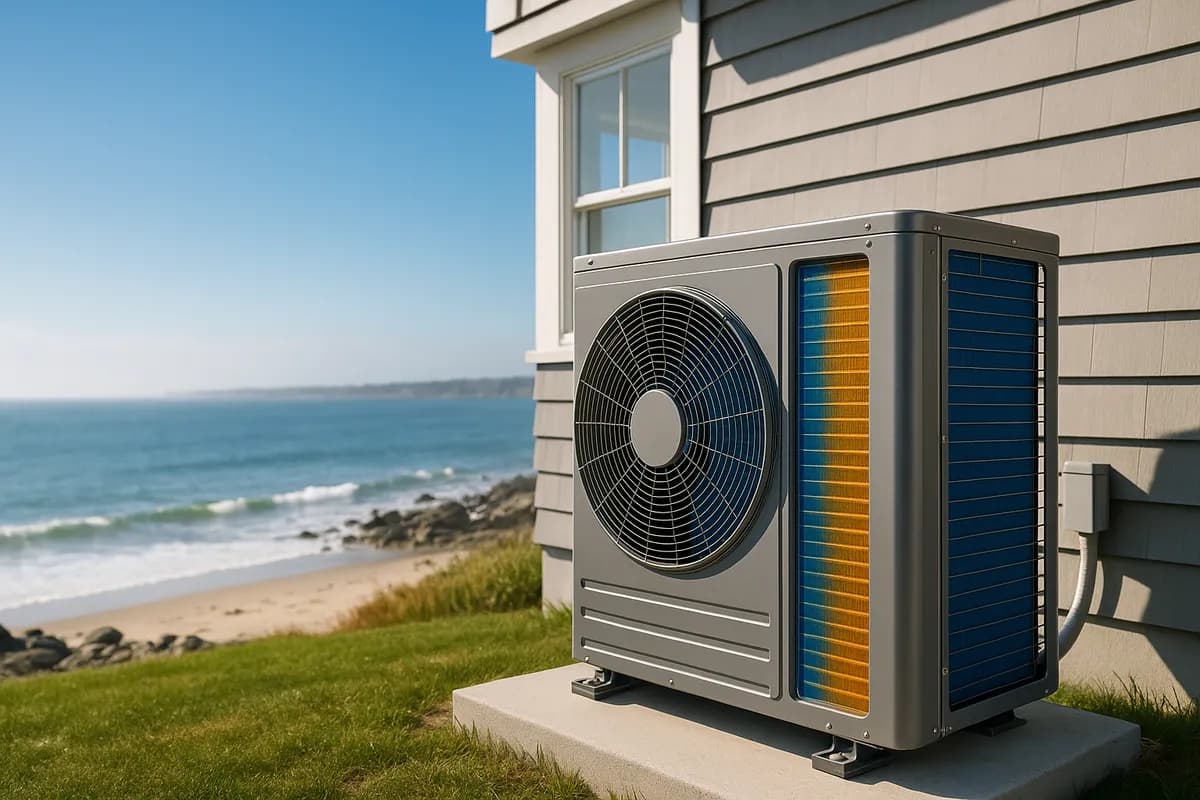
Narragansett, Newport, Westerly, Block Island — coastal RI homes need heat pumps that can handle salt air corrosion, 75–90% humidity, and frequent defrost cycles. The right equipment and maintenance makes all the difference between 5 years and 20 years of service.
Not all coastal locations are equal. Direct oceanfront homes face severe salt spray, while bay-side locations have moderate exposure. Distance from the water is the primary factor.
Exposed to open ocean. Salt spray reaches 1/2+ mile inland. Mandatory anti-corrosion coatings.
Historic district restrictions may affect outdoor unit placement. Ocean Drive homes get direct salt spray.
Southern coast fully exposed to Atlantic storms. Watch Hill particularly vulnerable to salt and wind.
Every surface exposed to constant salt air. Block Island Power rate: $0.35/kWh makes efficiency critical. Limited HVAC technicians on-island.
Aquidneck Island location means surrounded by Narragansett Bay and Sakonnet River. Salt exposure from multiple directions.
Narragansett Bay coastline. Less severe than open ocean but still requires corrosion consideration within 1/2 mile.
Salt is corrosive to aluminum, copper, and steel — the three primary metals in your heat pump. Without protection, a coastal heat pump can fail in 5–8 years versus 15–20 years for a protected unit.
Salt causes pitting and white oxidation on aluminum fins. Corroded fins restrict airflow, reducing efficiency by 15-30% and triggering more frequent defrost cycles.
Visible damage in 1-2 years without coating. Performance degradation in 3-5 years.
Green patina and micro-pitting at joints. Can cause slow refrigerant leaks that are expensive to locate and repair.
Leaks typically appear after 5-8 years in severe exposure without protection.
Rust forms on panel edges, screws, and any scratched surfaces. Structural weakening over time.
Surface rust in 1-3 years. Structural issues after 8-10 years.
Corrosion on wire terminals and contactors causes resistance, leading to voltage drops, overheating, and intermittent failures.
Can cause failures within 2-4 years if terminals are not protected with dielectric grease.
Factory-applied coatings are far superior to aftermarket treatments. For any RI home within 1/2 mile of the coast, a coated unit is not optional — it is essential.
Hydrophilic anti-corrosion coating on aluminum coil fins
Best for: Homes within 1/2 mile of coast
Gold-colored epoxy coating on condenser and evaporator coils
Best for: All coastal RI installations
Multi-layer corrosion protection on outdoor coil
Best for: When combined with Mitsubishi Hyper-Heat for cold climate performance
Spray-applied protective coating on any outdoor unit
Best for: Existing units without factory coating, or units beyond 1/2 mile where factory coating is not essential
These models combine cold climate performance (needed for RI winters) with anti-corrosion protection (needed for coastal salt air). All are ENERGY STAR Cold Climate rated and qualify for Clean Heat RI rebates.
MSZ-FH / MUZ-FH series
Top pick for coastal RI
DERA / RXB series
Best value with corrosion protection
LSU/LSN series
Best factory corrosion protection
RLS3H series
Best extreme cold performance, add corrosion coating
Coastal heat pumps need significantly more maintenance than inland units. Following this schedule extends equipment life from 5–8 years (neglected) to 15–20 years.
Use a garden hose at low pressure. Removes salt crystals before they corrode aluminum fins. Do not use a pressure washer.
Less frequent than oceanfront but still essential. Salt travels further than most people expect in RI's humid air.
Professional cleaning with coil cleaner solution, fin straightening, and corrosion inspection. $150-$250 per service.
High humidity = more condensate. Blocked drains cause water damage and mold. Salt can crystallize in drain lines.
Salt corrodes electrical connections. Look for green/white corrosion on terminals. Apply dielectric grease.
Coastal humidity increases dust and mold spore load. Filters clog faster than inland. MERV 8-11 recommended.
Salt exposure accelerates bearing wear. Listen for grinding or squealing noises as early warning signs.
Corrosion can cause micro-leaks at joints. A 10% refrigerant loss reduces efficiency 20%. Coastal units leak more frequently.
Budget $400–$600/year for professional maintenance on a coastal RI heat pump. This is $200–$300 more than inland, but it protects a $5,000–$20,000 investment. Some HVAC companies offer coastal-specific service plans — ask about salt air maintenance packages.
Coastal RI humidity (75–90% in summer) creates unique challenges. Your heat pump needs to dehumidify as much as it needs to cool. Sizing for temperature alone is a common mistake.
Impact
Indoor humidity above 60% causes mold, dust mites, and discomfort even at low temperatures
Solution
Run heat pump in DRY mode or use continuous fan + low cooling. Dehumidification is as important as cooling in coastal RI.
Impact
A unit that is too large cools the air quickly but short-cycles before removing enough moisture. Result: cold but clammy air.
Solution
Size for dehumidification, not just cooling. Manual J calculation should account for coastal humidity loads, not just temperature.
Impact
Coastal humidity causes more frequent defrost cycles (every 30-60 minutes vs 60-90 inland). More defrost = more aux heat = higher bills.
Solution
Choose demand defrost (not timer defrost). All ENERGY STAR Cold Climate units have demand defrost. Budget for slightly higher winter bills near the coast.
Impact
Temperature swings near the coast + high humidity can cause condensation inside, especially in older RI homes.
Solution
Keep indoor humidity below 50% in winter. Run bathroom and kitchen exhaust fans. Consider a whole-home dehumidifier if heat pump alone cannot maintain 50%.
Prevents storm surge flooding and reduces salt splash from rain hitting the ground. Use corrosion-resistant mounting brackets.
Reduces direct exposure to ocean-driven wind and salt spray. The ocean side of your home gets 3-5x more salt deposition.
A louvered fence 3-4 feet from the unit blocks direct salt spray while allowing airflow. Do not fully enclose the unit.
Standard galvanized screws and brackets corrode within 2-3 years at the coast. Stainless steel adds $50-$100 but lasts the life of the unit.
Prevents salt from corroding wire terminals. Reapply during each maintenance visit.
Makes regular rinsing easy and more likely to happen. If rinsing requires dragging a hose 100 feet, it will not get done.
A Manual J calculation for coastal RI must include latent (moisture) loads, not just sensible (temperature) loads. Slightly undersizing improves dehumidification by running longer at lower capacity.
| Cost Item | Inland RI | Coastal RI |
|---|---|---|
| Equipment (3-ton single zone) | $3,500-$5,500 | $4,000-$6,500 |
| Installation | $2,000-$3,500 | $2,500-$4,000 |
| Corrosion protection | $0 | $0-$600 (factory coating) |
| Annual maintenance | $150-$250 | $400-$600 |
| Expected lifespan | 15-20 years | 15-20 years (with protection) |
| Clean Heat RI rebate | 60% (max $11,500) | 60% (max $11,500) |
Yes, with the right equipment and maintenance. Modern cold-climate heat pumps with anti-corrosion coatings (Blue Fin, Gold Fin, KorroX) are specifically designed for salt air environments. The key differences from inland installations: you need corrosion-protected coils, more frequent maintenance (rinsing coils every 2-4 weeks), and proper dehumidification sizing for 75-90% summer humidity.
For salt air protection, the best options are: Daikin with Blue Fin coating, LG with Gold Fin coating, or Mitsubishi with KorroX coating. All three provide factory-applied anti-corrosion treatment on the outdoor coil. LG Gold Fin has the highest salt spray test rating (1,200+ hours ASTM B117). For combined cold climate and salt protection, Mitsubishi Hyper-Heating with KorroX is the top pick.
Within 1/4 mile of the coast: rinse outdoor coils with fresh water every 2-4 weeks year-round. Within 1/2 mile: monthly rinses. Professional coil cleaning twice per year (April and October). Annual refrigerant check in fall. This is significantly more maintenance than inland units, but it extends equipment life from 5-8 years (uncoated, unmaintained) to 15-20 years.
Expect 10-20% more than inland installations. Anti-corrosion coated units cost $200-$600 more. A corrosion-resistant mounting pad or elevated stand costs $200-$400. Annual maintenance costs are $300-$500 higher due to more frequent service. However, Clean Heat RI rebates cover 60% of costs (max $11,500) regardless of location.
Most manufacturer warranties do not cover corrosion damage from salt air unless you used their anti-corrosion coated model AND maintained proper cleaning schedules. This is why choosing a Blue Fin, Gold Fin, or KorroX unit is essential for coastal RI. Keep records of your maintenance schedule — manufacturers may require proof of regular cleaning.
Block Island has the most extreme salt exposure in RI (surrounded by ocean on all sides). You need factory anti-corrosion coating (Gold Fin or Blue Fin), elevated mounting to avoid storm surge flooding, and a service plan with an on-island or nearby mainland technician. Block Island Power rates ($0.35/kWh) make heat pump efficiency even more important — choose a unit with HSPF2 of 10+ to minimize operating costs.
Clean Heat RI covers 60% of costs (max $11,500) for coastal and inland homes alike. Choose a corrosion-protected unit, follow the maintenance schedule, and your coastal heat pump will last as long as any inland system. ARPA funding expires December 31, 2026.