Loading NuWatt Energy...

We use your location to provide localized solar offers and incentives.
We serve MA, NH, CT, RI, ME, VT, NJ, PA, and TX
Loading NuWatt Energy...
NuWatt designs, installs, and manages solar, battery, heat pump, and EV charger systems across 9 states. One company, one warranty, one point of contact.
Get a Free QuoteRI heat pumps last 15-20 years inland but only 10-15 years near the coast. With 130 miles of coastline, salt air is the silent killer of HVAC equipment in Rhode Island.
Last updated March 2026
2026 Update: The federal 25C heat pump tax credit expired December 31, 2025. There is no federal tax credit for heat pumps in 2026. Clean Heat RI rebates (60% up to $11,500) remain the primary incentive for replacement. Current RI rebates
Expected lifespan varies by system type, maintenance, and proximity to the coast. Rhode Island's maritime climate is harder on HVAC equipment than most states.
Inland Lifespan
15-25 years
Coastal Lifespan
10-18 years
Key maintenance: Wash outdoor coil 2x/year near coast
Inland Lifespan
15-20 years
Coastal Lifespan
10-15 years
Key maintenance: Duct inspection + coil cleaning annually
Inland Lifespan
15-20 years
Coastal Lifespan
12-17 years
Key maintenance: Both HP and furnace service annually
Inland Lifespan
12-18 years
Coastal Lifespan
8-14 years
Key maintenance: R-22 recharge increasingly impractical
Key takeaway: If your heat pump was installed before 2011, it has reached or exceeded its expected lifespan. Systems installed before 2016 using R-410A are entering the replacement window, especially near the coast.
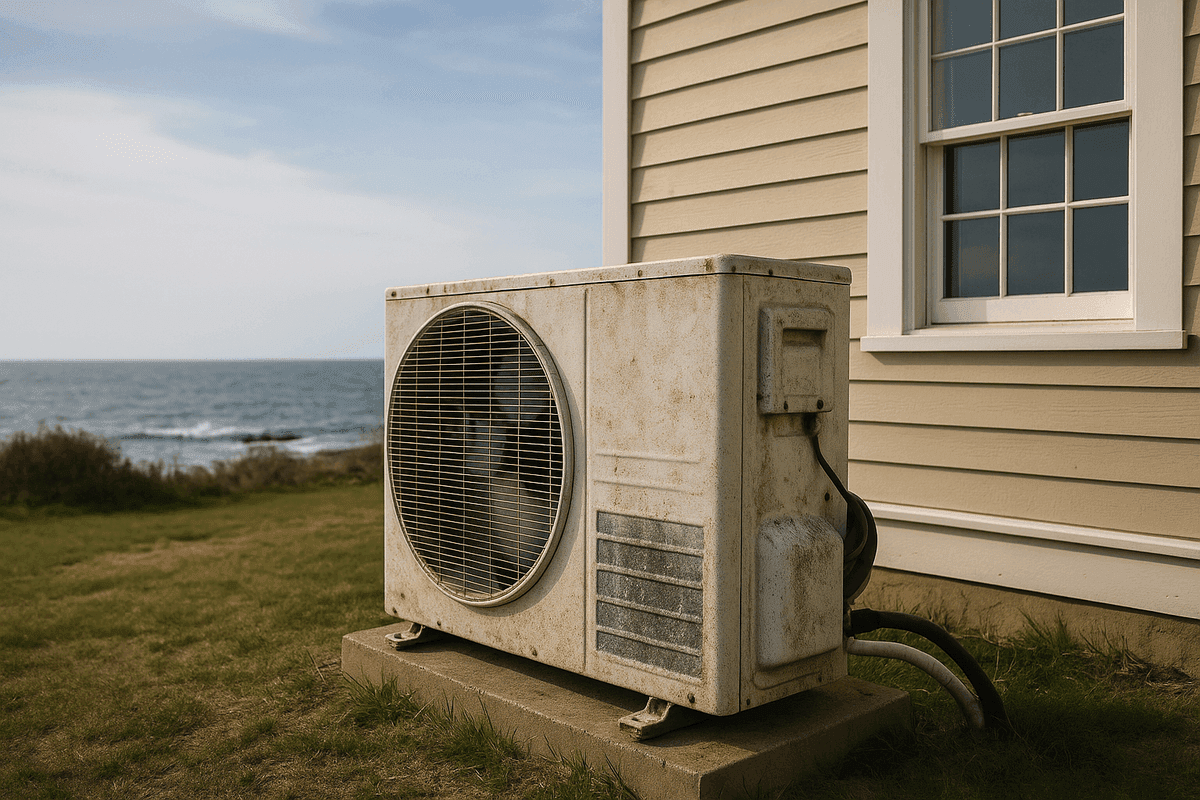
Rhode Island has more coastline per square mile than any other state. That means more homes exposed to corrosive salt air — the single biggest threat to heat pump longevity.
Rhode Island has more coastline per square mile than any US state. Most homes are within 20 miles of salt air.
Homes within 1 mile of the ocean see accelerated corrosion. Coastal heat pumps lose 3-5 years of expected lifespan.
Condenser fins are thin aluminum — they corrode and collapse, blocking airflow and reducing efficiency by 30-50%.
Salt causes formicary (ant-nest) corrosion in copper refrigerant lines, leading to slow leaks and refrigerant loss.
Rinsing the outdoor unit with fresh water every 3-6 months extends life significantly in coastal areas.
Severe (0-500 ft from ocean)
Narragansett, Westerly, Newport, Middletown beaches
High (500 ft - 1 mile)
Point Judith, Watch Hill, most of Aquidneck Island
Moderate (1-5 miles)
Warwick, Cranston coastal, East Greenwich, Bristol
Low (5+ miles inland)
Providence, Woonsocket, North Smithfield, Burrillville
Not every problem means replacement. But when multiple signs appear together, it is time to get quotes for a new system — especially with Clean Heat RI covering 60% of cost.
Heat pumps lose 5-10% efficiency per decade. A 15-year-old system costs 25-40% more to run than a new one.
Monitor closelyThe "50% rule" — if a single repair costs more than half the price of a new system, replacement makes financial sense.
Act nowR-22 was banned in 2020. Recharge costs $100-200 per pound and rising. Any R-22 system is at least 10 years old.
Act nowSalt air accelerates corrosion on condenser coils and copper lines. Once coils corrode through, the compressor will fail.
Act nowDeclining efficiency shows up in your RI Energy bill first. Compare December bills year over year.
Monitor closelyLoss of heating capacity means the compressor or refrigerant charge is degrading. Common in RI winters below 20°F.
Monitor closelyInternal compressor damage, bearing failure, or loose fan blades. Some are repairable, many indicate end of life.
Monitor closelyCompressor turning on and off every few minutes. Could be a failing capacitor, bad valve, or dying compressor.
Monitor closelyThe EPA AIM Act is phasing down R-410A production. Your existing system is fine for now, but replacement costs will rise as supply shrinks.
R-22 production banned (Clean Air Act)
Systems using R-22 can no longer be recharged affordably
EPA AIM Act begins HFC phase-down
R-410A production quotas start declining
Manufacturers shift to R-32 / R-454B
All new heat pumps use lower-GWP refrigerants
40% HFC reduction mandated
R-410A recharge costs will increase significantly
R-32 (GWP: 675)
Used in: Mitsubishi Hyper-Heat, Fujitsu XLTH, LG Red, Daikin FIT. Ductless and multi-zone systems.
R-454B (GWP: 466)
Used in: Carrier Greenspeed, Bosch IDS 2.0, Lennox XP25, Trane XV20i. Ducted central systems.
Both qualify for Clean Heat RI rebates. Both are A2L (mildly flammable) with built-in safety features. Full refrigerant guide
Clean Heat RI makes replacement financially compelling. The program covers 60% of total system and installation cost — applied at point of sale.
60% of installed cost
Up to $11,500 maximum
All RI Energy residential customers
ENERGY STAR 6.1 Cold Climate required
Home Energy Assessment + weatherization documented
Applied at point of sale — no reimbursement wait
100% of project cost
Up to $18,000 maximum
Households at or below 150% State Median Income
Includes electrical upgrades, weatherization, panel upgrades
Heat pump water heater included if needed
RI Energy utility rebates stack on top
Replacing electric resistance: $1,250/ton
3-ton system = $3,750 additional
Replacing fossil fuel: $400/ton
3-ton system = $1,200 additional
ARPA Deadline: Clean Heat RI is funded by the American Rescue Plan Act. All funds must be spent by December 31, 2026. Once exhausted or the deadline passes, this program ends. Do not wait until Q4 — apply early.
For a typical 3-ton system in a 2,000 sq ft RI home. Includes energy costs, repairs, and the Clean Heat RI rebate for new systems.
| Scenario | Upfront | Annual Cost | 5-Year Total |
|---|---|---|---|
Repair aging R-22 system R-22 recharges + parts + high energy waste | $800-$3,000/year | $3,200-$4,500 | $20,000-$37,500 |
Repair aging R-410A system Repairs + declining efficiency | $300-$1,200/year | $1,800-$2,500 | $10,500-$18,500 |
New HP (after Clean Heat RI) 60% covered by Clean Heat RI (up to $11,500) | $2,000-$7,000 net | $1,100-$1,400 | $7,500-$14,000 |
Assumptions: RI Energy rate of $0.30/kWh, COP 3.0 for new heat pumps, COP 2.0 for aging systems, 40 million BTU annual heating load, current fuel prices.
If you live near Rhode Island's coast, these steps can add 3-5 years to your heat pump's lifespan.
Use a garden hose to rinse salt deposits off the outdoor unit. Focus on the condenser fins and base. Never use a pressure washer — it bends fins.
Specify blue-fin or epoxy-coated coils when purchasing a new unit. Standard aluminum corrodes in 5-8 years near the ocean; coated coils last 12-15.
Plant a dense shrub row or install a vinyl fence on the ocean-facing side of the outdoor unit. Maintain 24" clearance for airflow.
Install the outdoor unit on a raised stand (12-18" above grade). Reduces salt spray splash from ground level and keeps snow away from the coil.
Spring and fall service checks. Technician inspects coils, checks refrigerant levels, cleans condensate drains, and tests compressor performance.
Some installers offer magnesium anode rods attached to the outdoor unit chassis — they corrode preferentially, protecting the unit itself.
Heat pumps in Rhode Island typically last 15-20 years inland and 10-15 years near the coast. Rhode Island has 130 miles of coastline, and salt air accelerates corrosion of outdoor unit components, particularly aluminum condenser fins and copper refrigerant lines. Regular maintenance (rinsing the outdoor unit with fresh water 2-4 times per year near the coast) can extend lifespan significantly.
Replace your heat pump when it is 15+ years old with declining performance, when a single repair costs more than 50% of a new system, when it uses banned R-22 refrigerant, or when visible corrosion is present on the outdoor unit. Clean Heat RI rebates cover 60% of replacement cost up to $11,500 for standard households and up to $18,000 for income-eligible households.
Yes. Homes within 1 mile of the Rhode Island coast see heat pump lifespans 3-5 years shorter than inland homes. Salt causes aluminum fin corrosion (reducing airflow and efficiency by 30-50%) and formicary corrosion in copper refrigerant lines (causing slow leaks). Mitigation includes coated coils, regular freshwater rinsing, and protective shrouds.
Clean Heat RI covers 60% of total system and installation cost, up to $11,500 for standard households. Income-eligible households (at or below 150% State Median Income) receive up to 100% coverage, capped at $18,000. RI Energy adds $400-$1,250 per ton in utility rebates. The federal 25C tax credit expired December 31, 2025 — there is no federal tax credit in 2026.
Generally no. A 15-year-old heat pump runs 25-40% less efficiently than a new one. Major repairs on aging systems often cost $1,500-$3,000, and another component typically fails within 1-2 years. With Clean Heat RI covering 60% of a new system, the net cost of replacement is often comparable to 1-2 major repairs on the old unit.
R-410A is not outright banned but is being phased down under the EPA AIM Act. All major manufacturers have already transitioned new equipment to R-32 or R-454B. By 2028, a 40% reduction in HFC production is mandated, making R-410A recharges more expensive. Existing R-410A systems can be serviced for their remaining lifespan, but when replacement time comes, the new unit will use R-32 or R-454B.
Five key strategies: (1) Rinse the outdoor unit with fresh water every 3-6 months, (2) Install coated condenser coils (blue-fin or epoxy-coated), (3) Use a wind/salt barrier (fence or shrub screen), (4) Elevate the unit on a stand to avoid salt spray splash, (5) Schedule professional cleaning and inspection twice per year. These measures can extend coastal unit lifespan by 3-5 years.
Yes. Clean Heat RI rebates apply to new heat pump installations regardless of your current heating system. Replacing an aging heat pump, oil furnace, propane system, or electric resistance heating all qualify. The key requirement is ENERGY STAR 6.1 Cold Climate certification and a completed Home Energy Assessment. The rebate is applied at point of sale.
Get a free assessment. Clean Heat RI covers 60% of a new system (up to $11,500). ARPA funds expire December 31, 2026 — act before they run out.
Complete guide to Clean Heat RI rebates, income-eligible coverage, and how to apply.
Read moreR-22 banned, R-410A phasing out. What refrigerant your new system will use.
Read moreClean Heat RI + personal loans, HELOC, and RI Infrastructure Bank programs.
Read moreLifespan data: ASHRAE equipment life expectancy tables, ACCA Manual J guidelines.
Salt air corrosion: NACE International corrosion engineering references, coastal HVAC studies.
Clean Heat RI: Rhode Island Office of Energy Resources, program guidelines 2026.
Refrigerant data: EPA AIM Act final rule, manufacturer transition timelines.
Electricity rates: RI Energy standard service rate ($0.30/kWh), March 2026.