Loading NuWatt Energy...

We use your location to provide localized solar offers and incentives.
We serve MA, NH, CT, RI, ME, VT, NJ, PA, and TX
Loading NuWatt Energy...
NuWatt designs, installs, and manages solar, battery, heat pump, and EV charger systems across 9 states. One company, one warranty, one point of contact.
Get a Free Quote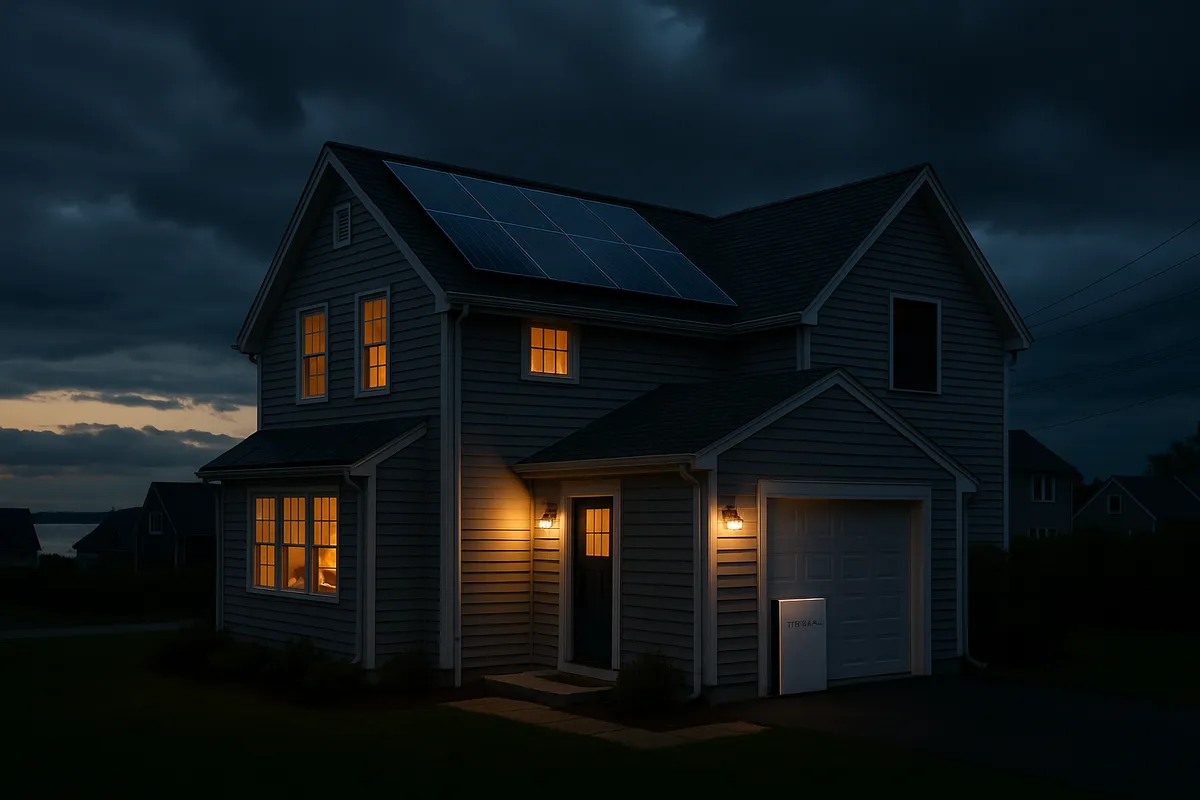
Rhode Island is the smallest state but faces outsized grid vulnerability. Nor'easters, tropical storms, and aging infrastructure cause multi-day outages for tens of thousands of households each year. Solar alone will not save you — but solar + battery will.
This surprises many homeowners, but it is a safety requirement, not a design flaw. Understanding why is key to making the right backup power decision.
When the grid goes down, your solar inverter detects the loss of utility power and shuts off within 2 seconds. This is called anti-islanding protection, required by IEEE 1547 and UL 1741 safety standards.
Why it matters: When utility workers climb poles to repair downed lines, they need to know those lines are dead. If your solar panels were still pushing electricity into the grid, they could electrocute a lineworker.
This means even on a sunny day with perfectly functioning panels, your home goes dark the moment the grid fails. The sun is shining. Your panels are fine. But your inverter will not allow power to flow.
A battery storage system with an automatic transfer switch (ATS) solves this problem. When the grid fails, the ATS disconnects your home from the grid and creates an independent “island.” Your solar panels then charge the battery, and the battery powers your home.
Modern systems like Tesla Powerwall and Enphase IQ Battery failover in under 200 milliseconds — so fast that most electronics never notice the switch. Your refrigerator keeps running, your Wi-Fi stays up, and your sump pump stays active.
Rhode Island's small size means a single storm can affect a disproportionate share of the population. Aging overhead lines and coastal exposure amplify the problem.
| Event | Date | Customers Affected | Duration |
|---|---|---|---|
| Tropical Storm Isaias | August 2020 | ~85,000 | 1-4 days |
| Winter Nor'easter | January 2024 | ~60,000 | 1-3 days |
| Summer Thunderstorms | July 2025 | ~40,000 | 4-24 hours |
| October Nor'easter | October 2023 | ~45,000 | 1-3 days |
450K
Total RI electric customers
85K
Affected in worst recent storm
19%
Of state affected in single event
The battery adds $10,000–$14,000 upfront but provides backup power, time-shifting, and ConnectedSolutions revenue that solar alone cannot deliver.
| Feature | Solar Only | Solar + Battery |
|---|---|---|
| Power during grid outage | No — shuts off immediately | Yes — automatic failover in <200ms |
| Nighttime backup power | No — no generation at night | Yes — battery stores daytime solar |
| Self-consumption optimization | Limited — excess goes to grid | Full — store excess for evening use |
| ConnectedSolutions revenue | No — requires battery | Yes — $225/kW summer + $50 winter |
| Net metering credits | Yes — 80% retail credit | Yes — plus battery time-shifting |
| Upfront cost (8 kW system) | $21,000-$26,000 | $33,000-$42,000 |
A single 13.5 kWh battery like the Tesla Powerwall 3 can power essential loads for 8–12 hours. With daytime solar recharging, you can maintain essential power indefinitely.
On a sunny RI day, an 8 kW solar array produces 30–40 kWh. That is enough to fully recharge a 13.5 kWh battery AND power your essential loads simultaneously. This means during multi-day outages (common in RI nor'easters), solar + battery provides indefinite essential power as long as you manage loads wisely. Cloudy days produce 10–20 kWh — enough for essentials but not heavy loads.
All four options are enrolled in RI Energy's ConnectedSolutions program. REF battery adder: $2,000. No federal 25D credit (expired Dec 31, 2025).
Most popular in RI. Seamless solar integration. Automatic storm watch mode.
Modular design. Pairs with Enphase microinverters. Start small, add later.
Excellent whole-home backup. Integrated gateway/transfer switch.
German engineering. 15-year warranty. Virtual power plant capable.
RI Energy's ConnectedSolutions program pays you to share battery capacity during peak demand events. This is separate from net metering — it is additional revenue.
RI Energy dispatches your battery during peak demand events. You get paid per kW of capacity enrolled.
Winter events are less frequent but still earn revenue. Battery is always available for your backup needs.
~$750/year
$615/year (summer) + $137/year (winter) = ~$750/year
Over a 10-year battery warranty period, that is $7,500 in revenue — covering 50–70% of the battery cost. Combined with backup power value, many RI homeowners find the battery pays for itself.
Exposed to nor'easters, hurricane remnants, and coastal surge. Overhead lines through wooded areas. Average outage: 24-72 hours for major storms.
Island geography means limited interconnection points. A single downed line can isolate sections. Historical vulnerability to hurricanes.
Submarine cable from mainland is the single point of failure. Island outages can last days. Block Island Power Company has limited generation.
More redundant infrastructure but aging overhead lines. Tree contact is the #1 cause. Typical outage: 4-24 hours.
Rural areas with long distribution feeders through dense forest. Restoration prioritized by population density, so rural areas wait longer.
$2,000
Additional rebate when you add battery storage to a solar installation through the Renewable Energy Fund. Stacks with the $0.65/W solar rebate (capped at $5,000).
Applied at point of sale through participating installers.
$550–$850/yr
Annual revenue from RI Energy demand response program. $225/kW summer + $50/kW winter. Paid as bill credits. No additional equipment needed.
Enrollment through your battery installer or RI Energy directly.
The Section 25D residential clean energy credit expired December 31, 2025. There is no federal tax credit for residential battery storage in 2026. However, if you go with a third-party owned system (PPA or lease), the financing company may claim Section 48/48E and pass savings to you as a lower rate.
No. Solar panels alone shut off during a grid outage within milliseconds. This is a safety requirement called "anti-islanding" — it prevents your panels from sending electricity into power lines that utility workers may be repairing. To use solar during an outage, you need a battery storage system that creates an independent "island" for your home.
Grid-tied solar inverters are required by IEEE 1547 and UL 1741 standards to detect grid loss and shut down within 2 seconds. This protects utility workers repairing downed power lines from being electrocuted by your solar panels. A battery system with a transfer switch safely disconnects your home from the grid and creates an independent power island.
For essential loads (refrigerator, lights, Wi-Fi, sump pump), a single 13.5 kWh battery like the Tesla Powerwall 3 provides 8-12 hours of backup. For extended outages typical of RI nor'easters (1-4 days), you will want the battery paired with solar panels that recharge it during the day, creating indefinite backup for essential loads.
ConnectedSolutions is RI Energy's demand response program. They pay you $225 per kW of battery capacity enrolled during summer (June-September) and $50/kW in winter. A 13.5 kWh Tesla Powerwall earns approximately $750/year. RI Energy dispatches your battery during peak demand events (30-60 hours per summer). Your battery remains available for backup — it does not drain below 20% during events.
A single battery (10-13.5 kWh) costs $10,000-$14,000 installed in RI. The REF program adds a $2,000 battery adder. ConnectedSolutions earns $550-$850/year in revenue. There is no federal tax credit for batteries in 2026 (25D expired). Third-party owned systems via PPA/lease may include batteries with no upfront cost.
A single mini-split zone (1,500W) can run on most batteries. A whole-home central heat pump (3,500-5,000W) may exceed a single battery's continuous output. For heat pump backup, consider two batteries or a hybrid system. During summer outages, heat pump cooling is manageable with solar recharging the battery during the day.
Solar + battery gives you outage protection AND $550–$850/year in ConnectedSolutions revenue. REF adds a $2,000 battery rebate. Explore your options below.