Loading NuWatt Energy...

We use your location to provide localized solar offers and incentives.
We serve MA, NH, CT, RI, ME, VT, NJ, PA, and TX
Loading NuWatt Energy...
NuWatt designs, installs, and manages solar, battery, heat pump, and EV charger systems across 9 states. One company, one warranty, one point of contact.
Get a Free Quote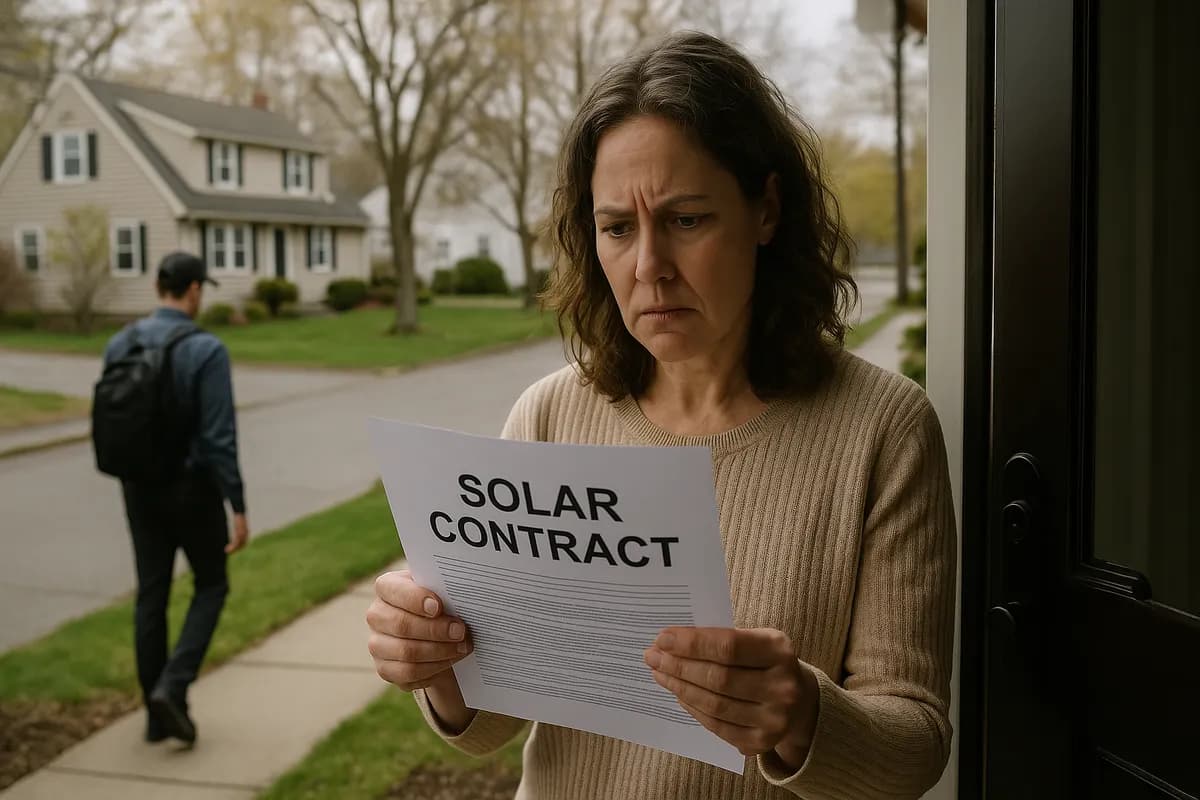
Protect yourself from dishonest solar companies in RI. The biggest red flag: anyone advertising the 30% federal tax credit that expired in 2025.
$0 ITC
25D Expired 2025
crb.ri.gov
Verify License
401-274-4400
RI AG Complaints
Rhode Island's solar market is booming — high electric rates ($0.29/kWh), strong state incentives (REG, REF), and aggressive renewable energy targets make it one of the best solar states in the country. Unfortunately, this also attracts dishonest companies looking to exploit homeowners who are not familiar with the specifics of RI's programs.
The single biggest red flag in 2026 is any company advertising the 30% federal residential tax credit. That credit (Section 25D) expired on December 31, 2025. But there are 9 more RI-specific warning signs you need to know before signing anything.
Report Solar Fraud in Rhode Island
RI Attorney General Consumer Protection: 401-274-4400or riag.ri.gov. RI Contractors' Registration Board: 401-222-1268 or crb.ri.gov. RI Public Utilities Commission: 401-941-4500.
The federal residential solar ITC (Section 25D) expired December 31, 2025 under the OBBBA. It is $0 for homeowner cash/loan purchases. Any RI company advertising a 30% credit in 2026 is either dangerously uninformed or intentionally deceptive.
Section 25D was eliminated by the One Big Beautiful Bill Act (OBBBA), signed July 4, 2025. For any solar system purchased by a homeowner with cash or a loan in 2026, the federal tax credit is $0.
Rhode Island's small, tight-knit solar market makes this especially concerning. A company still using outdated 2024-era marketing materials in 2026 demonstrates negligence at best and fraud at worst.
The exception: PPA and lease providers can legitimately reference Section 48/48E because the third-party system owner (not the homeowner) claims that credit. But if a company tells YOU that YOU will receive 30% off your taxes, they are wrong.
Ask This Question:
"Under which section of the tax code does the residential solar credit exist in 2026?"
Correct Answer:
It does not. Section 25D expired December 31, 2025. If they cannot answer this clearly, walk away.
The REG program (31.55¢/kWh for 15 years) REPLACES net metering during the REG term. You get one or the other, not both at the same time. This is the most common RI-specific solar scam in 2026.
REG and net metering are mutually exclusive during the 15-year REG term. When enrolled in REG, your solar generation earns the fixed REG rate. You do NOT also receive net metering credits on that same energy.
After the 15-year REG term, your system transitions to whatever net metering rate applies. Some companies present this sequential arrangement as "getting both" — they are being deliberately misleading.
This misrepresentation inflates projected savings by roughly double. If a company's ROI calculation shows REG income AND net metering savings in the same year, their math is fraudulent and their quote is unreliable.
Ask This Question:
"In your projection, are REG payments and net metering credits shown in the same year?"
Correct Answer:
They should never appear simultaneously. Years 1-15: REG only. After year 15: net metering only.
The REF rebate is $0.65/W, capped at $5,000 for residential solar, plus $2,000 for battery. If a company quotes you $8,000-$10,000+ in REF rebates, they are inflating numbers.
For a typical 8 kW system: 8,000W x $0.65/W = $5,200, but the cap is $5,000. Maximum REF check for solar is $5,000. With a qualifying battery, add $2,000 for $7,000 total.
Some companies confuse homeowners by combining REF with other savings (bill reduction, REG income) and presenting the total as "your rebate." The actual REF check from Commerce RI will not exceed $5,000 ($7,000 with battery).
REF funding is finite and operates through grant rounds (spring, summer, fall). A legitimate company confirms current availability before including REF in projections.
Ask This Question:
"What is the exact REF rebate in my quote? Have you confirmed the fund is open?"
Correct Answer:
$0.65/W capped at $5,000 for solar, plus $2,000 for battery. They should confirm current grant round availability.
As of April 2023, new RI net metering installations receive credits at 80% of retail, not 1:1. Only pre-2023 systems are grandfathered. Companies quoting 1:1 for a new 2026 system are using outdated data.
The RI PUC changed net metering compensation in April 2023. New enrollments receive approximately 80% of the retail electricity rate. At RI Energy's $0.30/kWh, that means ~$0.232/kWh in credit.
Pre-April 2023 systems retain 1:1 (full retail). A company cannot claim your new 2026 system will receive the old rate.
The 125% annual generation cap still applies. If a company does not mention this, ask — oversizing beyond 125% generates excess energy at reduced or no compensation.
Ask This Question:
"At what rate do new net metering customers receive credits — 1:1 or 80%?"
Correct Answer:
80% of retail (~$0.232/kWh). Only pre-April 2023 systems get 1:1. If they say 1:1 for your new system, they are wrong.
"Get free solar!" usually means a lease or PPA where you pay monthly for 20-25 years and never own the system. It is not free. Legitimate companies disclose the ownership structure upfront.
In a solar lease or PPA, a third-party company owns your panels. You pay them a monthly fee or per-kWh rate. Over 20-25 years, total payments often reach $18,000-$35,000+ for a system you never own.
The "free" pitch is effective in RI because $0.30/kWh rates mean even a PPA can save money vs RI Energy. But savings are far less than owning your system outright.
Under RI law (Home Solicitation Sales Act, RI General Laws 6-28), you have a 3-business-day right to cancel any contract signed during a door-to-door sale. If a salesperson pressures you to waive this, it is both a red flag and potentially illegal.
Ask This Question:
"Is this a purchase (cash/loan), a lease, or a PPA? Who owns the system?"
Correct Answer:
They should clearly state the ownership structure. In lease/PPA, they own it. In purchase, you own it. Nothing is "free."
Rhode Island requires solar installers to hold a valid contractor license from the RI Contractors' Registration and Licensing Board (CRB). Verify at crb.ri.gov. No license = illegal operation.
Every solar installer in RI must hold a valid CRB license. You can verify at crb.ri.gov or call 401-222-1268.
Companies claiming exemption from RI licensing are operating illegally. Out-of-state companies must register in RI before performing work.
Without a valid license, you have no recourse through the CRB complaint process if something goes wrong. Your homeowner's insurance may not cover work performed by an unlicensed contractor.
Ask This Question:
"What is your RI Contractors' Registration Board license number?"
Correct Answer:
They should provide it immediately. Verify at crb.ri.gov before signing anything.
Many solar leases include 2-3% annual escalators buried in fine print. At RI Energy's $0.30/kWh, a PPA starting at $0.15/kWh with a 2.9% escalator reaches $0.30/kWh by year 24 — exceeding your current utility rate.
The math: $0.15/kWh x (1.029^24) = $0.30/kWh by year 25. If RI Energy rates do not rise as fast as the escalator, you end up paying MORE for your leased solar than you would to the utility.
Ask for the year-by-year payment schedule for the full lease term. A legitimate company provides this in writing.
Flat (0% escalator) PPA contracts are available from some RI providers. The starting rate is slightly higher, but you are protected from escalation risk. Always compare escalating vs flat.
Ask This Question:
"Does this PPA have an annual escalator? Show me the year-by-year payment schedule for all 25 years."
Correct Answer:
They should provide the full schedule immediately. A 0% escalator option should also be discussed.
Realistic solar production in RI is 1,250-1,350 kWh/kW/year. If a company projects 1,500+, they are inflating your savings. RI gets less sun than the national average.
Rhode Island's average solar irradiance supports 1,250-1,350 kWh/kW/year for a south-facing roof with minimal shading. Coastal areas may be slightly higher from ocean reflection but rarely exceed 1,400.
A 10% production overestimate on a $25,000 system translates to ~$725/year in phantom savings, extending your actual payback by 12+ months vs what was promised.
Ask for the PVWatts report for your specific address. PVWatts is a free NREL tool that estimates production based on actual weather data, roof angle, and orientation.
Ask This Question:
"What kWh/kW/year are you projecting? Can you share the PVWatts report?"
Correct Answer:
Expect 1,250-1,350 kWh/kW/year for RI. They should provide a PVWatts or equivalent report specific to your roof.
Door-to-door solar sales are legal in RI, but high-pressure tactics and "sign today" pressure violate consumer protection norms. RI law gives you 3 business days to cancel.
Under RI General Laws 6-28 (Home Solicitation Sales Act), you have a 3-business-day right to cancel any contract signed during a door-to-door sale. If a salesperson pressures you to waive this right, it is potentially illegal.
Common pressure tactics: "This price expires tonight," "Your neighbor just signed," "Federal rebate ends this month" (it already expired). These are designed to prevent you from getting competing quotes.
A legitimate solar company welcomes comparison and gives you time to review the contract with your attorney or financial advisor. If they rush you, they are hiding something.
Ask This Question:
"Can I have 3 days to review this contract and get competing quotes?"
Correct Answer:
Any legitimate company will say yes. RI law requires it for door-to-door sales. If they resist, close the door.
RI Energy does not endorse, partner with, or recommend specific solar installers. Companies claiming RI Energy sent them or approved them are misrepresenting their relationship.
RI Energy facilitates interconnection and administers some energy efficiency programs. They do not sell solar or recommend solar companies.
Some companies use language like "RI Energy approved installer" or "preferred RI Energy contractor" to imply official endorsement. This is misleading.
RI Energy's role in your solar project is limited to: processing your interconnection application, connecting your system to the grid, and administering net metering credits. They do not select or recommend installers.
Ask This Question:
"In what capacity did RI Energy send or recommend you?"
Correct Answer:
RI Energy does not send, recommend, or endorse solar companies. If they claim otherwise, it is false.
Verify CRB license at crb.ri.gov before any meeting
Get 3+ written quotes with price per watt
Confirm no 30% federal credit in any quote
Verify REG and net metering are NOT shown simultaneously
Confirm REF rebate is $5,000 max ($7,000 with battery)
Check net metering at 80% retail, not 1:1
Request full year-by-year payment schedule for leases/PPAs
Ask for PVWatts production report for your address
Take 3+ days to review any contract (RI law for door-to-door)
Check RI AG complaint database for the company
Consumer Protection Unit
Phone: 401-274-4400
Web: riag.ri.gov
Deceptive trade practices, tax credit fraud, consumer complaints
Licensing Division
Phone: 401-222-1268
Web: crb.ri.gov
Unlicensed contractors, workmanship complaints, license verification
Consumer Affairs
Phone: 401-941-4500
Web: ripuc.ri.gov
Utility program misrepresentation, interconnection issues
Serving RI
Phone: 508-652-4800
Web: bbb.org
Business ratings, mediation, complaint history
A company advertising the 30% federal tax credit. The Section 25D residential solar ITC expired December 31, 2025 under the OBBBA. It is $0 for homeowner cash/loan purchases in 2026. Any RI company still advertising this credit is either dangerously uninformed or deliberately misleading homeowners. The only remaining federal credit (Section 48/48E) applies to PPA/lease company owners, not to homeowners directly.
Visit crb.ri.gov (RI Contractors' Registration and Licensing Board) and search by company name or license number. You can also call 401-222-1268. Every solar installer operating in RI must hold a valid CRB license. Working with an unlicensed contractor means you have no legal recourse through the CRB complaint process and your homeowner's insurance may not cover damages.
Not simultaneously. The REG program pays 31.55¢/kWh fixed for 15 years, but it replaces net metering during that term. After the 15-year REG term, your system transitions to net metering. You receive REG OR net metering in any given year, never both. Any company showing both in the same year of a financial projection is fabricating numbers.
File a complaint with the RI Attorney General's Consumer Protection Unit at 401-274-4400 or online at riag.ri.gov. Also contact the RI Contractors' Registration Board (crb.ri.gov, 401-222-1268) and the RI Public Utilities Commission (401-941-4500). If a company misrepresents the federal tax credit, that may constitute fraud under RI's Deceptive Trade Practices Act (RI General Laws 6-13.1).
Solar in Rhode Island costs $2.78-$3.15/W installed in 2026, depending on your town and equipment. A typical 8 kW system costs $22,240-$25,200. There is no federal tax credit. RI incentives include: REF rebate ($0.65/W, max $5,000 + $2,000 battery), REG (31.55¢/kWh for 15 years) OR net metering (80% retail), 7% sales tax exemption, 20-year property tax exemption, and ConnectedSolutions battery DR ($225/kW).
Yes, but RI law provides consumer protections. Under the Home Solicitation Sales Act (RI General Laws 6-28), you have a 3-business-day right to cancel any contract signed during a door-to-door sale. If a salesperson pressures you to waive this right or sign immediately, that is both a red flag and potentially illegal. Legitimate companies will always give you time to compare quotes.
Realistic solar production in RI is 1,250-1,350 kWh/kW/year for a south-facing roof with minimal shading. Coastal towns may see slightly higher output from ocean-reflected light but rarely exceed 1,400 kWh/kW/year. If a company projects 1,500+, they are inflating your savings. Ask for the PVWatts report for your specific address to verify.