

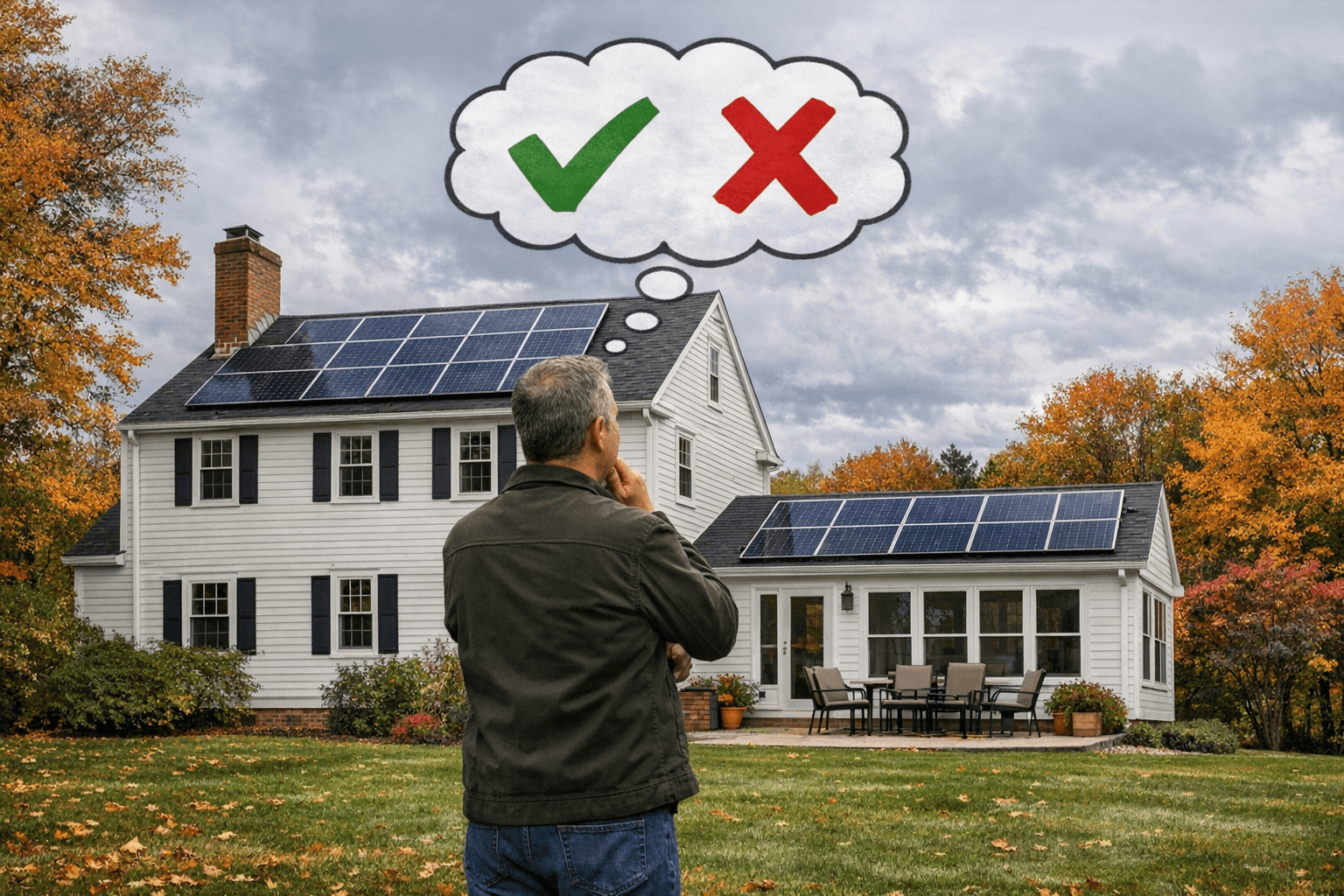
Rhode Island has one of the strongest solar incentive stacks in the country. Between the REG program's guaranteed 31.55¢/kWh payments, the REF rebate, 7% sales tax exemption, 20-year property tax exemption, and net metering, most RI homeowners with a decent roof and a $100+ monthly bill will benefit from solar — even without the federal 25D residential tax credit (which expired December 31, 2025).
But "most" isn't "all." Some situations make solar a poor financial decision, and we believe in being honest about that. Going solar when the math doesn't work wastes your money and damages the industry's credibility. Here are the specific scenarios where Rhode Island homeowners should think twice — or choose an alternative.
When You Should NOT Go Solar in RI
Your Electric Bill Is Under $75/Month
Strong NoAt $0.29/kWh, a $75/month bill means you're using roughly 260 kWh — about 40% less than the RI average. A solar system sized for this usage would be only 2–3 kW, costing $7,000–$9,600 installed. Without the federal 25D tax credit (expired 2025), the payback period stretches to 10–14 years even with REF and REG incentives. The math rarely works.
Threshold: $75/month or less
What to do instead: Focus on efficiency upgrades first. An RI Energy home energy assessment (free or $100) often finds $20–$40/month in savings from insulation and air sealing alone.
You're Moving Within 2 Years
Strong NoSolar adds 4.1% to RI home values (Zillow), but the system needs to be installed and producing to capture that premium. Factor in 2–4 months for permitting and installation, plus time to build production history for appraisers. The REF rebate ($5,000 max) is non-transferable — you capture it at install. But with 2026 installation costs of $24,000–$32,000 for an average 8 kW system, breaking even in under 2 years is unlikely even in Rhode Island.
Threshold: Moving within 24 months
What to do instead: Consider community solar (no roof commitment, cancel anytime) or invest in efficiency improvements that are immediately capitalized into the home's value.
Your Roof Needs Replacement Within 5 Years
Strong NoRemoving and reinstalling solar panels for a roof replacement costs $3,000–$8,000 in RI. If your asphalt shingle roof is 15+ years old or your slate/wood shake roof shows deterioration, you'll need to factor in the re-roof cost before solar makes sense. A structural engineer may also need to assess load capacity, especially on older Rhode Island homes (many are pre-1960 construction).
Threshold: Roof age 15+ years (asphalt shingles) or visible damage
What to do instead: Get a roof inspection first. If replacement is needed, many RI contractors bundle solar + roof for better pricing. NuWatt's solar reroof program handles both in one project.
Heavy Tree Shade (4+ Hours/Day)
Strong NoTrees that shade your roof between 9 AM and 3 PM (the peak solar window) can reduce production by 30–70%. Rhode Island has dense tree coverage, especially in areas like Lincoln, Foster, Coventry, and Burrillville. Even microinverter systems (Enphase IQ8) that optimize panel-by-panel production can't fully compensate for heavy canopy shade. Your annual production drops, payback stretches, and the economics weaken significantly.
Threshold: 4+ hours of direct shade during 9 AM – 3 PM
What to do instead: Get a professional shade analysis (free from most RI solar installers). Selective tree trimming can help. Otherwise, community solar is specifically designed for homes that can't host rooftop solar.
North-Facing Roof with No Alternative Surfaces
MarginalA north-facing roof in Rhode Island (latitude ~41.8°N) produces 25–35% less energy than south-facing. East- and west-facing roofs lose only 10–15%. If your only viable roof surface faces north, the reduced production pushes payback beyond 12–15 years. Combined with the loss of the federal ITC, the economics become marginal.
Threshold: Primary roof orientation: north (315°–45° azimuth)
What to do instead: Ground-mount systems are an option if you have yard space (requires at least 400 sq ft for a typical residential system). Ground-mount adds $0.20–$0.50/W but optimizes orientation.
You're on a Fixed Income and Can't Finance
MarginalWithout the 25D tax credit, RI homeowners pay 100% of system costs upfront or through financing. Cash purchase: $24,000–$32,000. Loans: $150–$250/month for 15–25 years. If these payments strain your budget, solar can become a financial burden rather than a benefit. However, RI has strong alternatives for fixed-income households.
Threshold: Cannot afford $24K+ cash or $150+/month loan payments
What to do instead: Check income eligibility for community solar (10% guaranteed savings, no upfront cost). Rhode Island's Section 48 lease/PPA market means third-party companies pay for the system and sell you power at a discount. Zero out of pocket.
Why RI Is Still One of the Best Solar States (When It Fits)
Before you rule out solar entirely, understand what makes Rhode Island exceptional. Most states lost their economic case for solar when the 25D ITC expired. RI is different because it has incentive programs that no other state matches — particularly the REG program.
REG Program (31.55¢/kWh for 15–20 Years)
$35,000–$50,000+Guaranteed production payments from Rhode Island Energy. Most states have nothing comparable. REG alone often makes the economics work even without the ITC.
REF Rebate ($0.65/W, Max $5,000)
Up to $5,000State rebate through Commerce RI. Applied at installation. Battery adder adds another $2,000. Available in grant rounds (spring, summer, fall).
Net Metering (80% Retail)
$0.23/kWh creditsExcess production credits at 80% of RI Energy's retail rate ($0.29/kWh). Grandfathered pre-2023 systems get full 1:1 retail. Annual cap at 125% of usage.
7% Sales Tax Exemption
$1,750–$2,450 savedNo RI sales tax on solar equipment, labor, or batteries. This is an immediate savings at purchase.
20-Year Property Tax Exemption
$7,000–$12,000 savedSolar-added home value is exempt from property tax for 20 years. Saves $350–$600/year.
ConnectedSolutions ($225/kW)
$2,250–$3,375/yearBattery storage demand response program. Earn $225/kW in summer + $50/kW in winter for participating in peak demand events.
The REG difference: In Massachusetts, Connecticut, or New Hampshire, losing the 25D ITC added 3–4 years to payback. In Rhode Island, the REG program's 31.55¢/kWh for 15–20 years — worth $35,000–$50,000+ for a typical system — means the loss of the ITC only adds about 2 years to payback. Rhode Island's solar economics are structurally different from other states because REG is essentially a guaranteed income stream.
The Honest Math: RI Solar in 2026 Without the ITC
| Factor | Value |
|---|---|
| System Size (Typical) | 8 kW |
| Gross Cost (Installed) | $24,000–$32,000 |
| Federal 25D ITC | $0 (expired 2025) |
| REF Rebate | -$5,000 (max) |
| Sales Tax Exemption (7%) | -$1,750–$2,450 |
| Net Cost After State Incentives | $17,250–$24,550 |
| Annual REG Income | +$2,000–$3,500 |
| Annual Net Metering Savings | +$600–$1,200 |
| Annual Property Tax Savings | +$350–$600 |
| Total Annual Value | +$2,950–$5,300 |
| Payback Period | 4–8 years (with REG) |
| 25-Year Total Value | $75,000–$130,000+ |
Note: These numbers assume an average 8 kW system with south-facing roof, RI Energy territory, and successful enrollment in the REG program. Individual results vary based on roof orientation, shading, usage patterns, and REG enrollment timing.
The Best Alternative: RI Community Solar
If rooftop solar doesn't make sense for your situation, community solar is the clear second choice in Rhode Island. It's not a consolation prize — it's a legitimate way to get solar savings without any of the barriers that make rooftop solar problematic.
Community Solar Benefits in RI
- No roof required — panels installed at a local solar farm
- No upfront cost — subscribe to a share of a community solar project
- Guaranteed 10–15% savings on your electric bill
- Cancel anytime (most RI community solar contracts are flexible)
- Works for renters, condo owners, and homes with shade or bad roofs
- Available through RI Energy's community solar program
- No installation, no permitting, no maintenance on your property
How community solar works in RI: You subscribe to a portion of a local solar farm's output. Rhode Island Energy applies credits to your monthly bill based on your share's production. Typical savings are 10–15% off your electric bill with zero upfront cost, no installation, and no long-term commitment. It's available to renters, condo owners, and anyone whose roof isn't suitable for panels.
Decision Framework: Is Solar Right for YOU?
Rooftop Solar Is Likely Worth It If:
- Your electric bill is $100+/month
- You own your home and plan to stay 5+ years
- Your roof is under 15 years old (asphalt) or structurally sound
- You have a south-, east-, or west-facing roof with minimal shade
- You can pay cash or qualify for a solar loan
- You're in RI Energy territory (for REG enrollment)
Community Solar or Lease/PPA Is Better If:
- Your bill is $50–$100/month
- You're renting, or own a condo with shared roof
- Heavy tree shade covers your roof
- Your roof is north-facing with no alternatives
- You're moving within 2–3 years
- You can't afford upfront costs or loan payments
Skip Solar Entirely If:
- Your electric bill is consistently under $50/month
- You're moving within 6 months
- Your roof has structural issues that need major repair
- Your entire property is in deep shade with no community solar available
Red Flags: Pushy Sales Tactics to Watch For
Some solar companies will try to sell you a system even when it doesn't make sense. Watch out for these signs that a salesperson is prioritizing their commission over your interest:
"The federal tax credit is still available!"
No. The 25D residential ITC expired December 31, 2025. It's $0 in 2026. Any company claiming otherwise is either uninformed or dishonest.
"Your electric rates will double in 5 years!"
RI rates are high ($0.29/kWh) but rate projections vary. A 3–5% annual increase is reasonable; "doubling" in 5 years is fear-based selling.
"You don't need a shade analysis"
Every legitimate installer performs a shade analysis (Suneye, Aurora, or satellite). Skipping this step means they can't accurately project production.
"Sign today for a special price"
Real installers give you time to compare quotes. High-pressure time limits are a classic sales tactic. Get at least 3 quotes.
"We'll handle the REG paperwork"
Legitimate, but verify they actually enroll you. Some companies promise REG enrollment but don't follow through. Get written confirmation.
"Your roof is fine for solar"
Without a roof inspection, no one can make this claim. Reputable installers inspect or require a recent inspection before proceeding.
The Bottom Line for Rhode Island in 2026
Rhode Island remains one of the best states for solar in 2026, even without the federal 25D tax credit. The REG program and REF rebate create value that most states simply don't have. But solar isn't a universal solution.
If your bill is under $75/month, your roof needs replacement, you have heavy shade, or you're moving soon — don't let anyone pressure you into a system. Community solar, efficiency upgrades, or simply waiting until your circumstances change are all valid, responsible choices.
For everyone else — especially those with $100+/month bills, sound roofs, and plans to stay put — Rhode Island's incentive stack makes solar one of the best home investments you can make in 2026.