Loading NuWatt Energy...

We use your location to provide localized solar offers and incentives.
We serve MA, NH, CT, RI, ME, VT, NJ, PA, and TX
Loading NuWatt Energy...
NuWatt designs, installs, and manages solar, battery, heat pump, and EV charger systems across 9 states. One company, one warranty, one point of contact.
Get a Free QuoteThe Section 25D residential ITC expired on December 31, 2025. That means zero federal tax credit on batteries purchased with cash or a loan. Here are the 5 best home batteries ranked by real-world performance, not marketing hype — with honest pricing and state incentive breakdowns.
5
Batteries Tested
$0
Federal Tax Credit
$8.5K-$17.5K
Price Range Installed
10-15 yr
Warranty Range
Skip the research — here are our recommendations by category, based on installing hundreds of battery systems since 2020.
Best Overall
Enphase IQ 10C
15yr warranty, 96% efficiency, 6,000 cycles
Best Whole-Home Backup
Tesla Powerwall 3
11.5 kW continuous — backs up everything including AC
Best Maximum Capacity
FranklinWH aPower 2
15 kWh per unit, scales to 225 kWh
Best Value per kWh
Tesla Powerwall 3
$1,140/kWh — lowest cost per kWh stored
Best Warranty
Enphase IQ 10C
15 years, 6,000 cycles — industry leading
Best for Enphase Systems
Enphase IQ 10C
Seamless IQ microinverter integration
Best for TOU Optimization
sonnenCore+ 10
10,000 cycles, 3 operating modes
Best Budget Entry
Enphase IQ 5P
$8,500 — lowest entry price, 15yr warranty
Best Generator Integration
FranklinWH aPower 2
aGate controller manages hybrid backup
The One Big Beautiful Bill Act (signed July 4, 2025) eliminated the Section 25D residential clean energy tax credit effective December 31, 2025. Here is what that means for battery buyers in 2026.
When you finance solar + battery through a Propel lease or PPA, the third-party system owner (the financing company — not the installer) claims the Section 48/48E commercial ITC on the entire system. This credit is passed through as a lower monthly payment to you. It is the only way for a homeowner to benefit from a federal tax credit on a battery system in 2026. The ITC is available for projects beginning construction before July 4, 2026.
Compare Propel vs Solar LoanDetailed reviews based on our installation experience, customer feedback, and real-world performance data.
10 kWh
7.08 kW
14.16 kW
$1,300
96% DC
15 yr
310 lbs
Up to 4 units
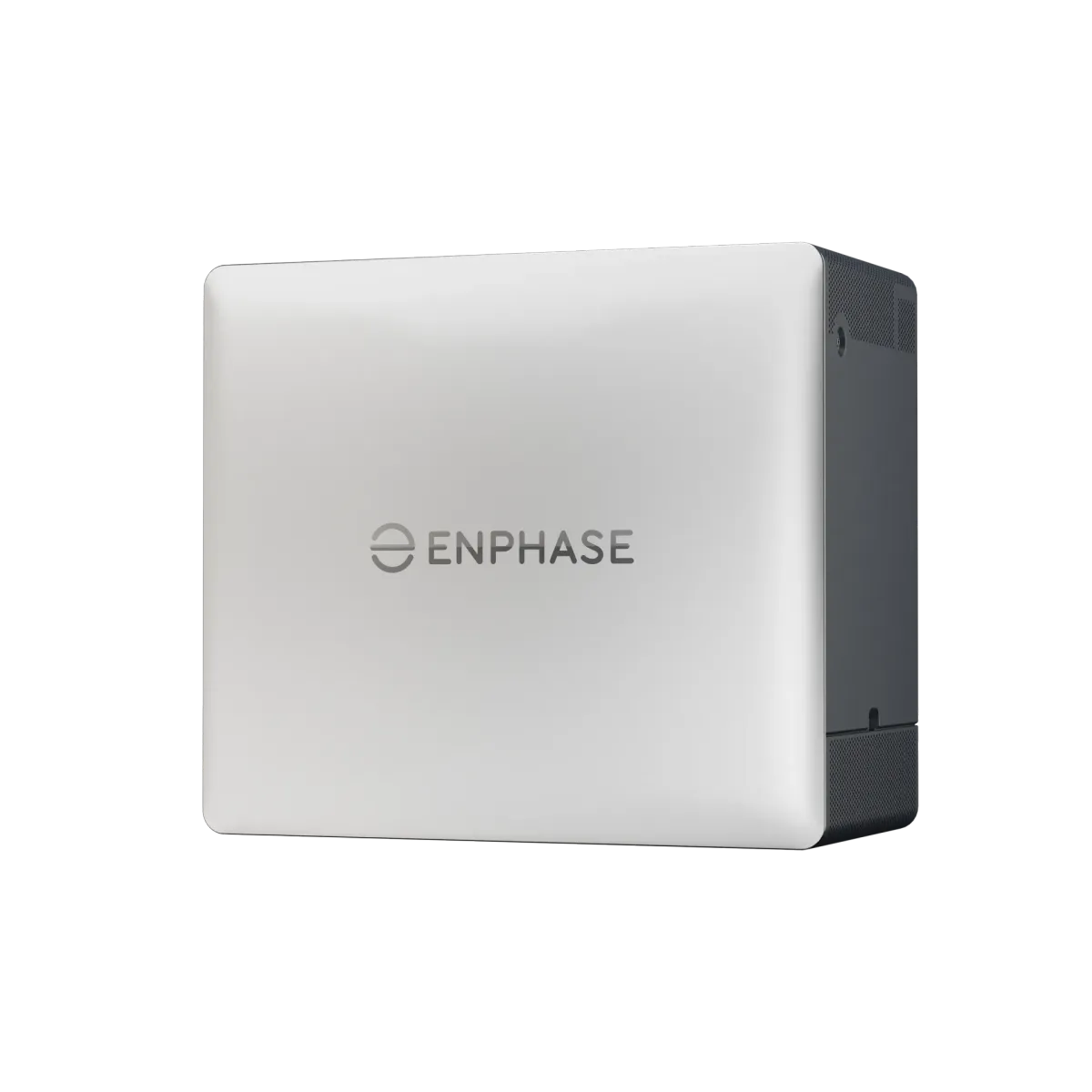
The IQ 10C is Enphase's Gen4 flagship battery. It's heavier than the 5P (310 lbs vs 185 lbs), so we bring a two-person crew. The install is similar to the 5P — wall-mount, connect to IQ System Controller, configure via Enphase app. The 7 kW continuous power is enough to back up essential loads plus a mini-split AC. For whole-home backup, we recommend two 10C units.
The Enphase IQ 10C earns our top pick thanks to its industry-best 15-year / 6,000-cycle warranty, 96% DC efficiency, and compact form factor. If you already have Enphase microinverters (or plan to install them), the 10C is the clear choice. The only drawback is cost — at $1,300/kWh, you're paying a premium for the Enphase ecosystem and warranty.

13.5 kWh
11.5 kW
11.5 kW sustained
$1,140
89%
10 yr
287 lbs
Up to 3 expansion packs
Powerwall 3 has a built-in solar inverter, so it replaces both the battery and inverter in a new solar+storage system — saves $2,000-3,000 vs separate components. Our Tesla-certified crew installs in 4-6 hours. The 11.5 kW continuous output means a single unit can back up the whole house including AC. Expansion packs ($5,900 each) add capacity without another inverter.
The Powerwall 3 is the king of whole-home backup. Its 11.5 kW continuous output means a single unit can power your entire house during an outage — something no other battery can claim. The built-in inverter saves $2,000-3,000 on new solar installs. The 10-year warranty is the weak spot, but Tesla's LFP chemistry should last well beyond that.
15 kWh
10 kW
15 kW
$1,167
89%
15 yr
331 lbs
Up to 15 batteries per aGate
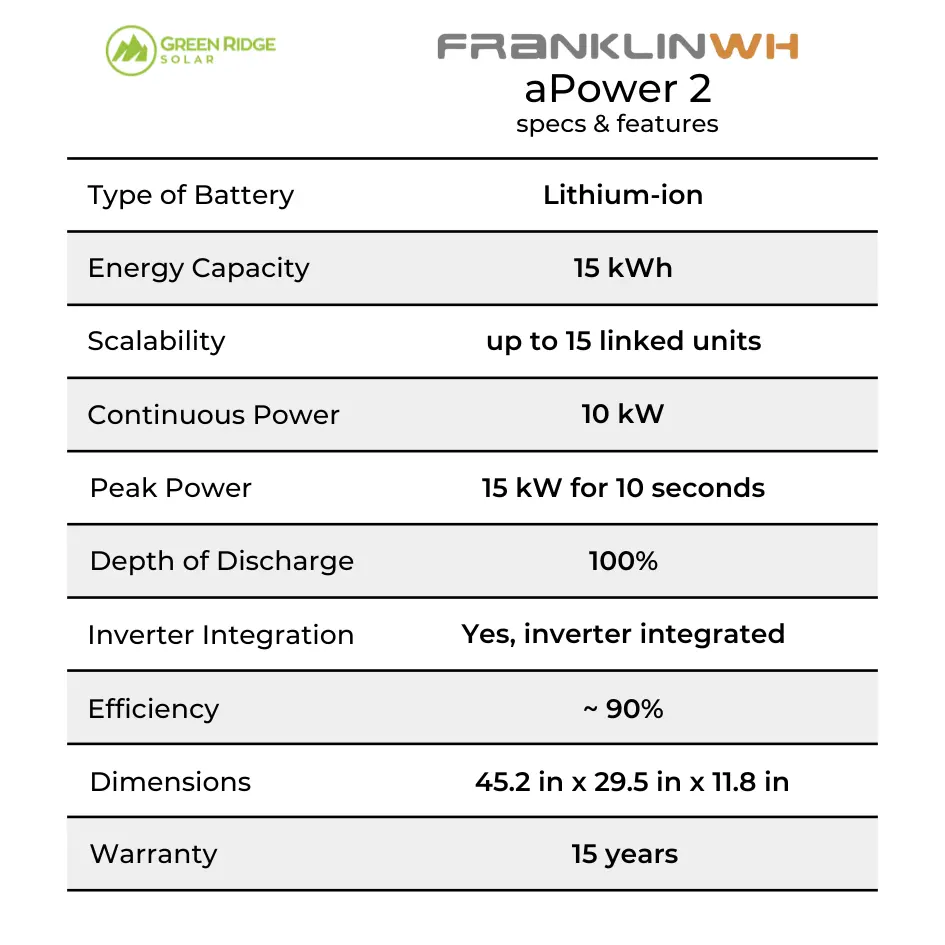
The aPower 2 is our whole-home backup champion. The aGate controller installs next to the main panel and handles automatic load management — it can prioritize circuits and integrate with a generator for extended outages. Total install runs 5-7 hours with a two-person crew. IP67 rating means we can mount it outdoors without a shelter. Best choice when the customer wants to back up everything including central AC and EV charger.
The FranklinWH aPower 2 offers the largest capacity (15 kWh) and most advanced load management of any residential battery. The aGate controller is genuinely impressive — it automatically prioritizes loads and integrates with generators. The downside is price: $17,500 total cost is the highest in our lineup. Worth it if you need maximum backup capability.
5 kWh
3.84 kW
7.68 kW
$1,700
96% DC
15 yr
185 lbs
Up to 16 per system
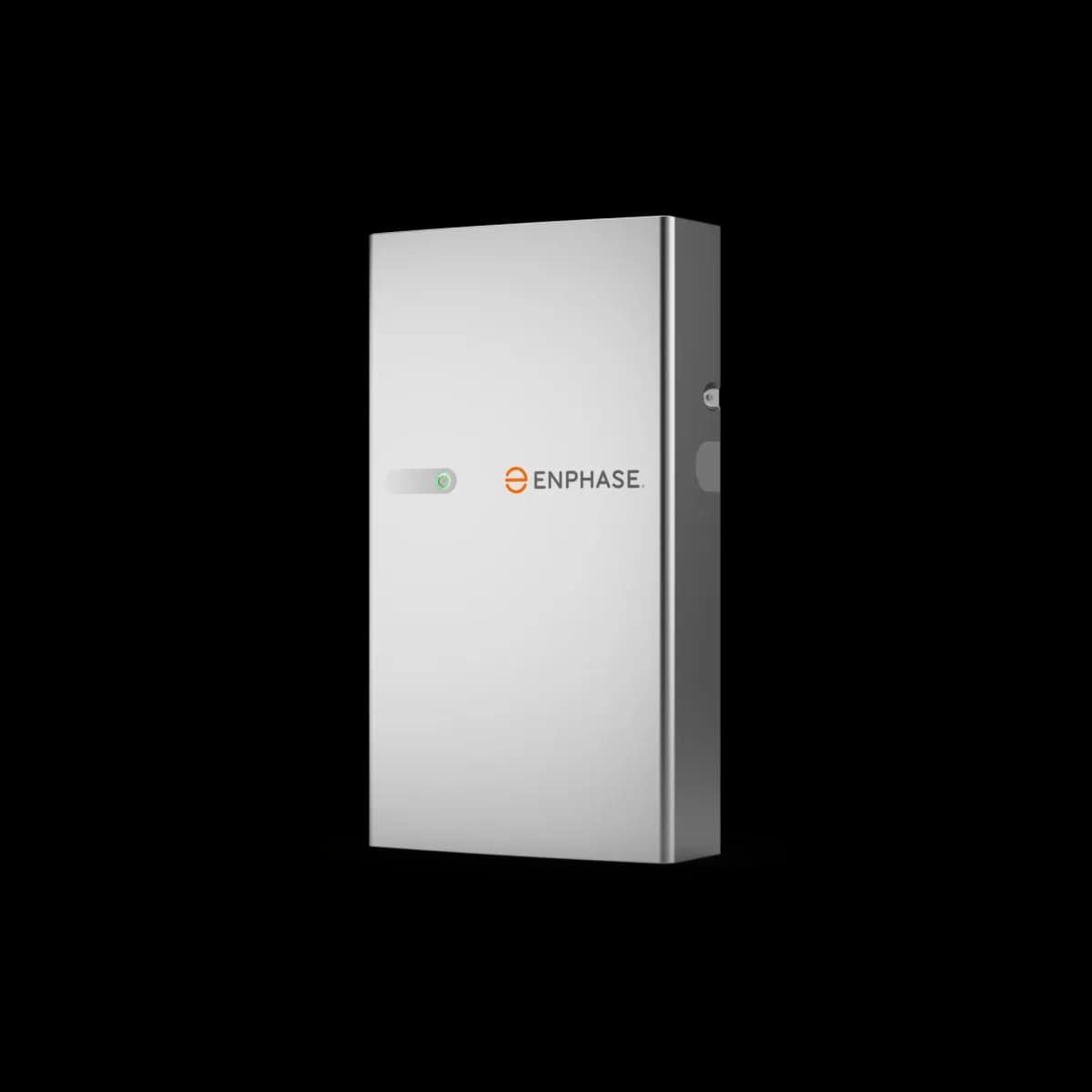
Our crew mounts the IQ 5P on a garage or basement wall in about 3 hours per unit. It pairs directly with the Enphase IQ System Controller — no separate gateway needed. We typically recommend 2-3 units for essential load backup or 4+ for near whole-home coverage. The modular approach means you can start small and add units later without rewiring.
The IQ 5P is the best entry point for battery backup — $8,500 gets you 5 kWh with a 15-year warranty. The modular design lets you start with one unit and add more later. The downsides are cost per kWh ($1,700 — highest in our lineup) and limited power per unit. If you can afford it, the 10C is a better value per kWh.
10 kWh
4.8 kW
8.5 kW
$1,600
91%
10 yr
198 lbs
Up to 3 units
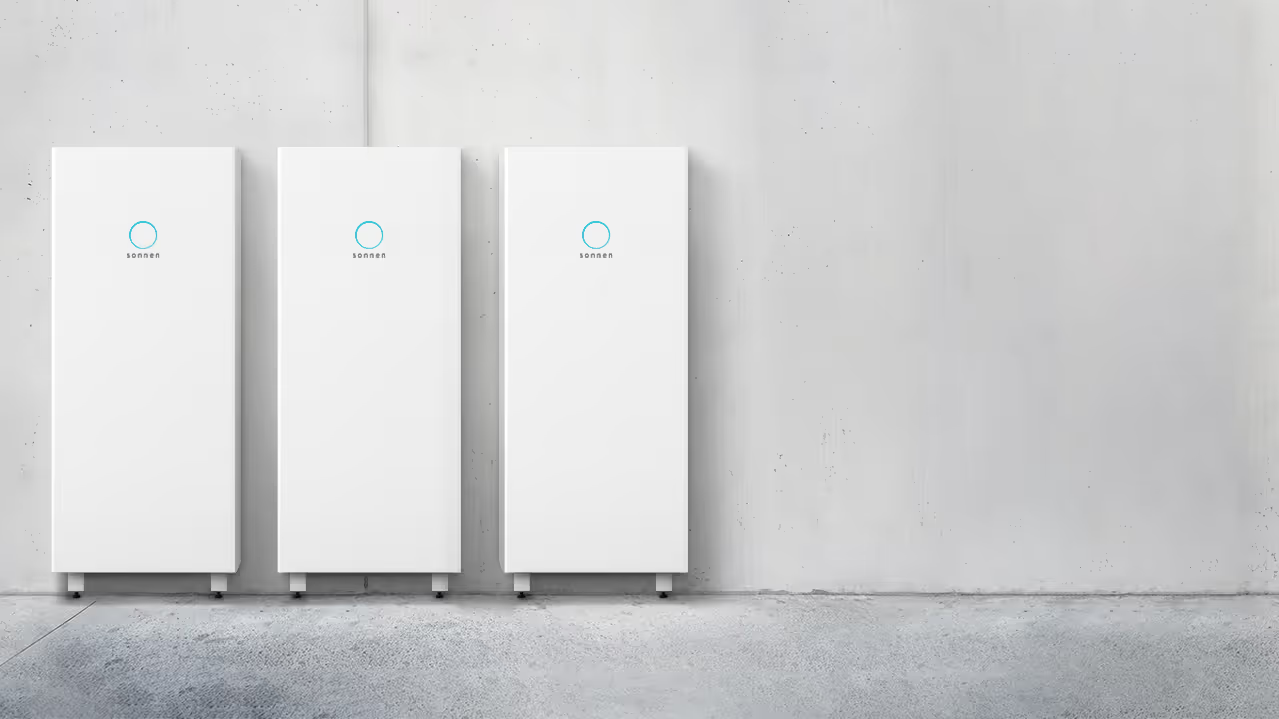
The sonnenCore+ is an all-in-one system — battery, inverter, and energy management in one box. Installs in 3-4 hours with a single crew. It's the lightest battery in our lineup at 198 lbs, making wall mounting straightforward. The TOU optimization mode is excellent for customers on time-of-use rates who want to minimize grid purchases during peak hours.
The sonnenCore+ 10 is a niche pick. Its 10,000-cycle warranty is exceptional, and the TOU optimization modes are the best in the business. But at $1,600/kWh with only 4.8 kW continuous power, it's hard to justify over the Tesla Powerwall 3 or Enphase IQ 10C for most homeowners. Best for TOU-focused customers who cycle their battery daily.
All specs, all prices, all in one table. Every battery uses LFP chemistry.
| Spec | Enphase IQ Battery 10C | Tesla Powerwall 3 | FranklinWH aPower 2 | Enphase IQ Battery 5P | sonnen sonnenCore+ 10 |
|---|---|---|---|---|---|
| NuWatt Rating | 9.5/10 | 9/10 | 9/10 | 8.5/10 | 7.5/10 |
| Price (installed) | $13,000 installed | $15,400 installed | $17,500 installed (with aGate) | $8,500 installed | $16,000 installed |
| Capacity | 10 kWh | 13.5 kWh | 15 kWh | 5 kWh | 10 kWh |
| Continuous Power | 7.08 kW | 11.5 kW | 10 kW | 3.84 kW | 4.8 kW |
| Peak Power | 14.16 kW (10 sec) | 11.5 kW sustained | 15 kW (10 sec) | 7.68 kW (10 sec) | 8.5 kW |
| $/kWh | $1,300 | $1,140 | $1,167 | $1,700 | $1,600 |
| Efficiency | 96% DC / 90% AC | 89% | 89% | 96% DC / 90% AC | 91% |
| Warranty | 15 yr / 6,000 cycles | 10 yr / Unlimited cycles | 15 yr / 60 MWh throughput | 15 yr / 4,000 cycles | 10 yr / 10,000 cycles |
| Weight | 310 lbs (141 kg) | 287 lbs (130 kg) | 331 lbs (150 kg) | 185 lbs (84 kg) | 198 lbs (90 kg) |
| Expandability | Up to 4 units (40 kWh) | Up to 3 expansion packs (+13.5 kWh each) | Up to 15 batteries per aGate (225 kWh) | Up to 16 per system (80 kWh) | Up to 3 units (30 kWh, 14.4 kW) |
| Connectivity | Enphase Envoy + Wi-Fi | Tesla Gateway + Wi-Fi/Cellular | FranklinWH aGate + Wi-Fi/Ethernet | Enphase Envoy + Wi-Fi | Wi-Fi / Ethernet |
| Operating Temp | -15°C to 55°C | -20°C to 50°C | -20°C to 55°C | -15°C to 55°C | -5°C to 45°C |
All prices are fully installed costs including labor, permits, and commissioning. Prices may vary by region and installation complexity.
Let us be honest: batteries extend solar payback periods. But they provide real value beyond simple ROI calculations.
System Cost (8 kW)
$22,000-$28,000
Payback Period
7-10 years
Backup Power
None
System Cost (8 kW + 10 kWh)
$35,000-$41,000
Payback Period
10-14 years
Backup Power
8-12 hours
System Cost (8 kW + 10 kWh)
$35,000-$41,000
Payback Period
8-11 years
DR Revenue (MA/CT/RI)
$1,125-1,375/yr
In Massachusetts, Connecticut, and Rhode Island, utilities pay you to briefly discharge your battery during peak demand events (typically 10-20 events per summer). This demand response revenue can significantly offset battery costs over time.
Example: A 10 kWh Enphase IQ 10C with 7.08 kW power on Eversource MA earns approximately $1,947/year ($275 x 7.08 kW). Over 10 years, that is $19,470 — more than the $13,000 battery cost.
If your utility offers time-of-use rates, you can charge your battery during cheap off-peak hours and discharge during expensive peak hours. The savings depend on the rate differential.
Reality check: TOU arbitrage alone rarely justifies battery cost. At $600/year savings, a $13,000 battery takes 21+ years to pay back from TOU alone. TOU savings are a bonus on top of backup value and DR revenue — not a standalone justification.
With no federal battery credit, state and utility programs are the only incentives left. Here is what is available in our service states.
ConnectedSolutions
$275/kW (Eversource), $225/kW (NGrid)
Annual demand response payments for battery discharge during peak events. A 10 kWh / 5 kW battery earns $1,125-1,375/year.
Grid Edge / ConnectedSolutions
Varies by utility
New 2026 battery demand response program. Eversource CT and UI participating. Payments structure similar to MA.
ConnectedSolutions
$225/kW
RI Energy demand response program. Summer peak events, similar structure to MA. $225/kW annual payment.
GMP Battery Program
Lease or incentive
Green Mountain Power offers battery leasing ($55/mo) or purchase incentives. Unique utility-run program.
No specific battery incentive
NJ does not currently have a dedicated home battery incentive program. ADI/SREC-II applies to solar only.
No specific battery incentive
NH has no state-level battery rebate or demand response payment program.
No specific battery incentive
Maine does not offer a battery-specific incentive. Efficiency Maine rebates apply to heat pumps, not batteries.
No specific battery incentive
TX has no statewide battery incentive. Some municipal utilities (Austin Energy) offer limited DR programs.
No specific battery incentive
PA does not currently offer a state-level battery rebate or demand response incentive.
The right battery size depends on what you want to power during an outage and for how long.
Fridge, lights, Wi-Fi, phone chargers, garage door
Recommended:
Enphase IQ 5P (1 unit) or IQ 10C (1 unit)
Essentials + mini-split AC, sump pump, electric range
Recommended:
Enphase IQ 10C or Tesla Powerwall 3
Everything including central AC, EV charger, well pump
Recommended:
Tesla Powerwall 3 or FranklinWH aPower 2
Total daily kWh of critical loads = sum of all loads you want to power
Hours of backup desired = typically 8-24 hours
Battery size needed = (daily kWh / 24) x hours desired x 1.2 (efficiency buffer)
Example: 15 kWh/day critical loads, 12 hours backup = (15/24) x 12 x 1.2 = 9 kWh minimum battery
Note: If you have solar panels, they recharge the battery during daylight hours, effectively extending backup duration by 50-100% on sunny days.
The Enphase IQ Battery 10C is our top pick for 2026. It offers 10 kWh capacity, 7.08 kW continuous power, 96% DC efficiency, and an industry-leading 15-year / 6,000-cycle warranty — all for $13,000 installed. For whole-home backup, the Tesla Powerwall 3 leads with 11.5 kW continuous power from a single unit.
No. The Section 25D residential ITC expired on December 31, 2025. Homeowners who buy batteries with cash or a loan receive zero federal tax credit in 2026. However, if a battery is included in a third-party-owned lease or PPA system (like Propel), the financing company can claim the Section 48/48E commercial ITC for projects beginning construction before July 4, 2026.
Home batteries in 2026 cost between $8,500 (Enphase IQ 5P, 5 kWh) and $17,500 (FranklinWH aPower 2, 15 kWh) fully installed, with no federal tax credit offset. The cost per kWh ranges from $1,140 (Tesla Powerwall 3) to $1,700 (Enphase IQ 5P). State incentive programs like ConnectedSolutions in MA, CT, and RI can offset $1,000-3,000+ over time through demand response payments.
It depends on your priority. The Tesla Powerwall 3 is better for whole-home backup (11.5 kW continuous vs 7.08 kW) and costs less per kWh ($1,140 vs $1,300). The Enphase IQ 10C is better for longevity (15-year/6,000-cycle warranty vs 10-year), efficiency (96% DC vs 89%), and Enphase ecosystem integration. If you have Enphase microinverters, go with the 10C. If you need maximum backup power, go with the Powerwall 3.
For essential loads only (fridge, lights, Wi-Fi, phone chargers): 5-10 kWh. For essential loads plus some comfort (add a mini-split or window AC): 10-15 kWh. For whole-home backup including central AC: 13.5-15+ kWh. Most homeowners use 25-30 kWh per day total, so a 10-13.5 kWh battery covers 8-12 hours of essential loads during an outage.
It depends on your goals. Batteries rarely pay for themselves through energy savings alone — they typically extend solar payback by 3-5 years. However, they provide real value through backup power during outages, demand response revenue (ConnectedSolutions pays $225-275/kW annually in MA), and TOU arbitrage in states with time-of-use rates. If you experience frequent outages or want energy independence, the peace-of-mind value can justify the cost.
ConnectedSolutions is a demand response program in MA, CT, and RI. Utilities pay you $225-275 per kW of battery capacity annually to briefly draw on your battery during peak demand events (typically summer afternoons). A 10 kWh battery with 5 kW power output earns roughly $1,125-1,375 per year. Over 10 years, that is $11,000-13,000+ — enough to offset a significant portion of the battery cost.
Yes — all five batteries in our 2026 lineup use LFP (Lithium Iron Phosphate) chemistry. LFP is safer than older NMC (Nickel Manganese Cobalt) chemistry, with virtually zero fire risk and longer cycle life. The entire residential battery industry has shifted to LFP as of 2025-2026.
Yes, but compatibility depends on your inverter. Enphase batteries require Enphase microinverters and an IQ System Controller. Tesla Powerwall 3 has a built-in inverter and can pair with most solar systems. FranklinWH aPower 2 works with any inverter brand through its aGate controller. The sonnenCore+ 10 also has a built-in inverter. Retrofit installations typically cost $500-1,500 more than new solar+battery installs.
Modern LFP home batteries last 15-25 years in real-world use. Warranty terms range from 10 years (Tesla, sonnen) to 15 years (Enphase, FranklinWH). Cycle count warranties range from 4,000 (Enphase 5P) to 10,000 (sonnen). A typical home battery cycles once per day, so 10,000 cycles equals roughly 27 years of daily use. All batteries in our lineup retain at least 60-70% capacity at end of warranty.
Our team will help you choose the right battery, size it for your loads, and find every available state incentive. Free site assessment, no pressure, no gimmicks.
We install Tesla Powerwall 3, Enphase IQ 5P/10C, FranklinWH aPower 2, and sonnenCore+ 10 across MA, CT, RI, NH, ME, NJ, TX, and PA.
Compare Propel lease (with ITC pass-through) vs solar loans (no ITC) after the residential credit expired.
Read GuideHow to get solar in 2026 without the residential ITC. Third-party ownership, state programs, and more.
Read GuideHow batteries perform in cold weather and what to expect for winter backup in the Northeast.
Read Guide