Loading NuWatt Energy...

We use your location to provide localized solar offers and incentives.
We serve MA, NH, CT, RI, ME, VT, NJ, PA, and TX
Loading NuWatt Energy...
NuWatt designs, installs, and manages solar, battery, heat pump, and EV charger systems across 9 states. One company, one warranty, one point of contact.
Get a Free QuoteThe residential solar tax credit (Section 25D) expired December 31, 2025. That single change made solar loans 25-30% more expensive overnight. The financing structure you choose now determines everything — your monthly payment, when you own the system, and your total cost over 25 years.
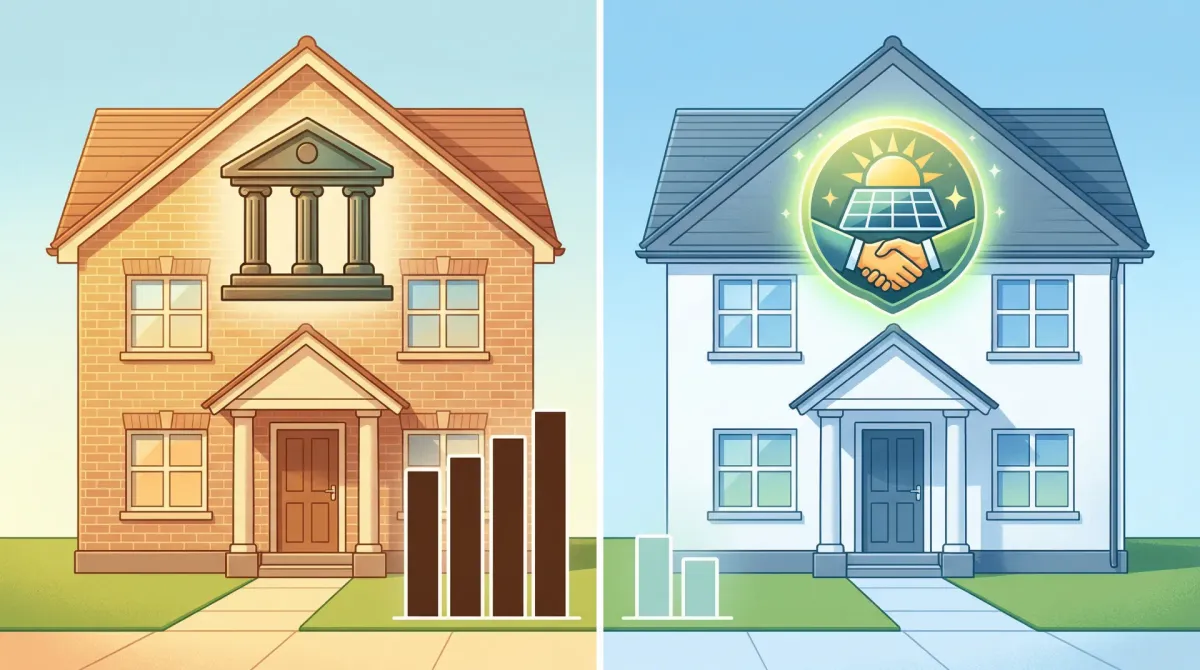
For almost 20 years, the financing decision was simple: get a solar loan, claim the 30% ITC on your taxes, and use that refund to pay down the principal. The effective cost dropped by nearly a third. That calculus is gone.
Solar loan + 30% ITC = low net cost
$27,000 system became ~$18,900 after the credit
Monthly payment: ~$133/mo (25yr at 5%)
The ITC made loans the obvious choice for most homeowners.
Solar loan + $0 ITC = full cost
$27,000 system stays $27,000 — no tax credit reduction
Monthly payment: ~$190/mo (25yr at 7%)
Loans now have 25-30% higher effective payments.
This is why Propel exists
Propel captures the ITC through a third-party commercial structure (Section 48) and passes the savings to you. The 30% discount does not disappear — it is redirected. Instead of you claiming it on your personal taxes, a financing company claims it and reduces your financed amount by 25-30%.
Every meaningful difference between a traditional solar loan and Propel hybrid financing in 2026 — side by side.
| Feature | Solar Loan | Propel |
|---|---|---|
| Upfront cost | $0 (financed) | $0 |
| Federal ITC benefit | $0 (25D expired) | 30% via Section 48 |
| System cost (ME, 9 kW) | $28,300 (you pay full) | ~$19,800 effective (after ~30% ITC pass-through) |
| System cost (TX, 10 kW) | $29,000 (you pay full) | ~$20,300 effective (after ~30% ITC pass-through) |
| Monthly payment (ME, 9 kW) | ~$230-250/mo | ~$184/mo |
| Monthly payment (TX, 10 kW) | ~$190-210/mo | ~$135/mo |
| Payment changes | Fixed (loan rate) | Fixed |
| Ownership timeline | Day 1 | Year 5 |
| Interest rate | 6-9% (2026 market) | Built into Propel factor |
| Dealer fees | Often 20-30% hidden | None |
| Credit requirement | 680+ typical | 660+ |
| Panels | Installer's choice | Silfab 440W (FEOC) |
| Maintenance | Homeowner responsibility | Free during lease period |
| Home value impact | +$20 per $1 saved | +$20 per $1 saved (after yr 5) |
Upfront cost
SOLAR LOAN
$0 (financed)
PROPEL
$0
Federal ITC benefit
SOLAR LOAN
$0 (25D expired)
PROPEL
30% via Section 48
System cost (ME, 9 kW)
SOLAR LOAN
$28,300 (you pay full)
PROPEL
~$19,800 effective (after ~30% ITC pass-through)
System cost (TX, 10 kW)
SOLAR LOAN
$29,000 (you pay full)
PROPEL
~$20,300 effective (after ~30% ITC pass-through)
Monthly payment (ME, 9 kW)
SOLAR LOAN
~$230-250/mo
PROPEL
~$184/mo
Monthly payment (TX, 10 kW)
SOLAR LOAN
~$190-210/mo
PROPEL
~$135/mo
Payment changes
SOLAR LOAN
Fixed (loan rate)
PROPEL
Fixed
Ownership timeline
SOLAR LOAN
Day 1
PROPEL
Year 5
Interest rate
SOLAR LOAN
6-9% (2026 market)
PROPEL
Built into Propel factor
Dealer fees
SOLAR LOAN
Often 20-30% hidden
PROPEL
None
Credit requirement
SOLAR LOAN
680+ typical
PROPEL
660+
Panels
SOLAR LOAN
Installer's choice
PROPEL
Silfab 440W (FEOC)
Maintenance
SOLAR LOAN
Homeowner responsibility
PROPEL
Free during lease period
Home value impact
SOLAR LOAN
+$20 per $1 saved
PROPEL
+$20 per $1 saved (after yr 5)
The summary
Propel wins on monthly payment (by 20-35%), credit flexibility, dealer fees, and maintenance. Solar loans win on immediate ownership. Everything else is a tie or context-dependent. The right choice depends on your state, credit score, and how much you value day-1 ownership vs. lower payments.
Solar loans are not dead in 2026 — they are just harder to justify financially without the ITC. Here are the scenarios where a loan is still the right call:
At 4.5% or below, a solar loan payment is competitive with Propel — and you own the system from day 1. At 6-9%, the math strongly favors Propel.
Some homeowners prefer outright ownership from the start. With a loan, the system is yours on installation day — no 5-year transfer period.
Without the ITC reducing your financed amount, loan payments are 25-30% higher than they were in 2025. If that difference is comfortable, a loan works.
States like Massachusetts (SMART: $0.03/kWh for 20 years) or New Jersey (ADI: $85.00/MWh for 15 years) partially compensate for the lost ITC through ongoing payments.
Propel is currently available in Maine and Texas only. If you are in MA, CT, RI, NH, NJ, or another state, a solar loan is one of your primary financing options.
Propel was designed for the post-ITC world. It captures the commercial tax credit and passes it to homeowners through a hybrid ownership structure. Here is who it works best for:
Propel is currently available in these two states. NuWatt has partnered with Concert Finance to offer the hybrid ownership structure here.
Because Propel captures the 30% ITC through Section 48 and passes it to you, your financed amount is roughly 25-30% lower than a traditional loan for the same system.
With Section 25D dead, the only way for a homeowner to benefit from the ITC is through a third-party ownership structure like Propel.
Propel has zero dealer fees. The pricing is transparent — the Propel factor (0.701 in ME, 0.749 in TX) is the mechanism. No inflated system cost.
Full ownership transfers to you at year 5, not day 1. For the first 5 years, Concert Finance technically owns the system. You still get all the energy savings.
Propel requires a 660+ credit score. Traditional solar loans typically need 680+ and offer their best rates only above 720. If your credit is in the 660-720 range, Propel may be your only competitive option.
When the 30% ITC existed, dealer fees were annoying but tolerable — the tax credit offset most of the damage. Without the ITC, dealer fees are exposed as one of the most expensive hidden costs in residential solar.

Many solar companies offer “0% interest” or “1.99% interest” loans. These rates are real — but they come with a 20-30% dealer fee that is added to your financed amount.
A $27,000 system with a 25% dealer fee becomes $33,750on your loan — but the company advertises it as “0% interest.”
That inflated $33,750 at 0% over 25 years is $112.50/mo. The real $27,000 at 0% would be $90/mo. You are paying $22.50 extra per month for 25 years — $6,750 in hidden fees.
Propel has no dealer fees
The Propel factor is the pricing mechanism. In Maine, the factor is 0.701 — you finance 70.1% of the system cost. In Texas, 0.749 — you finance 74.9%. There is no inflated system price, no hidden fee, no second layer of cost. The discount comes from the ITC, not from fee manipulation.
“Ask any solar loan company: what is the dealer fee?”
If they will not answer, that is your answer. A reputable solar lender will disclose the dealer fee upfront. If the total financed amount on your loan agreement is higher than the system cost on your installation contract, the difference is the dealer fee.
Before January 2026, buying solar outright (cash or loan) was the gold standard. You owned the system, you claimed the 30% ITC on your personal taxes, and the effective cost dropped by nearly a third. That math no longer works.
Section 25D (residential ITC) is dead. If you buy a system with cash or a loan, there is no federal tax credit to claim. You pay 100% of the system cost.
Section 48 (commercial ITC) is still alive — but only a business entity can claim it. A homeowner cannot. This is the gap that Propel's hybrid ownership structure bridges: Concert Finance (the third-party owner) claims the ~30% ITC on your system and passes the savings to you as a lower financed amount.
The result:A cash or loan buyer in 2026 pays the full system price. A Propel buyer's effective cost is ~30% lower for the same panels, same inverter, same installation — because the ITC still exists, just not for individuals.
| Scenario | System Cost | ITC Benefit | Effective Cost |
|---|---|---|---|
| Cash / Loan (2025, with 25D) | $28,000 | -$8,400 | $19,600 |
| Cash / Loan (2026, no 25D) | $28,000 | $0 | $28,000 |
| Propel (2026, via Section 48) | $28,000 | ~-$8,400 | ~$19,600 |
Illustrative example. Actual ITC pass-through varies by state (ME factor: 0.701, TX factor: 0.749) and includes FEOC domestic content bonus where applicable.
Here is exactly how the math works in each Propel state, using actual system pricing from Concert Finance's hybrid ownership model.
Silfab 440W (FEOC), ERCOT territory
CASH / LOAN (NO ITC)
$29,000
you pay full price
PROPEL (VIA SECTION 48)
~$20,300
effective cost
Key insight: A TX homeowner buying cash or with a loan pays $29,000 — the full system price with zero ITC. Through Propel, Concert Finance claims the ~30% Section 48 ITC and passes the savings to the homeowner, reducing the effective cost to ~$20,300.
Silfab 440W (FEOC), CMP territory
CASH / LOAN (NO ITC)
$28,300
you pay full price
PROPEL (VIA SECTION 48)
~$19,800
effective cost
Key insight:Maine's lower Propel factor (0.701 vs. TX's 0.749) means a larger effective discount. A ME homeowner's $28,300 system costs ~$19,800 through Propel — saving $8,500 compared to a cash purchase or loan where no ITC is available.
Concert owns the system
For the first 5 years, Concert Finance (the third-party entity) is the legal owner of the solar system on your roof.
Concert claims the ~30% ITC
As a commercial entity, Concert claims the Section 48 ITC (including FEOC domestic content bonus) — something a homeowner cannot do in 2026.
You get the lower price
Concert passes the ITC savings to you via the Propel factor — reducing your financed amount by ~25-30%. At year 5, full ownership transfers to you.
System prices reflect NuWatt pricing with Silfab 440W (FEOC-compliant) panels. Loan estimates assume 7% APR, 25-year term, no dealer fee. With a 25% dealer fee, loan payments would be ~$60-75/mo higher. Propel payments use actual Concert Finance factor pricing.
Based on a $40,000 solar system — the most common size for Propel customers. These examples break out the base ITC and domestic content bonus separately.
$40,000 System — Silfab 440W (FEOC)
Energy-community-eligible projects may see additional savings of up to $4,000, bringing effective cost to ~$20,000.
PROPEL PAYMENT
~$160/mo
STANDARD LOAN
~$245/mo
Texas note: No state income tax. 100% property tax exemption statewide for solar installations.
$40,000 System — Silfab 440W (FEOC)
Energy-community-eligible projects may see additional savings of up to $4,000, bringing effective cost to ~$20,000.
PROPEL PAYMENT
~$184/mo
STANDARD LOAN
~$260/mo
Maine note: 1:1 net energy billing at full retail rate. 100% property tax exemption statewide for solar installations.
Savings estimates based on Concert Finance Propel program examples. Actual savings depend on system size, credit tier, and location-specific eligibility. Energy community and domestic content bonuses are project-specific — verified during consultation.
The Section 48 commercial ITC — the mechanism that makes Propel work — remains available. Its begin-construction safe harbor closed July 4, 2026; projects that began construction on or before that date locked in the longer timing pathway, and new starts generally must be placed in service by December 31, 2027.
Solar loans never tapped this commercial ITC — a homeowner loan gets $0 federal credit in 2026 or 2027, so waiting does not improve the loan economics.
If you are considering Propel, start by May 2026 at the latest. Design, permitting, and safe-harbor documentation take time.
In Maine and Texas, Propel typically offers a lower monthly payment because it captures the 30% ITC through Section 48. Solar loans no longer have this benefit since the residential ITC (Section 25D) expired on December 31, 2025. For homeowners in other states where Propel is not yet available, a solar loan remains a viable option — but without the ITC, payments are 25-30% higher than they were in 2025.
Yes. Solar loans are still widely available in 2026. However, your monthly payment will be 25-30% higher than it would have been in 2025 because there is no 30% ITC to reduce the financed amount. A $27,000 system financed over 25 years at 7% is about $190/month — compared to roughly $133/month when the ITC reduced the balance to $18,900.
A dealer fee is a percentage added to your financed amount by the solar lender to compensate the installer. On many "0% interest" or "low interest" solar loans, the dealer fee can be 20-30% of the system cost. So a $27,000 system might become $35,000 on your loan. The interest rate looks low, but you are financing a significantly inflated amount. Propel has zero dealer fees.
Full ownership transfers to you at year 5. For the first 5 years, Concert Finance (the third-party financing company) technically owns the system and claims the Section 48 ITC. During this period, you make fixed monthly payments and receive all the energy your system produces. At year 5, the ownership transfers and you own the system outright for its remaining 20+ years of useful life.
In non-Propel states, your primary options are a solar loan (you own, no ITC), a solar lease/PPA (third-party owns, they get ITC, you pay monthly), or a cash purchase. Each state also has its own incentives — SMART in Massachusetts, ADI in New Jersey, REF in Rhode Island — that can significantly reduce costs regardless of financing method. See our state-specific guides for detailed breakdowns.
Propel is available in Maine and Texas. For all other states, use our instant quote tool to see your solar cost and financing options.
Solar Tax Credit Alternative 2026
How to still get the 30% discount after the ITC expired.
The Solar PPA Escalator Trap
Why lease and PPA payments go up every year — and how to avoid it.
Cash vs Loan vs Lease vs PPA
Full financing comparison with payback timelines.
Maine Propel Solar
Maine-specific Propel pricing, system design, and savings.
Texas Propel Solar
Texas Propel pricing for ERCOT territory.
Solar Buyers Guide Hub
All data-backed articles for solar buyers in 2026.