Loading NuWatt Energy...

We use your location to provide localized solar offers and incentives.
We serve MA, NH, CT, RI, ME, VT, NJ, PA, and TX
Loading NuWatt Energy...
NuWatt designs, installs, and manages solar, battery, heat pump, and EV charger systems across 9 states. One company, one warranty, one point of contact.
Get a Free QuoteCommunity solar promises savings without rooftop panels. But delayed credits, rate mismatches, and confusing dual billing mean many subscribers are paying more than they would on the grid alone. Here is how to check your actual numbers.
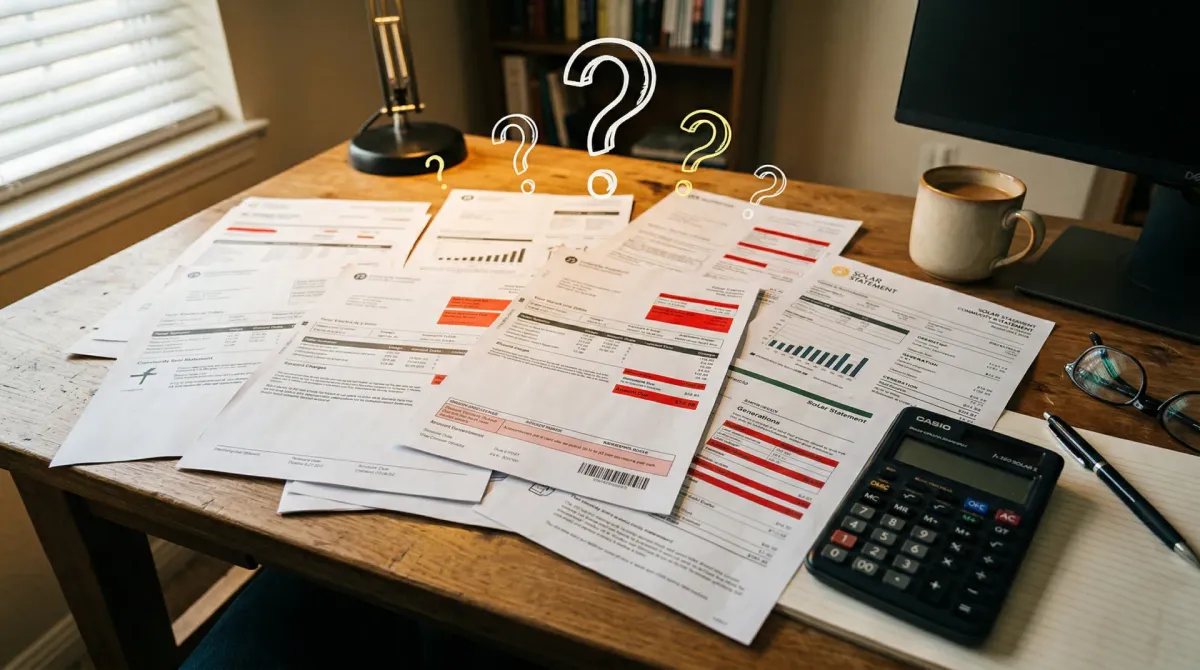
Community solar (also called shared solar or solar gardens) lets you subscribe to a portion of a large off-site solar farm. The farm generates electricity, your utility credits your bill for your share of that generation, and you pay the community solar provider a subscription fee — typically 5-10% less than your full utility rate. In theory, you save money without putting panels on your roof.
Renters, condo owners, and homeowners with shaded or unsuitable roofs. If you cannot install rooftop panels, community solar is one way to access solar energy.
You receive two bills: your regular utility bill (minus credits) and a separate community solar subscription bill. The difference between the credit and your subscription fee is your savings — or your loss.
Save 5-10% on electricity with no installation, no roof requirements, and no upfront cost. That is the marketing pitch. The reality, as we will show, is more complicated.
Community solar adds a layer of financial complexity between you and your electricity savings. Unlike rooftop solar — where your panels generate electricity that directly offsets your meter — community solar relies on credit calculations, third-party billing, and utility reconciliation processes that can introduce errors, delays, and unexpected costs.
These issues are not rare edge cases. They are documented in state Public Advocate reports, consumer complaints filed with utility commissions, and industry analyses from organizations like HeatSpring. If you are a community solar subscriber, check whether any of these apply to your situation.
Community solar credits often arrive 1-3 billing cycles after the energy was generated. You pay full price to your utility in January, but the credit from January generation does not appear until March or April. During high-usage months, this delay means hundreds of dollars in out-of-pocket costs before you see any offset.
You pay a subscription fee to the community solar company (typically 90-95% of the credit value), but the credit itself is calculated at the utility's avoided cost rate — not the full retail rate. When utilities lower their avoided cost rate, your credit shrinks while your subscription fee stays the same. The promised 5-10% savings can vanish or go negative.
Utility rate structures change. When your state restructures net metering or community solar billing credits (as Maine did with LD 1777), your expected savings can drop significantly mid-contract. You signed up based on one set of economics, and the rules changed underneath you.
You now receive two bills instead of one: your regular utility bill and a separate invoice from the community solar provider. Reconciling credits between the two is confusing. Many subscribers do not realize they are paying more in total until they sit down and compare line items — which most never do.
Many community solar contracts lock you in for 12-25 months. If the economics stop working in your favor, you cannot simply cancel. Early termination fees range from $100 to $500 or more depending on the provider and contract length. Moving to a new address outside the service territory triggers the same penalties.
Maine provides the most well-documented example of community solar billing problems in the United States. The state's Public Advocate investigated community solar billing and the findings were troubling.
| Metric | Before LD 1777 | After LD 1777 |
|---|---|---|
| Credit rate | 1:1 retail (~$0.27/kWh) | Below retail (varies by project) |
| Subscription fee | ~90% of credit value | ~90% of credit value (unchanged) |
| Net savings | 5-10% of electricity cost | 0% to negative (some subscribers pay more) |
| Rooftop solar credit | 1:1 NEB (unchanged) | 1:1 NEB (still full retail) |
Source: Maine Public Advocate reports, PUC docket analysis. Rooftop solar (NEB) credits remain at 1:1 retail rate and were not affected by LD 1777.
Most community solar subscribers never do this math. It takes about 20 minutes and 12 months of billing data. Here is the step-by-step process.
Log into your utility account and download 12 months of billing statements. Look for the line items showing community solar credits received. Write down the total amount paid to your utility each month (after credits).
Collect every invoice from your community solar provider over the same 12-month period. Write down the total amount paid to the community solar company each month.
Total annual cost = Utility payments + Community solar payments. This is what you actually spent on electricity over the last 12 months.
Call your utility or check your account for your total kWh usage over the same 12 months. Multiply by your current retail rate (e.g., $0.27/kWh in Maine). This is what you would have paid without community solar.
If your total cost with community solar is higher than your utility-only cost, you are losing money. Even if the difference is small, remember: you are paying two companies, managing two billing relationships, and owning nothing — all for a 0-5% savings at best.
Without community solar
8,400 kWh/year x $0.27/kWh = $2,268/year
One bill. Simple.
With community solar (post LD 1777)
Utility bill (after credits): $1,400/year
Community solar subscription: $960/year
Total: $2,360/year
Net loss: $92/year. Two bills. No ownership.
If your roof is suitable for solar panels, here is how the two options compare across the eight factors that matter most to your finances and peace of mind.
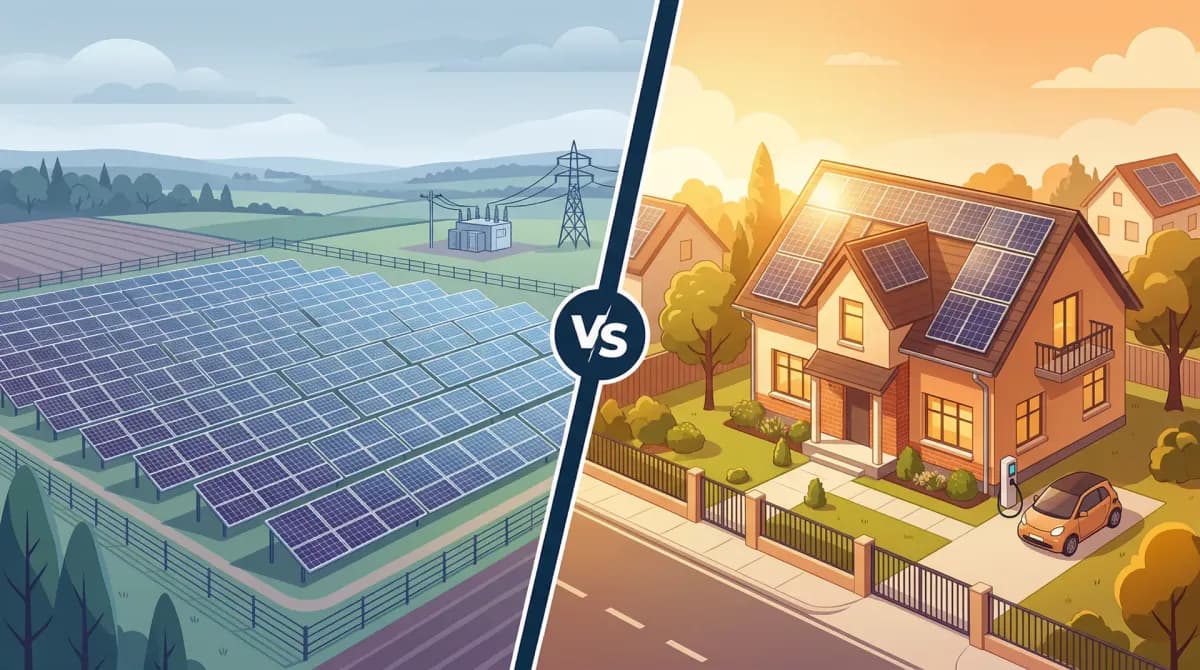
| Factor | Community Solar | Rooftop Solar |
|---|---|---|
| Ownership | Never — third-party owns the farm | You own the system on your roof |
| Billing clarity | Two bills, delayed credits, reconciliation needed | One bill — net metering credit appears same cycle |
| Home value impact | $0 — panels are not on your property | +$15K-$25K (Zillow/NREL data) |
| Savings reliability | Depends on credit rate, utility policy, and farm output | Predictable — your panels, your meter, your savings |
| Savings certainty | Variable — credit rate can change mid-contract | Fixed if owned — your production offsets your bill directly |
| Contract flexibility | 12-25 month lock-in, cancellation fees | No contract — you own the system |
| Credit visibility | Delayed 1-3 billing cycles, hard to verify | Real-time monitoring, same-cycle net metering |
| Equity growth | Zero — subscription-based service | Builds equity from day one; fully paid off in 5-15 years |
Community solar is not inherently bad. It is the right choice for renters, condo owners, and homeowners with heavily shaded or structurally unsuitable roofs. If you physically cannot put panels on your roof, community solar is one of your only options for accessing solar energy. The key is to monitor your bills closely and ensure the math still works in your favor.
If your roof qualifies — good sun exposure, 10+ years of remaining life, sufficient space — rooftop solar eliminates every billing problem described above. One bill, same-cycle credits, full ownership, and no third-party subscription fees.
Key advantage: Maine rooftop solar still receives 1:1 NEB credits at the full retail rate. Unlike community solar, your credits were not reduced by LD 1777. Propel gives you $0 down, a fixed payment, and ownership by year 5.
Key advantage: Texas has limited community solar options and a deregulated market where retail rates fluctuate. Rooftop solar with a fixed Propel payment removes rate uncertainty entirely. $0 down, ownership by year 5.
Even without Propel financing, rooftop solar through a traditional cash purchase or solar loan is typically a better long-term investment than community solar if your roof qualifies. You own the system, benefit from direct net metering credits, and add real value to your home.
Get a free rooftop solar quotePropel is a hybrid financing structure. A third-party owner purchases and installs the system on your roof, capturing the 30% Section 48 commercial ITC (the residential 25D credit expired December 31, 2025, so homeowners can no longer claim any federal solar credit on a cash or loan purchase). That ITC savings is passed through to you as a lower, fixed monthly payment. Full ownership transfers to you around year 5. No escalators, no subscription fees, no dual billing.
Community solar means two bills, delayed credits, and zero ownership. Rooftop solar means one bill, same-cycle credits, and a system you own. If your roof qualifies, the choice is clear. Check your options in 60 seconds.