Loading NuWatt Energy...

We use your location to provide localized solar offers and incentives.
We serve MA, NH, CT, RI, ME, VT, NJ, PA, and TX
Loading NuWatt Energy...
NuWatt designs, installs, and manages solar, battery, heat pump, and EV charger systems across 9 states. One company, one warranty, one point of contact.
Get a Free Quote$0 upfront through PPAs, demand charge reduction, STEM curriculum integration, and long-term operational savings for school budgets. Here is how schools are going solar in 2026.
Quick Answer
Most schools go solar through a Power Purchase Agreement (PPA) — paying $0 upfront while a third-party developer installs and owns the system. The developer claims the Section 48E ITC (30%+; projects that began construction by July 4, 2026 got the widest timing flexibility), and the school buys electricity at 15-30% below retail rates. Typical savings range from $25,000 to $250,000+ per year depending on school size.
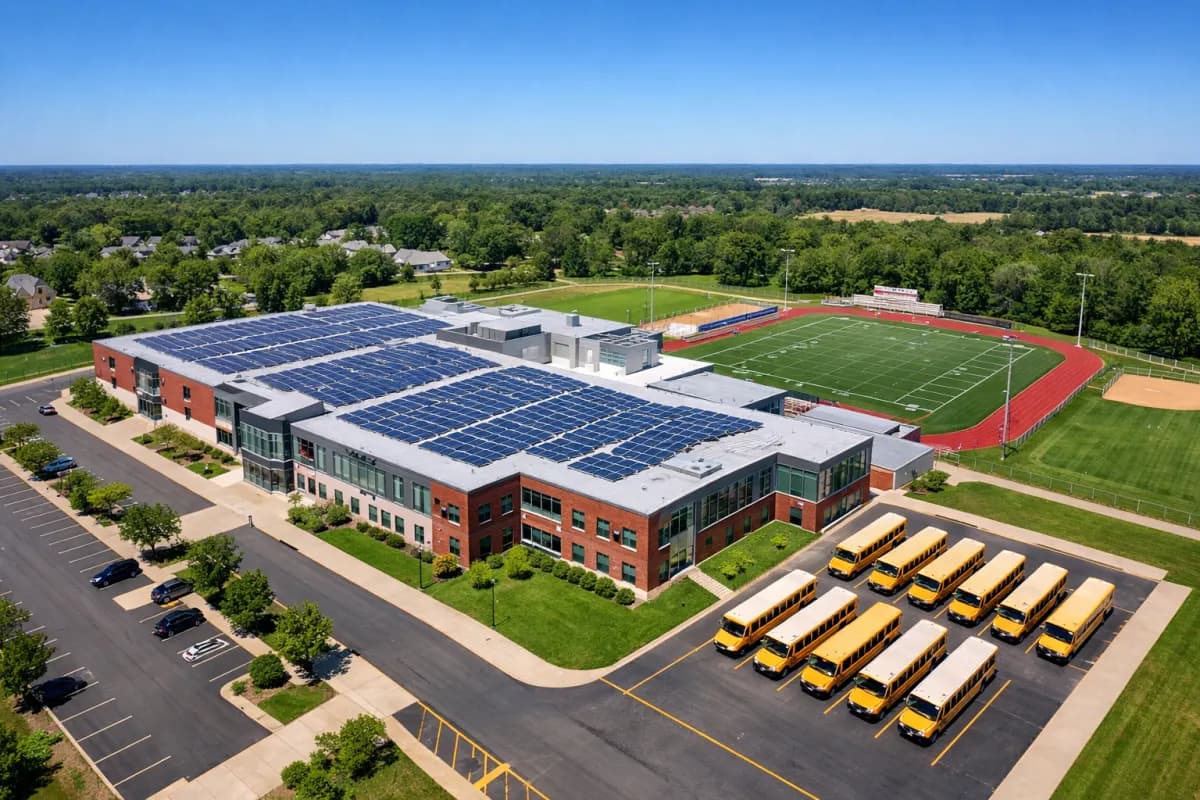
Schools have characteristics that make them uniquely well-suited for solar energy — large roofs, high daytime consumption, and strong community support.
School buildings typically have expansive flat roofs with minimal obstructions — ideal for solar panel installation. A single high school roof can accommodate 500 kW to 1 MW of solar capacity.
Schools consume the most electricity during daytime hours (lighting, HVAC, computers) — exactly when solar panels produce the most power. This alignment maximizes self-consumption and demand charge reduction.
Energy costs are typically the second-largest operating expense for schools after staffing. Every dollar saved on electricity can go toward teachers, programs, and resources that directly benefit students.
Solar panels produce the most electricity during summer — when school is empty. Net metering credits from summer overproduction offset higher fall and winter usage, providing year-round savings.
Solar installations double as living laboratories. Real-time energy monitoring dashboards, data analysis projects, and engineering design challenges connect classroom learning to real infrastructure.
School solar installations are visible sustainability commitments that build community pride. They demonstrate environmental stewardship and fiscal responsibility to taxpayers, parents, and students alike.
Public schools and nonprofit educational institutions cannot claim tax credits directly. But they still benefit — through the PPA structure. Here is how it works.
A third-party developer finances and installs the solar system on school property. The developer, not the school, owns the equipment.
As the system owner, the developer claims the Section 48E Investment Tax Credit — 30% base, up to 50%+ with adders for domestic content (10%) and energy community (10%).
The tax credit reduces the developer's cost, which they pass through as a lower PPA rate to the school. The school pays 15-30% less than retail for 20-25 years.
July 4, 2026 was a begin-construction safe-harbor date, not an expiration. Projects that began construction on or before July 4, 2026 locked in the full Section 48E timing pathway and can be placed in service through roughly 2030. Projects that begin construction after that date still qualify for the 30% credit, but generally must be placed in service by December 31, 2027. "Begin construction" means either starting physical work of a significant nature or incurring 5%+ of total project costs. Schools planning solar should engage a developer early to choose the pathway that best fits their timeline.
System size depends on building square footage, HVAC type, occupancy hours, and available roof/land area. These ranges cover typical installations across the Northeast.
| School Type | Building Size | Annual kWh | System Size | Est. Cost | Annual Savings |
|---|---|---|---|---|---|
| Elementary School | 50,000-80,000 sq ft | 200,000-400,000 | 100-250 kW | $180,000-$500,000 | $25,000-$60,000 |
| Middle School | 80,000-150,000 sq ft | 400,000-800,000 | 250-500 kW | $400,000-$900,000 | $50,000-$120,000 |
| High School | 150,000-300,000 sq ft | 800,000-1,500,000 | 500 kW-1 MW | $750,000-$1,800,000 | $100,000-$250,000 |
| University Campus | 500,000+ sq ft | 2,000,000-10,000,000 | 1-5 MW | $1.5M-$7.5M | $250,000-$1,200,000 |
Cost estimates based on commercial solar pricing of $1.40-$1.80/W for rooftop systems. Savings based on $0.20-$0.28/kWh commercial rates. PPA schools pay $0 upfront.
The right financing structure depends on whether the school can use tax credits (private schools) or needs a third-party owner (public schools).
Best for: Public schools, districts with no tax liability
The most popular option for public schools. A third-party developer finances, installs, and maintains the system. The developer (not the school) claims the Section 48E ITC.
Best for: Schools that want simplicity and predictable costs
Similar to a PPA but the school pays a fixed monthly lease payment rather than a per-kWh rate. Simpler billing, but less flexibility. The lessor owns the system and claims all tax benefits.
Best for: Districts with strong credit and voter support
The school district issues general obligation or revenue bonds to fund the installation. The district owns the system outright. No ITC benefit (tax-exempt), but long-term savings are higher because there is no third-party margin. Best for districts with community support for a bond referendum.
Best for: Underfunded districts, Title I schools
Multiple grant programs exist for school solar. USDA REAP (rural schools), state Green Communities grants, EPA Environmental Education grants, and utility-specific programs. Grants typically cover 25-50% of project cost and can be combined with a PPA for the remainder.
Schools have more options than typical residential installations. Each mounting type has distinct advantages depending on the school's facilities and goals.
Best for: Schools with newer roofs (flat TPO/EPDM) and adequate structural capacity
Best for: Schools with unused land, athletic field perimeters, or adjacent parcels
Best for: Schools with large parking lots, EV charging plans, or high visibility goals
Schools on commercial electric rates pay demand charges based on their peak power draw each month. Solar directly reduces this peak — and battery storage amplifies the savings.
Commercial rates include two components: energy charges (per kWh consumed) and demand charges (per kW of peak draw in a billing period). Schools typically see peak demand during hot afternoons when HVAC, lighting, and computer labs run simultaneously.
Adding battery storage to a school solar installation lets the system "shave" demand peaks even further. The battery discharges during high-demand periods, reducing the peak draw that determines demand charges.
A solar installation is not just infrastructure — it is a permanent, hands-on learning tool that connects science, math, and engineering to something students can see and touch every day.
Solar monitoring systems display live production data in school lobbies, classrooms, or online portals. Students track kWh generation, CO2 offset, and weather impacts daily. Many monitoring platforms (like Enphase Enlighten or SolarEdge) offer free educational dashboards designed for schools.
Students analyze real solar production data against weather, time of day, and seasonal patterns. This teaches data literacy, graphing, statistical analysis, and the scientific method — all with data from their own school building.
Students design and build small-scale solar systems, calculate optimal tilt angles for their latitude, or engineer solutions for shading problems. This hands-on STEM engagement connects classroom learning to the real installation on their roof.
Students calculate the school system's carbon offset, compare it to other emissions sources (bus fleet, cafeteria), and develop proposals for further sustainability improvements. This builds environmental literacy and civic engagement.
The solar industry needs 900,000+ workers by 2030. Students exposed to solar technology and installation gain awareness of careers in renewable energy, electrical engineering, project management, and clean energy policy.
Beyond the federal Section 48E ITC (via PPA), many states offer additional incentives, grants, and programs specifically for educational institutions.
| State | Program | Details |
|---|---|---|
| Massachusetts | Green Communities + SMART 3.0 | Green Communities designation unlocks grants for municipal buildings including schools. SMART 3.0 provides $0.03/kWh for systems up to 25 kW (larger systems get lower rates). ConnectedSolutions battery incentives also available. |
| Connecticut | CT Green Bank + ZREC | Zero-emission Renewable Energy Credits (ZREC) provide 15-year fixed revenue for school solar. CT Green Bank can finance the non-grant portion. Energize CT programs support energy efficiency upgrades alongside solar. |
| Maine | Efficiency Maine + Community Solar | Schools can subscribe to community solar farms for 15-20% bill savings with zero installation. Direct install programs available through Efficiency Maine for lighting and HVAC upgrades. |
| New Jersey | ADI/SREC-II + Green Acres | ADI payments ($85.00/MWh) provide 15-year revenue stream. Combined with PPA, schools see immediate savings. Green Acres exemptions may apply for ground-mount systems on school property. |
| Rhode Island | REG Program + REF Rebate | Renewable Energy Growth (REG) program offers $0.27/kWh for 15-20 years for qualifying systems. For commercial-scale school systems, REG provides long-term revenue certainty. ConnectedSolutions battery incentives available. |
| New Hampshire | NEM 2.0 + Group Net Metering | Schools can net meter at a utility-specific share of the retail rate. Group net metering allows school districts to share credits across multiple meters (school buildings). No state rebate (SB 303 repealed). |
| Texas | Utility Programs + Property Tax Exemption | No statewide school solar program, but Austin Energy, CPS Energy, and Oncor territories offer commercial rebates. 100% property tax exemption on solar equipment value. Deregulated market allows schools to shop for competitive rates. |
One of the most common concerns about school solar is summer vacancy. In reality, summer production is a financial advantage, not a problem.
June through August is when solar panels produce the most electricity — 30-40% more than winter months. A 500 kW school system in the Northeast produces roughly 250,000 kWh during summer alone.
Excess summer production flows back to the grid and generates net metering credits. These credits offset higher usage during the school year when HVAC, lighting, and technology loads peak.
Get a preliminary assessment for your school or district. Our commercial team specializes in educational institution solar — from elementary schools to university campuses.
Get a Free School Solar AssessmentSolar installation costs for schools range from $180,000 for a small elementary school (100 kW) to $1.8 million+ for a large high school (1 MW). However, most schools pay $0 upfront by using a Power Purchase Agreement (PPA) where a third-party developer finances the entire project.
Public schools cannot directly claim the Section 48E Investment Tax Credit because they are tax-exempt entities. However, by using a PPA or solar lease, the third-party system owner claims the ITC (30% base, with potential adders for domestic content and energy community bonuses up to 50%+). This benefit gets passed through to the school as a lower PPA rate.
A Power Purchase Agreement (PPA) is a contract where a third-party developer installs, owns, and maintains solar panels on school property at no cost to the school. The school agrees to purchase the electricity generated at a fixed rate (typically 15-30% below current retail rates) for 20-25 years. The developer profits from the tax credits and energy sales.
Solar panels produce the most electricity during summer months when school is typically empty. Through net metering, excess summer production generates credits that offset higher usage during the school year. This is actually a financial advantage — the system banks credits during peak production months for use during peak consumption months.
Solar canopies cost $2.50-$3.50 per watt compared to $1.40-$2.00 for rooftop systems. However, they provide dual benefits: power generation plus shaded parking that protects vehicles and provides weather cover for students and staff. They also serve as highly visible sustainability statements. For schools with aging roofs, canopies may be more cost-effective than a roof replacement plus rooftop solar.
Schools typically save 15-30% on electricity costs immediately with a PPA (no upfront cost). Over a 25-year PPA term, cumulative savings range from $500,000 to $5 million+ depending on system size and local rates. Schools that own their systems (via bonds or grants) save even more long-term — 30-50% — because there is no third-party margin.
Yes. Schools on commercial electric rates often pay significant demand charges based on peak power draw (typically during afternoon cooling). Solar panels generate maximum power during these same peak afternoon hours, directly reducing demand charges by 20-40%. Battery storage can further reduce demand charges by 40-60% when paired with solar.
Absolutely. Solar installations come with real-time monitoring dashboards that display live production data. Students analyze energy generation patterns, weather impacts, and seasonal variations. Schools incorporate solar data into math (statistics, graphing), science (physics, environmental), and engineering (design challenges) curricula. Many monitoring platforms offer free educational tools designed specifically for schools.