Loading NuWatt Energy...

We use your location to provide localized solar offers and incentives.
We serve MA, NH, CT, RI, ME, VT, NJ, PA, and TX
Loading NuWatt Energy...
NuWatt designs, installs, and manages solar, battery, heat pump, and EV charger systems across 9 states. One company, one warranty, one point of contact.
Get a Free QuoteReal production numbers for a 10kW system in New England. No marketing fluff — just honest data about what to expect from January through December, including the winter months everyone worries about.
Quick Answer
A 10kW solar system in Massachusetts produces about 13,100 kWh per year. June is peak (~1,620 kWh, 12.5% of annual) and December is the trough (~500 kWh, 3.9%). Winter production is roughly 40% of summer levels. Net metering credits banked during summer surplus months cover your winter deficit — so your annual electric bill can be near zero even though production varies dramatically by season.
Based on NREL PVWatts data for a south-facing, 30-degree tilt system in central Massachusetts. Your actual production will vary with roof orientation, shading, and specific location.
| Month | Production (kWh) | % of Annual | Avg Sun Hours/Day | Typical Weather |
|---|---|---|---|---|
| January | 650 | 5% | 3.2 | Short days, frequent overcast, snow reflection helps |
| February | 780 | 6% | 3.8 | Slightly longer days, cold temps boost efficiency |
| March | 1,050 | 8.1% | 4.5 | Equinox brings more daylight, mix of rain and sun |
| April | 1,280 | 9.9% | 5.2 | Warmer temps, longer days, spring rain |
| May | 1,520 | 11.7% | 5.8 | Near-peak daylight, mild temperatures ideal for panels |
| June | 1,620 | 12.5% | 6.1 | Longest days, peak sun angle, warm but not yet hot |
| July | 1,580 | 12.2% | 5.9 | Peak summer — haze and humidity slightly reduce output |
| August | 1,420 | 10.9% | 5.5 | Days shortening, hot afternoons reduce efficiency |
| September | 1,180 | 9.1% | 5 | Equinox transition, cooler temps help efficiency |
| October | 900 | 6.9% | 4.1 | Fall foliage, lower sun angle, some clear days |
| November | 620 | 4.8% | 3.1 | Short days, frequent overcast, early darkness |
| December | 500 | 3.9% | 2.8 | Shortest days, lowest sun angle, winter solstice |
| Annual Total | 13,100 | 100% | 4.5 avg | — |
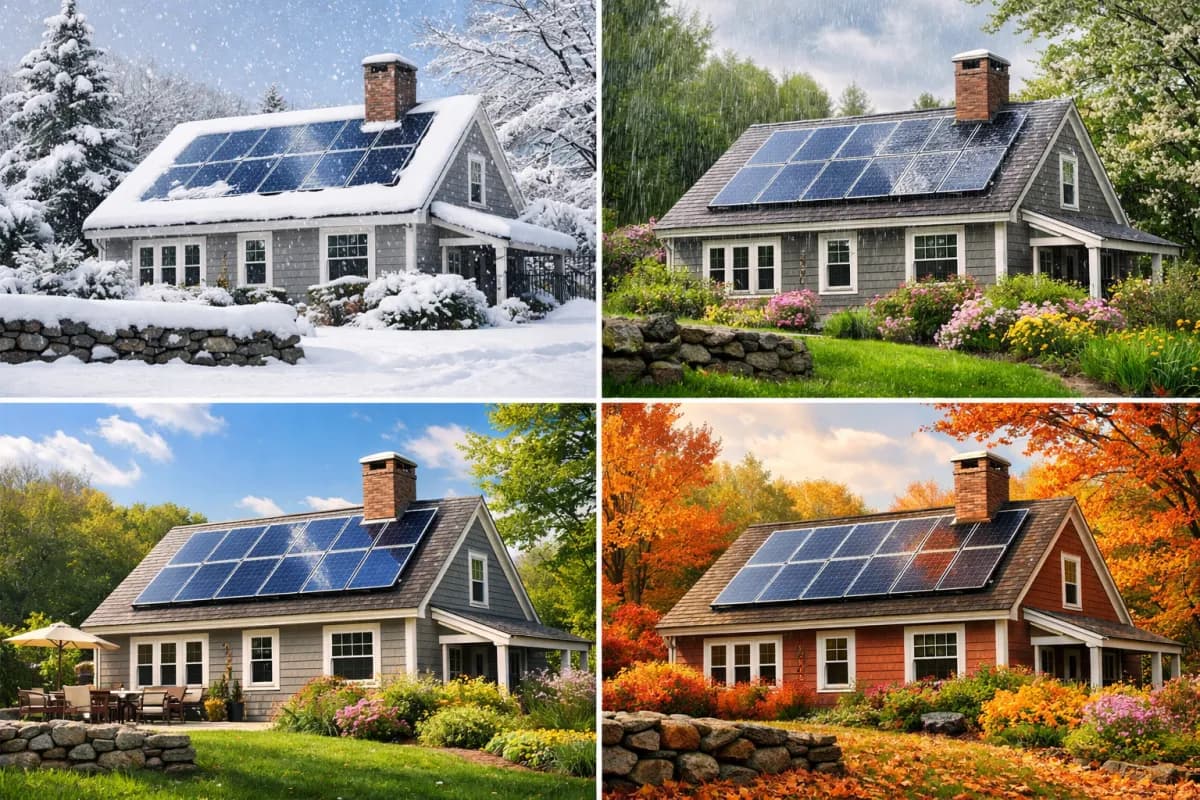
Solar production in New England follows a predictable curve. Understanding why output changes seasonally helps you set realistic expectations and avoid unnecessary worry.
~15% of annual
500-780 kWh/mo
Shortest days (9-10 hours of light), lowest sun angle, frequent overcast. But cold temps boost panel efficiency 3-5%. Snow on ground reflects light upward. This is your lowest season, but net metering credits from summer carry you through.
~30% of annual
1,050-1,520 kWh/mo
Days lengthen rapidly (11-15 hours). Sun angle climbs. Cool temperatures maintain high efficiency. April and May are when your system starts banking serious net metering credits. Pollen has minimal production impact despite yellow coating.
~36% of annual
1,420-1,620 kWh/mo
Longest days (15+ hours), highest sun angle, maximum solar resource. June peaks at about 150% of the monthly average. Heat and humidity slightly reduce per-hour efficiency compared to spring, but sheer daylight hours dominate. Your credit-banking powerhouse season.
~21% of annual
620-1,180 kWh/mo
Mirror image of spring — days shorten, sun angle drops. September still produces well. October sees the steepest decline. By November, production is near winter levels. Falling leaves rarely impact panels since they slide off the angled glass surface.
Six factors determine how much your panels produce each month. Daylight hours and sun angle dominate — the rest are secondary but worth understanding.
Boston gets 9.1 hours of daylight on December 21 vs. 15.3 hours on June 21. This 68% difference in daylight is the single biggest driver of seasonal production swings. More hours of light = more energy.
The sun is 24 degrees above the horizon at noon in December vs. 71 degrees in June. A lower angle means sunlight travels through more atmosphere and hits panels at a less efficient angle. Fixed-tilt panels are optimized for spring/fall angles.
New England averages 60% cloud cover in November-January vs. 40% in June-August. Panels still produce on cloudy days (10-25% of rated capacity), but extended overcast stretches noticeably reduce output. Diffuse light still generates power.
Snow covering panels blocks production entirely, but panels are angled and dark — most snow slides off within 1-2 days. Snow on the ground actually increases production via albedo (reflection). Net impact is smaller than most people think: 2-5% annual loss.
Solar panels lose 0.3-0.5% efficiency per degree Celsius above 25C (77F). A 95F summer day reduces output by ~10% compared to rated capacity. Cold winter days actually boost efficiency — a 20F day gives panels a 3-5% bonus over standard test conditions.
Panels degrade 0.25-0.5% per year. After 10 years, expect 95-97.5% of original output. After 25 years, 87.5-93.75%. This is a gradual, predictable decline — not a seasonal factor, but important for setting long-term production expectations.
Here is what a typical Massachusetts household (900 kWh/month average, higher in summer for AC) sees on their electric bill with a 10kW solar system and net metering at $0.29/kWh.
| Month | Solar (kWh) | Usage (kWh) | Net (kWh) | Bill Impact |
|---|---|---|---|---|
| January | 650 | 900 | -250 | Pay ~$73 (250 kWh x $0.29) |
| February | 780 | 850 | -70 | Pay ~$20 (70 kWh x $0.29) |
| March | 1,050 | 800 | +250 | Bank 250 kWh credit |
| April | 1,280 | 700 | +580 | Bank 580 kWh credit |
| May | 1,520 | 650 | +870 | Bank 870 kWh credit |
| June | 1,620 | 800 | +820 | Bank 820 kWh credit |
| July | 1,580 | 1,100 | +480 | Bank 480 kWh credit |
| August | 1,420 | 1,050 | +370 | Bank 370 kWh credit |
| September | 1,180 | 800 | +380 | Bank 380 kWh credit |
| October | 900 | 750 | +150 | Bank 150 kWh credit |
| November | 620 | 850 | -230 | Use banked credits (no bill) |
| December | 500 | 900 | -400 | Use banked credits (no bill) |
From March through October, your system produces more than you use — those surplus kWh become credits on your utility account. When November and December hit with lower production, you draw down those banked credits instead of paying full retail. A properly sized system banks enough credits (about 4,900 kWh in this example) to cover the winter deficit (about 950 kWh). The remaining credits typically settle at a lower wholesale rate at your annual true-up date.
Monthly production fluctuates naturally. Here is how to tell the difference between normal weather variation and an actual system problem.
All five New England states are viable for solar. Production differences are small (about 5%), while electric rate differences have a much bigger impact on savings.
| State | Annual (kWh) | Avg Sun Hrs/Day | Rep Utility Rate | Peak Month | Low Month | Peak:Trough |
|---|---|---|---|---|---|---|
| Massachusetts | 13,100 | 4.5 | $0.36/kWh (Eversource) | June (1,620 kWh) | Dec (500 kWh) | 3.2:1 |
| Connecticut | 12,800 | 4.4 | $0.33/kWh (Eversource CT) | June (1,580 kWh) | Dec (490 kWh) | 3.2:1 |
| Rhode Island | 12,900 | 4.4 | $0.29/kWh (Rhode Island Energy) | June (1,600 kWh) | Dec (495 kWh) | 3.2:1 |
| New Hampshire | 12,600 | 4.3 | $0.29/kWh (Eversource NH) | June (1,550 kWh) | Dec (480 kWh) | 3.2:1 |
| Maine | 12,400 | 4.2 | $0.24/kWh (Central Maine Power) | June (1,530 kWh) | Dec (470 kWh) | 3.3:1 |
Solar panels gradually produce less over time. Here is what that looks like for a 10kW system that starts at 13,100 kWh/year in Massachusetts.
| Year | Annual Production (kWh) | % of Original | Notes |
|---|---|---|---|
| Year 1 | 13,100 | 100% | Initial production baseline |
| Year 5 | 12,840 | 98% | Barely noticeable decline |
| Year 10 | 12,445 | 95% | Still producing strongly |
| Year 15 | 12,050 | 92% | Well within warranty spec |
| Year 20 | 11,660 | 89% | Most panels warranted to 87.5%+ |
| Year 25 | 11,270 | 86% | End of typical performance warranty |
| Year 30 | 10,880 | 83% | Panels still productive well beyond warranty |
Modern panels (manufactured 2020+) degrade at 0.25-0.35% per year — significantly slower than the 0.5% used in older projections. Many panels installed today will still produce 90%+ of original capacity at year 25. The technology keeps improving.
If your system loses more than 1% per year, something is wrong. Common culprits: hot spots (manufacturing defects), cracked cells, or a failing inverter reducing overall output. Check your monitoring data against your performance warranty — you may have a valid warranty claim.
These are averages. Your actual production depends on your roof orientation, shading, and location. Get a personalized production estimate in 2 minutes.
Get Your Free EstimateA 10kW solar system in Massachusetts produces roughly 500-780 kWh per month in winter (December through February), compared to 1,520-1,620 kWh in peak summer months (May through July). Winter production is about 40% of the summer peak. However, net metering credits banked during summer surplus months offset winter deficits, so your annual bill can still be near zero.
June is typically the peak production month, with the longest days (15+ hours of daylight) and high sun angle. A 10kW system in Massachusetts produces approximately 1,620 kWh in June. May and July are close behind at 1,520 and 1,580 kWh respectively. The peak period of May through August accounts for about 47% of annual production.
Net metering lets you bank surplus electricity as credits during high-production months (typically March through October) and use those credits to offset your bill during low-production months (November through February). In Massachusetts, credits carry forward month to month and settle annually. A properly sized system banks enough summer credits to cover winter deficits.
Less than most people think. Snow covering panels blocks all production temporarily, but panels are angled and dark — most snow slides off within 1-2 days. Snow on the ground around your panels actually increases production via albedo (light reflection). The net annual impact of snow is a 2-5% production loss in New England — far less significant than reduced daylight hours and lower sun angle.
Solar panels are rated at 25C (77F). For every degree below that, efficiency increases by 0.3-0.5%. On a crisp 20F winter day, panels can produce 3-5% more electricity per hour of sunlight than on a hot summer day. This is why a sunny February day can sometimes match or exceed production from a hazy July afternoon — fewer hours, but higher per-hour efficiency.
A 10kW solar system in Massachusetts produces approximately 13,100 kWh per year, which works out to about 1,092 kWh per month on average. This is enough to offset the electricity usage of a typical Massachusetts home (about 600-900 kWh/month for an all-electric home without EV charging). Production varies by roof orientation, shading, and exact location.
Production varies by about 5% across New England. Massachusetts and Rhode Island lead at roughly 13,000 kWh/year for a 10kW system, Connecticut is close at 12,800, New Hampshire at 12,600, and Maine at 12,400. The differences are small — all New England states are viable for solar. What varies more is electric rates: higher rates in MA ($0.29/kWh) mean faster payback despite similar production to NH ($0.27/kWh).
Normal monthly variation of plus or minus 10-15% from expected is common due to weather differences year to year. Worry if: production drops more than 20% below expected for two or more consecutive months, one panel consistently underperforms others (check monitoring), or production declines faster than 1% per year. A sudden complete drop to zero usually indicates an inverter or breaker issue, not a panel problem.