Loading NuWatt Energy...

We use your location to provide localized solar offers and incentives.
We serve MA, NH, CT, RI, ME, VT, NJ, PA, and TX
Loading NuWatt Energy...
NuWatt designs, installs, and manages solar, battery, heat pump, and EV charger systems across 9 states. One company, one warranty, one point of contact.
Get a Free QuotePanels are on the roof. Now what? From PTO approval to reading your new electric bill, monitoring your production, and maintaining your system for 25+ years — this is your complete owner's manual.
Quick Answer
After installation, your system goes through municipal inspection (1-5 days) and utility approval (2-8 weeks) before you receive Permission to Operate. Once active, download your monitoring app (Enphase Enlighten or mySolarEdge), expect your first full bill to show reduced charges, and plan for essentially zero maintenance — just visual checks and a professional inspection every 5-10 years. Your panels are warranted for 25-30 years and your home value just went up.
Your solar panels are physically installed, but the system is not turned on yet. Here is the step-by-step process from installation to your first kilowatt-hour.
Your panels are on the roof, wiring is done, and the inverter is mounted. The system is NOT turned on yet.
Your local building department inspects the installation for code compliance. NuWatt schedules this for you.
We submit your interconnection application and net metering agreement to your utility company.
Your utility installs a bi-directional (net) meter or reprograms your existing smart meter to track exports.
Your utility issues PTO. This is your green light. We activate the system remotely and you start generating.
The bottleneck is almost always the utility company, not NuWatt or your municipality. Utilities process interconnection applications in order, and some (like Eversource in MA) can take 4-8 weeks during busy seasons. We track your application status and push for faster processing. You will receive an email the moment PTO is granted.
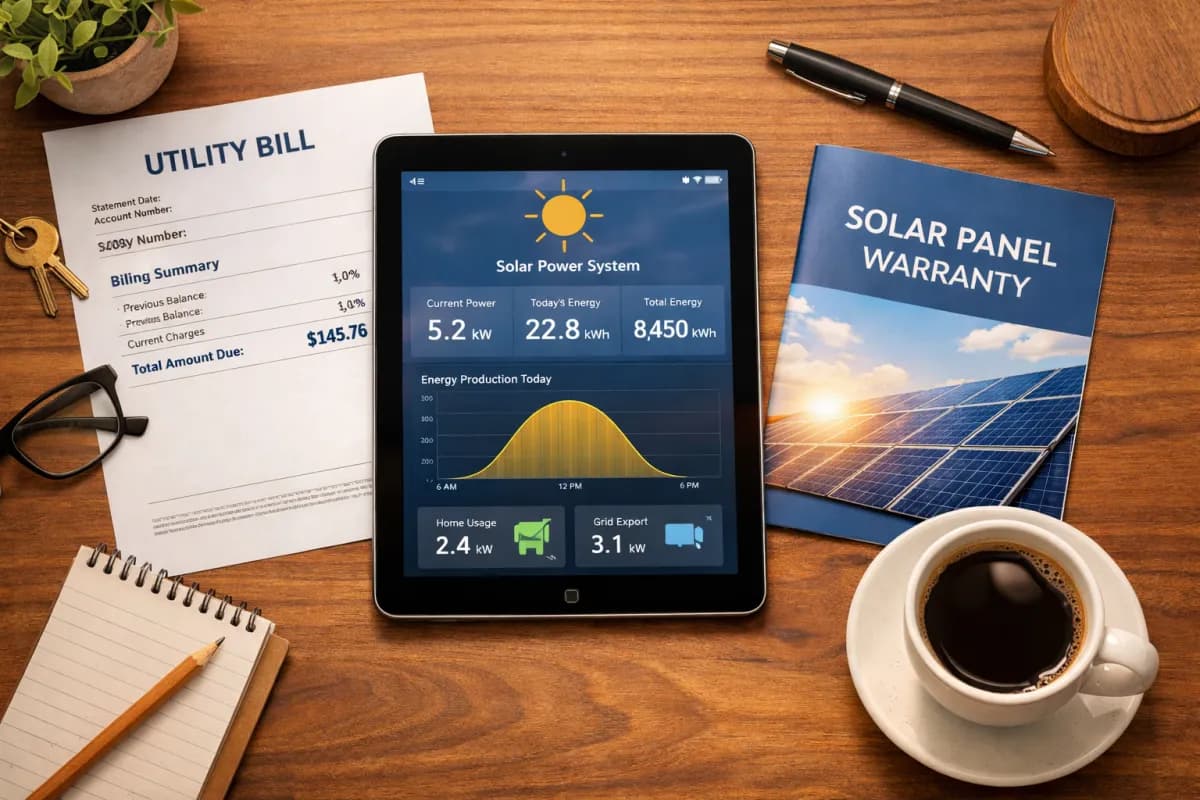
Your monitoring app is your dashboard for everything solar. Here is what each number means and what to watch for.
Used with Enphase IQ microinverters. Each panel reports independently.
Used with SolarEdge inverters + power optimizers. Reports at optimizer level.
Total energy your panels generated. This is what your system made, regardless of where the energy went.
Total energy your home used from all sources (solar + grid). If this is higher than production, you pulled the difference from the grid.
Energy your panels made that you did not use — it flowed to the grid. You earn net metering credits for this.
Energy you pulled from the grid (nighttime, cloudy days, high-usage periods). This is what you pay for on your bill.
Percentage of your solar production used directly by your home. Higher is better. Batteries increase this significantly.
Your post-solar electric bill looks different. Understanding these line items prevents confusion and helps you verify your savings are real.
Fixed fee everyone pays regardless of usage. Solar does not eliminate this.
Cost of electricity you import from the grid. Net metering credits reduce or eliminate this.
Covers grid infrastructure (transmission + distribution). Credits offset supply portion but typically not delivery.
Appears as a credit for energy you exported. Credits roll forward month to month.
Banked credits from high-production months (summer) carry forward to offset low-production months (winter).
Even with a perfectly sized system, you will always pay the fixed customer charge ($10-$20/month) plus some delivery charges. A realistic expectation: your annual electric bill drops from $2,000-$3,000 to $200-$400. The remaining amount covers grid connection fees that solar cannot offset.
Some utilities (especially in MA and RI) perform an annual true-up — they settle your remaining credit balance once per year. If you have excess credits after 12 months, you may receive a check or credit at a reduced rate. This is normal and expected for well-sized systems that overproduce in summer.
If you are enrolled in a state incentive program (MA SMART, NJ ADI, RI REG), these payments come separately — not on your electric bill. They typically appear as a direct deposit or check from the program administrator quarterly or semi-annually.
Here is what to expect month by month during your first year with solar. Production varies by season — this is normal and already accounted for in your annual estimate.
Solar panels require very little maintenance. No moving parts, no fluids, no filters. Here is the realistic schedule — not the exaggerated one some companies use to sell maintenance contracts.
Different components have different warranties from different companies. This table tells you exactly who handles what.
| Component | Typical Warranty | What It Covers | Who to Call |
|---|---|---|---|
| Solar Panels | 25-30 years | Manufacturing defects, power output guarantee (80% at 25 years) | Panel manufacturer (REC, Silfab, Hyundai) — NuWatt helps facilitate |
| Microinverters (Enphase) | 25 years | Hardware defects, performance failures | Enphase directly or NuWatt — we handle the replacement |
| String Inverter (SolarEdge) | 12 years (extendable to 25) | Hardware defects, internal component failure | SolarEdge warranty portal or NuWatt — we swap the unit |
| Optimizers (SolarEdge) | 25 years | Hardware defects, communication failures | SolarEdge / NuWatt — diagnosed through monitoring, replaced on-site |
| Racking & Mounting | 25 years | Structural integrity, corrosion, mounting hardware | NuWatt — we installed it, we stand behind it |
| Workmanship (Installation) | 10-25 years (varies by installer) | Roof leaks from penetrations, wiring issues, improper installation | NuWatt directly — this is our responsibility |
Solar panels are an asset, not a liability. But how the sale works depends on whether you own the system or lease it.
The residential Section 25D tax credit expired December 31, 2025 — there is no federal solar tax credit to worry about recapturing. State property tax exemptions (MA, RI, CT, NJ, NH) transfer with the home, so the buyer continues to benefit from no property tax increase on the solar system value. There are no capital gains implications specific to solar — the system is part of your home's cost basis.
Your solar system is designed to run for decades with minimal intervention. But there are specific situations where you should contact us.
If your monitoring app shows no production on a non-snowy, non-cloudy day, something may be wrong. Check your inverter for red lights first, then call us.
Call same dayCracked panels, loose wiring, displaced mounting hardware, or debris on the array after a storm. Do not attempt repairs yourself.
Call same dayA solid red or blinking error light on your string inverter indicates a system fault. Note the error code if displayed — it helps us diagnose remotely.
Call within 48 hoursPanels must be removed and reinstalled for a roof replacement. We coordinate with your roofer and re-mount the system. Plan 2-3 weeks lead time.
Call 1 month aheadWe provide production reports, warranty documentation, and facilitate any lease transfers for your buyer. This helps your real estate agent market the system.
Call when listingAdding panels, a battery, or an EV charger to your existing solar system. We design the expansion to integrate with your current equipment.
Call anytimeGet a personalized solar estimate for your home in 2 minutes. See your system size, costs, and projected savings before talking to anyone.
Get Your Free QuoteYou cannot turn on your solar system until you receive Permission to Operate (PTO) from your utility company. This typically takes 2-8 weeks after installation. Turning on the system before PTO is a code violation and can void your interconnection agreement. NuWatt notifies you and activates the system remotely once PTO is granted.
This depends on your inverter brand. If you have Enphase microinverters, use the Enphase Enlighten app. If you have a SolarEdge string inverter, use the mySolarEdge app. Both are free, available on iOS and Android, and show real-time production, historical data, and panel-level monitoring. NuWatt sets up your account during installation.
Most utilities charge a fixed monthly customer charge ($10-$20) regardless of usage. You also pay delivery charges on any grid electricity you import (nighttime, cloudy days). Net metering credits offset supply charges but typically not delivery charges. In high-usage months (summer AC, winter heating), you may import more than you export.
In New England and the Northeast, rain typically keeps panels clean enough. Annual production loss from dirt is only 2-5%. Professional cleaning costs $150-$300 and is rarely worth the incremental production gain. Never use a pressure washer — it can damage panel seals. If you notice heavy pollen, bird droppings, or leaf buildup, a garden hose from the ground is sufficient.
No. Do not climb on your roof or use tools to clear snow from panels. This voids most warranties and is extremely dangerous. Solar panels are dark and angled — snow slides off naturally within 1-3 days. The production lost during snow cover is already factored into your annual estimate. Panels actually perform better in cold temperatures once clear.
Typically no. Most insurers cover rooftop solar under your existing dwelling coverage at no additional premium. You should notify your insurance company that you have solar panels so the system is included in your dwelling replacement cost. Some insurers may adjust coverage limits upward by the system value ($15,000-$40,000) without a rate increase.
Owned solar systems (cash or loan) transfer with the home and typically increase resale value by 3-6%. Buyers inherit the panels, warranty, and net metering agreement. If you have a solar loan, you either pay it off at closing or the buyer assumes the remaining balance. Solar leases require the buyer to agree to assume the lease terms.
Contact NuWatt if: your monitoring app shows zero production for 24+ hours (on a non-snowy day), you notice physical damage to panels or wiring, your inverter displays a red error light, you are planning a roof replacement, you are selling your home, or you want to add panels or a battery to your existing system.