Loading NuWatt Energy...

We use your location to provide localized solar offers and incentives.
We serve MA, NH, CT, RI, ME, VT, NJ, PA, and TX
Loading NuWatt Energy...
NuWatt designs, installs, and manages solar, battery, heat pump, and EV charger systems across 9 states. One company, one warranty, one point of contact.
Get a Free Quote8.5 million Texas homes have gas appliances. Gas furnaces produce carbon monoxide — an odorless, colorless killer. Texas has no statewide CO detector law for existing homes. Switching to a heat pump eliminates the #1 residential CO source. Zero combustion. Zero risk.
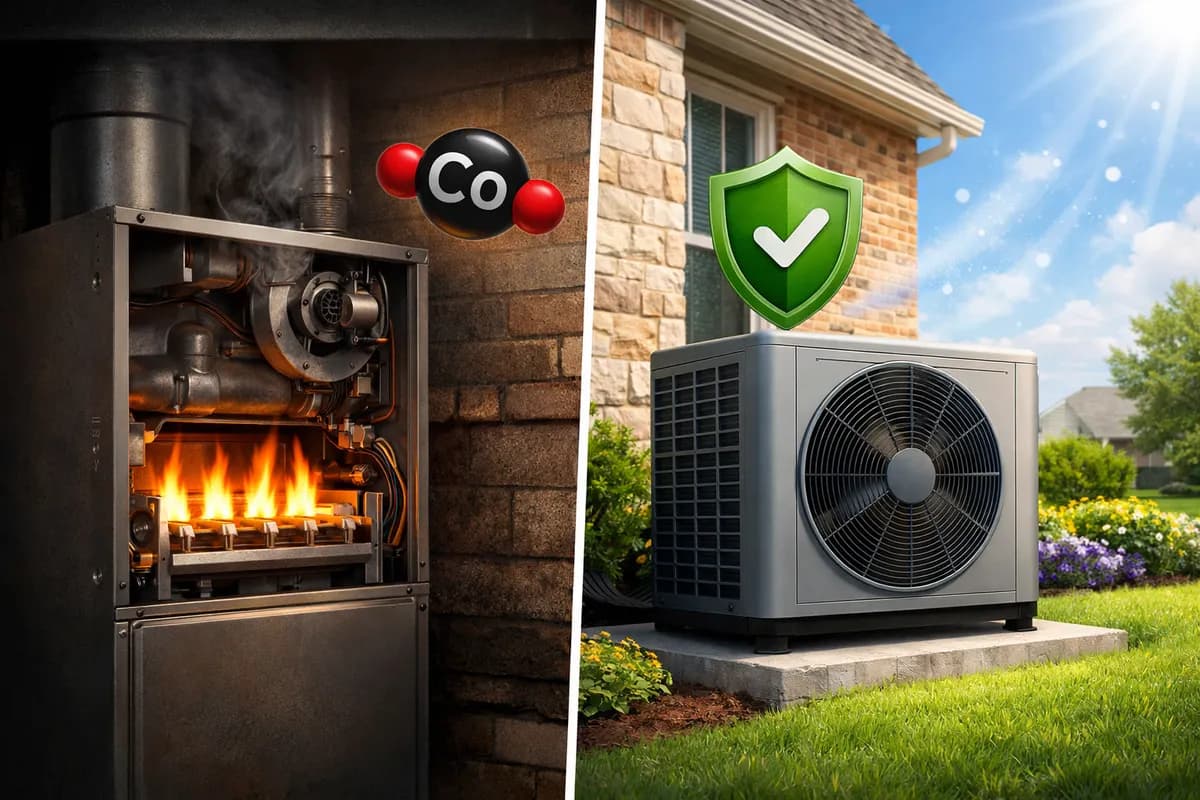
Carbon monoxide (CO) is an odorless, colorless, tasteless gas produced by burning fossil fuels. You cannot see it, smell it, or taste it. It kills by displacing oxygen in your bloodstream.
420+
Annual CO poisoning deaths in the US (CDC)
100,000+
Annual ER visits for CO poisoning (CDC)
#1
Cause of non-fire CO deaths: faulty heating equipment
8.5M
TX homes with gas appliances (furnaces, water heaters, stoves)
0
CO produced by electric heat pumps (zero combustion)
None
TX statewide CO detector law for existing homes
During Winter Storm Uri (February 2021), the Texas Poison Center Network reported a 500%+ increase in carbon monoxide calls. Desperate Texans ran portable generators indoors, used gas stoves for heat, and ran cars in attached garages — all producing deadly CO in enclosed spaces. At least 11 Uri deaths were attributed to CO poisoning. A fully electric home with battery backup would have eliminated this risk entirely.
Every gas appliance in your home is a potential CO source. A heat pump eliminates the biggest one — your furnace.
Gas furnaces burn natural gas, producing CO as a byproduct. A cracked heat exchanger — common in furnaces 10-20 years old — leaks CO directly into your ductwork and living space. Annual inspection required. Heat exchangers in TX face extra stress from summer-to-winter temperature swings.
Texas factor: TX homes run AC 7-8 months, then switch to heat for 3-4 months. This extreme cycling stresses the heat exchanger more than northern homes that gradually transition.
Tank-style gas water heaters produce CO through the flue. Backdrafting can push CO into the home — especially in tight, new-construction TX homes with poor ventilation. Tankless gas units have lower risk but still produce CO.
Texas factor: TX new construction is increasingly airtight (2018 IECC code), reducing natural ventilation that historically cleared CO from gas appliances.
Gas stoves produce CO, NO2, and particulates during operation. Unvented — exhaust goes directly into your kitchen. Range hoods help but most TX homeowners do not run them.
Texas factor: TX cooking culture (BBQ, Tex-Mex, large families) means more stove use than average. Open floor plans in TX homes allow gas pollutants to spread throughout.
Heat pumps use electricity to move heat — no combustion, no flame, no fossil fuel burned inside the unit. Zero CO production. Zero indoor air quality risk from the heating/cooling system itself.
Texas factor: Switching from gas furnace + AC to a heat pump eliminates the #1 source of residential CO — the gas furnace. If you also switch to HPWH and induction stove, you can go fully gas-free.
Texas has no statewide law requiring CO detectors in existing homes. This means millions of TX homes with gas furnaces have zero CO detection.
| City | CO Detector Requirement |
|---|---|
| Houston | CO detectors required in new construction per Houston Building Code |
| Dallas | CO detectors required in new construction per Dallas Building Code |
| Austin | CO detectors required in new construction per Austin Energy Code |
| San Antonio | CO detectors required in new construction per SA Building Code |
| Fort Worth | CO detectors required in new construction |
| El Paso | CO detectors required in new construction |
| All TX Cities | NO Texas city requires CO detectors in existing homes. If your home was built before the local code adoption, there is no legal requirement for CO detection — even with gas appliances. |
CO detectors are a secondary defense — they alert you after CO is already in your home. A heat pump is primary defense: it eliminates the CO source entirely. No combustion = no CO = no risk. If you replace your gas furnace with a heat pump, you remove the #1 residential CO source. Add a heat pump water heater and induction stove, and your home produces zero CO from any appliance.
The heat exchanger is the critical safety component in a gas furnace. When it cracks, CO leaks into your ductwork. TX furnaces face extra stress from extreme seasonal cycling.
| Furnace Age | Crack Risk | Notes (TX-Specific) |
|---|---|---|
| 0-5 years | Low | New furnace, factory warranty. Heat exchanger stress from TX cycling is minimal. |
| 5-10 years | Low-Moderate | Annual inspection recommended. TX rapid cycling begins to fatigue metal. |
| 10-15 years | Moderate | Hairline cracks possible. TX temperature swings from summer AC to winter heat stress metal. Professional inspection with camera recommended. |
| 15-20 years | High | Many TX furnaces develop cracks at this age. Major repair or replacement recommended. This is when most CO incidents occur. |
| 20+ years | Very High | Replace immediately. TX furnaces over 20 years old are beyond their designed lifespan. A cracked heat exchanger at this age is not uncommon. |
Consider replacing it with a heat pump rather than repairing it. A heat exchanger replacement costs $1,500-$3,000 — close to the price difference for a new heat pump system that eliminates CO risk entirely and handles both heating and cooling. In Texas, a heat pump replaces both your aging furnace AND your AC unit, making the economics even more favorable.
Replacing your furnace is the biggest safety win, but a fully electric home eliminates all indoor combustion.
Replaces gas furnace + AC. Handles heating and cooling. Zero CO.
$5,500-$14,000
Eliminates #1 CO source (furnace)
Replaces gas water heater. Uses heat pump technology. 3-4x more efficient than gas tank. Zero CO.
$2,500-$5,000
Eliminates #2 CO source
Replaces gas range. Magnetic induction heats cookware directly. Faster than gas. Zero CO. Zero indoor NO2.
$1,000-$3,000
Eliminates #3 CO source (stove)
Full electrification: $15,000-$30,000. This eliminates all combustion appliances, all CO risk, and your gas utility bill ($50-$150/month = $600-$1,800/year). Pair with solar panels and you can power your entire home with clean energy. The gas meter can be permanently removed, and you never worry about CO again.
Full cost and performance comparison: heat pump vs gas in TX climate.
Read guideMetro-specific guide for DFW — sizing, brands, HOA considerations.
Read guideDual-fuel vs electric-only backup heat for TX winters.
Read guideSolar + heat pump + battery bundle for full home electrification.
Read guideReplace your gas water heater for another CO-free appliance.
Read guideComplete pricing for heat pump systems across all TX metros.
Read guideZero CO. Lower energy bills. Better comfort. A heat pump replaces your gas furnace and AC in one system. Get a free assessment for your TX home.
No. Heat pumps produce zero carbon monoxide. They operate entirely on electricity, moving heat between indoor and outdoor air using a refrigerant cycle — no combustion, no flame, no fossil fuel burned inside the unit. This is fundamentally different from gas furnaces, which burn natural gas and produce CO as a byproduct. Switching from a gas furnace to a heat pump eliminates the #1 source of residential carbon monoxide — the furnace heat exchanger.
Texas has no statewide law requiring CO detectors in existing residential homes. Major cities (Houston, Dallas, Austin, San Antonio, Fort Worth) require CO detectors in new construction that has attached garages or fuel-burning appliances, but this does not apply to older homes. If your home was built before the local code was adopted, there is no legal requirement for CO detection — even if you have a gas furnace, gas water heater, and gas stove. NuWatt strongly recommends installing CO detectors on every level of any home with gas appliances regardless of legal requirements.
Nationally, over 420 people die from non-fire CO poisoning annually, and over 100,000 visit emergency rooms for CO exposure (CDC data). Texas does not publish state-specific CO death statistics separately, but with 8.5 million homes using gas appliances, TX has significant exposure. Winter Storm Uri in February 2021 caused a spike in CO poisoning cases as Texans ran portable generators and gas appliances indoors during power outages. The Texas Poison Center Network reported a 500%+ increase in CO calls during that week.
Yes — a cracked heat exchanger is one of the most dangerous conditions in residential HVAC. The heat exchanger is the metal barrier between the combustion chamber (where gas burns and CO is produced) and the air that flows through your ductwork into your home. A crack allows CO to leak directly into your living space. Symptoms of CO exposure include headache, dizziness, nausea, and confusion. Prolonged exposure can cause death. Texas furnaces are at elevated risk because the extreme cycling between summer AC and winter heat stresses the heat exchanger metal. Furnaces over 15 years old in TX should be professionally inspected with a camera.
An electric heat pump is the safest heating system for families with children. It produces zero carbon monoxide, has no open flame, no gas leak risk, and no combustion byproducts entering your home. Children are more vulnerable to CO poisoning than adults because they breathe faster and have smaller bodies. The American Academy of Pediatrics recommends CO detectors in all homes with gas appliances. A heat pump eliminates the risk at the source. For Texas families, the safety advantage compounds because TX has no statewide CO detector law, meaning many homes with gas furnaces have no detection system at all.
Yes. A fully electric Texas home is achievable and increasingly common. Replace your gas furnace + AC with a heat pump (handles both heating and cooling), your gas water heater with a heat pump water heater (HPWH), and your gas stove with an induction cooktop. This eliminates all combustion appliances and all CO risk. The total cost for full electrification is $15,000-$30,000 depending on your home, but you eliminate gas utility bills entirely ($50-$150/month) and improve indoor air quality. Solar panels can then power the entire electric home.