Loading NuWatt Energy...

We use your location to provide localized solar offers and incentives.
We serve MA, NH, CT, RI, ME, VT, NJ, PA, and TX
Loading NuWatt Energy...
NuWatt designs, installs, and manages solar, battery, heat pump, and EV charger systems across 9 states. One company, one warranty, one point of contact.
Get a Free QuoteTexas does not have traditional net metering. Instead, in deregulated areas covering roughly 85% of the state, you choose a Retail Electric Provider (REP) with a solar buyback plan. This guide compares every major buyback plan, explains deregulated vs. municipal utility differences, and helps you find the best rate for your delivery territory.
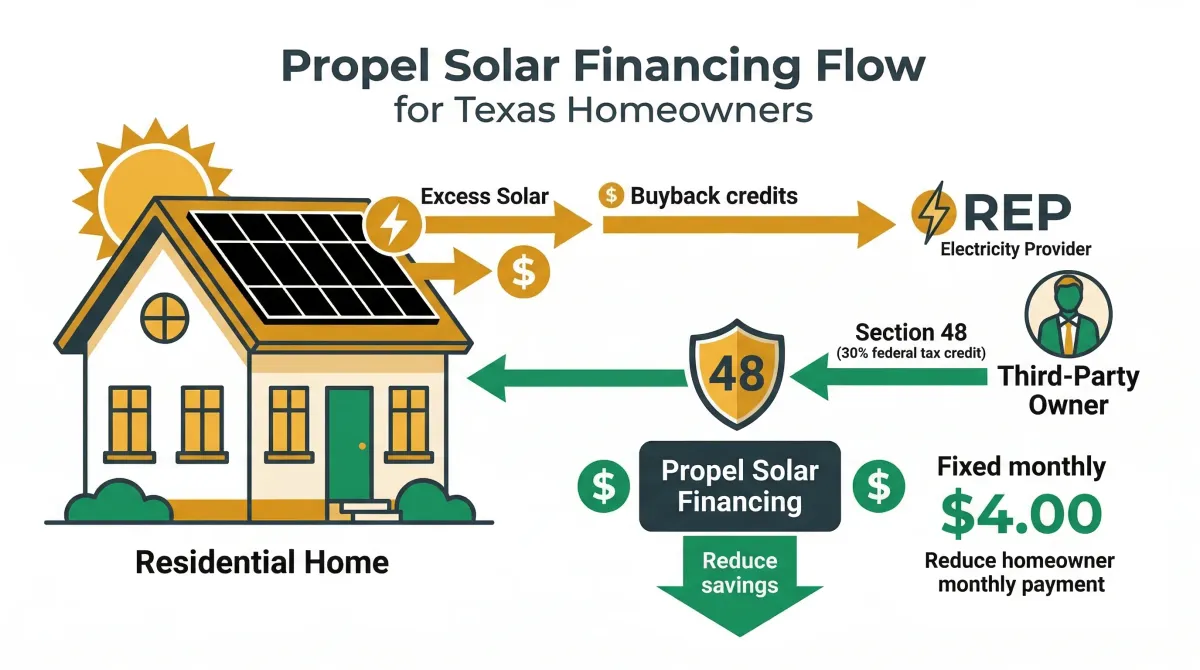
2026 Federal Tax Credit Update: The Section 25D residential solar investment tax credit (ITC) expired December 31, 2025. Homeowners who purchase solar in 2026 receive $0 in federal tax credits. Third-party-owned systems (leases and PPAs) may still benefit from Section 48/48E; the begin-construction window closed July 4, 2026, and projects starting now still qualify if placed in service by December 31, 2027. Your solar buyback plan is now even more critical to your financial return.
Unlike states with true net metering, Texas uses a buyback model in its deregulated electricity market. Understanding the key players is essential to maximizing your solar investment.
Your Transmission and Distribution Utility (Oncor, CenterPoint, AEP TX, or TNMP) owns the wires and poles. They deliver electricity to your home and maintain the grid. You cannot choose your TDU — it is assigned by your address. The TDU installs your bi-directional smart meter and processes your interconnection application.
Your Retail Electric Provider is the company you pay for electricity. In deregulated Texas, you choose your REP and can switch at any time (subject to contract terms). REPs set the buyback rate — the price they pay you for excess solar electricity exported to the grid. This is the key number that affects your solar economics.
Your solar panels generate electricity during daylight hours. When production exceeds your home's consumption, excess power flows to the grid through your bi-directional meter. The TDU records both inflows and outflows. Your REP then credits you for exported kWh at the buyback rate on your monthly bill.
Solar Panels
Generate electricity
Smart Meter
Tracks in/out flow
Grid (TDU)
Receives excess kWh
Bill Credit
REP pays buyback rate
Your TDU (Oncor, CenterPoint, etc.) reports interval meter data to your chosen REP. The REP applies the buyback rate to your exported kWh and issues a credit on your monthly bill. TDU delivery charges are based on consumption only.
Your solar buyback experience depends entirely on whether you are in a deregulated or regulated utility territory. About 85% of Texas residents are in deregulated areas.
~85% of Texas residents
Oncor
DFW, Lubbock, Waco, Abilene
CenterPoint
Houston metro area
AEP Texas
Corpus Christi, McAllen, Laredo
TNMP (Texas-New Mexico Power)
Parts of DFW suburbs, TX-NM border
~15% of Texas residents
Austin Energy
Value of Solar: 9.91¢/kWh credit
CPS Energy
Avoided cost rate: ~4-5 cents/kWh
San Marcos, Denton, others
Rates vary by municipality
The eight most popular solar buyback plans from major REPs in the ERCOT deregulated market, sorted by buyback rate. Rates are approximate and subject to change — always verify the current Electricity Facts Label (EFL) before enrolling.
| REP | Plan Name | Buyback Rate | Type | Contract | Rollover | Green | Territories |
|---|---|---|---|---|---|---|---|
| Green Mountain EnergyBest Rate | Renewable Rewards Solar Buyback 36 | Retail-match | Retail Match | 36 mo | Oncor, CenterPoint | ||
| TXU Energy | Solar Buyback Match 36 | Retail-match | Retail Match | 36 mo | Oncor only | ||
| Almika Energy | 60 Energy Plus Buyback | 10.0¢/kWh | Fixed | 60 mo | Oncor, CenterPoint | ||
| Chariot Energy | GreenVolt Solar Buyback 12 | 7.0¢/kWh | Fixed | 12 mo | Oncor, CenterPoint, AEP TX, TNMP | ||
| TXU Energy | Solar Buyback Saver 24 | 5.5¢/kWh | Fixed | 24 mo | Oncor, CenterPoint, AEP TX, TNMP | ||
| Rhythm Energy | PowerShift Solar Buyback 12 | 9.5¢/kWh | Fixed | 12 mo | Oncor, CenterPoint | ||
| Reliant Energy | Solar Payback Plus 12 | 4.3¢/kWh | Fixed | 12 mo | Oncor, CenterPoint | ||
| Gexa Energy | Solar Export Saver 12 | 3.0¢/kWh | Fixed | 12 mo | Oncor, CenterPoint |
Renewable Rewards Solar Buyback 36
Retail-match
Best RateOncor, CenterPoint
100% renewable. Credits at full retail rate — effectively 1:1 net metering. Annual true-up pays out excess.
Solar Buyback Match 36
Retail-match
Oncor only
Exports credited at same rate as consumption. Oncor territory only. Effectively 1:1 net metering.
60 Energy Plus Buyback
10.0¢/kWh
Oncor, CenterPoint
Highest fixed buyback rate in TX. 5-year commitment. Credits expire after 12 months of accumulation.
GreenVolt Solar Buyback 12
7.0¢/kWh
Oncor, CenterPoint, AEP TX, TNMP
Most widely available — all 4 TDU territories. 100% solar. Indefinite credit rollover. No cap on exports.
Solar Buyback Saver 24
5.5¢/kWh
Oncor, CenterPoint, AEP TX, TNMP
Widest TDU availability among TXU plans. Competitive consumption rate.
PowerShift Solar Buyback 12
9.5¢/kWh
Oncor, CenterPoint
Competitive fixed rate. Unlimited credit rollover. App-based TOU monitoring. $20/mo remaining ETF.
Solar Payback Plus 12
4.3¢/kWh
Oncor, CenterPoint
NRG brand. Credits offset energy + base fee + TDU delivery. $9.95/mo base.
Solar Export Saver 12
3.0¢/kWh
Oncor, CenterPoint
Lowest buyback but paired with cheapest consumption rate. Best for minimal-export systems.
Disclaimer: Rates shown are approximate as of February 2026 and may vary by usage level, TDU territory, and current market conditions. Always review the Electricity Facts Label (EFL) for exact rates and terms before signing a contract. Rates change frequently in the deregulated TX market.
The right system size depends on your usage, TDU territory, and buyback plan. Finance with Propel ($0 down) and your buyback credits offset a fixed monthly payment — no escalators.
Enter your ZIP code or select your delivery utility to see all available solar buyback plans in your territory. Plans vary by TDU — not every REP serves every area.
Find solar buyback plans from retail electric providers (REPs) in your delivery utility territory.
Texas does not have traditional net metering. Instead, in deregulated areas, you choose a Retail Electric Provider (REP) that offers a "solar buyback" plan. When your solar panels produce more electricity than you use, the excess is exported to the grid and your REP credits you at the buyback rate.
Found a plan you like? Let us handle the rest.
We size your system to maximize buyback credits, handle interconnection, and pair it with Propel financing so you still get ~30% federal savings with $0 down.
The highest buyback rate is not always the best plan. Evaluate these six factors to find the plan that maximizes your total savings.
Do not just look at the buyback rate in isolation. A plan with a 10-cent buyback rate but a 20-cent consumption rate costs more than a plan with a 9-cent buyback rate and a 14-cent consumption rate. Calculate the net cost based on your expected consumption-to-export ratio. Most solar homes in Texas self-consume 60-70% of their production.
24-month contracts typically offer slightly better rates because the REP has guaranteed revenue for longer. However, if wholesale electricity prices drop, you are locked in. 12-month contracts give you more flexibility to shop for better rates each year. For solar owners, 24-month plans are usually the better value because solar production is predictable.
Plans with credit rollover carry unused credits to the next billing cycle. This is critical in Texas because solar production peaks in summer when your system may generate far more than you consume. Without rollover, those summer credits vanish. With rollover, they offset your winter bills when production is lower. Chariot, Green Mountain, and Rhythm offer rollover.
Some plans use 100% renewable energy credits (RECs) for the electricity you consume from the grid. If environmental impact matters to you, Chariot, Green Mountain, and Rhythm all offer green plans. The cost premium for green plans is often minimal (0.5-1 cent per kWh more), and solar owners already produce clean energy directly.
TDU charges are regulated and the same regardless of which REP you choose. However, how REPs pass through TDU charges varies. Some include them in the advertised rate; others add them separately. Oncor charges average about 4 cents per kWh for delivery. Always compare the total all-in rate, including TDU pass-through, not just the energy rate.
Since solar panels produce electricity for 25-30 years, your REP strategy should be long-term. Lock in favorable buyback rates when available — a 24-month fixed plan at 10 cents is guaranteed income. Set a calendar reminder 45 days before your contract expires to shop for renewal rates. ERCOT market prices can swing significantly, so timing matters.
A typical 10 kW solar system in Texas produces approximately 1,350 kWh per month (annual average). After self-consumption, a typical home exports about 400 kWh to the grid. Here is what that looks like at various buyback rates.
10 kW
System Size
1,350
kWh/mo Production
950
kWh Self-Consumed
400
kWh Exported
Buyback Rate
3¢/kWh
Monthly Credit
$12
400 kWh x 3¢
Annual Credit
$144/yr
Buyback Rate
7¢/kWh
Monthly Credit
$28
400 kWh x 7¢
Annual Credit
$336/yr
Buyback Rate
10¢/kWh
Monthly Credit
$40
400 kWh x 10¢
Annual Credit
$480/yr
Best Rate AvailableThe 950 kWh you self-consume is worth far more — that electricity offsets grid purchases at 14-18 cents per kWh. At 16 cents per kWh, self-consumed solar saves you about $152 per month. Combined with a $40 buyback credit, your total monthly solar benefit is approximately $192. This is why maximizing self-consumption is even more important than chasing the highest buyback rate.
With the Section 25D residential solar tax credit expired as of December 31, 2025, homeowners who buy solar in 2026 cannot claim any federal tax credit on their system. This makes your buyback plan and electricity savings the primary financial drivers for going solar in Texas.
Cash or loan buyers get $0 from the IRS in 2026. But Propel uses a third-party ownership structure so Section 48 still applies — that means ~30% in federal savings built into your lower monthly payment.
Moving within Texas? Your solar buyback plan options depend on where you are going and your current contract terms.
If you move within the same delivery utility territory (for example, from one Oncor address to another), most REPs allow you to transfer your plan to the new address at no charge. Contact your REP before your move date to initiate the transfer. Your buyback plan and rate remain the same.
If you move from an Oncor area to a CenterPoint area (or vice versa), your REP may or may not serve the new territory. Check availability first. If your REP serves both territories, you can usually transfer. If not, you will need to find a new REP — and this may trigger an early termination fee (ETF) on your current contract, typically $150-$200.
If you move from a deregulated area (Oncor, CenterPoint) to a municipal utility area (Austin Energy, CPS Energy), your REP contract will end. You will switch to the municipal utility's solar program automatically. ETFs may apply to your old contract. Municipal utilities have their own solar credit rates and programs.
| REP | Typical ETF | Notes |
|---|---|---|
| Chariot Energy | $150 | Waived if moving out of ERCOT service area |
| Green Mountain | $150 | May waive for transfer within NRG brands |
| TXU Energy | $150 | Waived for military relocation |
| Reliant Energy | $200 | Higher ETF; strong service territory |
| Rhythm Energy | $150 | Check app for contract details |
| Constellation | $150 | Standard across most plans |
ETFs are per the most recent EFL filings. Always verify with your REP before canceling. Some REPs waive ETFs within 14 days of signing or for qualifying relocations.
Everything Texas solar owners ask about buyback plans, answered.
In deregulated Texas, you choose a Retail Electric Provider (REP) with a solar buyback plan. When your solar panels produce more electricity than you consume, the excess is exported to the grid. Your REP credits you at the buyback rate (typically 7-10 cents per kWh) on your monthly bill. The credits offset the cost of electricity you draw from the grid at night or on cloudy days. This is not traditional net metering — the buyback rate is usually lower than the retail rate you pay for consumption.
As of early 2026, the best value comes from retail-match plans: Green Mountain Energy Renewable Rewards (36 mo) and TXU Solar Buyback Match 36 (Oncor only) credit exports at your full retail rate — effectively 1:1 net metering. For fixed-rate plans, Almika Energy offers 10¢/kWh on a 60-month contract, while Chariot GreenVolt offers 7¢/kWh with just a 12-month commitment and all-TDU availability. The best plan depends on more than the buyback rate — also consider consumption rate, contract length, rollover policy, and your TDU territory.
Your smart meter tracks electricity flowing in both directions. Your TDU (delivery utility like Oncor or CenterPoint) reports the interval data to your REP. On your monthly bill, you will see total consumption (kWh drawn from the grid), total export (kWh sent to the grid), the buyback credit (exports multiplied by the buyback rate), and TDU delivery charges (which are based on consumption only, not netted against exports). The buyback credit reduces your energy charges but does not offset TDU delivery charges.
This depends on your REP and plan. Plans with rollover credits (like Chariot and Green Mountain) carry unused credits forward month-to-month during the contract. When the contract ends, most REPs forfeit any remaining credit balance. Some REPs may issue a final payout, but this is uncommon. To maximize value, try to time your contract renewal so you do not have a large accumulated credit balance at expiration.
Yes, you can switch REPs at any time — but check your current contract for early termination fees (ETFs). Most solar buyback plans charge $150 to $200 for early cancellation. If your contract is ending, you can switch with no penalty. The transition typically takes one to two billing cycles. Your solar system continues to work normally during the switch; your TDU service is unaffected.
Traditional net metering (used in states like California and Massachusetts) credits your exports at the full retail rate, effectively spinning your meter backward. Texas solar buyback plans credit exports at a separate, usually lower, buyback rate. For example, you might pay 15 cents per kWh for consumption but receive only 9 cents per kWh for exports. This means sizing your system to minimize exports and maximize self-consumption is more important in Texas than in net metering states.
On plans with rollover credits (Chariot, Green Mountain, Rhythm), unused credits carry forward to the next billing cycle for the duration of your contract. On plans without rollover (TXU, Reliant, Constellation, Pulse Power), credits that exceed your monthly bill are typically forfeited or capped. Always check the specific plan terms — the rollover policy significantly affects the value of a buyback plan, especially during high-production summer months.
Wholesale (indexed) buyback plans tie your export credit to real-time ERCOT wholesale prices. During peak summer afternoons, wholesale rates can spike to 50 cents or more per kWh, which sounds attractive. However, wholesale rates can also drop below 2 cents per kWh during off-peak hours and even go negative. For most homeowners, a fixed buyback rate of 9 to 10 cents per kWh provides more predictable and reliable value. Wholesale plans are better suited for owners with battery storage who can time their exports.
There is no minimum system size to enroll in a solar buyback plan from a REP. However, your system must be interconnected with your TDU (Oncor, CenterPoint, AEP TX, or TNMP) and have a bi-directional smart meter installed. The interconnection application is typically handled by your solar installer. Systems up to 50 kW qualify for simplified residential interconnection. Most residential systems (5-12 kW) qualify easily.
On fixed-rate buyback plans (which most are), yes — both your consumption rate and buyback rate are locked for the contract duration (typically 12 or 24 months). This protects you from rate increases during the contract. When the contract expires, you will need to renew or switch to a new plan. Rates at renewal may be higher or lower depending on market conditions. Variable-rate plans can change monthly, which introduces more risk.
Explore our other Texas-specific guides to make informed energy decisions.
Complete overview of going solar in TX
Find your TDU and available programs
Regional pricing, no ITC reality
100% exemption from property tax
Value of Solar, rebates, interconnection
San Antonio solar programs & rates
NuWatt Energy helps Texas homeowners navigate solar system sizing, buyback plan selection, and interconnection. Get a free solar assessment with personalized buyback projections based on your TDU territory and usage profile.
Free assessment includes system sizing, buyback plan recommendation, and projected monthly credits
Propel uses Section 48 so you still get ~30% federal savings — even though 25D expired
Last updated: February 2026
Data sources: PUCT filings, REP Electricity Facts Labels, ERCOT market data