Loading NuWatt Energy...

We use your location to provide localized solar offers and incentives.
We serve MA, NH, CT, RI, ME, VT, NJ, PA, and TX
Loading NuWatt Energy...
NuWatt designs, installs, and manages solar, battery, heat pump, and EV charger systems across 9 states. One company, one warranty, one point of contact.
Get a Free Quote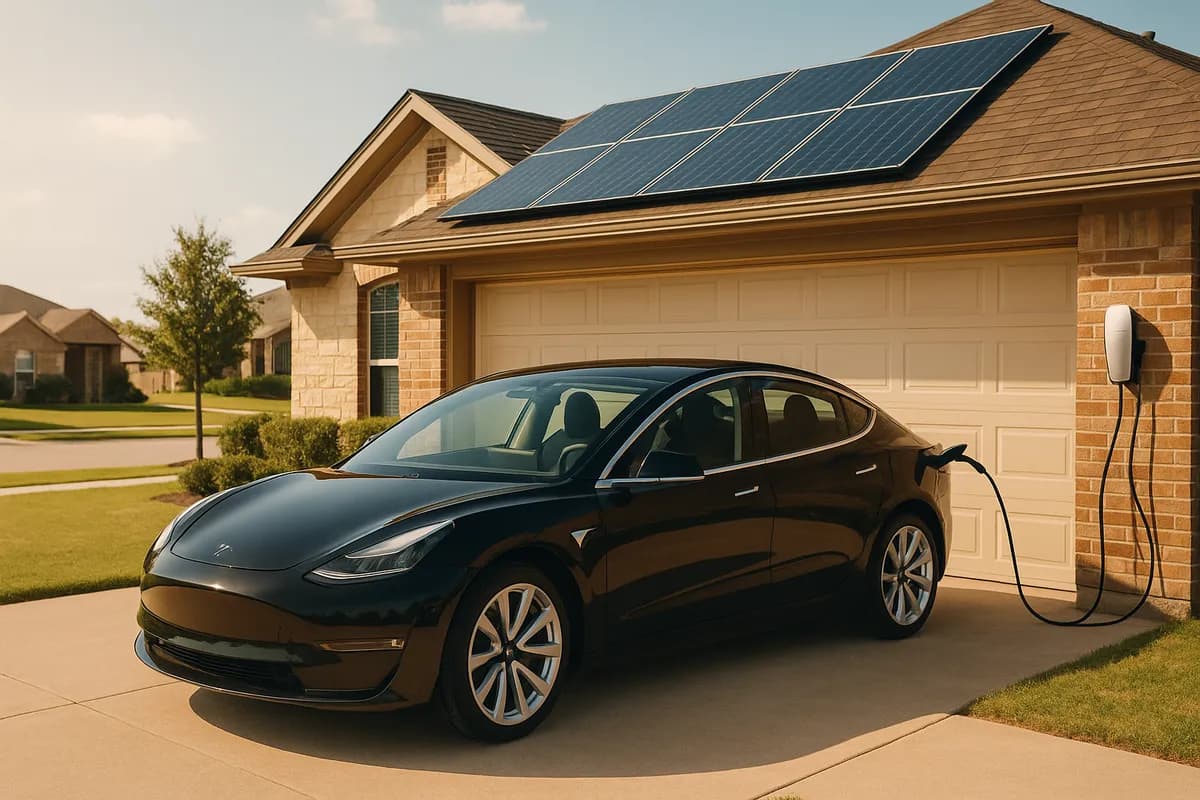
Texas is the #2 state for EV registrations. Combine rooftop solar with your EV to eliminate fuel costs entirely. Here is how to size your system, pick the right electricity plan, and charge for pennies on off-peak ERCOT rates.
Texas has a unique combination that makes solar + EV ownership extremely lucrative: abundant sunshine (4.7-5.6 peak sun hours), a deregulated electricity market with creative rate plans, and the highest EV adoption rate outside California. When you power your EV with rooftop solar, you are essentially driving on free fuel for 25+ years.
Texas averages 1,600-1,800 kWh per installed kW annually. More sun means fewer panels to charge your EV.
Over 200,000 registered EVs in Texas (2025). Tesla Gigafactory Austin produces Model Y locally.
Replace $3.10/gallon gas with free solar electricity. A sedan saves $1,500/yr; a truck saves $2,400+/yr.
Unique to deregulated Texas: export solar by day, charge your EV free at night. Double the savings.
Average Texas home: 8 kW solar system = ~$24,000 installed (no federal ITC in 2026)
Add 7 panels for EV: 10.5 kW system = ~$31,500 installed
Annual savings: $1,200 (electricity) + $1,500 (fuel) = $2,700/year
Simple payback: ~9.5 years (with solar buyback plan, as low as 7 years in Austin Energy territory)
The number of extra panels depends on your EV model, annual mileage, and Texas location. We calculate based on 12,000 annual miles (Texas average) and 440W panels producing ~730 kWh/year each in Texas.
| EV Model | kWh/100 mi | Annual kWh | Extra Panels | Gas Savings/yr |
|---|---|---|---|---|
| Tesla Model Y | 26 | 3,120 | 7 | $1,680 |
| Tesla Model 3 | 24 | 2,880 | 7 | $1,680 |
| Ford F-150 Lightning | 48 | 5,760 | 13 | $2,400 |
| Chevy Equinox EV | 29 | 3,480 | 8 | $1,680 |
| Hyundai Ioniq 5 | 29 | 3,480 | 8 | $1,680 |
| Rivian R1S | 50 | 6,000 | 14 | $2,520 |
* Based on 12,000 annual miles, $3.10/gallon gas, 25 MPG average gas vehicle. Texas solar production: ~730 kWh/panel/year (440W panels).
Texas is truck country. The F-150 Lightning and Rivian R1S consume nearly double the electricity of a sedan. If you drive a truck, budget for 12-14 extra panels. The good news? Your gas savings are also roughly double ($2,400-$2,520/year vs $1,680 for a sedan) because you are replacing a 15-18 MPG gas truck. The extra panels typically pay for themselves in under 5 years from fuel savings alone.
The residential Section 30C Alternative Fuel Vehicle Refueling Property Credit expired June 30, 2026 and is no longer available for home EV charger installations. This joins Section 25D (solar ITC) and Section 25C (energy efficiency), both of which expired December 31, 2025. Texas EV owners can still save big through off-peak ERCOT plans and by charging from rooftop solar.
Here is the real math for a typical Texas driver (12,000 miles/year). Solar charging eliminates fuel costs entirely once the system is paid off, typically in 8-10 years.
| Category | Gas Vehicle | EV (Grid / Solar) |
|---|---|---|
| Average TX gas price (2026) | $3.10/gallon | N/A |
| Average fuel cost per mile | $0.124/mile | $0.034/mile (grid) / $0.00/mile (solar) |
| Annual fuel cost (12,000 mi) | $1,488 | $408 (grid) / $0 (solar) |
| 10-year fuel cost | $14,880+ | $4,080 (grid) / $0 (solar, panels paid) |
| Maintenance per year | $1,200 | $500 |
Tesla Supercharging in Texas costs $0.30-$0.40/kWh. For a Model Y driven 12,000 miles/year, that is $780-$1,040/year at Superchargers vs $0/year with home solar. Even if you finance your solar system, your effective per-kWh cost is $0.05-$0.08 -- still 75-85% cheaper than Supercharging. Home charging with solar is the clear winner.
Texas is the only deregulated market where you can pick an electricity plan specifically designed for EV charging. These plans let you charge for free during off-peak hours. Combine with solar for the ultimate setup: sell solar during the day, charge your EV free at night.
This is the optimal Texas strategy for solar + EV owners: (1) Install solar panels. (2) Sign up for a solar buyback plan that credits you for daytime exports. (3) Switch to a free-nights plan once your solar system covers your daytime usage. You export solar during the day at full retail credit, then charge your EV free between 9 PM - 6 AM. Net result: near-zero electricity bill AND near-zero fuel cost. Some Texas homeowners report total energy costs under $30/month with this strategy.
Texas homes typically need an 8-10 kW system for electricity alone. Adding an EV increases your system size by 2-6 kW depending on the vehicle. Here is how to calculate your ideal system.
8-10 kW
Avg TX home: 14,000 kWh/yr
+3-6 kW
3,000-6,000 kWh/yr for EV
11-16 kW
25-36 panels (440W each)
Average TX home has 1,500+ sq ft roof. You need ~65 sq ft per 440W panel. A 16 kW system needs ~580 sq ft of south-facing roof.
Some TX HOAs try to limit panel count. Texas Property Code Section 202.010 protects your right to install. They CANNOT ban solar.
Deregulated areas (Oncor, CenterPoint) allow systems up to 150% of annual usage. Municipal utilities may have lower caps.
EV charging (240V, 40-50A) may require an electrical panel upgrade from 100A to 200A. Factor $1,500-$3,000 into your budget.
Austin stands out because Austin Energy offers a Value of Solar rate ($0.097/kWh credit for exports) PLUS Austin is home to Tesla Gigafactory Texas. Austin Energy customers get a special solar + EV combination that no deregulated city can match.
When pairing with solar, you want a smart charger that can schedule charging during off-peak hours or when solar production is highest. Here are the top picks for Texas homes.
$475
Power: 48A / 11.5 kW
Best for: Tesla owners
Key feature: Built-in solar tracking with Powerwall
$550
Power: 50A / 12 kW
Best for: All EVs
Key feature: App scheduling, energy tracking, NEMA 14-50
$450
Power: 48A / 11.5 kW
Best for: Budget-conscious
Key feature: Solar excess mode with Emporia Vue monitor
All three pair well with rooftop solar and off-peak ERCOT plans. Charge from your own solar during the day, or overnight on a free-nights plan, for near-$0 fuel.
Texas families increasingly own two EVs. The economics get even better because you are replacing two gas bills with one solar system. Here is what changes with two EVs.
14-20 kW
System size for home + 2 EVs
$3,000-$5,000
Annual fuel savings (2 gas cars eliminated)
6-8 years
Payback (faster with double savings)
With two EVs, you may need to stagger charging times or install a load-sharing device. A 200A panel is essential. Some Texas homeowners add a small battery (5-10 kWh) to buffer solar production and charge both vehicles overnight without hitting demand charges.
Get a custom quote that includes your home electricity usage AND your EV charging needs. Charge from solar and off-peak ERCOT rates to drive your fuel cost to near $0.