Loading NuWatt Energy...

We use your location to provide localized solar offers and incentives.
We serve MA, NH, CT, RI, ME, VT, NJ, PA, and TX
Loading NuWatt Energy...
NuWatt designs, installs, and manages solar, battery, heat pump, and EV charger systems across 9 states. One company, one warranty, one point of contact.
Get a Free QuoteTexas is the #1 solar state with 50+ GW installed. In 10-15 years, millions of panels will reach end of life. TX has no mandatory recycling law, but recycling infrastructure is growing. Here is what TX homeowners need to know about panel disposal, recycling options, and TCEQ guidelines.
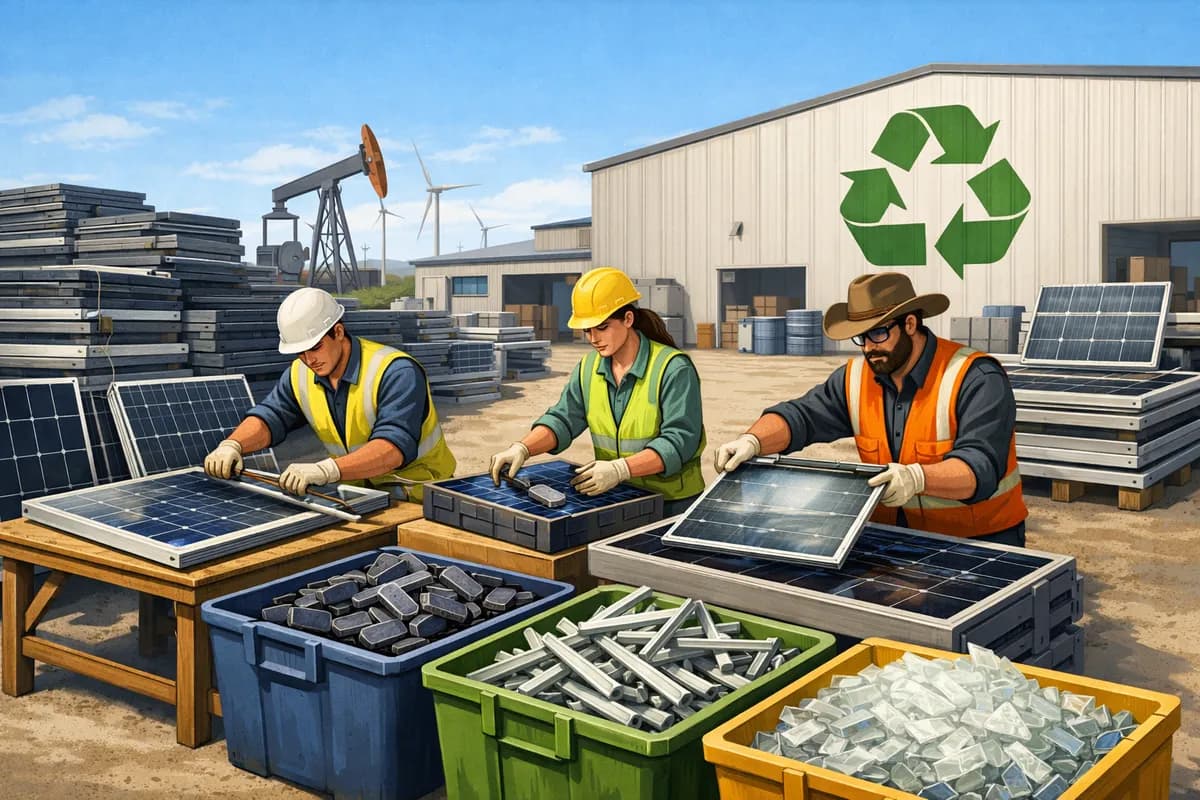
Texas leads the nation in solar installations. The sheer scale of TX solar means recycling infrastructure must grow dramatically in the next decade.
#1
TX is the #1 state for solar installations (2025 cumulative)
50+ GW
Total TX solar capacity (utility + residential + commercial)
1.2M+
Estimated residential solar systems in TX
25-30 years
Typical solar panel lifespan
2036-2041
When the first major TX residential panel retirement wave begins
78M+ tons
Estimated global solar panel waste by 2050 (IRENA)
Most TX residential solar panels installed in 2015-2020 will reach end of life around 2040-2050. Utility-scale solar farms (which represent the majority of TX capacity) will begin decommissioning around the same time. The International Renewable Energy Agency (IRENA) projects 78+ million tons of global solar panel waste by 2050. Texas, as the #1 solar state, will need to handle a disproportionate share. Fortunately, 85-95% of panel materials are recoverable.
A standard crystalline silicon solar panel is 85-90% recyclable by weight. The challenge is economically separating the materials.
| Material | % of Panel | Recyclable | Value | Notes |
|---|---|---|---|---|
| Glass | 75% | Yes | Low | Tempered glass. Easily recycled into new glass products. Largest component by weight. |
| Aluminum (frame) | 10% | Yes | Moderate | Aluminum frame is the most valuable recyclable component. Easily separated and remelted. |
| Silicon (solar cells) | 5% | Yes | High (if recovered) | Silicon wafers can be reprocessed into new cells or sold as raw material. Requires specialized processing. |
| Copper wiring | 1% | Yes | Moderate | Copper is easily recycled. Small quantity per panel but valuable per pound. |
| Polymer (backsheet, EVA) | 7% | No | None | Plastic backsheet and EVA encapsulant. Difficult to recycle. Usually landfilled or incinerated. |
| Silver | <0.1% | Yes | Very High | Tiny quantity but high value per gram. Modern panels use less silver but it is still worth recovering. |
| Other metals (tin, lead) | <1% | Yes | Low | Solder contains small amounts of lead (older panels) or lead-free alternatives. Requires proper handling. |
The Texas Commission on Environmental Quality (TCEQ) oversees waste disposal in Texas. Here is what they say about solar panels.
Standard crystalline silicon solar panels are classified as general solid waste by TCEQ (not hazardous waste). They can legally be landfilled in permitted municipal solid waste facilities.
Thin-film panels containing cadmium telluride (CdTe) — primarily First Solar — may require hazardous waste handling. The TCEQ Toxicity Characteristic Leaching Procedure (TCLP) test determines if a specific panel fails the cadmium threshold.
Texas has NO mandatory solar panel recycling law as of 2026. Unlike Washington state (which requires manufacturer-funded recycling), Texas leaves disposal decisions to the panel owner.
The federal EPA has considered but NOT enacted solar panel recycling regulations. The Resource Conservation and Recovery Act (RCRA) may eventually classify solar panels as e-waste requiring special handling, but no rule exists as of 2026.
Washington became the first US state to pass a solar panel recycling law (RCW 70A.510) in 2017, requiring manufacturers to fund and manage recycling programs. Texas has not followed suit, but as the #1 solar state, TX will likely face pressure to adopt similar legislation within the next decade. Responsible panel owners should plan for recycling regardless of legal requirements.
Five options for TX homeowners when panels reach end of life — ranked by environmental responsibility.
Send panels to a dedicated solar recycling facility (SOLARCYCLE in Odessa TX or We Recycle Solar). They separate glass, aluminum, silicon, copper, and silver for reuse. This is the most environmentally responsible option.
Some manufacturers (First Solar, SunPower/Maxeon) offer take-back programs where they recycle their own panels at end of life. Check your panel warranty and manufacturer website. Most residential panel brands do NOT offer this.
Panels that still produce 70-85% of rated output have value on the secondary market. They can be used for off-grid cabins, RV installations, agricultural pumping, or developing countries. List on eBay, Craigslist, or contact used panel dealers.
Texas does NOT classify standard crystalline silicon solar panels as hazardous waste. They can legally be landfilled. This is the cheapest option but wastes valuable materials and adds to landfill burden. As TX panel volumes grow, this option should be avoided.
Many solar installers will remove old panels and handle disposal as part of a re-roofing or system upgrade project. Ask your installer what happens to the old panels — the best installers have recycling partnerships.
These facilities accept solar panels from Texas homeowners and businesses.
Odessa, TX
All crystalline silicon panels, thin-film panels, inverters
Varies — commercial volume pricing. Contact for residential rates.
One of the largest US solar recycling facilities. Texas-based. Growing rapidly with TX solar market.
Yuma, AZ (serves TX via freight)
All panel types, batteries, inverters, racking
$15-$30/panel (residential). Volume discounts for commercial.
Accepts shipments from TX. One of the most established US solar recyclers.
Various US (take-back program)
First Solar CdTe panels only
Free for First Solar panels (covered by original contract)
Only applies to First Solar branded panels. Not for standard crystalline silicon panels.
Austin, TX
Solar panels (case by case), inverters, batteries, electronics
Contact for pricing
General e-waste recycler that accepts some solar equipment. May not process panels — may broker to dedicated recycler.
Multiple TX locations
Panels classified as e-waste or hazardous (thin-film with cadmium)
Industrial pricing
For panels that contain cadmium (CdTe thin-film). Handles hazardous materials. Not typical for residential crystalline panels.
Understand your 25-year production and workmanship warranty coverage.
Read guideKeep your panels producing at peak with TX-specific maintenance tips.
Read guideChoose panels with strong warranties and recycling programs.
Read guidePanels designed to withstand TX hail — reducing premature replacement.
Read guideInsurance coverage for hail damage, which may trigger early panel replacement.
Read guideTrack panel degradation and know when end-of-life is approaching.
Read guideNuWatt partners with recycling-certified facilities. Every installation includes guidance on end-of-life options and warranty documentation for responsible ownership.
No. Texas has no mandatory solar panel recycling law as of 2026. Standard crystalline silicon panels are classified as general solid waste by TCEQ and can legally be landfilled. This differs from Washington state, which requires manufacturer-funded recycling. However, recycling is strongly recommended because panels contain valuable recoverable materials (silicon, silver, copper, aluminum) and TX solar volumes will make landfilling unsustainable within 10-15 years. Dedicated solar recyclers like SOLARCYCLE in Odessa TX can recover 85-95% of panel materials.
Dedicated solar panel recycling costs $15-$30 per panel for residential quantities. Some manufacturers offer free take-back programs for their own panels. If you are replacing panels as part of a re-roofing or upgrade project, many installers will handle removal and recycling as part of the project cost. Landfill disposal is cheaper ($1-$3/panel) but wastes valuable materials. For a typical 25-panel residential system, recycling costs $375-$750 total — a small fraction of the system value.
Solar panels reach end of life after 25-30 years when output drops below 80% of rated capacity. At that point you have four options: (1) Dedicated recycling ($15-$30/panel, recovers 85-95% of materials), (2) Resale on the secondary market if panels still produce 70%+ ($20-$80/panel revenue), (3) Manufacturer take-back if available (free), or (4) Landfill disposal (legal in TX but environmentally irresponsible). The best option depends on panel condition and quantity. Most TX residential panels installed in 2020-2026 will not reach end of life until 2045-2055.
Standard crystalline silicon solar panels (which are 95%+ of residential installations) are NOT classified as hazardous waste by TCEQ. They are general solid waste that can be landfilled. However, thin-film panels containing cadmium telluride (CdTe) — primarily from First Solar — may fail the TCLP toxicity test and require hazardous waste handling. If you have standard mono or poly-crystalline panels from brands like REC, Silfab, Canadian Solar, or any major residential brand, they are not hazardous. The lead content in solder is below regulatory thresholds.
The primary dedicated solar recycling facility in Texas is SOLARCYCLE in Odessa, which processes 10+ million pounds per year and is expanding. We Recycle Solar (Yuma, AZ) also accepts shipments from Texas. For general e-waste that includes solar equipment, E-Recycling of Texas in Austin may accept panels. For thin-film CdTe panels, Clean Earth/Covanta handles hazardous materials at multiple TX locations. Many solar installers also have recycling partnerships and can handle end-of-life panels as part of a system replacement.
The first major wave of TX residential solar panel retirements will begin around 2036-2041, as panels installed during the 2011-2016 solar boom reach their 25-year lifespan. TX utility-scale solar (which represents the majority of TX solar capacity) will create even larger recycling volumes starting around 2040-2050. By 2050, IRENA estimates 78+ million tons of global solar panel waste. Texas, as the #1 solar state, will need industrial-scale recycling infrastructure. This is why facilities like SOLARCYCLE are expanding now — preparing for the wave.