Loading NuWatt Energy...

We use your location to provide localized solar offers and incentives.
We serve MA, NH, CT, RI, ME, VT, NJ, PA, and TX
Loading NuWatt Energy...
NuWatt designs, installs, and manages solar, battery, heat pump, and EV charger systems across 9 states. One company, one warranty, one point of contact.
Get a Free QuoteHeat Pump Water Heaters for Zone 6 Vermont
Efficiency Vermont offers $300-$600 rebates for qualifying heat pump water heaters. Premium models with UEF 3.5 or higher earn the $600 rebate. HPWHs use 60-70% less electricity than standard electric tanks and work well in Vermont basements -- even in winter.
Updated February 2026
The rebate amount depends on the model's Uniform Energy Factor (UEF). Higher-efficiency models earn a larger rebate.
Income-Eligible Enhancement
Enhanced rebate available — contact EVT for current income-eligible HPWH rebate amounts. See the income-eligible programs guide for qualification details.
These models meet EVT rebate requirements and perform well in Vermont's cold climate. Each card shows the rebate tier, efficiency rating, and key features.
Best overall — highest efficiency, qualifies for $600 premium EVT rebate
Most widely available — qualifies for $600 premium EVT rebate
Budget-conscious — qualifies for $300 standard EVT rebate
Premium quality — quietest option, ideal for finished spaces. Stiebel Eltron has VT-area presence.
Total installed cost including equipment, installation, and EVT rebate. No federal 25C credit is available in 2026.
How much a HPWH saves compared to your current water heater, based on Vermont energy prices.
HPWH uses 60-70% less electricity than standard electric tank. Strong savings at VT electric rates.
Eliminates oil-fired water heating. No more fuel deliveries for hot water. Common switch in VT.
Eliminates propane water heating. Significant savings at VT propane prices ($3.50+/gal).
Vermont's Zone 6 climate adds specific considerations for HPWH placement. Verify these before purchasing.
Same as electric dryer. Most VT homes have capacity, but panel space must be verified by electrician.
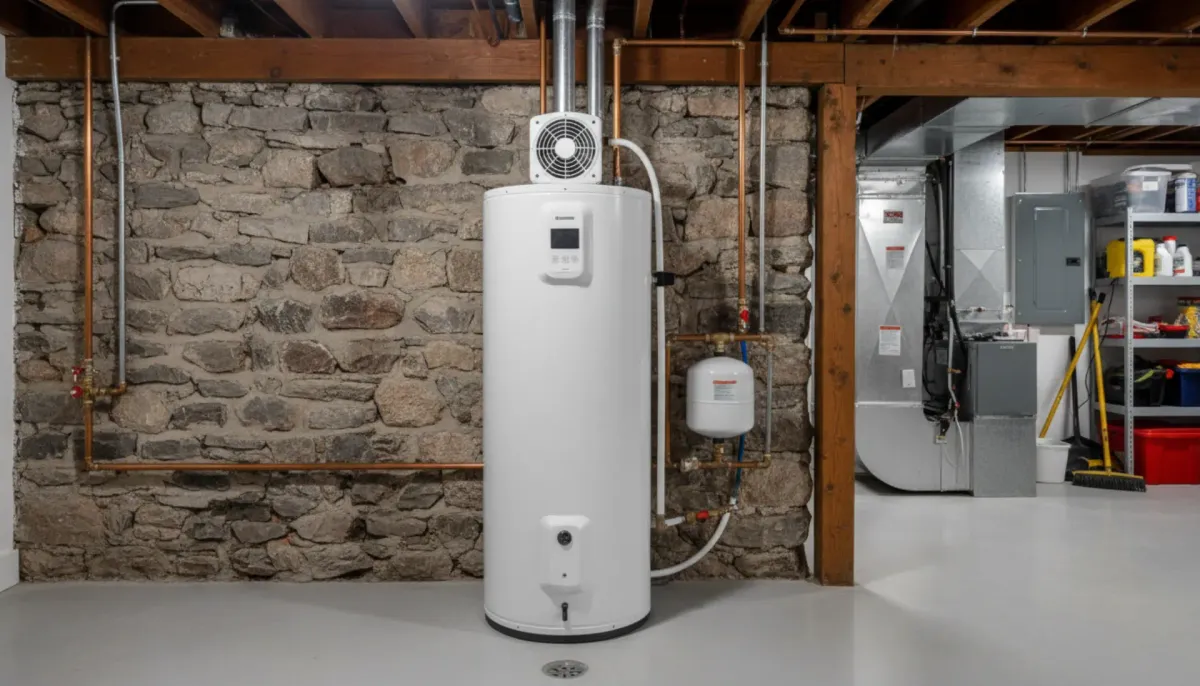
Standard basement, garage, or utility room. Cannot be in a small closet — needs air circulation for heat exchange.
HPWH produces condensation — needs floor drain nearby or condensate pump (adds $100-200).
HPWH extracts heat from surrounding air. In VT basements (45-60F in winter), efficiency drops but still operates. Consider location carefully in Zone 6 climate.
Most models run 45-55 dB (dishwasher level). Stiebel Eltron is quietest at 37 dB. Locate away from bedrooms.
HPWH must be in a space that stays above 35F. Unheated VT garages or sheds are NOT suitable unless insulated and heated.
HPWHs extract heat from surrounding air to heat water. In Vermont basements (typically 45-60F in winter), efficiency drops slightly but the units still operate effectively. The backup electric element may engage more during the coldest months, but year-round savings remain substantial.
The Section 25C energy efficiency tax credit expired December 31, 2025. There is no federal tax credit for heat pump water heaters in 2026. The EVT rebate ($300 or $600) is your primary incentive. It is a direct rebate funded by Vermont ratepayers and is unaffected by the federal expiration.
Not always. Standalone HPWH installations may qualify for the rebate without a full audit. However, if you are combining the HPWH with insulation or other measures, an audit is required. Call 888-921-5990 to confirm for your situation.
Yes, but efficiency depends on basement temperature. HPWHs work best above 50F. In a typical VT basement (45-60F in winter), they still operate but may use the backup electric element more. In summer, they provide free dehumidification. Most VT homeowners find them effective year-round in a basement setting.
The $600 premium rebate is for models with a Uniform Energy Factor (UEF) of 3.5 or higher — like the Rheem ProTerra and A.O. Smith Voltex. The $300 standard rebate is for qualifying models with UEF between 2.0 and 3.49.
General rule: 50 gallons for 1-2 people, 65 gallons for 2-3 people, 80 gallons for 3+ people. HPWHs heat more slowly than gas or oil, so sizing up is recommended. When in doubt, choose 80 gallons — especially in VT where incoming water temperatures are colder (40-50F).
No. The Section 25C energy efficiency tax credit expired December 31, 2025. There is no federal tax credit for heat pump water heaters in 2026. The EVT rebate ($300 or $600) is your primary incentive.
Absolutely — this is one of the most common HPWH installations in Vermont. Oil-to-HPWH eliminates fuel oil deliveries for hot water (saving ~100 gallons/year of oil). You will need a 240V circuit installed by an electrician if one does not exist.
Typically 4-6 hours for a straightforward replacement. If electrical panel work is needed (adding a 240V circuit), allow an additional 2-4 hours and $200-500 for the electrician.
This guide is provided by NuWatt Energy as an educational resource. All rebate amounts, model specifications, and program details are sourced from efficiencyvermont.com and manufacturer data. Call EVT at 888-921-5990 to confirm HPWH rebate availability and qualifying models.
Complete overview of all Efficiency Vermont programs.
May be required for some HPWH installations.
Enhanced HPWH rebate for qualifying households.
$800/unit standard heat pump (ASHP) rebates.
Replace oil-fired water heater with HPWH for big savings.
Electric rates affect HPWH operating costs by utility.
Save $300-$600 on a heat pump water heater with the EVT rebate. Cut water heating costs by 60-70% and eliminate oil or propane fuel deliveries for hot water.
Visit efficiencyvermont.com/rebates for the latest qualifying models