Loading NuWatt Energy...

We use your location to provide localized solar offers and incentives.
We serve MA, NH, CT, RI, ME, VT, NJ, PA, and TX
Loading NuWatt Energy...
NuWatt designs, installs, and manages solar, battery, heat pump, and EV charger systems across 9 states. One company, one warranty, one point of contact.
Get a Free QuoteQuick Answer
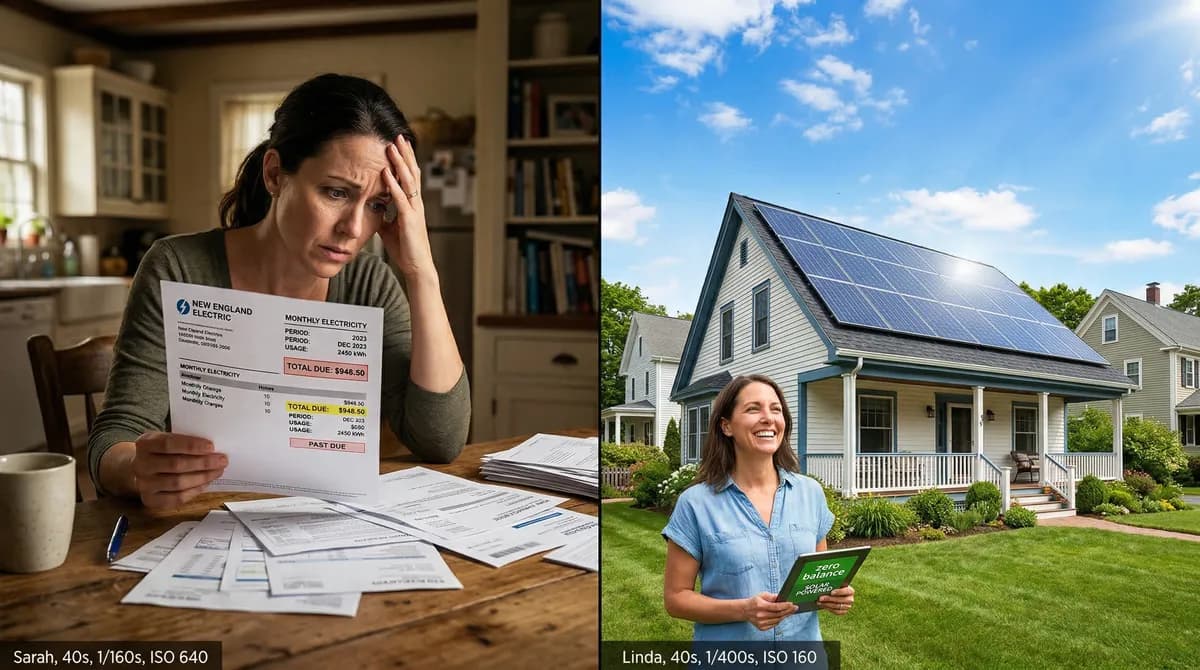
Northeast electricity rates are the highest in the nationbecause of constrained natural gas pipelines, aging grid infrastructure, aggressive renewable mandates, and limited interconnection with cheaper power regions. Massachusetts pays $0.33/kWh — 94% above the $0.17 national average. Solar locks in $0.06–0.08/kWh for 25 years, eliminating rate risk entirely.
$0.33/kWh
Massachusetts Average
$0.17/kWh
National Average
Five structural factors keep New England electricity rates 42–94% above the national average. Solar panels lock in your rate at $0.06–0.08/kWh for 25+ years — regardless of what utilities do next.
Every state NuWatt serves pays significantly more than the national average. Here is what you're actually paying per kilowatt-hour in 2026.
Massachusetts
Eversource $0.28, NGrid $0.32, Unitil $0.28
$0.38
Eversource Eastern MA
+94% vs national
Connecticut
Eversource $0.33, UI $0.28
$0.25
Eversource CT
+76% vs national
Rhode Island
RI Energy $0.30
$0.34
Rhode Island Energy
+71% vs national
New Hampshire
Eversource $0.25, Liberty $0.24, Unitil $0.26
$0.29
Eversource NH
+59% vs national
Maine
CMP $0.27, Versant $0.32
$0.24
Central Maine Power
+59% vs national
New Jersey
PSE&G, JCP&L, ACE (varies)
$0.26
PSE&G
+53% vs national
Vermont
GMP $0.22
$0.21
Green Mountain Power
+29% vs national
Pennsylvania
PPL, PECO, Duquesne (varies widely)
$0.23
PECO Energy
+18% vs national
National Average
EIA residential average, all states
$0.17
Sources: EIA Electric Sales, Revenue, and Average Price (2025-2026), utility rate filings. The headline rate per state is the rep (most-quoted) utility's residential rate including supply + delivery; your utility may differ. See the per-utility breakdown above for the full range in each state.
It is not one thing. It is five compounding factors that have made the Northeast the most expensive electricity market in the continental U.S.
~50%
of NE electricity from natural gas
New England relies on natural gas for roughly 50% of its electricity generation, but the region has severely limited pipeline capacity. Every winter, residential heating demand consumes nearly all available pipeline flow, forcing power plants to compete for the scraps. When gas-fired generators set the marginal price for the entire grid, this scarcity ripples through to every ratepayer's bill.
The deeper story: Multiple pipeline expansion projects (Northern Access, Constitution Pipeline, Northeast Energy Direct) have been blocked by state regulatory actions over the past decade. The result: New England is the only region in the U.S. that regularly imports liquefied natural gas (LNG) from overseas to keep the lights on during winter peaks.
800%
increase in NE transmission costs (2004-2023)
The Northeast's transmission and distribution networks are among the oldest in the country, with some infrastructure dating back to the 1950s and 1960s. Replacing aging poles, transformers, and underground cables is enormously expensive. These modernization costs are passed directly to ratepayers through delivery charges that have increased dramatically.
The deeper story: ISO New England transmission charges alone have risen from about $1.5 billion in 2004 to over $13 billion by 2023. On top of that, grid hardening for extreme weather events (nor'easters, ice storms, hurricanes) adds billions more in capital spending that shows up on your bill as infrastructure surcharges.
40-50%
RPS targets in MA/CT/RI by 2030
Massachusetts, Connecticut, and Rhode Island have among the most aggressive Renewable Portfolio Standards in the country. These mandates require utilities to source an increasing percentage of electricity from renewable sources. To comply, utilities purchase Renewable Energy Certificates (RECs) — and pass those costs directly to ratepayers through their supply charges.
The deeper story: While RPS mandates are driving long-term clean energy deployment, they add $0.01-0.03/kWh to supply costs in the near term. Massachusetts' SMART program, Connecticut's RRES tariff, and Rhode Island's REG all layer additional costs onto bills. The irony: these programs also create the incentive stack that makes rooftop solar financially viable.
Limited
import capacity from neighboring grids
New England is essentially an electrical island. The region has limited interconnection capacity with the rest of the Eastern Interconnect (primarily through New York and a single underwater cable from Quebec). When demand spikes or supply drops, the region cannot easily import cheap power from the Midwest or Southeast.
The deeper story: The Champlain Hudson Power Express and New England Clean Energy Connect (NECEC) projects aim to bring more Canadian hydropower south, but both have faced years of permitting delays. Until significant new import capacity comes online, New England remains bottlenecked — paying premium prices for electricity that costs half as much just a few hundred miles away.
6 months
typical supply rate reset cycle
Retail electricity choice markets in Massachusetts, Connecticut, Maine, and New Hampshire split your bill into two components: supply and delivery. Both charge separately, and supply rates typically reset every 6 months based on wholesale market conditions. This biannual reset creates "rate shock" — the sudden 20-40% jumps that hit your bill without warning.
The deeper story: While deregulation was supposed to drive competition and lower prices, the practical effect has been increased complexity and volatility. Competitive suppliers often offer teaser rates that escalate, and the default "basic service" rate tracks volatile wholesale markets. The result: NE ratepayers face some of the most unpredictable bills in the country.
New England electricity rates have risen 41% since 2020. EIA projections show no reversal in sight. The gap between NE and national rates is widening.
| Year | NE Average | National Avg | NE Premium | Solar LCOE |
|---|---|---|---|---|
| 2020 | $0.22 | $0.13 | +69% | $0.07 |
| 2021 | $0.23 | $0.14 | +64% | $0.07 |
| 2022 | $0.28 | $0.15 | +87% | $0.07 |
| 2023 | $0.29 | $0.16 | +81% | $0.07 |
| 2024 | $0.29 | $0.16 | +81% | $0.07 |
| 2025 | $0.30 | $0.17 | +76% | $0.07 |
| 2026(proj.) | $0.31 | $0.17 | +82% | $0.07 |
| 2027(proj.) | $0.33 | $0.18 | +83% | $0.07 |
| 2028(proj.) | $0.35 | $0.18 | +94% | $0.07 |
| 2029(proj.) | $0.37 | $0.19 | +95% | $0.07 |
| 2030(proj.) | $0.39 | $0.19 | +105% | $0.07 |
The Growing Gap
$0.22
NE avg rate in 2020
$0.31
NE avg rate in 2026
$0.39
NE projected 2030
Solar stays at $0.06–0.08/kWh the entire time.
No rate increases. No supply resets. No surprises. For 25 years.
Historical data: EIA Electricity Monthly Update. Projections: EIA Annual Energy Outlook 2026, adjusted for NE-specific factors. Solar LCOE: NREL 2025 residential benchmark.
Solar panels produce electricity at a fixed cost for 25+ years. No rate resets. No pipeline constraints. No infrastructure surcharges. Just predictable, cheap power.
Solar's levelized cost of energy (LCOE) is $0.06–0.08/kWh over 25 years. Once your system is installed, your per-kWh cost never changes. Compare that to the 41% increase NE ratepayers have absorbed since 2020.
No more biannual supply rate resets. No more “rate shock” letters from Eversource or National Grid. Solar makes your electricity cost as predictable as a fixed-rate mortgage. Your neighbors' rates go up; yours stay flat.
Here is the math that makes solar in high-rate states extraordinary: your solar cost is fixed, but utility rates rise 4–6% annually. By year 10, you're saving $0.25+/kWh. By year 20, the gap is enormous. The higher your starting rate, the more you save.
A typical 10 kW solar system in Massachusetts (producing ~11,500 kWh/year) at current rates:
Year 1 Savings
$2,875
11,500 kWh x ($0.33 - $0.08)
Year 10 Savings
$4,370
Utility rate now ~$0.46/kWh
Year 20 Savings
$6,440
Utility rate now ~$0.64/kWh
25-Year Total
$58,000+
Cumulative savings
Assumes 4.5% annual utility rate increase, 0.5% annual panel degradation, $0.08/kWh solar LCOE. No federal tax credit included.
Higher rates mean faster payback. Here is how solar pencils out in each state we serve — even without the federal residential tax credit.
| State | Utility Rate | Solar Cost | Cash Payback | Key Incentive |
|---|---|---|---|---|
| Massachusetts | $0.33/kWh | $3.15/W | 8-10 yr | SMART 3.0 ($0.03/kWh, 20yr) |
| Connecticut | $0.30/kWh | $3.10/W | 8-9 yr | RRES + ConnectedSolutions |
| Rhode Island | $0.29/kWh | $3.05/W | 7-9 yr | REF $0.65/W + REG $0.27/kWh |
| New Jersey | $0.26/kWh | $3.00/W | 10-12 yr | ADI $85.00/MWh (15yr) |
| New Hampshire | $0.27/kWh | $3.03/W | ~9.5 yr | NEM 2.0 (utility-specific component credit) |
| Maine | $0.27/kWh | $3.05/W | 12-15 yr (CMP) / 10-12 yr (Versant) | 1:1 net metering, tax exempt |
Important: No Federal Tax Credit for Cash/Loan Purchases
The 30% residential solar tax credit (Section 25D) expired December 31, 2025. These payback periods reflect the full out-of-pocket cost with no federal credit. Solar leases and PPAs still benefit from the commercial ITC (Section 48/48E) through July 4, 2026, because the third-party system owner — not the homeowner — claims the credit.
In the Northeast, batteries do more than back up your home during outages. They earn money through demand response programs.
Massachusetts, Connecticut, and Rhode Island offer the ConnectedSolutions program, which pays homeowners with battery storage to reduce grid demand during summer peak events. Your battery automatically dispatches stored solar energy to the grid when demand is highest.
$275/kW
Eversource MA (summer)
$225/kW
National Grid MA (summer)
A typical 10 kWh battery earns $1,000–1,500 per year, accelerating your solar payback by 2–3 years. Plus, you get backup power during grid outages from nor'easters, ice storms, and summer heat events.
Even without ConnectedSolutions, batteries optimize your energy economics. They store cheap solar power generated during the day and discharge it during expensive evening peak hours, maximizing the value of every kWh your panels produce.
The residential tax credit is gone, but solar companies can still claim the commercial ITC. This makes $0-down leases and PPAs more attractive than ever for homeowners who want immediate savings without upfront cost.
$0
Upfront cost
10–30%
Day-one bill savings
25 yrs
System + warranty coverage
How it works: A financing company owns the solar system on your roof and claims the 30% commercial ITC (Section 48/48E). They pass some of that savings to you through a lower monthly lease payment or PPA rate. You pay less than your current utility bill from day one, with no upfront investment. The commercial ITC is available for projects beginning construction before July 4, 2026.
Massachusetts electricity rates average $0.33/kWh in 2026 — nearly double the national average. The primary drivers are constrained natural gas pipeline capacity (which spikes winter generation costs), aging transmission infrastructure requiring billions in upgrades, and aggressive Renewable Portfolio Standards that add REC compliance costs to supply charges. The deregulated market structure also creates biannual rate resets that produce sudden bill increases.
Vermont has the lowest average electricity rate in New England at approximately $0.22/kWh, thanks to its unique utility structure (Green Mountain Power is the dominant utility) and significant hydro/nuclear baseload generation. However, even Vermont's rates are 29% above the national average of $0.17/kWh. No New England state has rates at or below the national average.
No credible forecast projects rate decreases for the Northeast. EIA projections, ISO-NE market analysis, and utility rate filings all point to continued increases of 4-6% annually. The fundamental drivers — pipeline constraints, infrastructure aging, and growing electrification demand from EVs and heat pumps — are structural problems that will take decades to resolve. This is precisely why locking in solar at $0.06-0.08/kWh is so valuable.
Solar panels produce electricity at a levelized cost of $0.06-0.08/kWh over their 25-year lifespan (even without the federal tax credit, which expired in 2025). Compare that to Northeast utility rates of $0.22-0.33/kWh that increase every year. A Massachusetts homeowner paying $0.33/kWh who goes solar effectively locks in a rate that is 76-82% cheaper than their current utility cost — and the gap widens every year as utility rates rise.
Absolutely — high electricity rates actually make solar more valuable, not less. The higher your utility rate, the more each kilowatt-hour your panels produce saves you. A 10 kW system in Massachusetts saves approximately $40,000-$60,000 over 25 years. In Rhode Island, the combination of high rates ($0.29/kWh) and strong incentives (REF rebate + REG payments) creates a 7-9 year payback period, making it one of the best solar markets in the country.
The 2022 spike was triggered by global natural gas price surges following Russia's invasion of Ukraine, which disrupted energy markets worldwide. Because New England relies on natural gas for ~50% of electricity generation and has constrained pipeline capacity, the region was hit especially hard. Eversource and National Grid both implemented 50%+ supply rate increases. While rates have moderated somewhat since then, they have not returned to pre-2022 levels and EIA projects continued increases.
Yes. Battery storage paired with solar unlocks additional revenue through demand response programs like ConnectedSolutions in Massachusetts, Connecticut, and Rhode Island. These programs pay $225-275 per kW of battery capacity for reducing grid demand during summer peaks. A typical 10 kWh battery can earn $1,000-1,500 per year through these programs, accelerating your solar payback period by 2-3 years.
As of early 2026, Eversource Massachusetts residential rates are approximately $0.34/kWh, while National Grid Massachusetts charges approximately $0.32/kWh. Both utilities reset their supply rates every 6 months (January and July), so these numbers fluctuate. National Grid has historically been somewhat higher than Eversource. Both are significantly above the national average of $0.17/kWh.
The Levelized Cost of Energy (LCOE) for residential rooftop solar in the Northeast is approximately $0.06-0.08/kWh over a 25-year lifespan. This calculation divides the total installed cost by the total energy produced over the system's lifetime. Even without the federal tax credit (which expired in 2025), this is 76-82% cheaper than Massachusetts utility rates. With state incentives like SMART 3.0 or Rhode Island's REG, the effective LCOE drops even further.
For many Northeast homeowners, a solar lease or PPA is now more attractive than ever. Since the residential tax credit expired, cash purchases have longer payback periods. But leases and PPAs still benefit from the commercial ITC (Section 48/48E) because the third-party owner claims the credit. This means $0 upfront with immediate savings of 10-30% on your electric bill. Cash purchases still deliver greater lifetime savings for those who can wait 8-12 years for full payback.
Enter your address and utility bill. We will show you exactly how much solar saves at your specific rate — and how the savings grow every year as utility rates climb.
Free, no-obligation analysis. Takes 2 minutes. Available in MA, CT, RI, NH, NJ, ME, PA, VT, and TX.