
Loading NuWatt Energy...
We use your location to provide localized solar offers and incentives.
We serve MA, NH, CT, RI, ME, VT, NJ, PA, and TX
Loading NuWatt Energy...
NuWatt designs, installs, and manages solar, battery, heat pump, and EV charger systems across 9 states. One company, one warranty, one point of contact.
Get a Free QuoteTwo heat pump technologies, two very different approaches to home comfort. We compare installed cost, efficiency, noise, aesthetics, and real-world performance so you can make the right choice for your home.
Updated March 2026
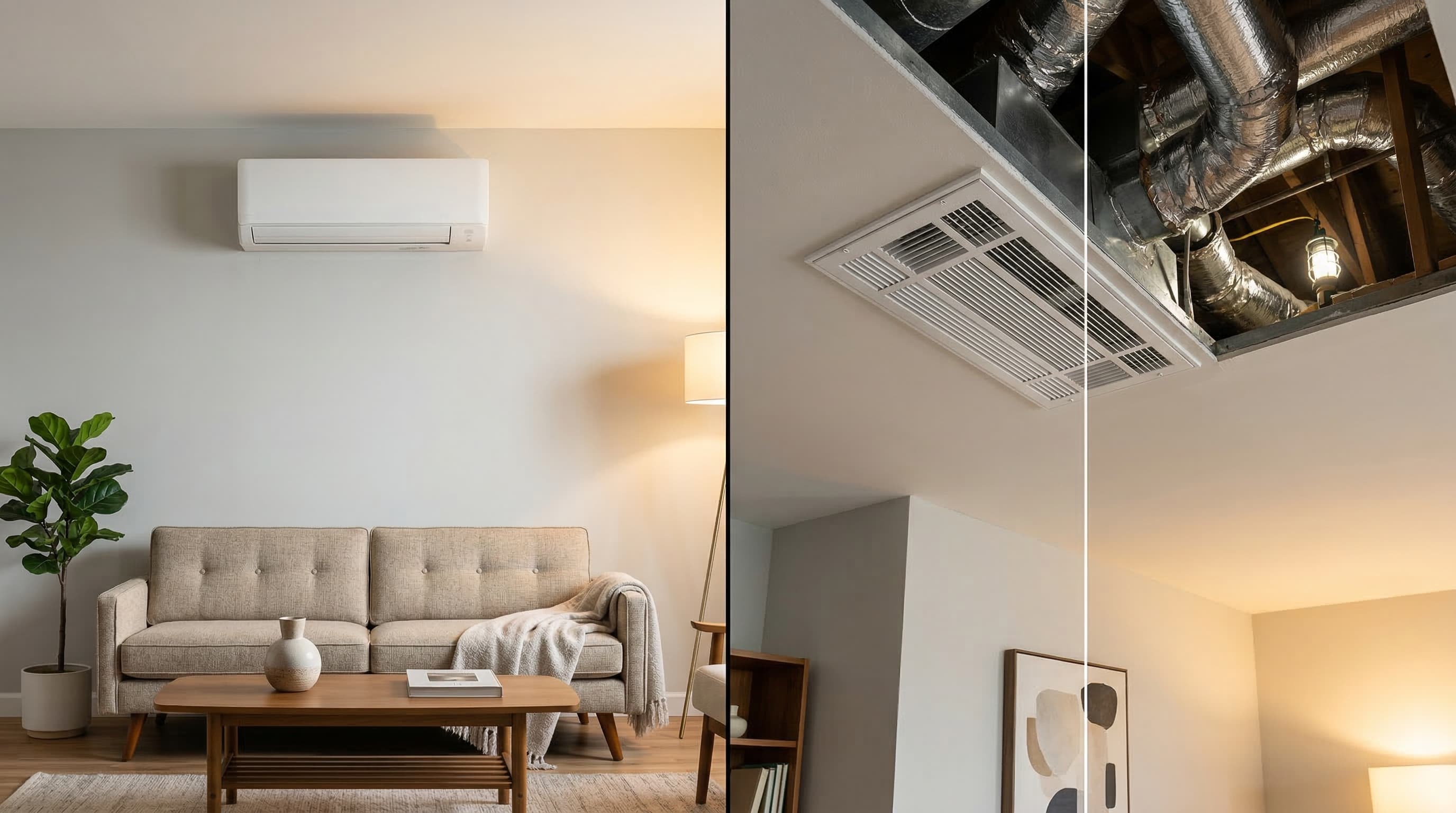
Bottom line: Mini splits deliver superior efficiency and zone control at a lower per-room cost. Central air heat pumps win on aesthetics and whole-home simplicity when good ductwork already exists. Many homeowners combine both in a hybrid setup.
How mini splits and central air heat pumps stack up across the 8 categories homeowners care about most.
| Category | Mini Split | Central Air HP | Notes |
|---|---|---|---|
| Installed Cost | $3,000-$6,800 per zoneWINS | $8,000-$15,000 whole-home | Mini split is cheaper for 1-2 zones; central air is more cost-effective for whole-home coverage with existing ductwork. |
| Cooling Efficiency (SEER2) | 20-33 SEER2WINS | 15-22 SEER2 | Mini splits avoid duct losses (15-30% of energy in typical ductwork) and use inverter compressors for precise output. |
| Heating Efficiency (HSPF2) | 10-14 HSPF2WINS | 8-11 HSPF2 | Cold-climate mini splits like Mitsubishi Hyper-Heat and Fujitsu XLTH+ maintain high output even at -13F. |
| Installation Complexity | Minor wall penetration (3" hole)WINS | Requires existing or new ductwork | Mini split install takes 4-8 hours. Ducted systems with new ductwork can take 3-5 days. |
| Aesthetics | Visible wall-mounted indoor unit | Hidden behind vents and grillesWINS | Concealed duct and ceiling cassette mini split options exist for those who want the efficiency without visible wall units. |
| Zone Control | Per-room temperature controlWINS | Single thermostat (or expensive zone dampers) | Each mini split head has its own thermostat. Zone dampers for ducted systems add $2,000-$3,500. |
| Indoor Noise | 19-32 dB (whisper quiet)WINS | 35-55 dB (duct noise + air handler) | 19 dB is quieter than a library. Duct noise comes from air rushing through supply and return vents. |
| Maintenance | Filter cleaning every 2-4 weeks | Filter replacement + duct cleaning every 3-5 yearsTIE | Mini split filters are washable but need frequent cleaning. Ducted systems need professional duct cleaning ($300-$500). |
Mini Split
$3,000-$6,800 per zone
WINSCentral Air HP
$8,000-$15,000 whole-home
Mini split is cheaper for 1-2 zones; central air is more cost-effective for whole-home coverage with existing ductwork.
Mini Split
20-33 SEER2
WINSCentral Air HP
15-22 SEER2
Mini splits avoid duct losses (15-30% of energy in typical ductwork) and use inverter compressors for precise output.
Mini Split
10-14 HSPF2
WINSCentral Air HP
8-11 HSPF2
Cold-climate mini splits like Mitsubishi Hyper-Heat and Fujitsu XLTH+ maintain high output even at -13F.
Mini Split
Minor wall penetration (3" hole)
WINSCentral Air HP
Requires existing or new ductwork
Mini split install takes 4-8 hours. Ducted systems with new ductwork can take 3-5 days.
Mini Split
Visible wall-mounted indoor unit
Central Air HP
Hidden behind vents and grilles
WINSConcealed duct and ceiling cassette mini split options exist for those who want the efficiency without visible wall units.
Mini Split
Per-room temperature control
WINSCentral Air HP
Single thermostat (or expensive zone dampers)
Each mini split head has its own thermostat. Zone dampers for ducted systems add $2,000-$3,500.
Mini Split
19-32 dB (whisper quiet)
WINSCentral Air HP
35-55 dB (duct noise + air handler)
19 dB is quieter than a library. Duct noise comes from air rushing through supply and return vents.
Mini Split
Filter cleaning every 2-4 weeks
Central Air HP
Filter replacement + duct cleaning every 3-5 years
TIEMini split filters are washable but need frequent cleaning. Ducted systems need professional duct cleaning ($300-$500).
These prices include equipment and professional installation. Actual cost depends on brand, home complexity, and your region.
| Configuration | Equipment | Installation | Total Installed |
|---|---|---|---|
| Single-zone (1 room) | $1,500-$3,500 | $1,500-$3,000 | $3,000-$6,800 |
| 2-zone system | $3,000-$6,500 | $2,500-$4,500 | $5,500-$11,000 |
| 3-zone system | $5,500-$10,000 | $3,500-$6,000 | $9,000-$16,000 |
| 4-zone system | $7,500-$13,000 | $4,500-$7,500 | $12,000-$20,500 |
| 5-zone whole-home | $10,000-$16,000 | $5,500-$8,500 | $15,500-$24,500 |
Mini splits shine in homes where installing ductwork would be impractical, expensive, or impossible. They deliver the highest efficiency of any residential HVAC system and give you granular room-by-room temperature control that ducted systems simply cannot match without expensive zone damper add-ons.
If your home fits any of the following scenarios, a ductless mini split is almost certainly the right call.
Homes with baseboard heat, radiators, or wall heaters. Adding ductwork typically costs $5,000-$15,000 and involves tearing into walls and ceilings. A mini split avoids all of that.
Finished attics, basement apartments, above-garage rooms, sunrooms, and enclosed porches. Extending existing ductwork to these spaces is often impractical.
Homes with lath-and-plaster walls, no chase routes for ductwork, and historical architectural details you do not want to disturb. A 3-inch hole in the wall is all a mini split needs.
Multi-story homes where the second floor is always warmer, or households where different family members prefer different temperatures. Each mini split head has its own thermostat.
Spaces that are disconnected from the main HVAC system. A single-zone mini split provides both heating and cooling for $3,000-$5,000 installed.
If whole-home HVAC replacement is not in the budget, a single-zone mini split can heat and cool your most-used room for a fraction of the cost.
Mitsubishi Hyper-Heat
SEER2 up to 33 | -13F | 12-yr warranty
Fujitsu XLTH+
HSPF2 14 | -22F | Highest cold-climate efficiency
Daikin Aurora
SEER2 28 | -22F | R-32 refrigerant
LG Red
SEER2 26 | -13F | Strong value proposition
TOSOT
SEER2 22 | R32 | Multi-zone budget option
Carrier Greenspeed
SEER2 22 | HSPF2 11 | Variable-speed inverter
Daikin FIT
SEER2 18 | Slim outdoor unit | Side-discharge
Lennox XP25
SEER2 21 | HSPF2 10 | SilentComfort tech
Bosch IDS 2.0
SEER2 20 | HSPF2 10.5 | 5F rated | Inverter
A ducted central air heat pump replaces both your furnace and air conditioner in a single unit. If your home already has well-sealed, properly insulated ductwork, this is often the most cost-effective path to all-electric heating and cooling.
Central air heat pumps make the most sense in these scenarios:
If your home already has a ducted forced-air system with well-sealed, insulated ducts, swapping the outdoor unit and air handler is far cheaper than installing multiple mini split heads. Typical cost: $8,000-$15,000 installed.
A central system heats and cools every room to the same temperature through a network of supply and return vents. Ideal for open floor plans and homes where consistent comfort throughout is the priority.
No wall-mounted indoor units visible in any room. The only visible components are small supply vents and the outdoor compressor. Many homeowners with newer or higher-end homes prefer this clean look.
One thermostat controls the entire home. No need to manage multiple remote controls or apps for different zones. Works seamlessly with smart thermostats like Ecobee and Google Nest.
If your central AC or furnace is at end of life (15+ years), replacing both with a single heat pump is the most efficient upgrade. You eliminate the gas bill entirely and get two-way comfort from one system.
Many New England homeowners are discovering that the best HVAC system is actually two systems working together. A ducted heat pump handles the main living areas while mini split heads provide targeted comfort in bedrooms, additions, or problem rooms.
Main Floors: 3-ton Carrier Greenspeed
Ducted system for first and second floor living areas using existing ductwork. Handles 70% of the heating/cooling load.
Upstairs Bedrooms: 2 Mitsubishi Wall-Mount Heads
Independent temperature control for each bedroom. Whisper-quiet 19 dB operation for better sleep. Handles the remaining 30% of the load.
Total Installed Cost
$18,000-$24,000
Annual Operating Cost
$1,100-$1,500
The ducted system provides base-load comfort while mini split heads address the rooms that ductwork struggles to reach — typically upstairs bedrooms, finished attics, and additions.
Mini split heads in bedrooms can be set to lower temperatures during the day and pre-cool/pre-heat before bedtime. The ducted system handles common areas during waking hours. This targeted approach reduces total energy use by 15-25%.
If one system needs service, the other keeps your home habitable. This matters in northern climates where losing heat in January is more than an inconvenience.
You can install the ducted system first and add mini split heads later as budget allows. Or start with mini splits in the most uncomfortable rooms and add the ducted system when the old furnace fails.
NuWatt installer tip: When designing a hybrid system, we size the ducted unit for the base load (typically 60-70% of the home) and add mini split heads for the remaining zones. This avoids oversizing either system, which wastes money and reduces efficiency.
"Mini split" does not mean "wall unit." There are four indoor unit styles, each suited to different room types and aesthetic preferences.
The most common mini split type. Mounts high on the wall, distributes air downward. Easiest and fastest to install.
Best For
Standard rooms, bedrooms, living areas
Pros
Cons
Flush-mounted into the ceiling with only the grille visible. Distributes air in 4 directions for even coverage.
Best For
Open floor plans, rooms where aesthetics matter, commercial spaces
Pros
Cons
Sits near the floor, often under windows. Heats from the bottom up, similar to a radiator. Ideal for rooms with limited wall space.
Best For
Rooms with large windows, radiator replacements, attic spaces with knee walls
Pros
Cons
Hidden above the ceiling or in a closet, uses short duct runs (10-15 feet) to supply registers. Combines mini split efficiency with a traditional look.
Best For
Renovations where aesthetics are paramount, multi-room coverage from one unit
Pros
Cons
All four indoor unit types connect to the same outdoor compressor. You can mix and match styles in a multi-zone system — for example, a wall mount in the bedroom and a ceiling cassette in the living room.
The efficiency gap between mini splits and central air heat pumps comes down to two factors: duct losses and inverter technology.
Even in a well-maintained ducted system, 15-30% of the conditioned air never reaches your rooms. It leaks through joints, connections, and gaps in the ductwork — especially in unconditioned attics and crawlspaces. That is energy you are paying for but never feeling.
Mini splits deliver air directly into the room with zero duct losses. The refrigerant line between outdoor and indoor units loses less than 1% of energy.
Nearly all mini splits use inverter-driven compressors that vary speed continuously based on demand. Instead of cycling on and off (which wastes energy at startup), they run at exactly the output needed.
Most central air heat pumps still use single-speed or two-stage compressors. Premium models like the Carrier Greenspeed and Bosch IDS 2.0 do have inverter compressors, narrowing the gap — but they cost more ($12,000-$15,000 vs $6,000-$10,000 for standard ducted models).
A mini split with SEER2 26 and HSPF2 12 costs roughly 30-40% less to operate annually than a standard ducted heat pump with SEER2 16 and HSPF2 9. For a typical 2,000 sq ft New England home, that translates to $400-$700 per year in lower electricity bills.
Over a 15-year system life, the energy savings ($6,000-$10,500) often exceed the price difference between the two systems, making mini splits the lower total-cost-of-ownership option even for whole-home installations.
Both mini splits and central air heat pumps can handle cold climates, but the technology leaders differ. In the mini split category, Mitsubishi Hyper-Heat, Fujitsu XLTH+, and Daikin Aurora all operate at -13F to -22F. For ducted systems, the Carrier Greenspeed and Bosch IDS 2.0 are the top cold-climate performers, rated to 0F and 5F respectively.
The key difference: cold-climate mini splits maintain a higher percentage of rated capacity at extreme temperatures. The Fujitsu XLTH+ retains 87% of its capacity at 5F, while even the best ducted systems retain about 70-80%. This matters in northern states where sustained sub-zero temperatures are common in January and February.
The Northeast Energy Efficiency Partnerships (NEEP) cold-climate air source heat pump (ccASHP) specification is the industry standard for northern performance. To qualify:
Most state rebate programs require NEEP-listed or equivalent models. Both mini split and ducted models can qualify, though mini splits dominate the NEEP list.
For homes in climate zones 5-6 (most of New England, upstate NY, northern PA), we recommend cold-climate rated models regardless of whether you choose mini split or ducted. Standard heat pumps lose too much capacity below 20F to serve as a sole heat source.
The most common questions we hear from homeowners deciding between mini splits and central air.
Yes. Ductless mini splits typically achieve SEER2 ratings of 20-33, compared to 15-22 for central air heat pumps. They also avoid duct losses, which waste 15-30% of energy in a typical ducted system. A mini split with a SEER2 of 26 can cost 30-40% less to operate than a central air system rated at SEER2 16.
Yes, but it requires multiple indoor units (heads) connected to one or more outdoor units. A typical 2,000 sq ft home needs 3-5 zones. Multi-zone mini split systems cost $15,500-$24,500 installed for whole-home coverage. For homes with existing ductwork in good condition, a ducted central air heat pump is often more cost-effective for whole-home heating and cooling.
As a general rule: one head per room you want to independently control. A 1,500 sq ft home typically needs 3-4 heads, while a 2,500+ sq ft home needs 4-6. Each head handles 9,000-24,000 BTU depending on the model. A professional load calculation (Manual J) determines exact sizing based on your home's insulation, windows, and climate zone.
Absolutely. Cold-climate mini splits from Mitsubishi (Hyper-Heat), Fujitsu (XLTH+), Daikin (Aurora), and LG (Red) are rated to heat at temperatures as low as -13F to -22F. These models maintain 75-100% of their rated heating capacity at 5F, meeting NEEP cold-climate specifications. They are standard equipment throughout New England, where NuWatt installs hundreds each year.
For 1-2 rooms, a mini split is significantly cheaper ($3,000-$6,800 per zone vs $8,000-$15,000 for whole-home central air). For whole-home coverage in a home with existing, well-sealed ductwork, central air is usually more cost-effective. If you need new ductwork ($5,000-$15,000 additional), mini splits almost always win on cost.
Yes, and this is increasingly common. Many homeowners add 1-2 mini split heads to supplement their ducted system. Common scenarios include adding a mini split to a room addition, a finished attic or basement, a garage or sunroom, or bedrooms that are too hot or cold. The hybrid approach gives you whole-home duct coverage plus targeted zone control where you need it most.
Both systems have similar lifespans. Mini splits typically last 15-20 years, while central air heat pumps last 15-20 years for the outdoor unit (the ductwork can last 20-25 years with maintenance). Premium brands like Mitsubishi and Daikin offer 12-year compressor warranties, and Carrier offers 10-year warranties on their ducted systems.
Mini split indoor units are among the quietest HVAC systems available, operating at 19-32 decibels (dB) — quieter than a library (40 dB) or a whispered conversation (30 dB). Central air systems generate 35-55 dB indoors due to air moving through ductwork. Outdoor mini split units operate at 48-58 dB, comparable to a normal conversation.
Our NABCEP-certified energy advisors will evaluate your home, ductwork condition, insulation, and comfort goals — then recommend the system (or combination) that delivers the best value. Free assessment, no obligation.
Serving Massachusetts, Connecticut, Rhode Island, New Hampshire, Maine, Vermont, New Jersey, Pennsylvania, and Texas.