
Loading NuWatt Energy...
We use your location to provide localized solar offers and incentives.
We serve MA, NH, CT, RI, ME, VT, NJ, PA, and TX
Loading NuWatt Energy...
NuWatt designs, installs, and manages solar, battery, heat pump, and EV charger systems across 9 states. One company, one warranty, one point of contact.
Get a Free QuoteA single-zone system heats and cools one room for $3K-$6.8K. A multi-zone system covers your whole home for $9K-$24.5K. But sometimes buying multiple single-zone units is the smarter play. Here is how to decide.
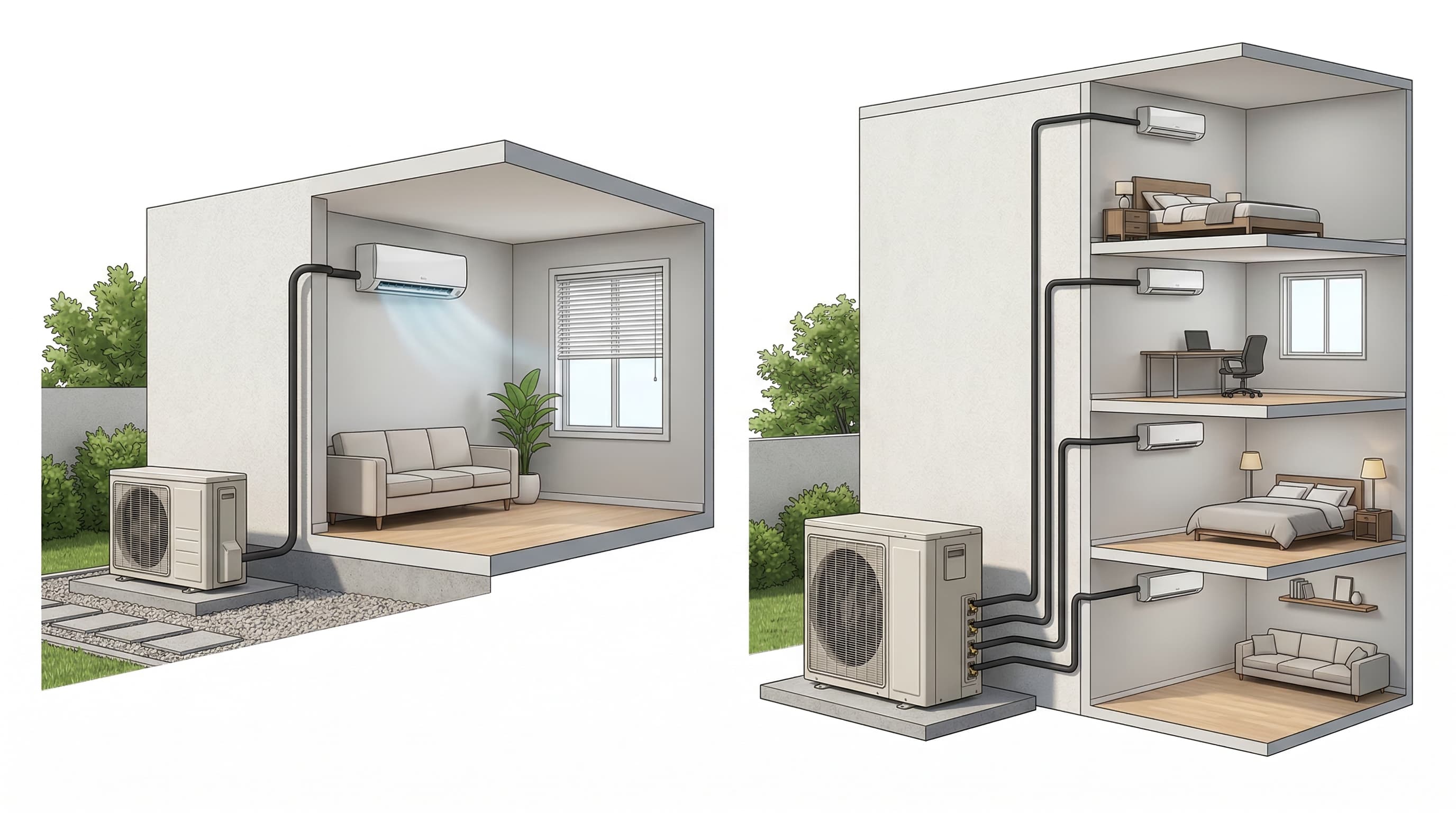
Single-Zone Wins When
You have one problem room (hot bedroom, cold office, garage gym). Budget: $3,000-$6,800.
Multi-Zone Wins When
You need whole-home comfort across 2-5 rooms. One outdoor unit, independent zone control. Budget: $5,500-$24,500.
Multiple Singles Win When
Zones are far apart, you want redundancy, or you plan to add rooms over time. Best for 2-3 zones.
How the two configurations compare across the six factors that matter most to homeowners.
| Factor | Single-Zone | Multi-Zone |
|---|---|---|
| Cost per zone | $3,000-$6,800 | $2,000-$4,000/zone when bundled |
| Efficiency per zone | Highest SEER2 per head | Slightly lower per head |
| Installation complexity | 1 outdoor + 1 indoor unit | 1 outdoor + 2-5 indoor units |
| Outdoor units needed | 1 per zone (can add up) | 1 total for all zones |
| Failure risk | Independent — others keep running | Single point of failure (outdoor unit) |
| Ideal home size | 1 problem room or supplement | Whole-home replacement (2-5 zones) |
Fully installed pricing including equipment, labor, materials, and permit fees. Costs vary by brand, line-set length, and local labor rates.
| Configuration | Equipment | Installation | Total Installed |
|---|---|---|---|
| Single-zone (1 room) | $1,500-$3,500 | $1,500-$3,000 | $3,000-$6,800 |
| 2-zone system | $3,000-$6,500 | $2,500-$4,500 | $5,500-$11,000 |
| 3-zone system | $5,500-$10,000 | $3,500-$6,000 | $9,000-$16,000 |
| 4-zone system | $7,500-$13,000 | $4,500-$7,500 | $12,000-$20,500 |
| 5-zone whole-home | $10,000-$16,000 | $5,500-$8,500 | $15,500-$24,500 |
Price note: These are national averages for 2026. New England installations tend toward the higher end due to labor costs and code requirements. State and utility rebates can reduce your out-of-pocket cost significantly — check your state rebates.
A single-zone system pairs one outdoor compressor with one indoor unit. It is the simplest, most efficient, and most affordable way to heat and cool a specific space.
That bedroom over the garage that is always too hot in summer and freezing in winter. A single 12K BTU head solves it for $3,500-$5,500.
Your central system handles most of the house, but one area needs help. A single-zone unit fills the gap without replacing your furnace.
Starting at $3,000 installed, a single-zone system is the most affordable entry point to heat pump comfort. No need to finance $15K+ for the whole house.
New additions and three-season rooms rarely have existing ductwork. A wall-mounted or ceiling cassette unit adds year-round comfort with zero duct modifications.
Work-from-home spaces need independent temperature control. A single-zone unit lets you heat your office without heating the whole house.
Garages need their own system anyway. A single-zone unit rated for low temperatures handles heating and cooling without connecting to your home system.
A multi-zone system connects one outdoor condenser to 2-5 indoor units (called “heads”). Each head has its own thermostat for independent room-by-room control.
Retiring an old furnace and central AC? A 4-5 zone system replaces both with one efficient heat pump system. You get heating, cooling, and dehumidification from a single outdoor unit.
Each bedroom gets its own temperature. No more thermostat wars. Kids can keep their room at 68 degrees while the master stays at 72 degrees — without affecting each other.
Large open-concept spaces often have temperature stratification — hot by the windows, cool in the center. A multi-zone system with heads in strategic positions evens things out.
Building a new home or a major addition? A multi-zone mini split eliminates the need (and cost) for a full duct system. You save $5,000-$15,000 in ductwork installation.
There is a third path that many homeowners overlook: installing two or three separate single-zone systems instead of one multi-zone. This approach has real advantages in specific situations.
Independent Operation
If one outdoor unit fails, the other rooms keep running. With a multi-zone system, a single compressor failure takes out every zone in your home.
Higher Individual SEER2
Single-zone units typically achieve higher SEER2 ratings than the same brand's multi-zone heads. A Mitsubishi single-zone can hit SEER2 20+, while the multi-zone head averages 17-18.
Flexible Staging
Add units one at a time as your budget allows. Install the bedroom this year, the living room next year. No need to buy the full system upfront.
Better for Distant Zones
Long lineset runs (50+ feet) between the outdoor unit and indoor heads degrade efficiency. Separate outdoor units placed close to each room avoid this penalty.
Two Single-Zone 12K BTU Systems
$7,000-$13,000
Two outdoor units, two indoor heads
One 2-Zone 24K BTU System
$5,500-$11,000
One outdoor unit, two indoor heads
Bottom line: The multi-zone saves $1,500-$2,000 upfront, but the two singles give you redundancy and higher per-unit efficiency. If the zones are in distant parts of the house, multiple singles may also perform better due to shorter lineset runs.
Proper sizing is critical. An undersized unit will not keep up on extreme days. An oversized unit will short-cycle, waste energy, and fail to dehumidify. Use this table as a starting point, then have your installer run a Manual J load calculation for your specific home.
| Room Size (sq ft) | BTU Needed | Tons | Typical Rooms |
|---|---|---|---|
| 150-300 sq ft | 6,000-9,000 BTU | 0.5-0.75 ton | Bedroom, home office |
| 300-550 sq ft | 9,000-12,000 BTU | 0.75-1 ton | Large bedroom, living room |
| 550-800 sq ft | 12,000-18,000 BTU | 1-1.5 ton | Open kitchen/dining area |
| 800-1,200 sq ft | 18,000-24,000 BTU | 1.5-2 ton | Great room, finished basement |
Adjust Up For
Adjust Down For
Pro Tip
For cold climates (New England, Upstate NY), size your mini split for the heating load, not the cooling load. Heating requires more BTU than cooling for the same room. A unit that handles winter will handle summer easily.
Answer these three questions to narrow down your best option.
1. How many rooms need independent temperature control?
1
Single-zone
2-3
Multi-zone or multiple singles
4-5
Multi-zone
2. Are the rooms close together or far apart?
Close (same floor, nearby)
Multi-zone works well. Short linesets mean minimal efficiency loss.
Far (opposite ends, different floors)
Multiple singles may perform better. Long linesets reduce multi-zone efficiency.
3. Is this replacing your entire HVAC system?
Yes, whole-home replacement
Multi-zone is usually the most cost-effective. One outdoor unit keeps the exterior clean.
No, supplementing existing HVAC
Single-zone for one room. Multiple singles if supplementing 2-3 rooms over time.
For a single room, a single-zone mini split ($3,000-$6,800) is the most affordable option. For 3+ rooms, a multi-zone system typically costs less per zone ($2,000-$4,000 each) because you share one outdoor unit. The break-even point is usually around 2-3 zones — at that point, multi-zone starts to become cheaper per room than buying separate single-zone systems.
No. A single-zone outdoor unit is designed for exactly one indoor unit. You cannot add a second head to it. However, you can install additional standalone single-zone systems later — each with its own outdoor unit. If you think you might want multiple zones in the future, consider installing a multi-zone outdoor unit sized for your eventual needs, then adding indoor heads over time.
As a general guide: 150-300 sq ft needs 6,000-9,000 BTU (bedroom), 300-550 sq ft needs 9,000-12,000 BTU (living room), 550-800 sq ft needs 12,000-18,000 BTU (open kitchen), and 800-1,200 sq ft needs 18,000-24,000 BTU (great room). These are starting estimates — actual sizing depends on ceiling height, insulation quality, sun exposure, and climate zone. A Manual J calculation provides the most accurate result.
Not necessarily. A multi-zone system uses one inverter-driven compressor that adjusts output to match total demand. When only one zone is calling for heat or cooling, the outdoor unit runs at low capacity and uses minimal electricity. However, each individual head in a multi-zone system tends to have a slightly lower SEER2 rating than a dedicated single-zone unit. The practical difference in monthly bills is usually small (5-10%).
If the single outdoor unit on a multi-zone system fails, every indoor unit in your home loses heating and cooling simultaneously. Repairs can take 1-3 days depending on parts availability. With separate single-zone systems, a failed outdoor unit only affects that one room — the rest of your home stays comfortable. This redundancy is the biggest advantage of multiple single-zone installations.
No. Multi-zone systems require matched indoor and outdoor units from the same manufacturer. The outdoor compressor communicates with each indoor head via proprietary control signals. Mixing brands will result in communication errors, warranty voidance, and poor performance. If you want units from different brands, install separate single-zone systems instead.
Heat Pump Comparison Hub
Side-by-side comparisons of all major brands and configurations.
ExploreHeat Pump Products
Detailed specs on all 12 models we install, from Mitsubishi to TOSOT.
View allBest Ductless Mini Splits
Our ranked picks for the best mini splits in 2026 with installer notes.
See rankingsOur HVAC specialists will assess your home layout, insulation, and comfort goals to recommend the right single-zone or multi-zone setup. Free estimates, no pressure.