
Loading NuWatt Energy...
We use your location to provide localized solar offers and incentives.
We serve MA, NH, CT, RI, ME, VT, NJ, PA, and TX
Loading NuWatt Energy...
NuWatt designs, installs, and manages solar, battery, heat pump, and EV charger systems across 9 states. One company, one warranty, one point of contact.
Get a Free Quote
Size your solar system to charge your EV for free, get your Level 2 charger for near $0 net cost, and stack PA SRECs + net metering + tax exemptions before the federal credit expires.

$1,000
30C Tax Credit
$300
PECO Rebate
~$0
Net Charger Cost
6/30/26
Credit Expires
Installing a solar system and EV charger together saves money three ways.
One electrician visit, one permit, one inspection. Bundled installation saves $500-$1,000 vs. separate projects. The charger circuit gets wired during the solar panel install.
Your solar installer runs the 240V circuit for the EV charger while they are already on-site for the panel and inverter installation. One disruption instead of two.
Stack Section 30C ($1,000) + PECO rebate ($300) + PA SREC income ($30-40/MWh) + 1:1 net metering + property and sales tax exemptions. The 30C credit expires June 30, 2026.
Select your EV, enter your annual miles, and choose your utility to see exactly how much extra solar you need and what it will cost in Pennsylvania.
Adjust inputs below to see your PA results
24.2 kWh/100mi · 310 mi range
$0.1800/kWh
Total Annual Savings
$523/yr
Solar offset savings · 13.3 yr payback
Annual EV Energy
2,904kWh
Extra Solar Needed
2.4kW
Additional Panels
~6panels
Solar Upgrade Cost
$6,970
You save $1,157/yr vs gas
$523/yr
Solar EV Offset
13.3 yrs
Payback Period
Based on PECO ($0.1800/kWh) ·1,200 kWh/kW/yr PA avg · $2.88/W installed · Gas: $3.50/gal at 25 MPG · 30C expires 6/30/26 · No residential ITC (25D expired 12/31/25)
Four steps from daily driving to panel count.
Start with your annual miles (US avg: 12,000) and your EV's efficiency rating (kWh per 100 miles).
12,000 mi/yrMultiply: (miles / 100) x efficiency. A Tesla Model Y at 24.2 kWh/100mi x 12,000 miles = 2,904 kWh/year.
2,904 kWh/yrDivide by PA solar production: 2,904 kWh / 1,200 kWh/kW/yr = 2.4 kW of additional solar capacity.
2.4 kW extraDivide by panel wattage: 2,400W / 420W/panel = 6 additional panels on your roof.
~6 panels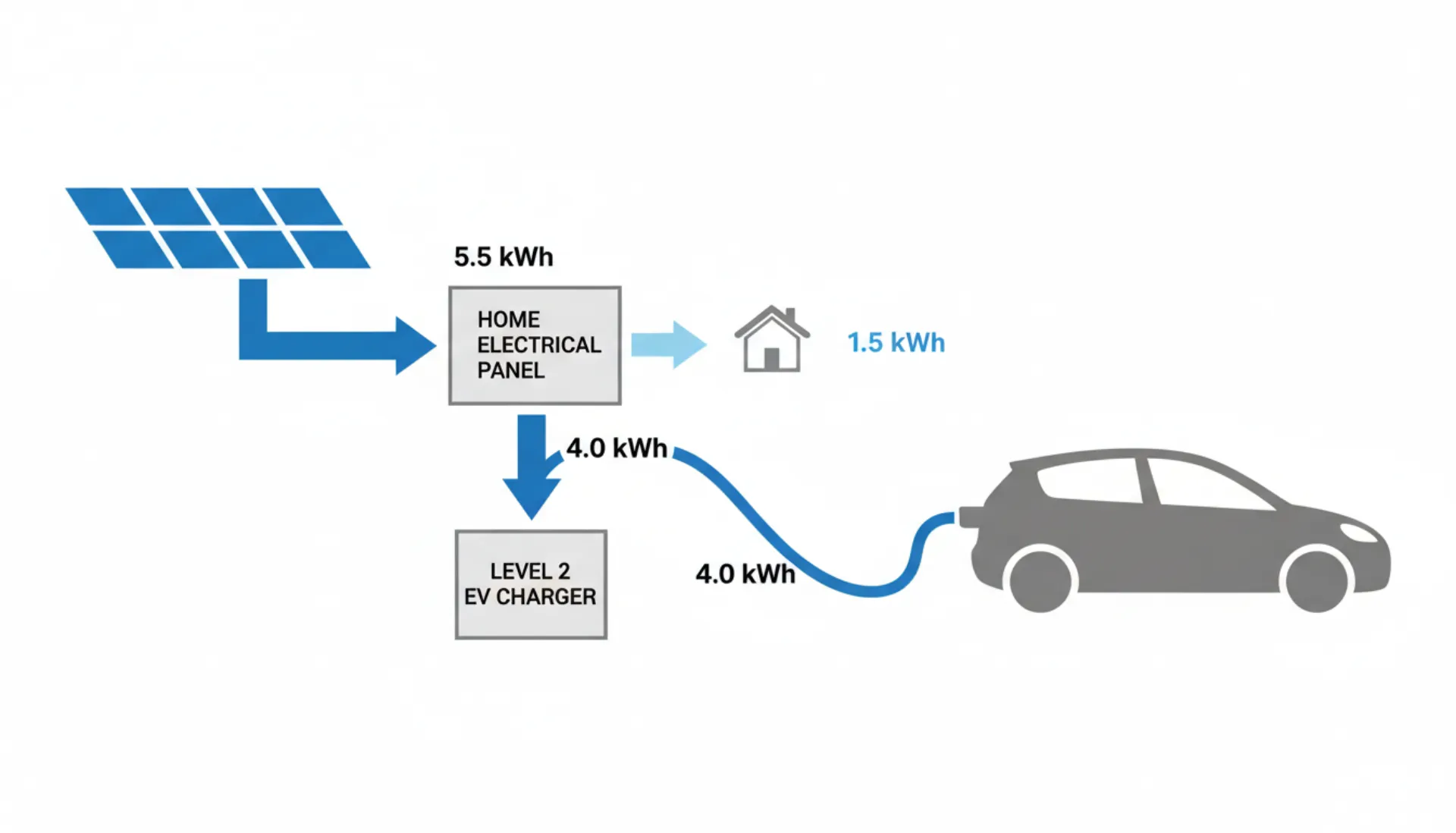
Annual EV energy: (12,000 / 100) x 24.2 = 2,904 kWh
Additional solar: 2,904 / 1,200 = 2.4 kW
Extra panels: 2,400 / 420 = ~6 panels
Solar upgrade cost: 2.4 kW x $2,880/kW = $6,912
Charger net cost: $1,200 - $1,000 (30C) - $300 (PECO) = ~$0
Annual savings: $523/yr electricity + ~$105/yr SREC = $628/yr
Every dollar you can claim in 2026. No residential solar ITC (25D expired).
| Incentive | Amount | Type | Status | Notes |
|---|---|---|---|---|
| Section 30C (EV Charger) | Up to $1,000 | Federal tax credit | Active | Expires June 30, 2026. 30% of cost, max $1,000 residential. |
| PECO EV Charger Rebate | Up to $300 | Utility rebate | Active | PECO territory only (SE PA / Philadelphia metro). Level 2 charger installation. |
| PA SREC Market | ~$30-40/SREC | Ongoing income | Active | 1 SREC per 1,000 kWh produced. Tradeable on open market. Income varies with supply/demand. |
| Net Metering (1:1) | Full retail rate | Bill credit | Active | PA Act 213 requires 1:1 net metering for all utilities. Credits roll over monthly, trued up annually. |
| Property Tax Exemption | 100% exempt | Tax exemption | Active | Solar installations exempt from property tax assessment increases statewide. |
| Sales Tax Exemption | 6% saved | Tax exemption | Active | No sales tax on solar equipment and installation in Pennsylvania. |
| PA State Income Tax | 3.07% flat | Tax context | Info | PA has a flat 3.07% income tax. No state solar tax credit, but low tax burden overall. |
| Section 25D (Residential Solar ITC) | $0 | Expired | Dead | Expired December 31, 2025. No federal credit for homeowner-owned solar. |
| Section 25C (Energy Efficiency) | $0 | Expired | Dead | Expired December 31, 2025. No federal credit for heat pumps, insulation, etc. |
The One Big Beautiful Bill Act (OBBBA), signed July 4, 2025, set the final expiration for the Section 30C EV charger tax credit at June 30, 2026. There is no extension provision. Here is what qualifies and what does not.
Timeline tip: Solar + EV charger installations in Pennsylvania typically take 6-10 weeks from contract to completion (permitting, utility interconnection, inspection). To meet the June 30, 2026 deadline, sign a contract by mid-April 2026 at the latest.
Level 2 is the standard for home charging. Here is what to know.
Many older Pennsylvania homes, especially in Philadelphia row houses and Pittsburgh colonials, have 100A or 150A panels. Adding solar + EV charger may require a 200A panel upgrade ($1,500-$3,000). Your installer should assess panel capacity during the site visit.
Pennsylvania follows NEC 2023. EV chargers require a dedicated branch circuit, GFCI protection, and proper conduit for outdoor installations. All work must be permitted and inspected by your local municipality.
Mount the charger as close to your electrical panel as possible to minimize wiring costs. Garage installs are simplest. Outdoor installations need NEMA 4 rated enclosures for PA winter weather and storms.
Your utility determines your charging cost and SREC registration process.
SE PA / Philadelphia metro
Best for: Highest rate = biggest solar offset + EV charger rebate available
Central & NE Pennsylvania
Best for: Lowest rate in PA — cheapest EV charging when solar not generating
Pittsburgh metro area
Best for: Mid-rate territory — good solar economics for western PA
Pennsylvania has an active SREC market under its Alternative Energy Portfolio Standard (AEPS). Every 1,000 kWh your solar system produces earns one SREC that you can sell on the PJM-GATS market. Current prices range from $30-40 per SREC. A typical 8 kW residential system producing ~9,600 kWh/yr generates approximately 9-10 SRECs annually, adding $270-400/yr in income on top of your electricity savings and EV charging offset.
PA has unique advantages for EV owners going solar.
Unlike most states, Pennsylvania has a tradeable SREC market. Every 1,000 kWh your system produces earns ~$30-40 in SREC income. This ongoing revenue stream improves solar payback even without the expired 25D ITC.
PA suburban homes in the Philadelphia and Pittsburgh metros have large, pitched roofs ideal for solar. The typical 2,000+ sq ft colonial or split-level can easily accommodate an 8-12 kW system plus EV charging adder.
PA Turnpike tolls add up, but the fuel savings from switching to a solar-charged EV are substantial. A 50-mile round-trip commuter saves $1,200-1,800/yr on gas by switching to solar EV charging.
Pennsylvania exempts solar installations from property tax assessment increases. Your home value rises with solar panels but your property taxes stay the same, protecting your investment from being taxed away.
PA has three major electric utilities (PECO, PPL, Duquesne) with competitive rates ranging from $0.16-0.18/kWh. All three offer 1:1 net metering, ensuring fair solar credit regardless of where you live in the state.
Pennsylvania charges 6% sales tax on most goods, but solar energy equipment and installation are fully exempt. On a $20,000 solar system, that is $1,200 in savings right off the top before any other incentives.
Everything homeowners ask about bundling solar with an EV charger in PA.
Most EVs need 2,400-4,900 extra kWh per year (12,000 miles). In Pennsylvania with 1,200 kWh/kW/yr solar production, that translates to 2-4.1 kW of additional solar, or roughly 5-10 extra 420W panels. Efficient sedans like the Tesla Model 3 need fewer panels; trucks like the F-150 Lightning need more.
PECO offers up to $300 toward a Level 2 EV charger installation for residential customers in southeastern Pennsylvania. This stacks with the federal Section 30C tax credit ($1,000), bringing your net charger cost close to $0. The rebate is available to PECO territory customers only.
Pennsylvania has an active Solar Renewable Energy Credit (SREC) market. For every 1,000 kWh your system produces, you earn one SREC that can be sold on the open market for approximately $30-40. This is ongoing income on top of your electricity savings and applies to all solar production, including energy used to charge your EV.
The Section 30C credit expires June 30, 2026. The One Big Beautiful Bill Act (OBBBA), signed July 4, 2025, accelerated the expiration date. There is no extension mechanism. To claim the credit, your EV charger must be placed in service by June 30, 2026.
No. The Section 25D residential solar ITC expired December 31, 2025. Homeowners who purchase solar systems in 2026 receive $0 federal tax credit. However, PA solar still makes financial sense thanks to SREC income, net metering at 1:1 retail, property tax exemption, and sales tax exemption on solar equipment.
Level 2 (240V, 32-48 amp) is recommended for home charging. It adds 25-37 miles of range per hour, fully charging most EVs overnight. Level 1 (120V) only adds 3-5 miles per hour, which is impractical for daily commuters unless you drive under 30 miles per day.
Pennsylvania requires all utilities to offer 1:1 retail net metering for residential solar systems. Your solar panels generate during the day, and excess energy is credited at the full retail rate. You use those credits to charge your EV overnight. Credits roll over monthly and are trued up annually.
PPL has the lowest average residential rate at about $0.16/kWh, followed by Duquesne at $0.17/kWh and PECO at $0.18/kWh. Lower rates mean cheaper EV charging and faster payback on your solar investment. However, PECO offers the $300 EV charger rebate, which offsets the slightly higher rate.
Yes. Pennsylvania exempts solar energy equipment from both sales tax (6% saved) and property tax assessment increases. Your home value rises with solar but your property taxes do not increase. The EV charger installation itself is subject to standard sales tax, but the solar portion is fully exempt.
Only if you have a battery backup system with a solar+battery hybrid inverter that can island from the grid. Standard grid-tied solar systems shut down during outages for safety. With a battery, you can charge your EV from stored solar energy. This is especially valuable in PA where storms can cause extended outages.
Lock in the Section 30C credit before June 30, 2026. Our PA-licensed installers handle solar panels, EV charger, and all permitting in one project.
Free, no-obligation quote. Licensed PA electricians. Typical installation: 6-10 weeks.
Complete pricing by city and system size
How solar pencils out without 25D ITC
1:1 retail credit for all PA utilities
How to earn and sell PA SRECs
Utility rate comparison for solar
Compare financing options in PA
Whole home electrification in PA
National EV charger guide